Question
A1.Simple Simple l Factual Activities:
Write True or False for the statements:
(i) The narrator had heard of Bach.
(ii) The narrator's answer displeased Einstein.
(iii) The upper room had a gramophone.
(iv) The narrator liked the kind of music where he could follow the words.

   I knew that I must tell this man the truth. He looked at me as if my answer was very important.
  “I do not know anything about Bach”, I said, “I have never heard any of his music.” He looked surprised.
  “You have never heard of Bach?” he asked.
   He made it sound as if I had said that I had never taken a bath !
   “I’d like to understand music so that I could understand Bach,” I said, “but I’m not able to. I’m tone-deaf.”
  The old man got up.
  “You will come up with me ?” he asked. I just remained seated. “I’m requesting you to come with me”, he said again.
   So I went up with him. He took me to a room which had a gramophone in it and asked, “What kind of music do you like ?”
  “Well,” I answered, “I like songs that have words,and the kind of music where I can follow the tune.”
   He smiled and nodded, obviously pleased. “You can give me an example, perhaps ?” 

A2. Complex Factual Activity:
Complete the following sentences:
(i) Einstein was surprised to hear that ...................... .
(ii) The narrator could not understand music because ..................... .
A3. Activities based on Vocabulary: 
Write opposites of the words using the prefixes 'dis', 'mis', or 'un':

(i) able
(ii) important
(iii) pleased
(iv) like
A4. Activities based on Contextual Grammar:
(i) I'm not able to.(Rewrite using a modal auxiliary.)
(ii) He said, "What kind of music do you like?"(Rewrite using the indirect form of narration.)
A5. Personal Response:
(i) What do you learn from Einstein's treatment of the young man?
Answer

A1. Simple Factual Activities:
(i) False
(ii) True
(iii) True
(iv) False
A2. Complex Factual Activities:
(i) Einstein was surprised to hear that the narrator had never heard any of Bach's music and did not know anything about him.
(ii) The narrator could not understand music because he was tone-deal.
A3. Activities based on Vocabulary:
(i) unable, disable
(ii) unimportant
(iii) displeased
(iv) unlike, dislike
A4. Activities based on Contextual Grammar:
(i) I cannot.
(ii) He asked what kind of music 1 (the narrator) liked.
A5. Personal Response:
(i) From Einstein's treatment of the young man, we learn that Einstein expected others to be truthful. He questioned the young man and managed to persuade him into trying to understand another point of view. This shows Einstein as a man who gave importance to the perceptions of others, but at the same time, was quite persistent about his own viewpoint. Being a man of science, he liked to use the question-answer method to put across his point of view.

Need a full question paper?

Generate a complete, print-ready paper with questions like this in minutes — across 16+ boards, with answer keys.

Start Generating Free

Similar questions

A1. Simple Factual Activities:
Write if the following statements are True or False: 
(i) Joan is angry when Robert tells her to get out.
(ii) Joan feels that Squire Jack is kind.
(iii) The steward's name is Bertrand de Poulengey.
(iv) Robert thinks that the girl's idea is crazy.

Robert : (Shocked) To free Orleans!
Joan : (Simply) Yes, squire. Three men will be enough for you to send with me. Polly
and Jack have promised to come with me.
Robert : You mean Monsieur de Poulengey?
Joan : Yes, Squire Jack will come willingly.He is a very kind gentleman, and gives
me money to give to the poor. I think John Godsave will come, and Dick the Archer, and their servants, John of Honecourt and Julian. There will be no trouble for you, squire. I have arranged it all. You have only to give the order.
Robert : (To the steward) Is this true about Monsieur de Poulengey ?
Steward : (Eagerly) Yes, sir, and about Monsieur de Metz too. They both want to go with her.
Robert : (Goes to the window, and shouts into the court-yard.) Send Monseiur de Poulengey to me, will you? (He turns to Joan) Get out and wait in the yard.
Joan : (Smiling brightly at him) Right, squire. (She goes out).
Robert : (To the steward) Go with her. Stay within call and keep your eye on her.
I shall have her up here again. (The steward retreats hastily. Bertrand de Poulengey, a French guard, enters, salutes and stands waiting.)
Robert : She says you, Jack and Dick have offered to go with her. What for ? Do
you take her crazy idea of going to the Dauphin seriously ?  

A2. Complex Factual Activities:
Name the persons needed by Joan to free Orleans.
(i) Explain why Joan wanted to meet Captain Squire.
A3. Activities based on Vocabulary:
(i) Pick out four adverbs of manner from the passage.
A4. Activities based on Contextual Grammar: 
Make the following sentences affirmative without changing the meaning:

(i) Polly and Jack have promised to come with me.(Rewrite using "that".)
(ii) You have only to give the order. (Rewrite using 'nothing'.) 
A5. Personal Response:
(i) 'I have arranged it all'. What does this statement tell you about Joan?
A1.Simple Factual Activities:
Write whether the following statements are True or False :
(i) Della wanted to buy a Christmas present for Jim.
(ii) There was a pier glass between the windows of the room.
(iii) Jim now earned $30 per weck.
(iv) It was Christmas Eve.

    Della finished her cry and attended to her cheeks with the powder rag. She stood by the window and looked out dully at a gray cat walking a gray fence in a gray backyard.Tomorrow would be Christmas Day, and she had only $1.87 with which to buy Jim a present. She had been saving every penny she could for months, with this result.Twenty dollars a week doesn’t go far. Expenses had been greater than she had calculated. They always are. Only $1.87 to buy a present for Jim. Her Jim. Many a happy hour she had spent planning for something nice for him. Something fine and rare and sterling - something just a little bit near to being worthy of the honour of being owned by Jim.
   There was a pier-glass between the windows of the room. Perhaps you have seen a pier-glass in an $8 flat. A very thin and very agile person may, by observing his  reflection in a rapid sequence of longitudinal strips, obtain a fairly accurate conception of his looks. Della,being slender, had mastered the art.
    Suddenly she whirled from the window and stood before the glass. Her eyes were shining brilliantly, but her face had lost its colour within twenty seconds. Rapidly she pulled down her hair and let it fall to its full length.

A2. Complex Factual Activity:

(i) What troubled Della on Christmas Eve?
A3. Activity based on Vocabulary:
Write the part of speech of each of the words given below :
(i) falrly accurate conception.
(ii) very agile person."
A4. Activities based on Contextual Grammar:
(i) Rewrite the following sentence as an interrogative sentence :
Twenty dollars a week doesn't go far.
(ii) Rewrite the following sentence beginning 'Though.....' :
Her eyes were shining brilliantly, but her face had lost its colour.
A5. Personal Response:
(i) Della counted the money thrice. Explain what you think the reason for this may be.
A1. Simple Factual Activities :
Write who said to whom:

StatementWhoTo Whom
(a) You'll wake him up.  
(b) "We mustn't miss the chance."  


   One morning in a small apartment in Bombay a girl of about sixteen looked up from the newspaper and said excitedly, ‘Pandit Ravi Shankar is playing tomorrow at the Shanmukhananda auditorium.’
  ‘Sh-sh,’ said her mother pointing to the figure sleeping on the bed. ‘You’ll wake him up. You know he needs all the sleep and rest he can get.’
   But the boy on the bed was not asleep. ‘Pandit Ravi Shankar!’ he said. ‘Pandit Ravi Shankar, the sitar maestro? He raised himself up on his elbows for one second, then fell back. But his eyes were shining. ‘We mustn’t miss the chance,’ he said. ‘I’ve - ‘I’ve –
always wanted to hear him and see him…’
   ‘Lie down son, lie down.’ His mother sprang to his side. ‘He actually raised himself up without help,’ she murmured with a catch in her throat and her eyes turned to the idols on a corner shelf. The prayer, which she uttered endlessly, came unbidden to her lips.
  ‘I must hear him and see him,’ the boy repeated. ‘It’s the chance of a lifetime.’ Then he began to cough and gasp for breath and had to be given oxygen from the cylinder that stood under the bed. But his large eyes were fixed on his sister.
   Smita bit her lip in self-reproach. She had been so excited at seeing the announcement, that she had not remembered that her brother was very ill. She had
seen how the doctors had shaken their heads gravely and spoken words that neither she nor even her parents could understand. But somewhere deep inside Smita had known the frightening truth – that Anant was going to die. The word cancer had hung in the air – her brother 

A2. Complex Factual Activities:
Write which emotions are revealed in these sentences.
(i) Pandit Ravi Shankar's playing tomorrow at Shanmukhananda auditorium."
(ii) 'It's the chance of a lifetime."
A3. Activities based on Vocabulary:
You will find some words describing a particular speciality of the individuals/personalities in the passage. Explain the meaning of the following words given in the table with reference to the particular personality mentioned in the text:

SpecialityPersonalityExplanation
 Maestro  
 Pandit  

A4. Do as directed:
Choose the appropriate Adverb or Adjective form to fill in the gaps:
(i) She spoke in an excited tone. (excited/excitedly)
(ii) I wished the noise would stop. It seemed to go on endlessly. (endless, endlessly)
A5. Personal Response:
(i) Two contradictory pictures are depicted in the passage. Discuss in pairs and describe them in your own words.

A1.Simple Simple l Factual Activities:
Name the following from the passage:
(i) The great personalities from India:
(ii) The two centres of global peace and brotherhood:

   My journey from the great land of Lord Buddha, Guru Nanak and Mahatma Gandhi; India to Norway is a connect between the two centres of global peace and brotherhood, ancient and modern.
   Friends, the Nobel Committee has generously invited me to present a “lecture.” Respectfully, I am unable to do that. Because, I am representing here the sound of silence. The cry of innocence. And, the face of invisibility. I represent millions of those
children who are left behind and that’s why I have kept an empty chair here as a reminder.
   I have come here only to share the voices and dreams of our children - because they are all our children - (gesture to everyone in the audience). I have looked into their frightened and exhausted eyes.I have held their injured bodies and felt their broken spirits.
   Twenty years ago, in the foothills of the Himalayas, I met a small, skinny child labourer. He asked me: “Is the world so poor that it cannot give me a toy and a book, instead of forcing me to take a gun or a tool?”
   I met with a Sudanese child-soldier. He was kidnapped by an extremist militia. As his first training lesson, he was forced to kill his friends and family. He asked me: “What is my fault?” 

A2. Complex Factual Activity:

(i) Explain the reason why a chair is kept empty on the podium by Shri Satyarthi.
A3. Activities based on Vocabulary:
 Find the odd man out:
(i) dream, tiny, militia, expenditure
(ii) compassion, liberty, children, pessimism
A4. Activities based on Contextual Grammar:
Pick out the verbs from the following sentences and state their tense:
(i) I met a small, skinny child labourer.
(ii) I am representing here the sound of silence.
A5. Personal Response:
(i) "Write any two efforts that you can make to enrol deprived children/out of school children into a school. One is given for you:
i.c. will persuade parents of such children to send them to school.
A1.Simple Simple l Factual Activities:
Complete the following sentences:
(i) The narrator was not happy about the concert because ........................ .
(ii) When the narrator turned to look at his neighbour ......................... .

 When I was a very young man, I was invited to dine at the house of a philanthropist. After a wonderful dinner, our hostess took us to a large drawing room. Chairs were being arranged. “I’m arranging the chairs for a concert”, my hostess said, “We’re going to listen to a very good pianist.”
  Though everyone else was very happy, I was not. I did not understand classical music. I thought I was tone-deaf. I sat down so that I would not be impolite and waited for the concert to begin. I did not pay attention to the music after it began.
   After a while, I heard everyone clapping, so I realised that the piece was over. Just then I heard a gentle, but firm voice saying, “You’re fond of Bach?”
   I knew as much about Bach as I did about nuclear physics. I was going to say something ordinary so that I could get out of the situation. I turned in order to look at my neighbour and I saw a very famous face.It was someone with a shock of white hair and a pipe.

A2. Complex Factual Activity:
Who said to whom?

StatementWhoTo Whom Effect on the listener
(i) "We are going to listen to       a very good pianist."   
(ii) "You're fond of Bach?"   

A3. Activities based on Vocabulary:
Rewrite the following sentences using the phrases given in the brackets:
(to pay attention to, to be fond of, to get out of. shock of hair)
(i) Sachin ............... playing cricket.
(ii) The teacher asked her students ............... their studies,
(iii) The rabbit trapped in the snare was trying to ................ it.
(iv) He moved and I saw a ............... gleaming in the sun.
A4. Activities based on Contextual Grammar:
Write what the underlined auxiliaries indicate:

(i) Chairs were being arranged.(Change to the active voice.)
(ii) I heard a gentle, but firm, voice saying, "You're fond of Bach?"(Rewrite using the indirect form of narration.)
A5. Personal Response:
(i) Point out some differences among light music, classical music and folk music.

A1.Simple Simple l Factual Activities:
Choose the correct alternatives and fill in the blanks:
(i) Whenever the narrator hears the piece of Bach, he remembers ................. .(Einstein/the hostess)
(ii) The hostess was ................. with the narrator. (happy/angry)
(iii) Finally, the narrator ................. the concert. (enjoyed/did not enjoy)
(iv) Einstein was ................ with the narrator.(pleased/displeased)

   I was amazed that this great man was paying complete attention to me so that I could learn something new. It was as if I was the most important person in his world. Suddenly, he got up and turned off the gramophone.
  “Now young man”, he said, “We’re ready to listen to Bach.”
   We went down and sat in the hall. “Just allow yourself to listen”, he said, “that’s all there is to it.”
    I have heard that piece many times since that day. But I am never alone. I am sitting beside a small man with a shock of untidy hair and a pipe in his mouth.He has eyes that are unusually warm. When the concert ended, I too was able to clap-sincerely. Our hostess came towards us. We both stood up.
   “I’m so sorry, Dr Einstein”, she said, giving me a cold look, “that you missed so much.”
   “I’m sorry too”, he said, “My young friend here and I, however, were engaged in the greatest activity of which a human being is capable.”
   She looked puzzled. “Really?” she said. “And what is that ?”
   Einstein smiled and put his arm across my shoulders.“Opening up the frontiers of beauty.”

A2. Complex Factual Activity:
(i) The narrator's memory has an image of Einstein as ........................... .
(ii) The greatest act towards human beings is ........................ .
A3. Activity based on Vocabulary:
Choose the correct meaning in the context of the passage:

(i) down:
(a) southwards (b) downstairs (c) soft feathers
(ii) piece:
(a) a thing
(b) an example of artistic workmanship
(c) musical composition
A4. Activities based on Contextual Grammar:
(i) I was the most important person in the world. (Rewrite in the comparative and positive degree.)
(ii) "I'm so sorry, Dr. Einstein," she said. (Rewrite using the indirect form of narration.)
A5. Personal Response:
(i) Why, do you think, did the lady look 'puzzled'?
A1.Simple Simple l Factual Activities:
Fill in the blanks:
(i) Two scientists other than Stephen Hawking mentioned in this passage are ................ and ................. .
(ii) Hawking was ............. years old when he was admitted into a medical clinic.
(iii) Hawking first began to notice problems with his physical health while he was at .................. .

    The Grand Design was Hawking’s first major publication in almost a decade. Within his new work,Hawking set out to challenge Sir Isaac Newton’s belief that the universe had to have been designed by God,simply because it could not have been born from chaos. 
  “It is not necessary to invoke God to light the blue touch paper and set the universe going,” Hawking said.
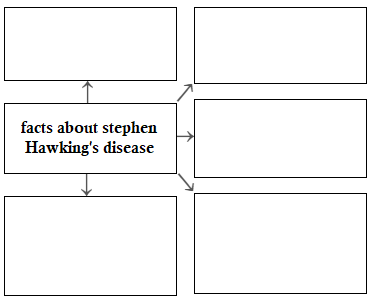
   At the age of 21, Stephen Hawking was diagnosed with amyotrophic lateral sclerosis (ALS, or Lou Gehrig’s disease). In a very simple sense, the nerves that controlled his muscles were shutting down. At the time, doctors gave him two and a half years to live.
   Hawking first began to notice problems with his physical health while he was at Oxford - on occasion he would trip and fall, or slur his speech - he didn’t look into the problem until 1963, during his first year at Cambridge. For the most part, Hawking had kept these symptoms to himself. But when his father took notice of the condition, he took Hawking to see a doctor. For the next two weeks, the 21-year-old college
student made his home at a medical clinic, where he underwent a series of tests.
   “They took a muscle sample from my arm, stuck electrodes into me, and injected some radio-opaque fluid into my spine, and watched it going up and down with
X-rays, as they tilted the bed,” he once said. “After all that, they didn’t tell me what I had, except that it was not multiple sclerosis, and that I was an atypical case.”

A2. Complex Factual Activity:
Complete the following map:
Image
A3. Activity based on Vocabulary:
Complete the following:

(i) A decade is a period of ............... .
(ii) ............. refers to the formless matter supposed to have existed before the creation of the universe.
A4. Activities based on Contextual Grammar:
(i) He would trip and fall or slur his speech.(Rewrite using 'not only...but also.....)
(ii) He didn't look into the problem until 1963. (Rewrite without 'didn't'.)
A5. Personal Response:
(i) You must have suffered from some illness or sickness. Mention two or three symptoms.
A1. Simple Factual Activities:
Complete the following:

(i) Arjan Singh became a Squadron Leader at the age of ...................... .
(ii) Arjan Singh was the first Indian pilot to be awarded the ...................... .

   Commending his role in the war, Y B Chavan, the then Defence Minister had written: “Air Marshal Arjan Singh is a jewel of a person, quite efficient and firm; unexcitable but a very able leader.”
   In 1944, the Marshal had led a squadron against the Japanese during the Arakan Campaign, flying close air support missions during the crucial Imphal Campaign and later assisted the advance of the Allied Forces to Yangoon (formerly Rangoon).
   In recognition of his feat, he was awarded the Distinguished Flying Cross (DFC) on the spot by the Supreme Allied Commander of South East Asia, the first Indian pilot to have received it. Singh was selected for the Empire Pilot training course at Royal Air Force
(RAF) Cranwell in 1938 when he was 19 years old. He retired from service in 1969.
   Singh was born on April 15, 1919, in Lyalpur (now Faislabad, Pakistan), and completed his education at Montgomery (now Sahiwal, Pakistan). His first assignment on being commissioned was to fly Westland Wapiti biplanes in the North-Western Frontier Province
as a member of the No.1 RIAF Squadron.
   After a brief stint with the newly formed No. 2 RIAF Squadron where the Marshal flew against the tribal forces, he later moved back to No.1 Sqn as a Flying Officer to fly the Hawker Hurricane. He was promoted to the rank of Squadron Leader in 1944.

A2. Complex Factual Activities:
(i) Explain what enabled Arjan Singh to win the DFC award.
A3. Activities based on Vocabulary:
Complete the table:

 VerbAdjectiveNoun
(1) recognise................ ................
(2) educate ................ ................
(3) promote ................ ................
(4) move ................ ................

A4. Activities based on Contextual Grammar: 
(i) In 1944, the Marshal had led a squadron against the Japanese during the Arakan Campaign. (Change the voice.)
(ii) His first assignment on being commissioned was to fly Westland Wapiti biplanes in the North- Y Western Frontier Province.(Rewrite as a complex sentence.)
A5. Personal Response:
(i) Name any four qualities that you think a leader must have.

A1.Simple Simple l Factual Activities:
Go through the given statements and say whether you Agree or Disagree with each of them :
(i) The Space Research set up facility was planned at Allapi, Kerala -
(ii) The person who could help and could be co-ordinated with was the Bishop-
(iii) It was quite easy to relocate so many people and destroy religious institutions for the space-research- centre
(iv) Dr Kalam joined ISRO in 1970-

   In the 1960, when Dr Kalam joined ISRO, it was just a fledgling organization. His interactions with the great scientist Professor Vikram Sarabhai and the Reverend Peter Bernard Pereira, shaped his thoughts on religion. It was here that he learnt about the true meanning of religious service. Professor Sarabhai and his team had selected a site in Thumba, Kerala, to set up their space research facility. It was an ideal site due to its proximity to the magnetic equator. But there was a major roadblock in getting possession of the site as it was the fishing grounds of Thumba’s fishermen.Moreover, it had an old church of St Mary Magdalene, a bishop’s house and a school, which was under the administration of the church. Government officials predicted that it would be impossible to relocate so many people from the site and destroy religious institutions for the sake of a space research centre.
   But upon Dr Sarabhai’s persistence, it was suggested that they approach the only person who could help them in this situation- Father Pereira, the then bishop of the region.

A2. Complex Factual Activity:
Complete the following:
(i) ........................... shaped Dr Kalam's thoughts on religion.
(ii) The site in Thumba was selected for building the space research centre due to ............................ .
A3. Activities based on Vocabulary:
Match the phrases with one word from the passage:

'A''B'
(i) which is new and inexperienced(a) proximity
(ii) a place provided for a particular purpose(b) fledgling
(iii) something that causes delay or obstruction(c) site
(iv) nearness in space(d) roadblock

A4. Activities based on Contextual Grammar:
(i) Professor Sarabhai and his team had selected a site in Thumba, Kerala.(Pick out the subject of the sentence.)
(ii) It was here that he learnt about the true meaning of religious service.(Frame a question to get the underlined part as answer.)
A5. Personal Response:
(i) What do you learn from this passage?<

A1. Simple Factual Activities:
Choose the correct answer and fill in the blanks:
(i) Many learned people came to the court and gave ....................... .
(a) the same answers  (b) correct answers
(c) different answers    (d) wrong answers.
(ii) The King wanted to know the ............... time to begin everything.
(a) right (b) exact (c) proper  (d) good

   Once a certain king had an idea. If he always knew the right time to begin everything, if he knew who were the right people to listen to and who to avoid the most important thing to do, he would never fail in anything that he would undertake and above all, if he
always knew what was the most undertake. Since he was convinced that he was right in thinking this way, he had a proclamation made in his kingdom. He would give a great reward to anyone who would teach him what the right time was for every action, who the most necessary people were, and how he might know the most important thing to do.
    Many learned people came to the court but they all gave different answers. In reply to the first question,some said that to know the right time for every action,one must draw up in advance a table of days, months and years, and must live strictly according to it. Others declared that it was impossible to decide beforehand the right time for every action; but that, not letting oneself be absorbed in idle pastimes, one should always attend to all that was going on, and then do that which was most essential. Yet others said that it was impossible for one man to decide correctly the right time for every action and that the king should, instead, have a council of wise people, who would help him to fix the proper time for everything.

A2. Complex Factual Activities:
Summarize the following aspect in 4 to 5 lines each in your own words:
(i) The King's problem.
A3. Activities based on Vocabulary:
The following compound words from the passage are spelt in jumbled order. Rearrange the letters to make them meaningful:

(i) a r e e t u k d n
(ii) y o n n a c
(iii) s t a p s i e m
(iv) h e e d a r f o n b
A4. Activities based on Contextual Grammar:
(i) They all gave different answers.(Rewrite using the opposite of 'different'.)
(ii) He was convinced that he was right. (Pick out the clauses and name them.)
A5. Personal Response:
(i) The learned advisers who came to the court confused the king. How do you know?