Question
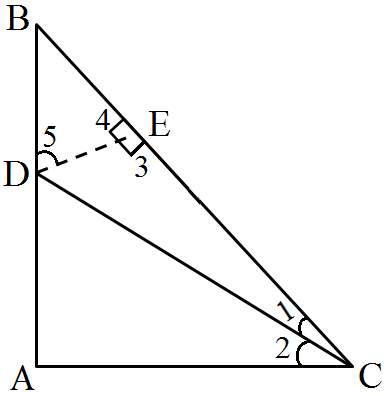
ABC is a right triangle such that AB = AC and bisector of angle C intersects the side AB at D. Prove that AC + AD = BC.
Answer

Given in right angled $\triangle\text{ABC},\text{AB}= \text{AC}\text{ and }\text{CD}$ is the bisector of $\angle\text{C}.$ contruction draw $\text{DE}\ \bot\ \text{BC}.$ to prove $\text{AC}+\text{AD}= \text{BC}$ proof in right angled $\triangle\text{ABC},\text{AB}=\text{AC}\text{ and }\text{BC}$ is a hypotenuse [given]
$\angle1=\angle2$ [given,$\text{CD}$ isthe bisector of $\angle\text{C}$] $\text{DC}=\text{DC}$ [common sides] $\therefore\ \triangle\text{DAC}\cong\triangle\text{DEC}$ [by AAS congruence rule] $\Rightarrow\ \text{DA}=\text{DE}.$ [by CPCT]...(i) $\text{and}\ \text{AC}=\text{EC}$ ...(ii) $\text{ln}\ \triangle\text{ABC},\ \text{AB}=\text{AC}$ $\angle\text{C}=\angle{B}$   [angle opposite to equal sides are equal]...(iii) Again,in $\triangle\text{ABC},\ \angle\text{A}+\angle\text{B}+\angle\text{C}= 180^\circ$ [by angle sum property of a triangle]  $\Rightarrow\ 90^\circ+\angle\text{B}+\angle\text{B}=180^\circ$ $\Rightarrow\ 2\angle\text{B}=180^\circ-90^\circ$[from Eq.(iii)] $\Rightarrow\ 2\angle\text{B}=90^\circ$ $\Rightarrow\ \angle\text{B}=45^\circ$ $\text{ln}\ \triangle\text{BED},\ \angle5=180^\circ-\big(\angle\text{B}+\angle{4}\big)$  [by angle sum property of a triangle] $=180^\circ-(45^\circ+90^\circ)$ $=180^\circ-135^\circ=45^\circ$ $\therefore\ \angle\text{B}=\angle{5}$ $\Rightarrow\ \text{DE}=\text{BE}\ [\because$ sides opposite to equal angle are equal$]$ ...(iv) from Eqs. (i) and (iv), $\text{DA}=\text{DE}=\text{BE}$ ...(v) $\because\text{BC}=\text{CE}+\text{EB}$  $=\text{CA}+\text{DA}$ [from Eqs. (ii) and (v)] $\therefore\text{AD}+\text{AC}=\text{BC}$ Hence proved.

Need a full question paper?

Generate a complete, print-ready paper with questions like this in minutes — across 16+ boards, with answer keys.

Start Generating Free

Similar questions

If $\text{x}-\frac{1}{\text{x}}=\frac{1}{2},$ then write the value of $4\text{x}^2+\frac{4}{\text{x}^2}.$
The number of runs scored by a cricket player in 25 innings is as follows: 
26, 35, 94, 48, 82, 105, 53, 0, 39, 42, 71, 0, 64, 15, 34, 15, 34, 6, 71, 0, 64, 15, 34, 15, 34, 67, 0, 42, 124, 84, 54, 48, 139, 64, 47
  1. Rearrange these runs in ascending order.
  2. Determine the player, is highest score.
  3. How many times did the player not score a run?
  4. How many centuries did he score?
  5. How many times did he score more than 50 runs?
Prove that:
$\frac{1}{3+\sqrt{7}}+\frac{1}{\sqrt{7}+\sqrt{5}}+\frac{1}{\sqrt{5}+\sqrt{3}}+\frac{1}{\sqrt{3}+1}=1$
If $\text{x}^4+\frac{1}{\text{x}^4}=194,$ find $\text{x}^3+\frac{1}{\text{x}^3},\ \text{x}^2+\frac{1}{\text{x}^2}$ and $\text{x}+\frac{1}{\text{x}}.$
The production of saleable steel in some of the steel plants of our country during 1999 is given below:
Plant
Bhilai
Durgapur
Rourkela
Bokaro
Production (in thousands)
160
80
200
150
Construct a bar graph to represent the above data on a graph paper by using the scale 1 big divisions = 20 thousand tones.
Prove that in a quadrilateral the sum of all the sides is geater than the sum of its diagonals.
Find the rational roots of the polynomial $f(x) = 2x^3 + x^2 - 7x - 6$
In a triangle $\triangle\text{ABC}, AB = 15\ cm, BC = 13\ cm$ and $AC = 14\ cm.$ Find the area of triangle $\text{ABC}$ and hence its altitude on $AC.$
ABCD is a trapezium in which AB || DC, DC = 30cm and AB = 50cm. If X and Y are, respectively the mid-points of AD and BC, prove that $\text{ar}(\text{DCYX})=\frac{7}{9}\ \text{ar}(\text{XYBA})$
Two coins are tossed $400$ times and we get:
Two heads: $112$ times; one head: $160$ times; $0$ head: $128$ times.
When two coins are tossed at random, what is the probability of getting
  1. $2$ heads?
  2. $1$ heads?
  3. $0$ heads?