Question 14 Marks
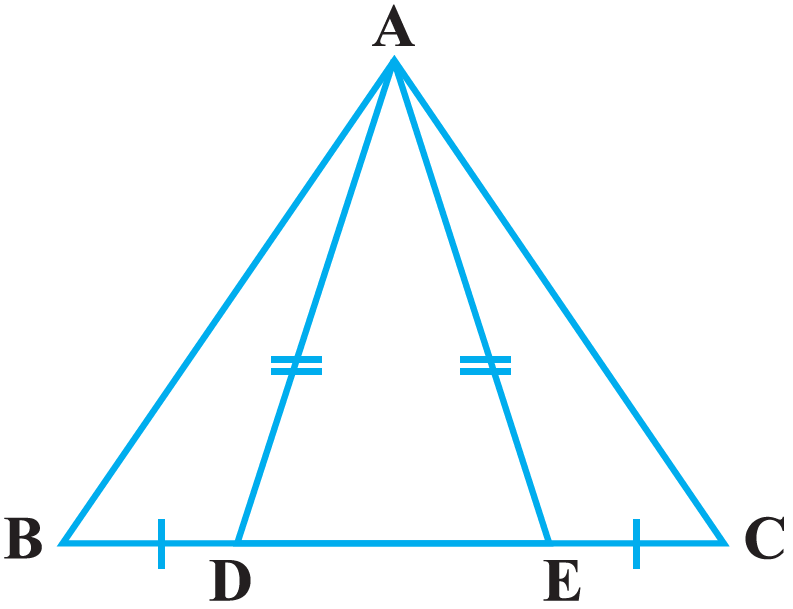
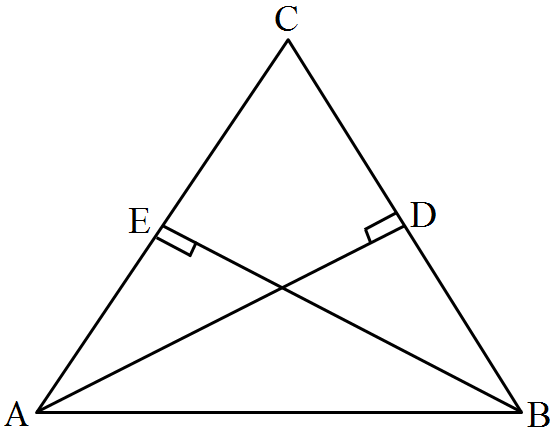
ABC is an isosceles triangle with AB = AC and BD, CE are its two medians. Show that BD = CE.
Answer
View full question & answer→Given $\triangle\text{ABC}$ is an isosceles triangle in which AB = AC and BD, CE are its two medians.
To show BD = CE.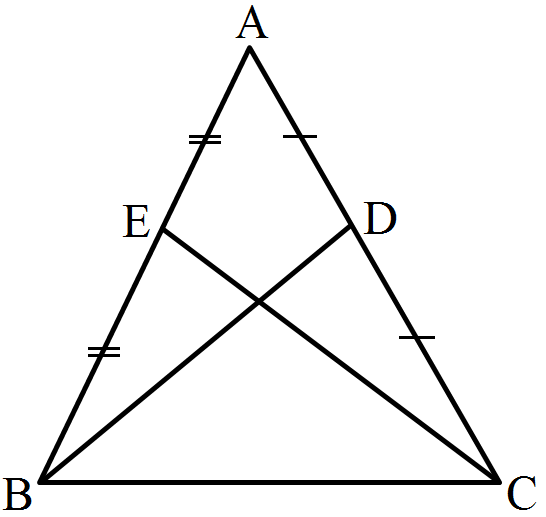 In $\triangle\text{ABD}$ and $\triangle\text{ACE},$
$\text{AB}=\text{AC}$
$\angle\text{A}=\angle\text{A}$
$\text{AD}=\text{AC}$
$\frac{1}{2}\text{AB}=\frac{1}{2}\text{AC}$
$\text{AE}=\text{AD}$
AS D is the mid-point of AC and E is the mid-point of AB.
$\triangle\text{ABC}\cong\triangle\text{ACE}$
To show BD = CE.
In $\triangle\text{ABD}$ and $\triangle\text{ACE},$$\text{AB}=\text{AC}$
$\angle\text{A}=\angle\text{A}$
$\text{AD}=\text{AC}$
$\frac{1}{2}\text{AB}=\frac{1}{2}\text{AC}$
$\text{AE}=\text{AD}$
AS D is the mid-point of AC and E is the mid-point of AB.
$\triangle\text{ABC}\cong\triangle\text{ACE}$
 $\text{BC}=2\text{AD}$
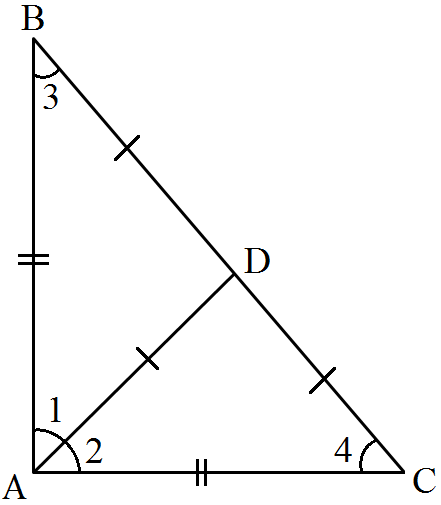
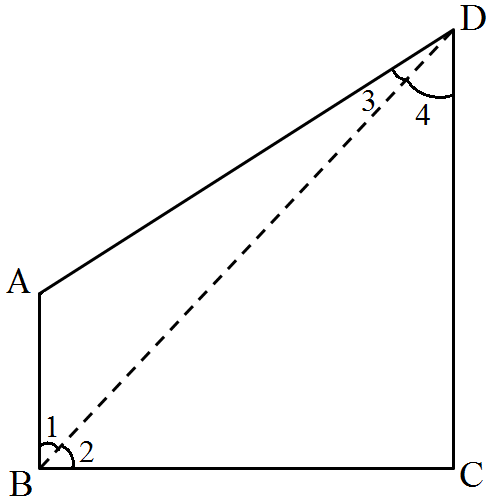
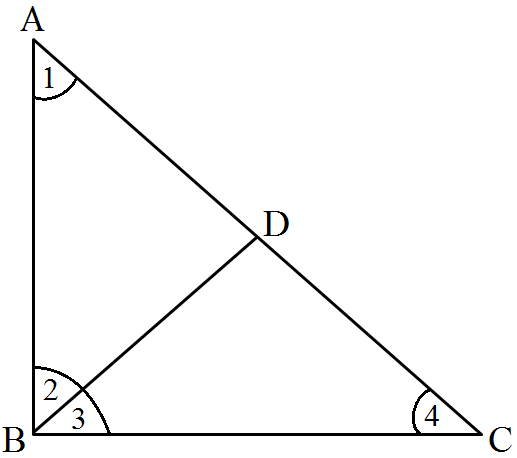
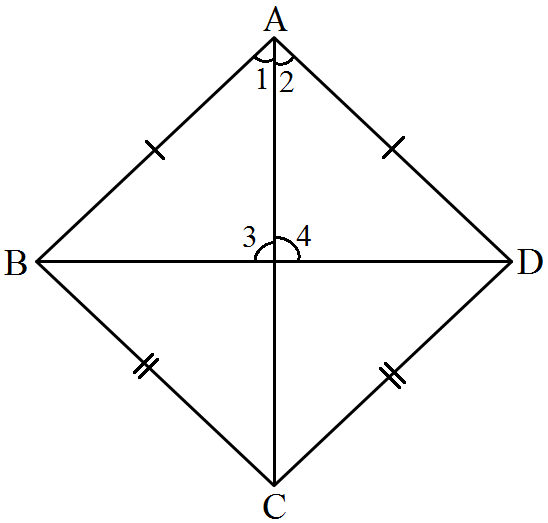 Proof In $\triangle\text{ABC}\text{ and }\triangle\text{ADC},$ $\text{AB}=\text{AD}$ [given] $\text{BC}=\text{CD}$ [given] $\text{and}\ \text{AC}=\text{AC}$ [common side] $\therefore \triangle\text{ABC}\cong\triangle\text{ADC}$ [by SSS congruence rule] $\Rightarrow\ \angle1=\angle2$ [by CPCT] now, in $\triangle\text{AOB}\text{ and }\triangle\text{AOD},\ \text{AB}=\text{AD}$ [given] $\Rightarrow\ \angle1=\angle2$ [proved above] $\text{and}\ \text{AO}=\text{AO} $ [common side] $\therefore\ \triangle\text{AOB}\cong\triangle\text{AOD}$ [by SAS congruence rule] $\Rightarrow\ \text{BO}=\text{DO}$ [by CPCT] $\text{and}\ \angle3=\angle4$ [by CPCT]...(i) But $\angle3+\angle4=180^\circ$[linear pair axiom] $\angle3+\angle3=180^\circ$ [from Eq. (i)] $\Rightarrow\ 2\angle3=180^\circ$ $\Rightarrow\ \angle3=\frac{180^\circ}{2}$ $\therefore\ \angle3=90^\circ$ i.e., AC is perpendicular bisector of BD.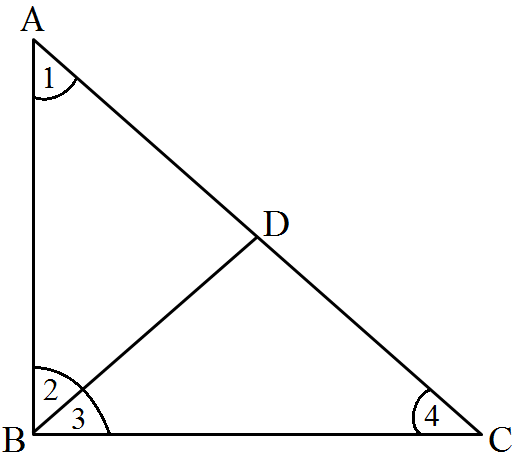
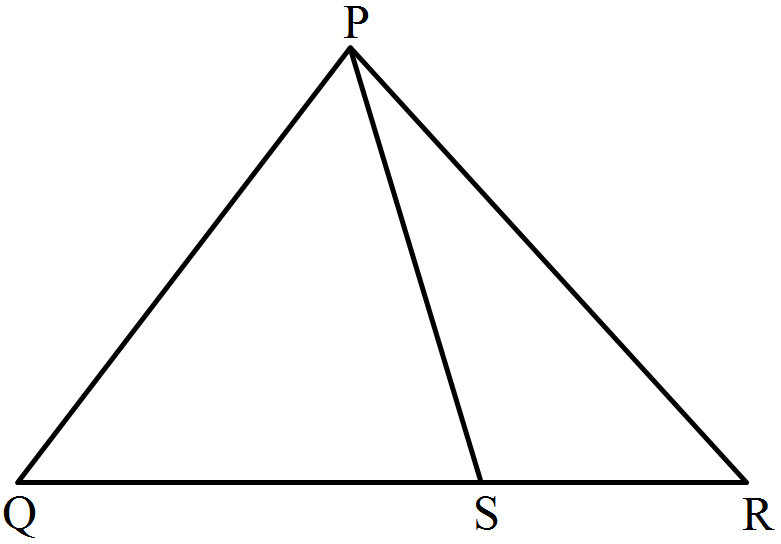 In $\triangle\text{PQS},$ we have
 $\text{AB}=\text{AC}$ $\angle\text{ABD}=\angle\text{ACD}$ $\angle\text{BAD}=\angle\text{CAD}$ $\therefore\triangle\text{ADC}\cong\triangle\text{BCD}$ $\therefore\text{AB}=\text{AC}$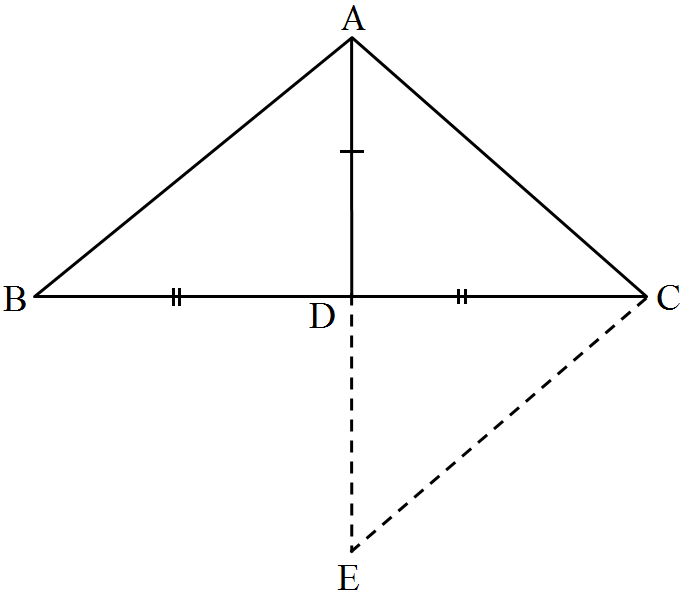
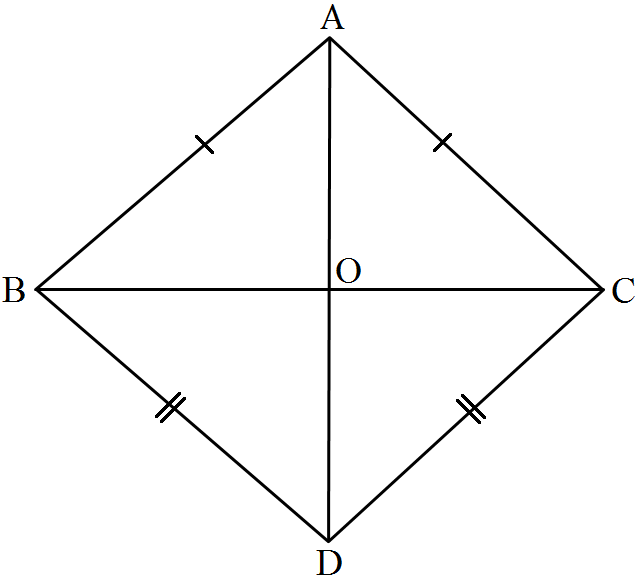 In $\triangle\text{ABO},$
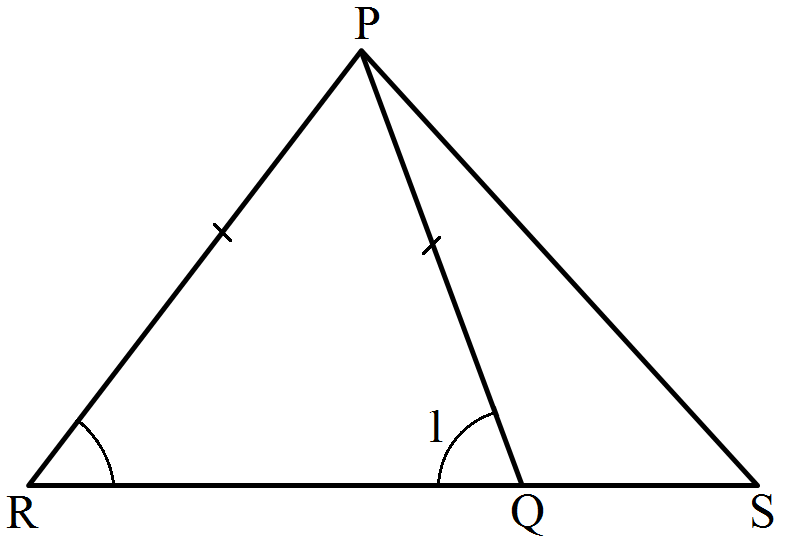 In $\triangle\text{PRQ},$ we have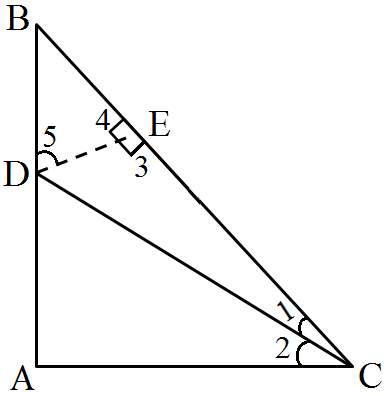
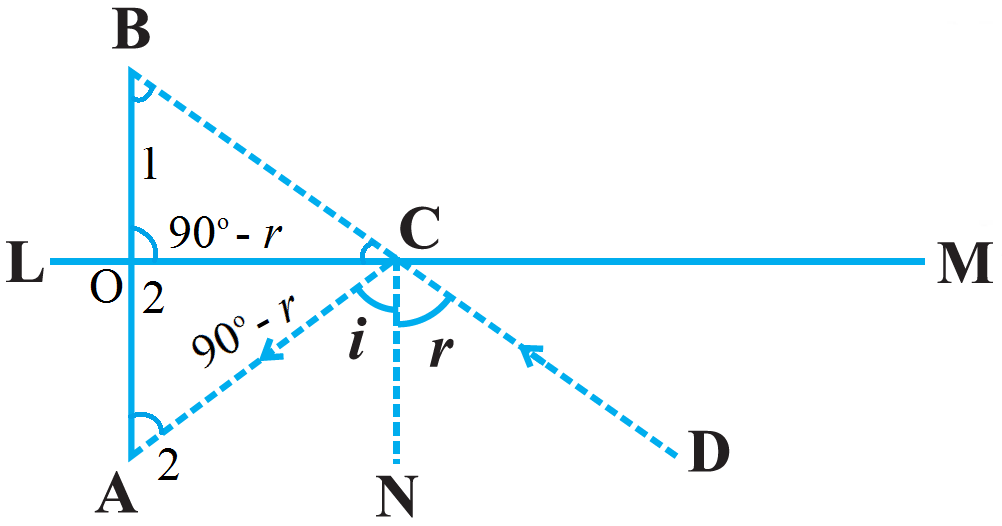 $\therefore\text{CN}\perp\text{LM}$ and $\text{AB}\perp\text{LM}$
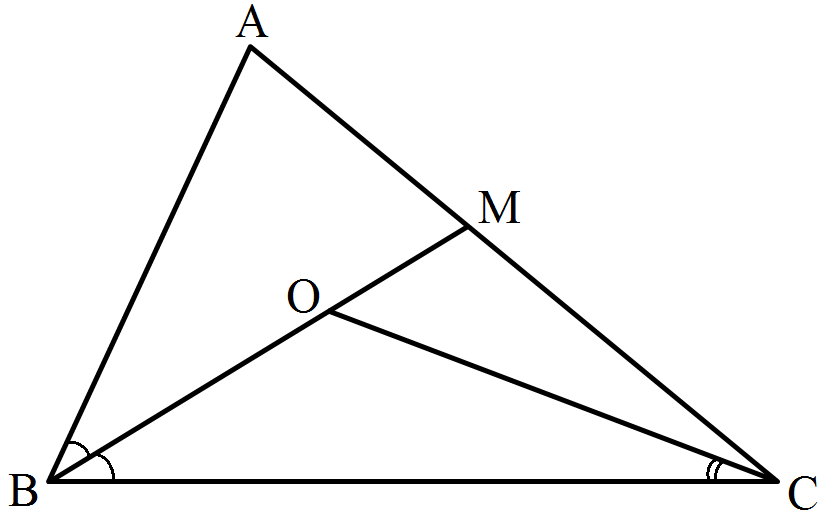 In $\triangle\text{ABC},$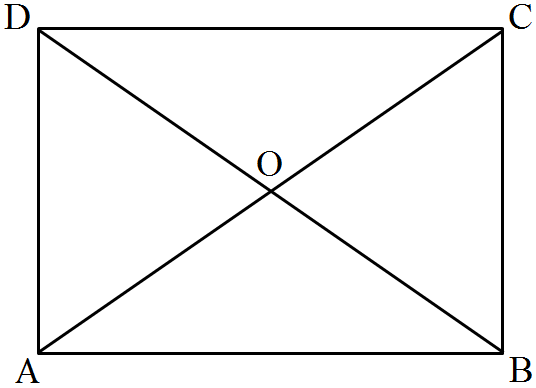
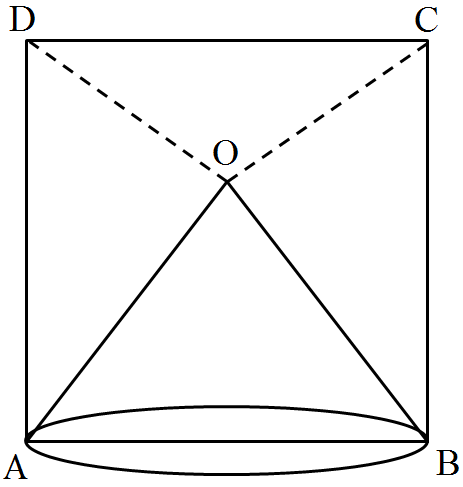 Since, AOB is an triangle.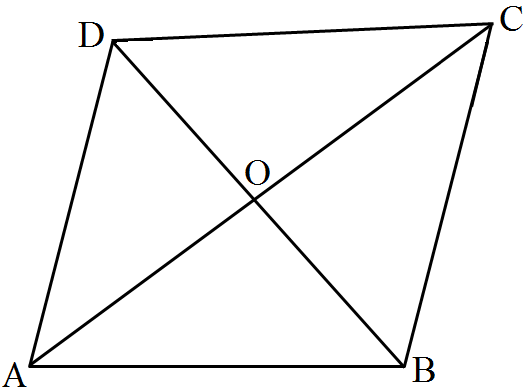
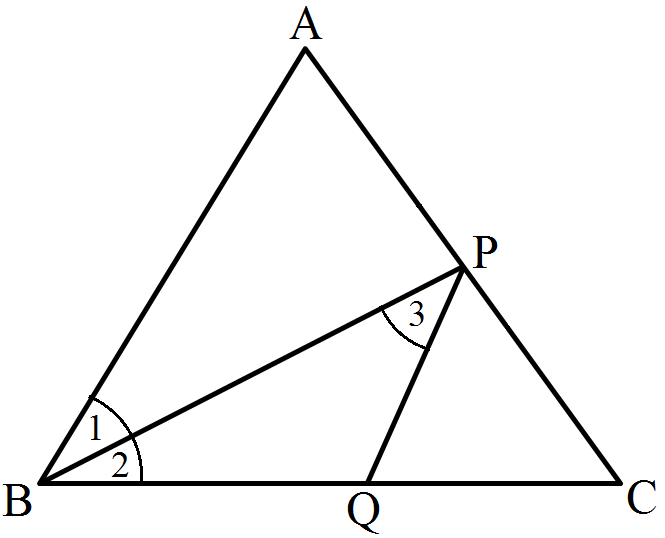 $\angle\text{1}=\angle\text{2}\ ...(\text{i})$