Question
ABC is an isosceles triangle with $AB = AC$ and $D$ is a point on $BC$ such that $\text{AD}\perp\text{BC}$ (see figure). To prove that $\angle\text{BAD} = \angle\text{CAD},$ a student proceeded as follows:
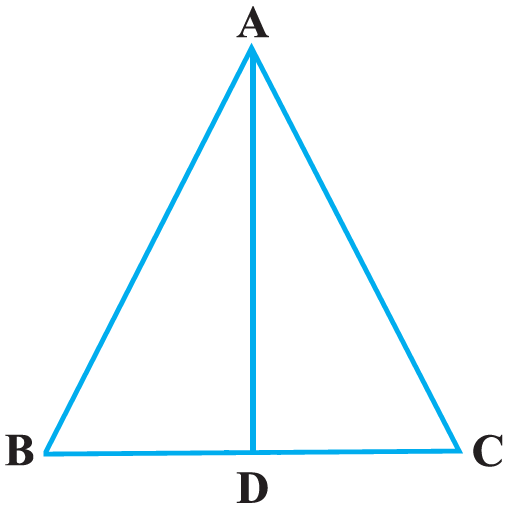
In $\triangle\text{ABD}$ and $\triangle\text{ACD},$
$\text{AB}=\text{AC}$
$\angle\text{B}=\angle\text{C}$
$\angle\text{ADM}=\angle\text{ADC}$
$\therefore\triangle\text{ABD}\cong\triangle\text{ADC}$
$\angle\text{BAD}=\angle\text{CAD}$
What is the defect in the above arguments?
In $\triangle\text{ABD}$ and $\triangle\text{ACD},$
$\text{AB}=\text{AC}$
$\angle\text{B}=\angle\text{C}$
$\angle\text{ADM}=\angle\text{ADC}$
$\therefore\triangle\text{ABD}\cong\triangle\text{ADC}$
$\angle\text{BAD}=\angle\text{CAD}$
What is the defect in the above arguments?
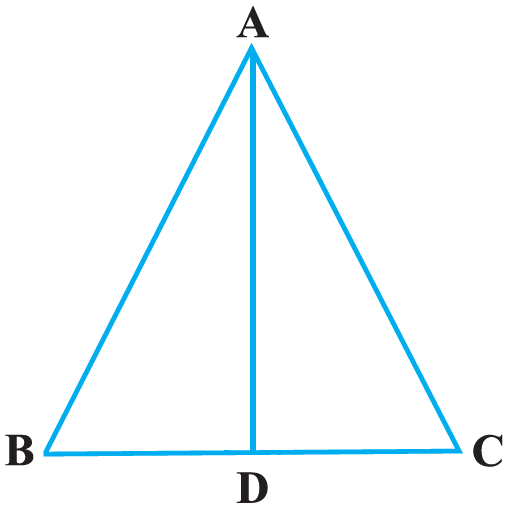 In $\triangle\text{ABD}$ and $\triangle\text{ACD},$