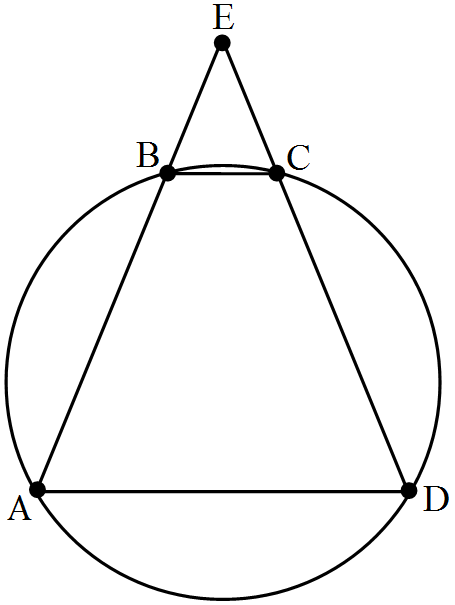
Question
ABCD ia a cyclic quadrilateral in which BA and CD when produced meet in E and EA = ED. Prove that:
  1. AD || BC.
  2. EB = EC.

Answer


Given ABCD is a cyclic quadrilateral in which EA = ED
To prove:
  1. AD || BC.
  2. EB = EC.
Proof:
  1. Since EA = ED
Then, $\angle\text{EAD}=\angle\text{EDA}\dots(1)$ [Oppo. angles to equal sides]

Since, ABCD is a cyclic quadrilateral

Then, $\angle\text{ABC}+\angle\text{ADC}=180^\circ$

But $\angle\text{ABC}+\angle\text{EBC}=180^\circ$ [Linear pair of angles]

Then, $\angle\text{ADC}=\angle\text{EBC}\dots(2)$

Compare equations (1) and (2)

$\angle\text{EAD}=\angle\text{EBC}\dots(3)$

Since, corresponding angles are equal

Then, BC || AD
  1. From equation (3)
$\angle\text{EAD}=\angle\text{EBC}\dots(3)$

Similarly $\angle\text{EDA}=\angle\text{ECB}\dots(4)$

Compare equations (1)(3) and (4)

$\angle\text{EBC}=\angle\text{ECB}$

$\Rightarrow \text{EB}=\text{EC}$ [Opposite angles to equal sides]

Need a full question paper?

Generate a complete, print-ready paper with questions like this in minutes — across 16+ boards, with answer keys.

Start Generating Free

Similar questions

Sketch proper figure and write the answers of the following questions. [2 Marks each]
i. If A – B – C and l(AC) = 11,
l(BC) = 6.5, then l(AB) = ?
ii. If R – S – T and l(ST) = 3.7,
l(RS) = 2.5, then l(RT) = ?
iii. If X – Y – Z and l(XZ) = 3√7,
l(XY) = √7, then l(YZ) = ?
In the given figure, line AB || line CD and line PQ is transversal. Measure of one of the angles is given. Hence find the measures of the following angles.

i. ∠ART
ii. ∠CTQ
iii. ∠DTQ
iv. ∠PRB
Rationalise the denominator of the following:$\frac{4}{2+\sqrt{3}+\sqrt{7}}$
Find the value of $27 x^3+8 y^3$, if
$3 x+2 y=14 \text { and } x y=8$
In a parallelogram ABCD, the bisector of $\angle\text{A}$ also bisects BC at X. Find AB : AD.
A chord of a circle is equal to the radius of the circle. Find the angle subtended by the chord at a point on the minor arc and also at a point on the major arc.
ABCD is a square, X and Y are points on sides AD and BC respectively such that $\text{AY}=\text{BX}.$ prove that $\text{BY}=\text{AX}$ and $\angle\text{BAY}=\angle\text{ABX}.$
A square is inscribed in an isosceles right triangle so that the square and the triangle have one angle common. Show that the vertex of the square opposite the vertex of the common angle bisects the hypotenuse.
Two lines AB and CD intersect at O such that BC is equal and parellel to AD. prove that the lines AB and CD bisect at O.
Using rulers and compasses only, construct a $\triangle\text{ABC},$ given base BC = 7cm, $\angle\text{ABC}=60^\circ,$ and AB + AC = 12cm.