Question
ABCD is a parallelogram, AD is produced to E so that DE = DC and EC produced meets AB produced in F.Prove that BF = BC.

Answer

Draw a parallelogram ABCD with AC and BD intersecting at O.
Produce AD to E such that DE = DC.
Join EC and produce it to meet AB produced at F.
In $\triangle\text{DCE},$
$\therefore\angle\text{DCE}=\angle\text{DEC}\dots(1)$ (In a triangle, equal sides have equal angles opposite to them)
AB || CD (Opposite sides of the parallelogram are parallel)
$\therefore$ AF || CD (AB lies on AF)
AF || CD and EF is the transversal,
$\therefore\angle\text{DCE}=\angle\text{BFC}\dots(2)$ (Pair of corresponding angles)
From (1) and (2), we get
$\angle\text{DCE}=\angle\text{BFC}$
In $\triangle\text{AFE},$
$\angle\text{AFE}=\angle\text{AEF}$ $(\angle\text{DEC}=\angle\text{BFC})$
$\therefore$ AE = AF (In a triangle, equal angles have equal sides opposite to them)
⇒ AD + DE = AB + BF
⇒ BC + AB = AB + BF $(\because$ AD = BC, DE = CD AND CD = AB, AB = DE$)$
⇒ BC = BF

Need a full question paper?

Generate a complete, print-ready paper with questions like this in minutes — across 16+ boards, with answer keys.
Start Generating Free

Similar questions

Find the area of the quadrilateral $ABCD$ in which $AD = 24\ cm$, $\angle\text{BAD}=90^\circ$ and $BCD$ forms an equilateral triangle whose each side is equal to $26\ cm$. $\big($ Take $\sqrt{3}=1.73\big)$
If an angle of a parallelogram is two-third of its adjacent angle, find the angles of the parallelogram.
$O$ is a point in the interior of a square $ABCD$ such that $OAB$ is an equilateral triangle. Show that $ΔOCD$ is an isosceles triangle.
A cylindrical container with diameter of base $56\ cm$ contains sufficient water to submerge a rectangular solid of iron with dimensions $32\ cm \times 22\ cm \times 14\ cm$. Find the rise in the level of the water when the solid is completely submerged.
Two opposite angles of a parallelogram are $(3x - 2)^\circ $ and $(50 - x)^\circ .$ Find the measure of each angle of the parallelogram.
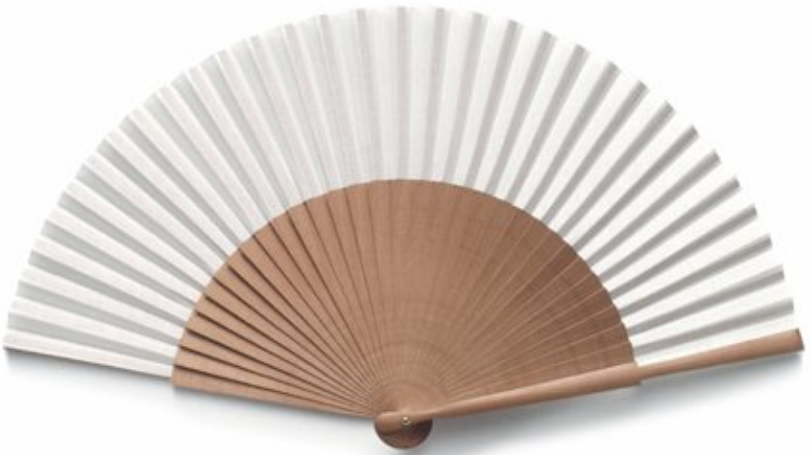
A hand fan is made by sticking $10$ equal size triangular strips of two different types of paper as shown in the figure. The dimensions of equal strips are $25\ cm, 25\ cm$ and $14\ cm$ . Find the area of each type of paper needed to make the
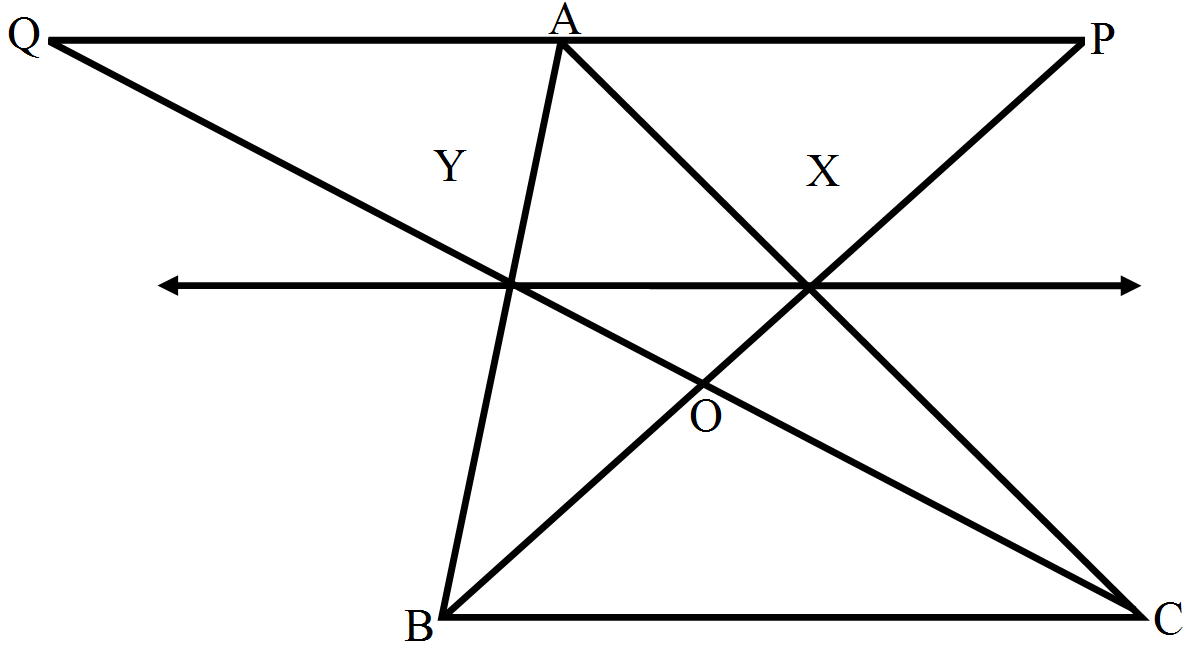
In figure, $X$ and $Y$ are the mid points of $AC$ and $AB$ respectively, $QP || BC$ and $CYQ$ and $BXP$ are straight lines. Prove that $\text{ar}(\triangle\text{ABP})=\text{ar}(\triangle\text{ACQ}).$
Simplify the following expressions: $(x^2 - x + 1)^2 - (x^2 + x + 1)^2$​​​​​​​
Construct the angles of the following measurements$: \ 135^\circ$
If bisectors of opposite angles of a cyclic quadrilateral $ABCD$ intersect the circle, circumscribing it at the points $P$ and $Q,$ prove that $PQ$ is a diameter of the circle.