Questions

4 Marks Questions

Take a timed test

91 questions · self-marked practice — reveal the answer and mark yourself.

Question 14 Marks
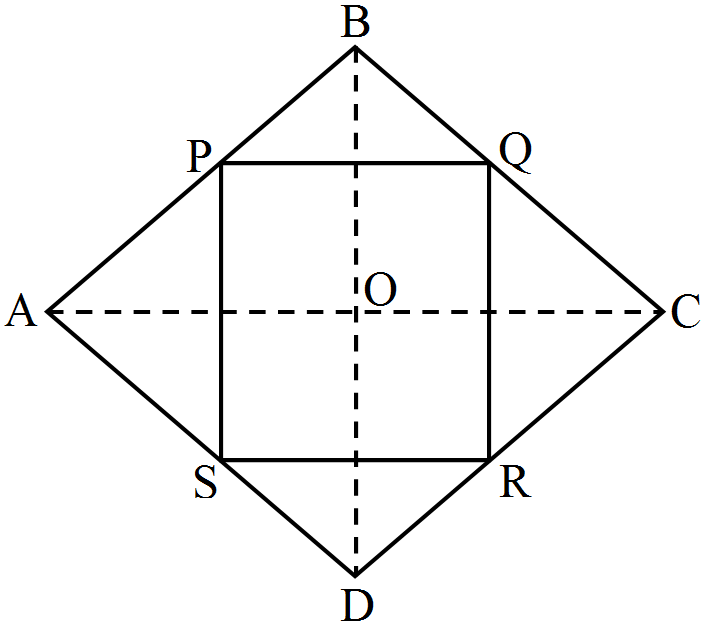
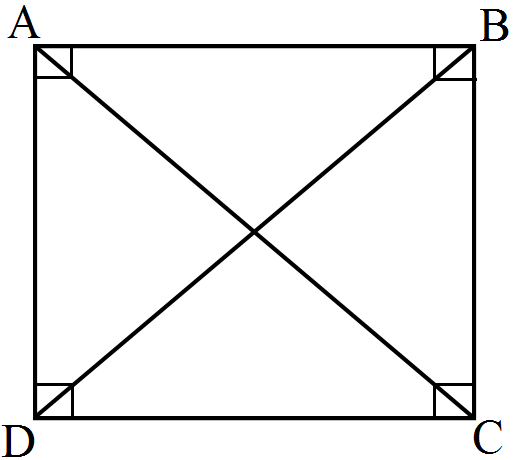
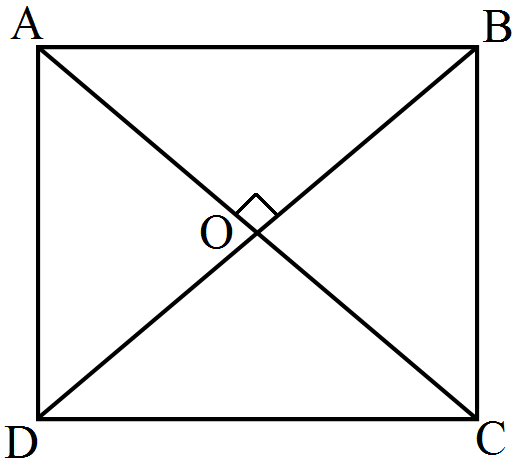
Show that if the diagonals of a quadrilateral are equal and bisect each other at right angles, then it is a square.
Answer


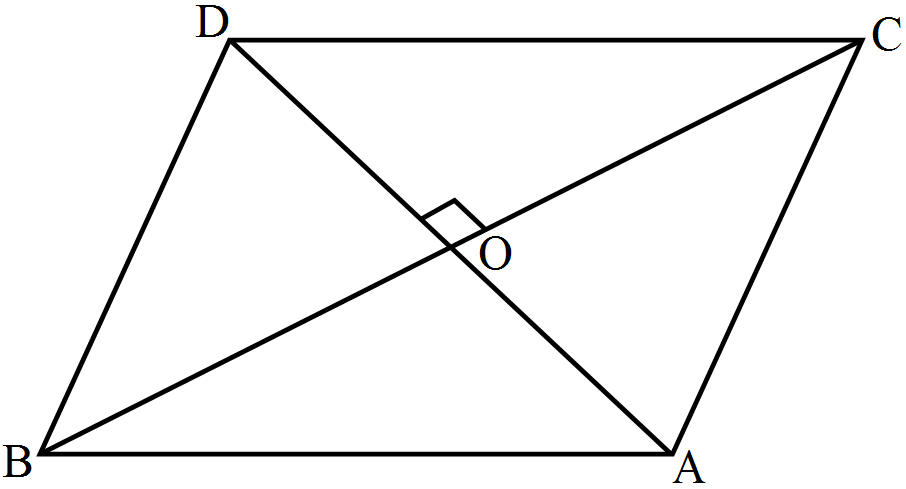
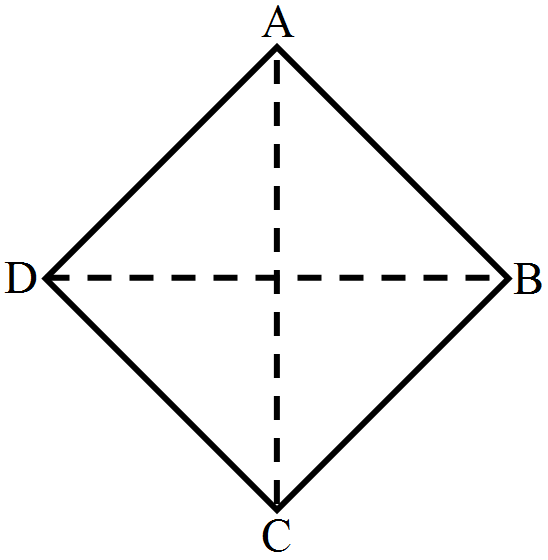
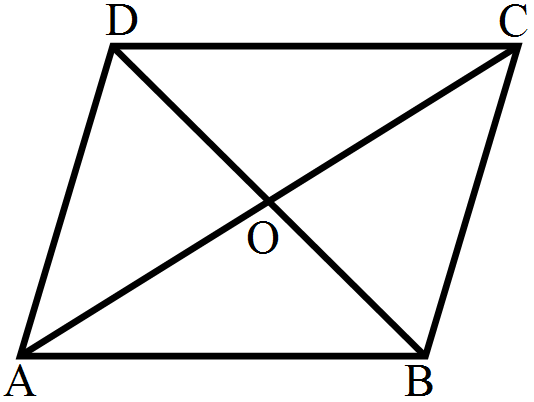
Let us consider a quadrilateral ABCD in which the diagonals AC and BD intersect each other at O. It is given that the diagonals of ABCD are equal and bisect other at right angles. Therefore, AC = BD, OA = OC, OB = OD, and $\angle\text{AOB}=\angle\text{BOC}=\angle\text{COD}=\angle\text{AOD}=90^{0}$. To prove ABCD is a square, we have prov that ABCD is a parallelogram, AB = BC = CD = AD, and one of its interior angles is 90º.
In $\triangle\text{AOB}$ and $\triangle\text{COD}$
AO = CO (Diagonals bisect each other)
OB = OD (Diagonals bisect each other)
$\angle\text{AOB}=\angle\text{COD}$ (Vertically opposite angles)
$\therefore \triangle\text{AOB}\cong\triangle\text{COD}$ (SAS congruence rule)
AB = CD (By CPCT) ... (i)
However, these are alternate interior angles for line AB and CD and alternate interior angles are equal to each other only when the two lines are parallel.
AB || CD ... (ii)
From equations (i) and (ii), we obtain
ABCD is a parallelogram.
In $\triangle\text{AOD}$ and $\triangle\text{COD}$
AO = CO (Diagonals bisect each other)
$\angle\text{AOD}=\angle\text{COD}$ (Given that each is 90º)
OD = OD (Common)
$\therefore \triangle\text{AOD}\cong\triangle\text{COD}$ (SAS congruence rule)
AD = DC ... (iii)
However, AD = BC and AB = CD (Opposite sides of parallelogram ABCD)
AB = BC = CD = DA
Therefore, all the sides of quadrilateral ABCD are equal to each other.
In $\triangle\text{ADC}$ and $\triangle\text{BCD}$
AD = BC (Already proved)
AC = BD (Given)
DC = CD (Common)
$\therefore \triangle\text{ADC}\cong\triangle\text{BCD}$ (SSS Congruence rule)
However, $\therefore \angle\text{ADC}+\angle\text{BCD}=180^{0}$(Co-interior angles)
$ \angle\text{ADC}+\angle\text{ADC}=180^{0}$
$2 \angle\text{ADC}=180^{0}$
$ \angle\text{ADC}=90^{0}$
One of the interior angles of quadrilateral ABCD is a right angle.
Thus, we have obtained that ABCD is a parallelogram, AB = BC = CD = AD and one of its interior angles is 90º. Therefore, ABCD is a square.

View full question & answer
Question 24 Marks
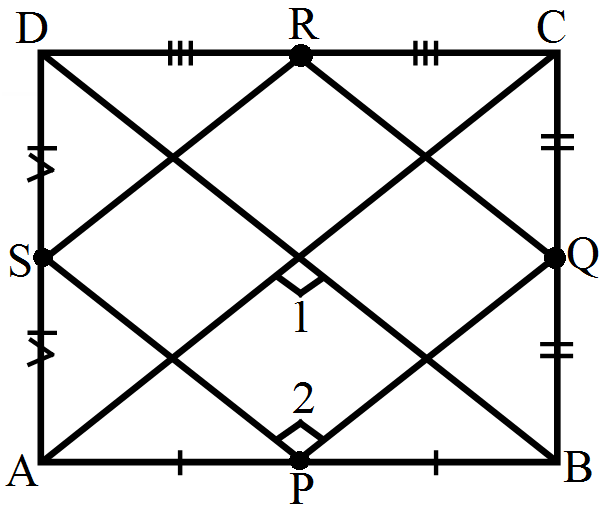
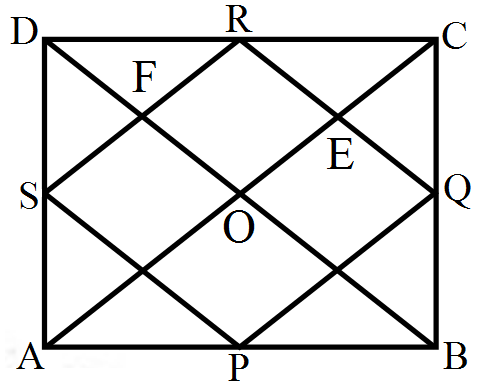
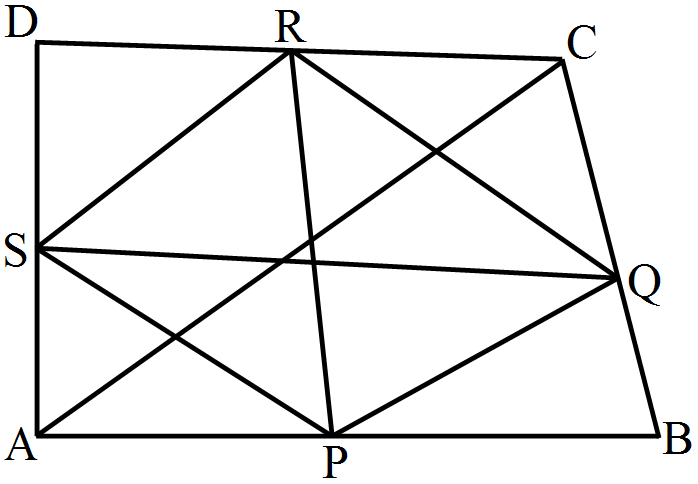
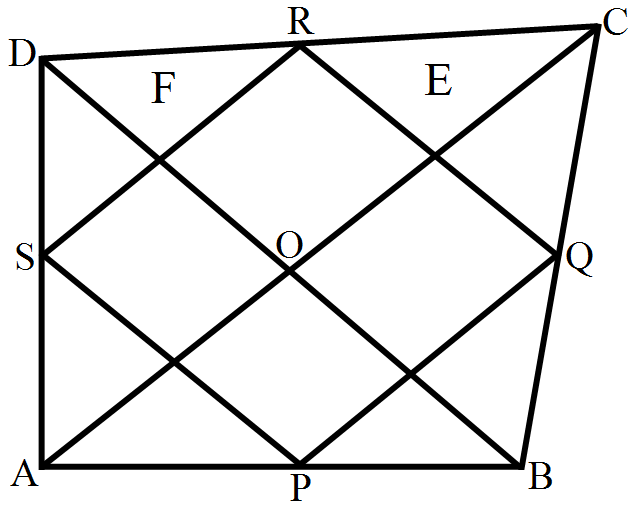
ABCD is a rhombus and P, Q, R and S are the mid - points of the sides AB, BC, CD and DA respectively. Show that the quadrilateral PQRS is a rectangle.
View full question & answer
Question 34 Marks
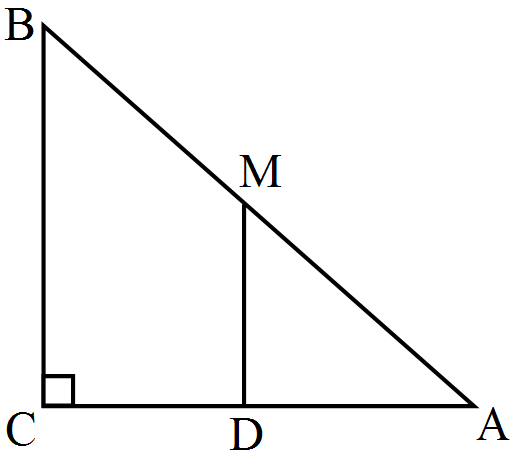
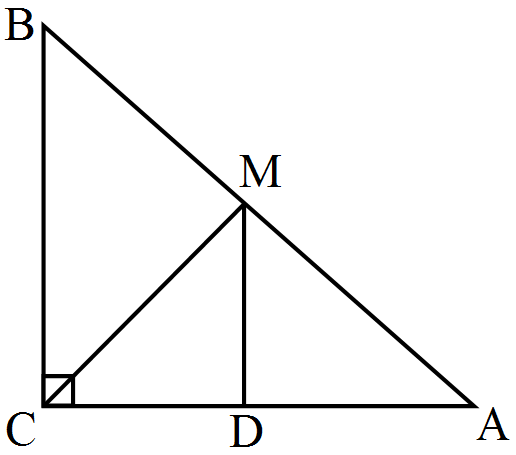
ABC is a triangle right angled at C. A line through the mid-point M of hypotenuse AB and parallel to BC intersects AC at D. Show that,
  1. D is the mid - point of AC
  2. $\text{MD}\bot\text{AC}$
  3. $\text{CM}=\text{MA}=\frac{1}{2}\text{AB}$
View full question & answer
Question 44 Marks
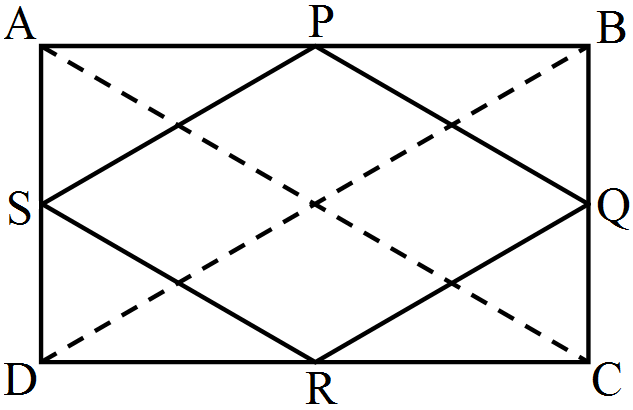
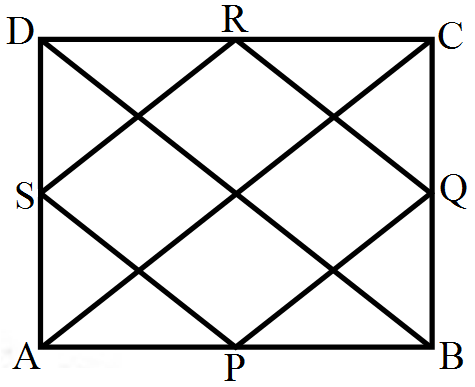
ABCD is a rectangle and P, Q, R and S are mid-points of the sides AB, BC, CD and DA respectively. Show that the quadrilateral PQRS is a rhombus.
View full question & answer
Question 54 Marks
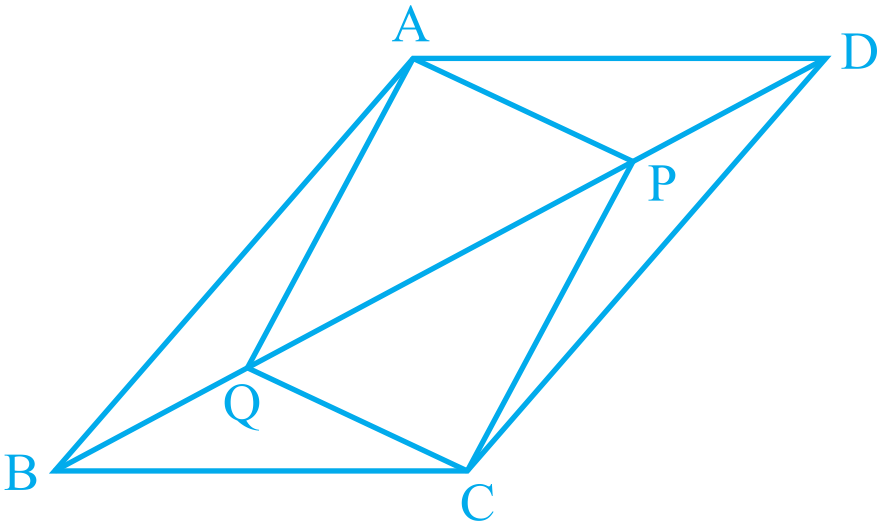
Answer
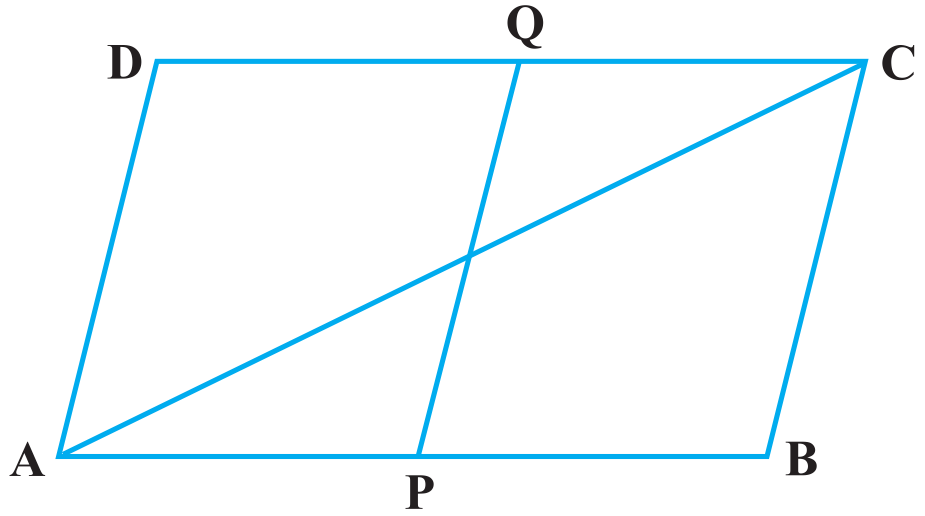
  1. In $\triangle\text{APD}$ and $\triangle\text{CQB}$

$\angle\text{ADP}=\angle\text{CBQ}$ (Alternate interior angles for BC || AD)

AD = CB (Opposite sides of parallelogram ABCD)

DP = BQ (Given)

$\Rightarrow \triangle\text{APQ}\cong\triangle\text{CQB}$ (Using SAS congruence rule)

  1. As we had observed that $\Rightarrow \triangle\text{APQ}\cong\triangle\text{CQB}$

 AP = CQ (CPCT)

  1. In $\triangle\text{AQB}$ and $\triangle\text{CQB}$

$\angle\text{ABQ}=\angle\text{CPD}$ (Alternate interior angles for AB || CD)

AB = CD (Opposite sides of parallelogram ABCD)

BQ = DP (Given)

$\Rightarrow \triangle\text{APQ}\cong\triangle\text{CQB}$ (Using SAS congruence rule)

  1. As we had observed that $\Rightarrow \triangle\text{APQ}\cong\triangle\text{CQB}$

AQ = CP (CPCT)

  1. From the result obtained in (ii) and (iv),

AQ = CP and

AP = CQ

Since opposite sides in quadrilateral APCQ are equal to each other, APCQ is a parallelogram.

View full question & answer
Question 64 Marks
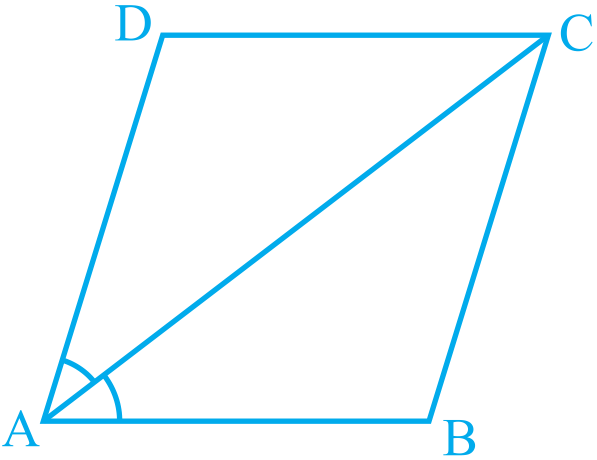
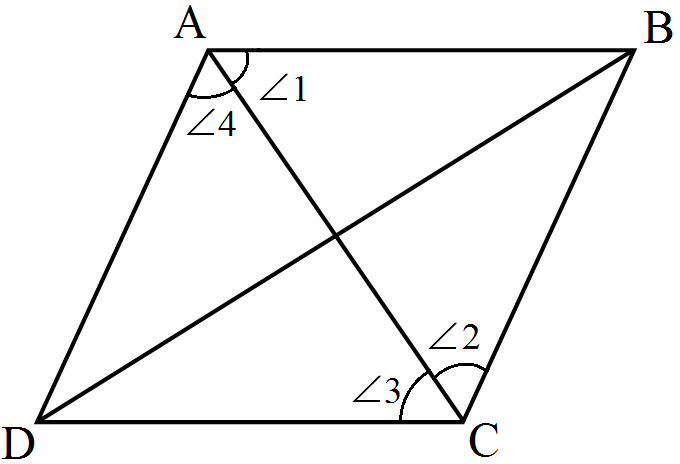
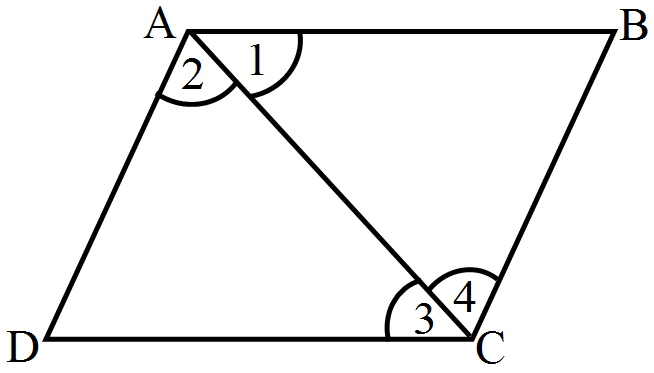
Diagonal AC of a parallelogram ABCD bisects $\angle\text{A}$ . Show that
  1. It bisects $\angle\text{C}$ also,
  2. ABCD is a rhombus.
View full question & answer
Question 74 Marks
View full question & answer
Question 84 Marks
If the diagonals of a parallelogram are equal, then show that it is a rectangle.
Answer
Let ABCD be a parallelogram. To show that ABCD is a rectangle, we have to prove that one of its interior angles is 90º.
In $\triangle \text{ABC}$ and $\triangle \text{DCB}$
AB = DC (Opposite sides of a parallelogram are equal)
BC = BC (Common)
AC = DB (Given)
$\therefore \triangle\text{ABC}\cong\triangle\text{DCB}$
$\Rightarrow \angle\text{ABC}=\angle\text{DCB}$
It is known that the sum of the measures of angles on the same side of transversal is 180º.
$\angle\text{ABC}+\angle\text{DCB}=180^{0}$
$\Rightarrow \angle\text{ABC}+\angle\text{ABC}=180^{0}$
$\Rightarrow 2\angle\text{ABC}=180^{0}$
$\Rightarrow \angle\text{ABC}=90^{0}$
Since ABCD is a parallelogram and one of its interior angles is 90º, ABCD is a rectangle.
View full question & answer
Question 94 Marks
ABCD is a rectangle in which diagonal AC bisects $\angle\text{A}$ as well as $\angle\text{C}.$ Show that:
  1. ABCD is a square.
  2. Diagonal BD bisects $\angle\text{B}$ as well as $\angle\text{D}.$ 
View full question & answer
Question 104 Marks
Show that the line segments joining the mid-points of the opposite sides of a quadrilateral bisect each other.


View full question & answer
Question 114 Marks
Answer
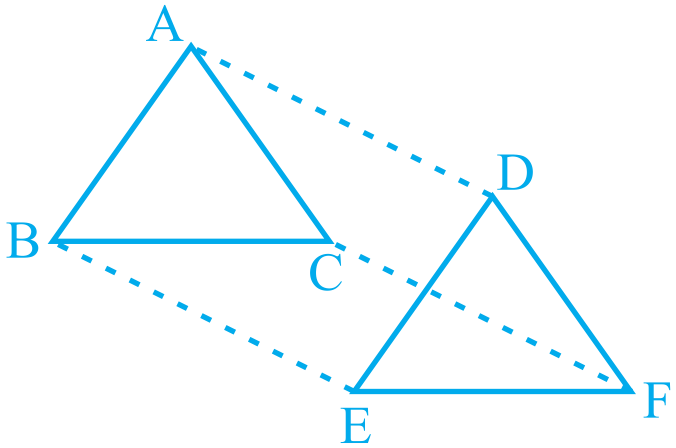
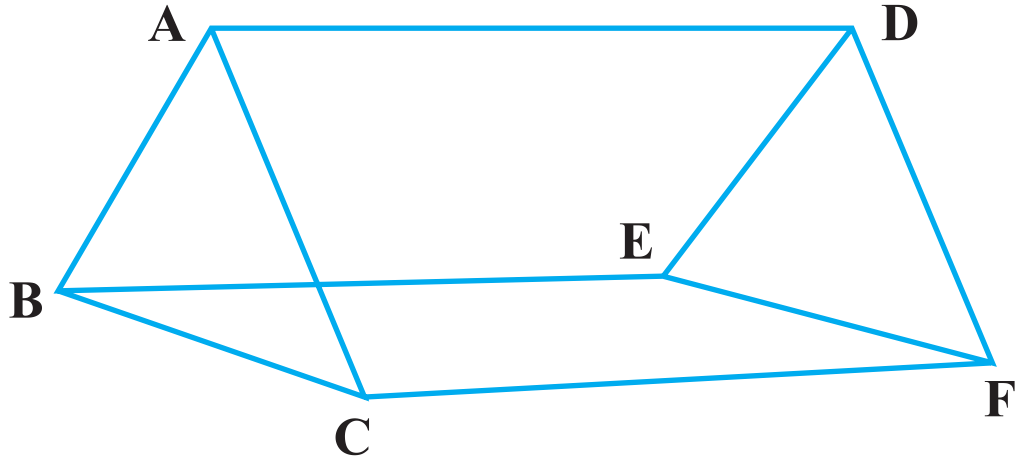
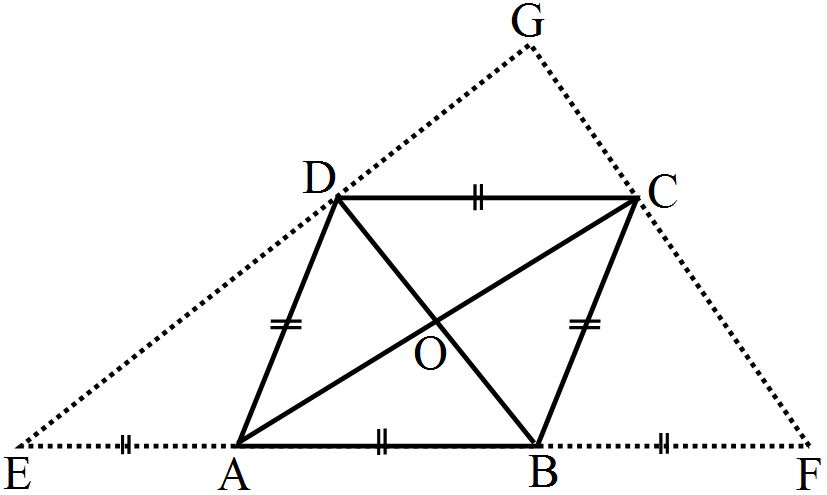
  1. It is given that AB = DE and AB || DE.

If two opposite sides of a quadrilateral are equal and parallel to each other, then it will be a parallelogram.

Therefore, quadrilateral ABED is a parallelogram.

  1. Again, BC = EF and BC || EF

Therefore, quadrilateral BCEF is a parallelogram.

  1. As we had observed that ABED and BEFC are parallelograms, therefore

AD = BE and AD || BE

(Opposite sides of a parallelogram are equal and parallel)

And, BE = CF and BE || CF

(Opposite sides of a parallelogram are equal and parallel)

 AD = CF and AD || CF

  1. As we had observed that one pair of opposite sides (AD and CF) of quadrilateral ACFD are equal and parallel to each other, therefore, it is a parallelogram.

  2. As ACFD is a parallelogram, therefore, the pair of opposite sides will be equal and parallel to each other.

 AC || DF and AC = DF

  1. $\therefore \triangle\text{ABC}\cong\triangle\text{DEF}$

AB = DE (Given)

BC = EF (Given)

AC = DF (ACFD is a parallelogram)

$\therefore \triangle\text{ABC}\cong\triangle\text{DEF}$ (By SSS congruence rule).

View full question & answer
Question 124 Marks
ABCD is a rhombus. Show that diagonal AC bisects $\angle\text{A}$ as well as $\angle\text{C}$ and diagonal BD bisects $\angle\text{B}$ as well as $\angle\text{D}.$ 
View full question & answer
Question 134 Marks
View full question & answer
Question 144 Marks
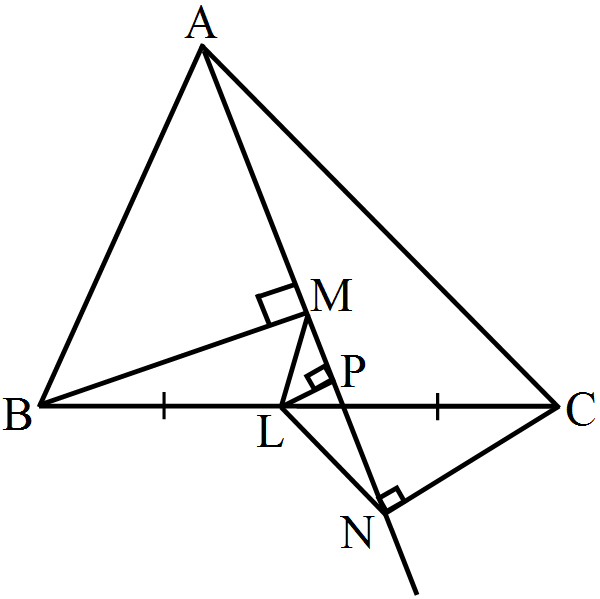
In a $\triangle\text{ABC},$ BM and CN are perpendiculars from B and C respectively on any line passing through A. If L is the mid-point of BC, prove that ML = NL.
View full question & answer
Question 154 Marks
View full question & answer
Question 164 Marks
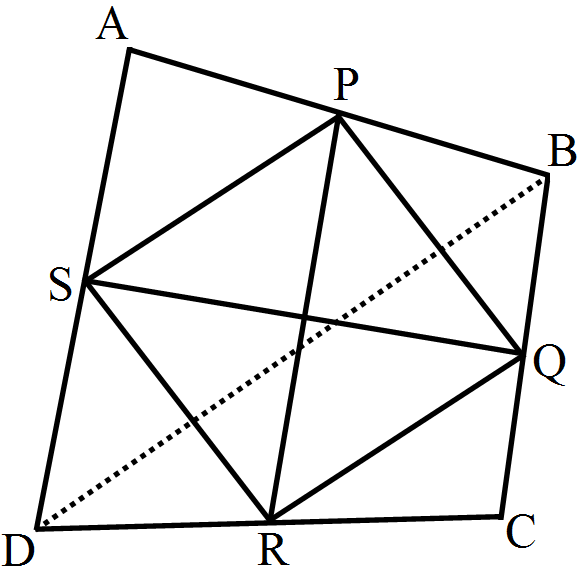
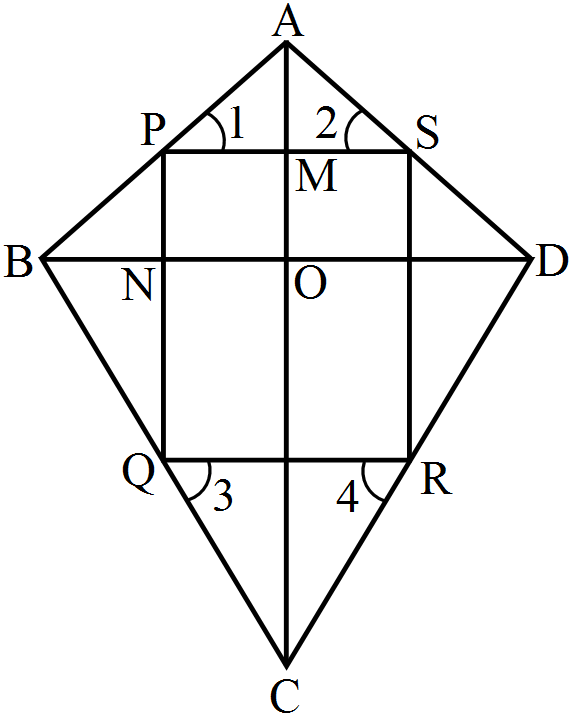
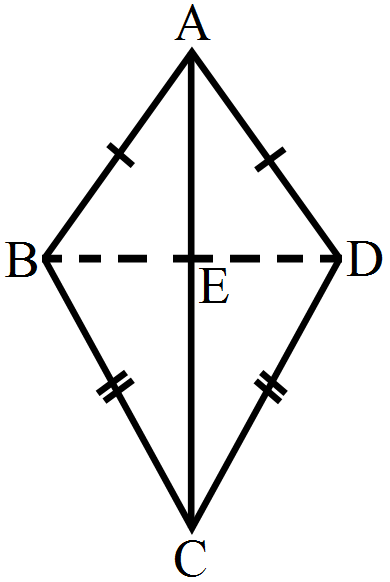
ABCD is a kite having AB = AD and BC = CD. Prove that the figure found by joining the mid points of the sides, in order, is a rectangle.
Answer
Given,
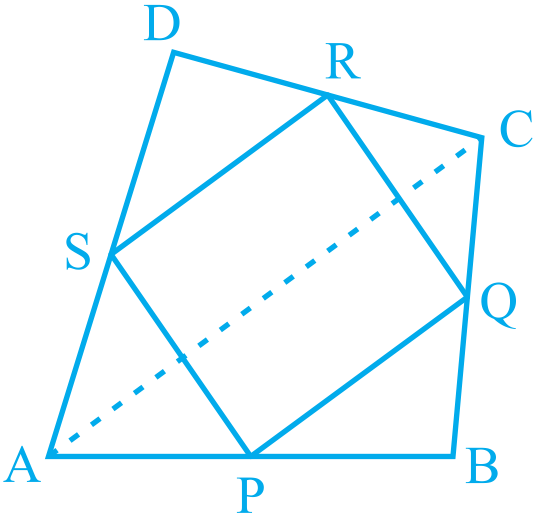
A kite ABCD having AB = AD and BC = CD. P, Q, R, S are the mid-points of sides AB, BC, CD and DA respectively. PQ, QR, RS and SP are joined.
To prove:
PQRS is a rectangle.

Proof:
In $\triangle\text{ABC},$ P and Q are the mid-points of AB and BC respectively.
$\therefore\text{PQ}||\text{AC}$ and $\text{PQ}=\frac{1}{2}\text{AC}\ ...(\text{i})$
In $\triangle\text{ADC}$ R and S are the mid-points of CD and AD respectively.
$\therefore\text{RS}||\text{AC}$ and $\text{RS}=\frac{1}{2}\text{AC}\ ...(\text{ii})$
From (i) and (ii) we have
PQ || RS and PQ = RS
Thus, in quadrilateral PQRS, a pair of opposite sides is equal and parallel. So, PQRS is a parallelogram. Now, we shall prove that one angle of parallelogram PQRS is a right angle.
Since AB = AD
$\Rightarrow12\text{B}=12\text{AD}$
$\Rightarrow\text{AP}=\text{AS}\ ...(\text{iii})$ $[\therefore$ P and S are midpoints of AB and AD$]$
$\Rightarrow\angle1=\angle2\ ...(\text{iv})$
Now, in $\triangle\text{PQB}$ and $\triangle\text{SDR},$ we have
PB = SD $\Big[\therefore\text{AD}=\text{AB}\Rightarrow\Big(\frac{1}{2}\Big)\text{AB}\Big]$
BQ = DR [Since PB = SD]
And PQ = SR [Since, PQRS is a parallelogram]
So, by SSS criterion of congruence, we have
$\triangle\text{PBQ}\cong\triangle\text{SDR}$
$\Rightarrow\angle3=\angle4$ [CPCT]
Now, $\Rightarrow\angle3+\angle\text{SPQ}+\angle2=180^\circ$
And $\angle1+\angle\text{PSR}+\angle4=180^\circ$
$\therefore\angle3+\angle\text{SPQ}+\angle2=\angle1+\angle\text{PSR}+\angle4$
$\Rightarrow\angle\text{SPQ}=\angle\text{PSR}$ $[\angle1=\angle2\text{and}\angle3=\angle4]$
Now, transversal PS cuts parallel lines SR and PQ at S and P respectively.
$\therefore\angle\text{SPQ}+\angle\text{PSR}=180^\circ$
$\Rightarrow\angle2\text{SPQ}=180^\circ$
$\Rightarrow\angle\text{SPQ}=90^\circ$ $[\therefore\angle\text{PSR}=\angle\text{SPQ}]$
Thus, PQRS is a parallelogram such that $\angle\text{SPQ}=90^\circ.$
Hence, PQRS is a parallelogram.

View full question & answer
Question 174 Marks
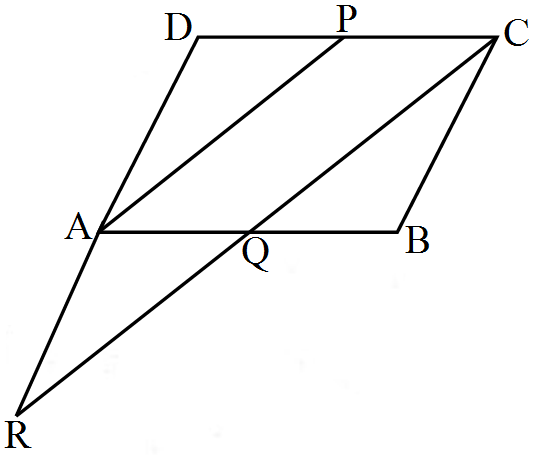
P is the mid-point of the side CD of a parallelogram ABCD. A line through C parallel to PA intersects AB at Q and DA produced at R. Prove that DA = AR and CQ = Q
View full question & answer
Question 184 Marks
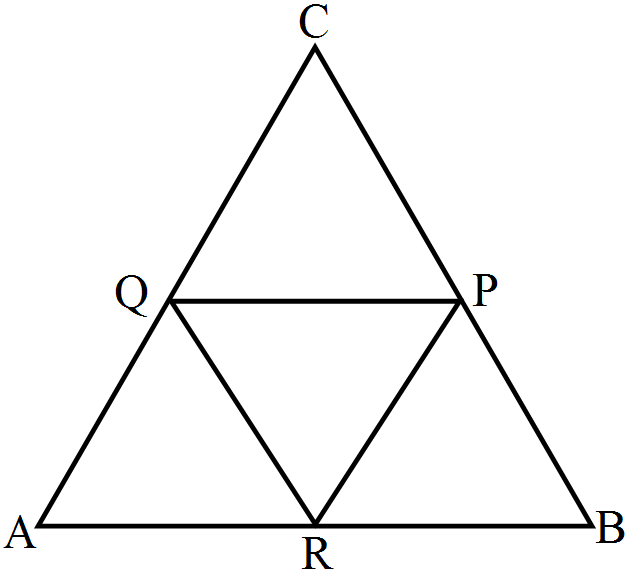
In a triangle, P, Q and R are the mid points of sides BC, CA and AB respectively. If AC = 21cm, BC = 29cm and AB = 30cm, find the perimeter of the quadrilateral ARPQ.
View full question & answer
Question 194 Marks
A diagonal of a parallelogram bisects one of its angles. Show that it is a rhombus.
View full question & answer
Question 204 Marks
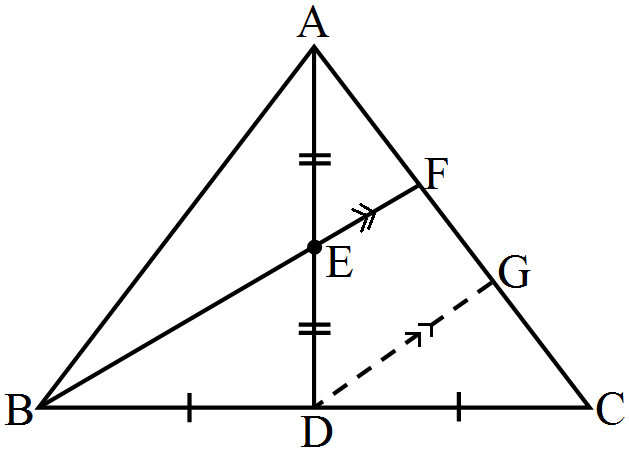
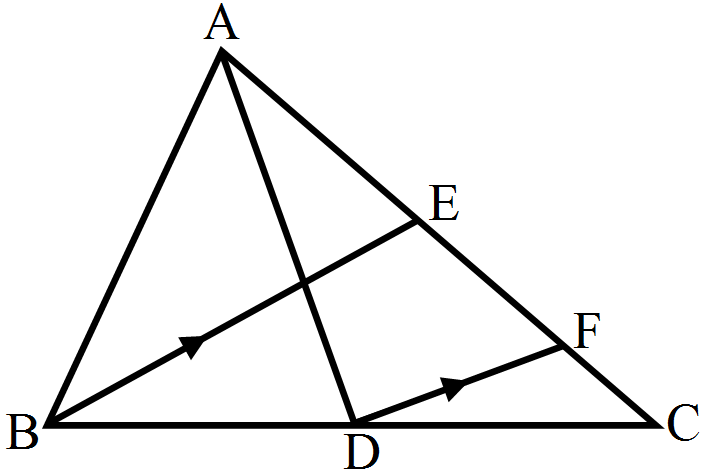
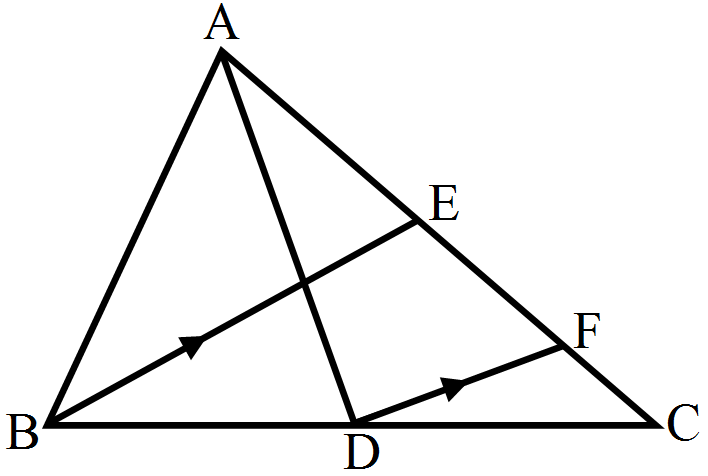
E is the mid-point of a median AD of $\Delta\text{ABC}$ and BE is produced to meet AC at F. Show that $\text{AF}=\frac{1}{3}\text{AC}.$
View full question & answer
Question 214 Marks
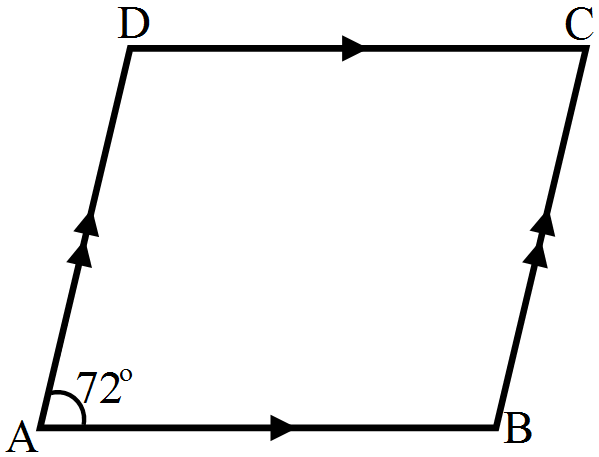
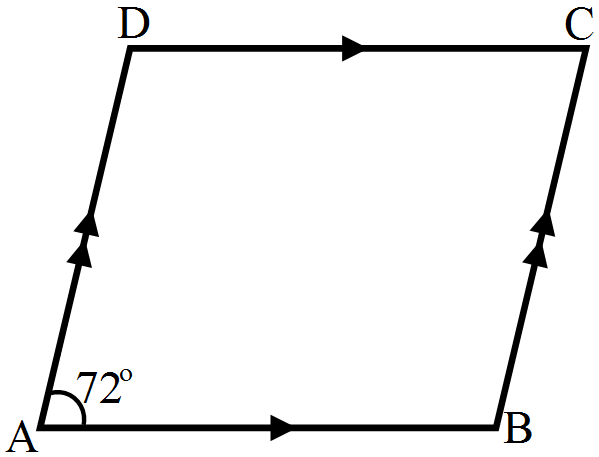
If an angle of a parallelogram is two-third of its adjacent angle, find the angles of the parallelogram.
Answer
Let one of the angle of the parallelogram as x°
Then the adjacent angle becomes $\frac{2}{3}\text{x}^\circ$
We know that the sum of adjacent angles of the parallelogram is supplementary.
Therefore,
$\text{x}+\frac{2}{3}\text{x}=180$
$\frac{5}{3}\text{x}=180$
$\text{x}=180\Big(\frac{3}{5}\Big)$
$\text{x}=108^\circ$
Thus, the angle adjacent to 108° 
$=\frac{2}{3}(108)^\circ$
$=72^\circ$
Since, opposite angles of a parallelogram are equal.
Therefore, the four angles in sequence are 108°, 72°, 108° and 72°.
View full question & answer
Question 224 Marks
P, Q, R and S are respectively the mid-points of sides AB, BC, CD and DA of quadrilateral ABCD in which AC = BD and $\text{AC}\bot\text{BD}.$ Prove that PQRS is a square.
View full question & answer
Question 234 Marks
View full question & answer
Question 244 Marks
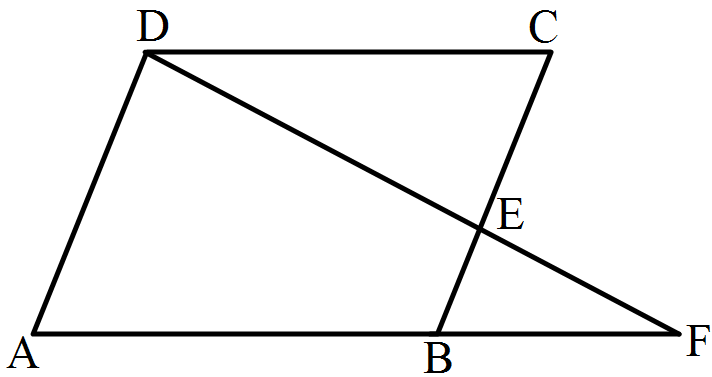
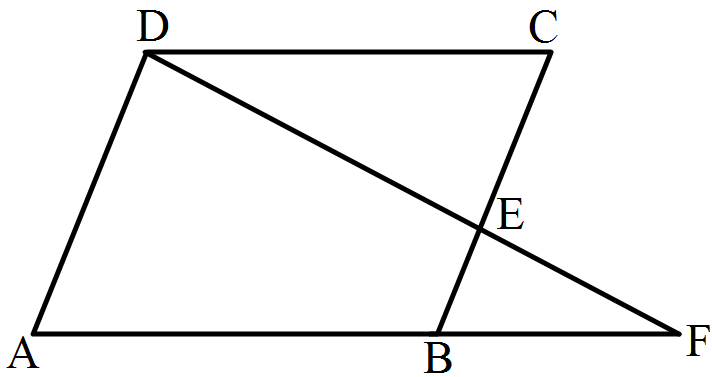
ABCD is a parallelogram, AD is produced to E so that DE = DC and EC produced meets AB produced in F.Prove that BF = BC.
Answer
Draw a parallelogram ABCD with AC and BD intersecting at O.
Produce AD to E such that DE = DC.
Join EC and produce it to meet AB produced at F.
In $\triangle\text{DCE},$
$\therefore\angle\text{DCE}=\angle\text{DEC}\dots(1)$ (In a triangle, equal sides have equal angles opposite to them)
AB || CD (Opposite sides of the parallelogram are parallel)
$\therefore$ AF || CD (AB lies on AF)
AF || CD and EF is the transversal,
$\therefore\angle\text{DCE}=\angle\text{BFC}\dots(2)$ (Pair of corresponding angles)
From (1) and (2), we get
$\angle\text{DCE}=\angle\text{BFC}$
In $\triangle\text{AFE},$
$\angle\text{AFE}=\angle\text{AEF}$ $(\angle\text{DEC}=\angle\text{BFC})$
$\therefore$ AE = AF (In a triangle, equal angles have equal sides opposite to them)
⇒ AD + DE = AB + BF
⇒ BC + AB = AB + BF $(\because$ AD = BC, DE = CD AND CD = AB, AB = DE$)$
⇒ BC = BF
View full question & answer
Question 254 Marks
View full question & answer
Question 264 Marks
View full question & answer
Question 274 Marks
View full question & answer
Question 284 Marks
Answer
Given In $\Delta\text{ABC}$ PQ || AB and PR || AC and RQ || BC.
To show $\text{BC}\frac{1}{2}\text{QR}$
Proof In quadrilateral BCAR, BR || CA and BC|| RA
So, quadrilateral, BCAR is a parallelogram.
BC = AR …(i)
Now, in quadrilateral BCQA, BC || AQ
and AB||QC
So, quadrilateral BCQA is a parallelogram,
BC = AQ …(ii)
On adding Eqs. (i) and (ii), we get
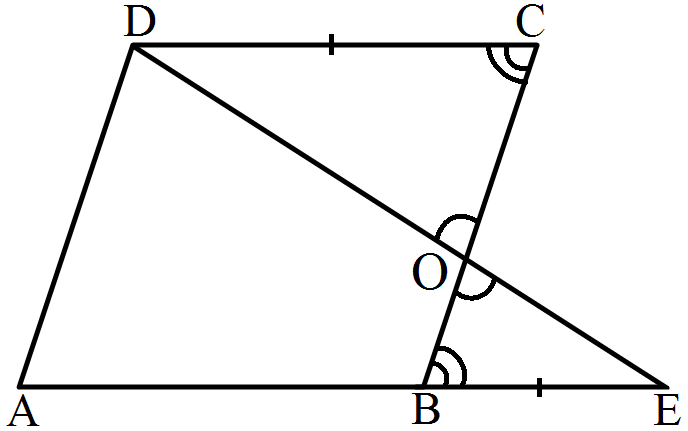
2BC = AR+ AQ
$\Rightarrow$ 2 BC = RQ
$\Rightarrow\ \text{BC}=\frac{1}{2}\text{QR}$
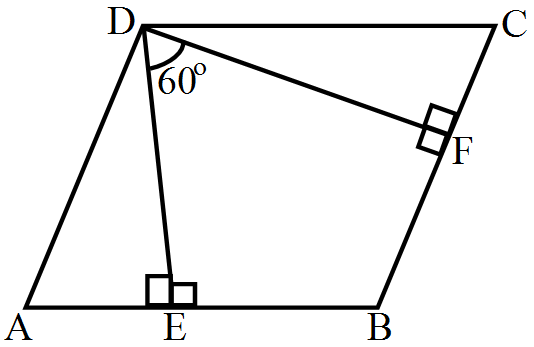
Now, BEDF is a quadrilateral, in which $\Delta\text{BED}=\Delta\text{BFD}=90^\circ$
$\Delta\text{FSE}=360^\circ-(\Delta\text{FDE}+\Delta\text{BED})=360^\circ-(60^\circ+90^\circ+90^\circ)$
= 360° - 240° = 120°
View full question & answer
Question 294 Marks
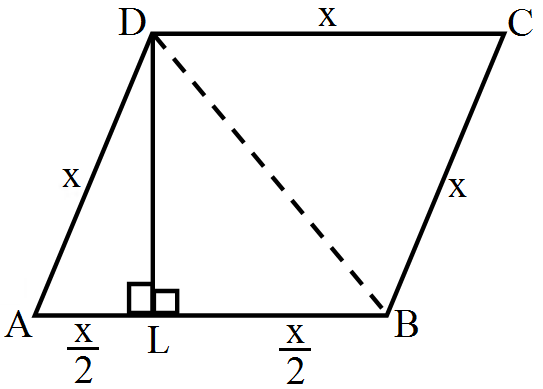
ABCD is a rhombus in which altitude from D to side AB bisects AB. Find the angles of the rhombus.
View full question & answer
Question 304 Marks
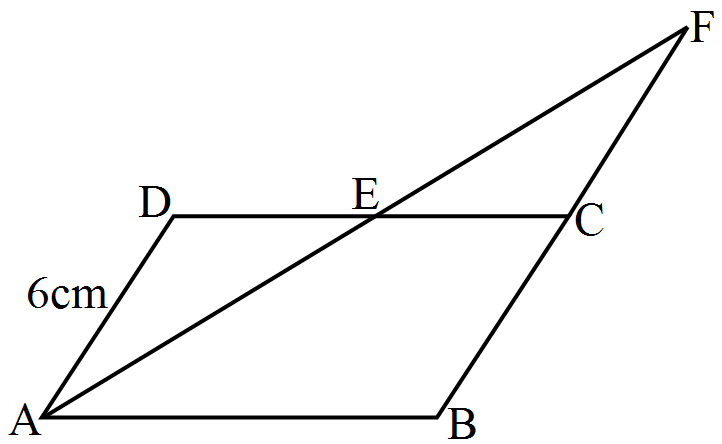
In a parallelogram ABCD, AB = 10cm and AD = 6cm. The bisector of $\angle\text{A}$meets DC in E. AE and BC produced meet at F. Find the length of CF.
View full question & answer
Question 314 Marks
View full question & answer
Question 324 Marks
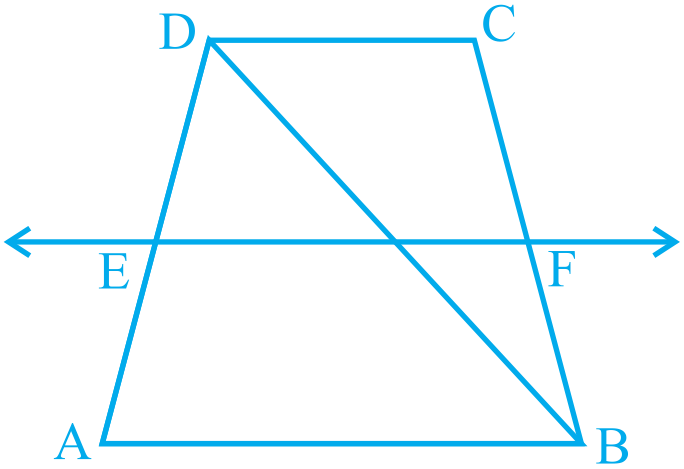
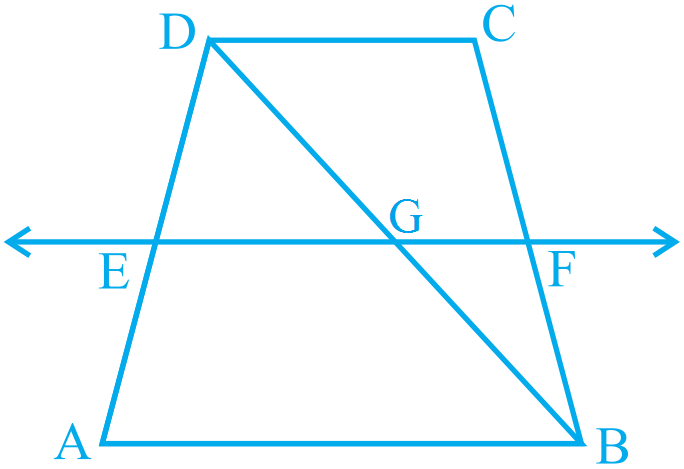
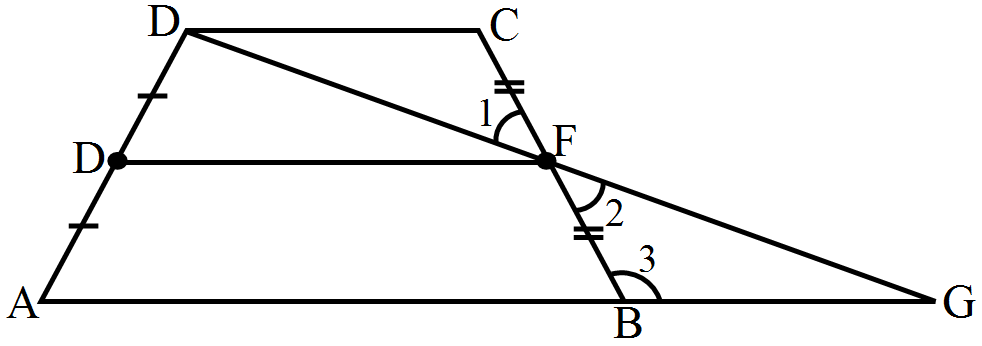
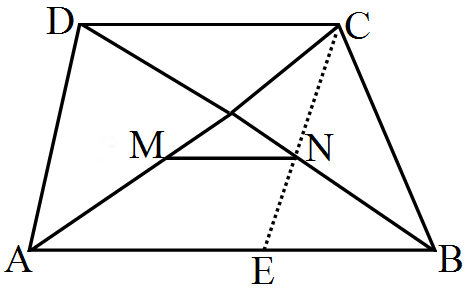
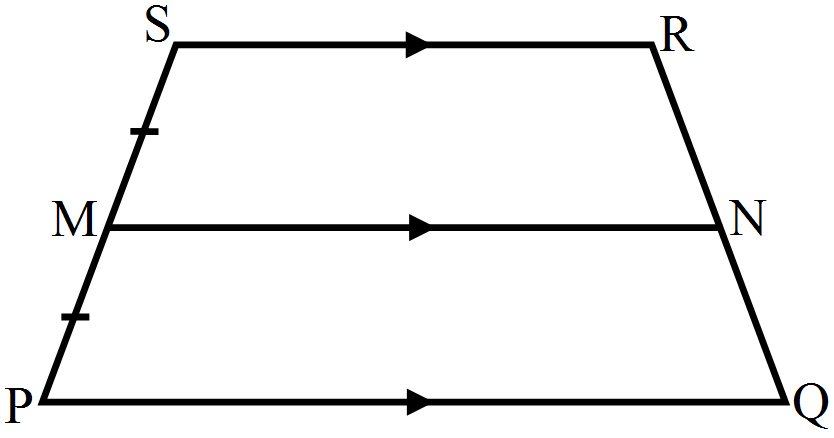
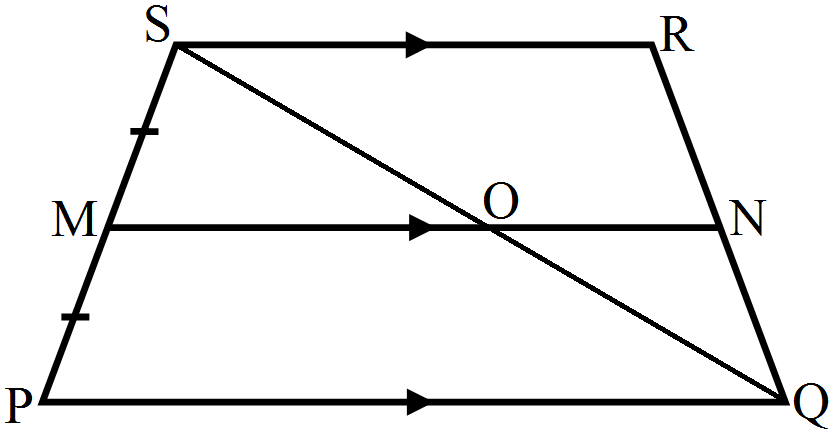
E is the mid-point of the side AD of the trapezium ABCD with AB || DC. A line through E drawn parallel to AB intersect BC at F. Show that F is the mid-point of BC.
[Hint: Join AC]
View full question & answer
Question 334 Marks
View full question & answer
Question 344 Marks
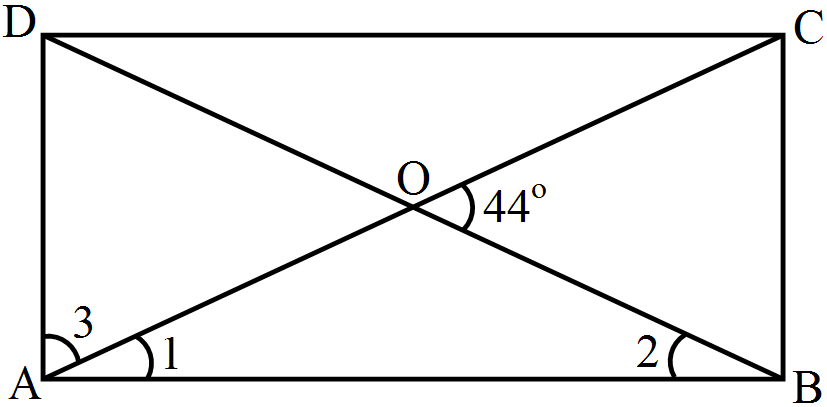
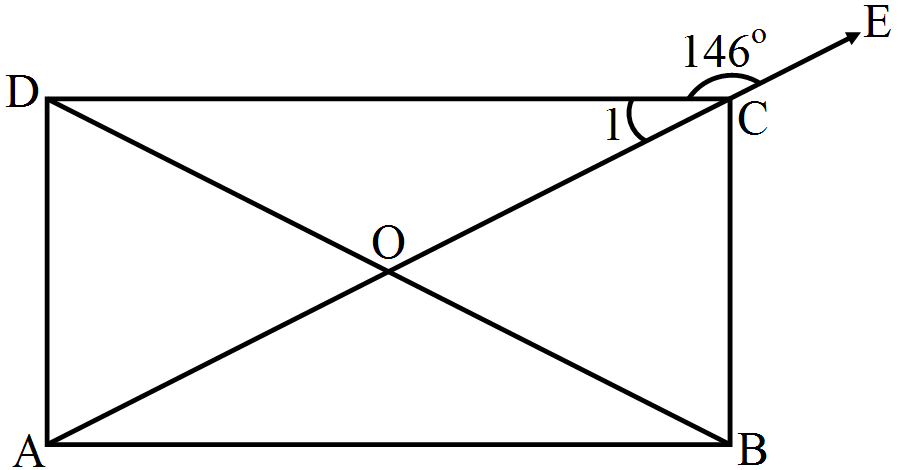
The diagonals of a rectangle ABCD meet at O, If $\angle\text{BOC}=44^\circ,$ find $\angle\text{OAD}.$
View full question & answer
Question 354 Marks
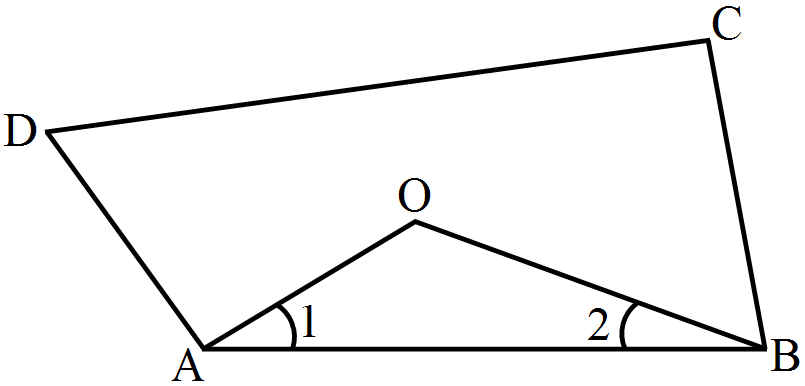
In a quadrilateral ABCD, CO and DO are the bisectors of $\angle\text{C}\ \text{and}\ \angle\text{D}$ respectively. Prove that $\angle\text{COD} = \frac{1}{2} (\angle\text{A}\ \text{and}\ \angle\text{B})$.
Answer
In $\triangle\text{DOC}$
$\angle1+\angle\text{COD}+\angle2=180^\circ$ [Angle sum property of a triangle]
$\Rightarrow\angle\text{COD}=180-(\angle1-\angle2)$
$\Rightarrow\angle\text{COD}=180-\angle\ 1+\angle2$
$\Rightarrow\angle\text{COD}=180-\Big[\frac{1}{2}\text{LC}+\frac{1}{2}\text{LD}\Big]$ $\big[\because$ OC and OD are bisectors of LC and LD respectively$\big]$
$\Rightarrow\angle\text{COD}=180-\frac{1}{2}(\text{LC+LD)}\ ...(\text{i})$
In quadrilateral ABCD
$\angle\text{A}+\angle\text{B}+\angle\text{C}+\angle\text{D}=360^\circ$ [Angle sum property of quadrilateral]
 $\angle\text{C}+\angle\text{D}=360^\circ-(\angle\text{A}+\angle\text{B)}\dots(\text{ii})$
Substituting (ii) in (i)
$\Rightarrow\angle\text{COD}=180-\frac{1}{2}(360^\circ-(\angle\text{A}+\angle\text{B))}$
$\Rightarrow\angle\text{COD}=180-180+\frac{1}{2}(\angle\text{A}+\angle\text{B})$
$\Rightarrow\angle\text{COD}=\frac{1}{2}(\angle\text{A}+\angle\text{B})$
View full question & answer
Question 364 Marks
Answer
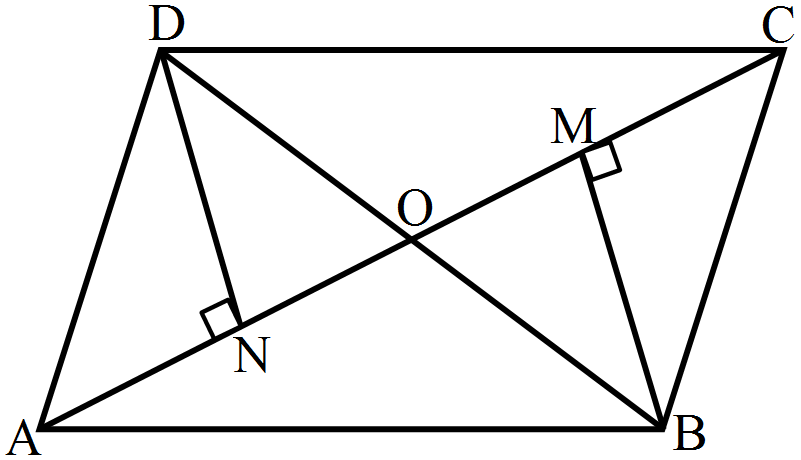
Given: A quadrilateral ABCD, in which $\text{BM}\perp\text{AC}$ and $\text{DN}\perp\text{AC}$ and BM = DN.
To prove: AC bisects BD; or DO = BO
Proof:
Let AC and BD intersect at O.
Now, in $\triangle\text{OND}$ and $\triangle\text{OMB},$ we have:
$\angle\text{OND}=\angle\text{OMB}$ (90° each)
$\angle\text{DON}=\angle\text{BOM}$ (Vertically opposite angles)
Also, $\text{DN = BM}$ (Given)
i.e., $\triangle\text{OND}\cong\triangle\text{OMB}$ (AAS congrurence rule)
$\therefore\text{OD = OB}$ (C.P.C.T.)
Hence, AC bisects BD.
View full question & answer
Question 374 Marks
ABCD is a rectangle in which diagonal BD bisects $\angle\text{B}.$ Show that ABCD is a square.
View full question & answer
Question 384 Marks
Two opposite angles of a parallelogram are (3x - 2)° and (50 - x)°. Find the measure of each angle of the parallelogram.
Answer
We know that,
Opposite sides of a parallelogram are equal.
(3x - 2)° = (50 - x)°
⇒ 3x + x = 50 + 2
⇒ 4x = 52°
⇒ x = 13°
Therefore, (3x - 2)° = (3 × 13 - 2)° = 37°
(50 - x)° = (50 - 13) = 37°
Adjacent angles of a parallelogram are supplementary.
$\therefore$ x + 37 = 180°
$\therefore$ x = 180° - 37° = 143°
Hence, four angles are: 37°, 143°, 37°, 143°.
View full question & answer
Question 394 Marks
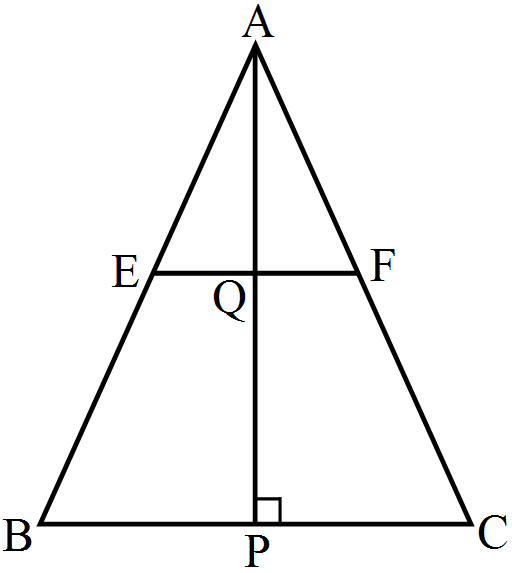
In a $\triangle\text{ABC},$ E and F are the mid-points of AC and AB respectively. The altitude AP to BC intersects FE at Q. Prove that AQ = QP.
View full question & answer
Question 404 Marks
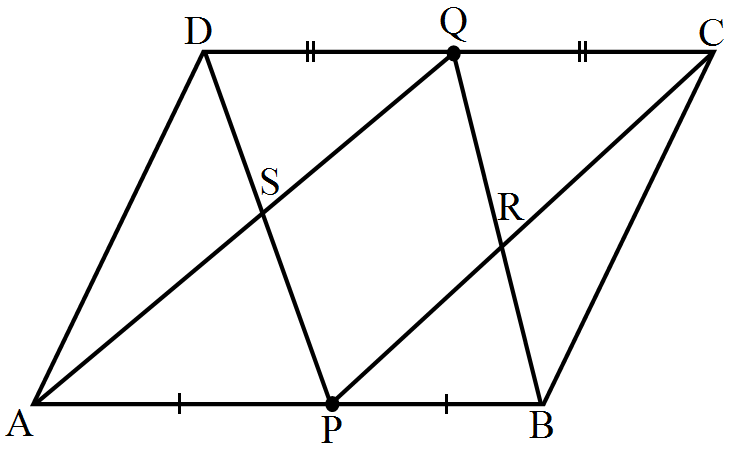
P and Q are the mid-points of the opposite sides AB and CD of a parallelogram ABCD. AQ intersects DP at S and BQ intersects CP at R. Show that PRQS is a parallelogram.
View full question & answer
Question 414 Marks
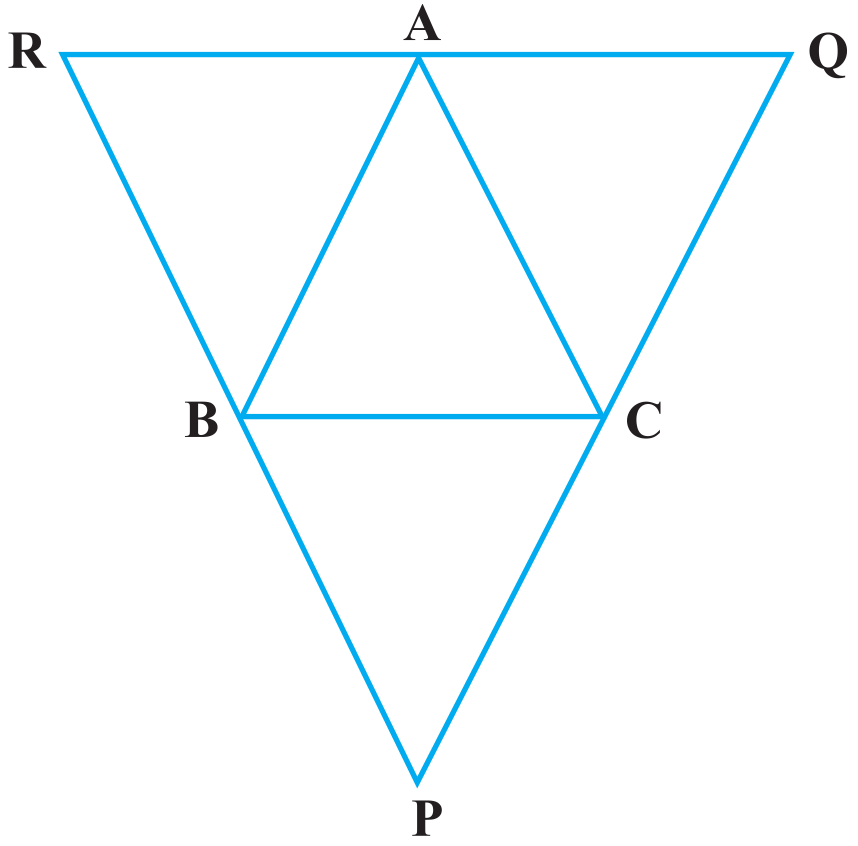
ABC is a triangle and through A, B, C lines are drawn parallel to BC, CA and AB respectively intersecting at P, Q and R. Prove that the perimeter of $\triangle\text{PQR}$ is double the perimeter of $\triangle\text{ABC}.$
Answer
Clearly ABCQ and ARBC are parallelograms.
Therefore, BC = AQ and BC = AR
⇒ AQ = AR
⇒ A is the mid-point of QR
Similarly B and C are the mid points of PR and PQ respectively.
$\therefore\text{AB}=\Big(\frac{1}{2}\Big)\text{PQ},$ $\text{BC}=\Big(\frac{1}{2}\Big)\text{QR},$ $\text{CA}=\Big(\frac{1}{2}\Big)\text{PR}.$
⇒ PQ = 2AB, QR = 2BC and PR = 2CA
⇒ PQ + QR + RP = 2 (AB + BC + CA)
⇒ Perimeter of $\triangle\text{PQR}=2$ $($perimeter of $\triangle\text{ABC})$
View full question & answer
Question 424 Marks
View full question & answer
Question 434 Marks
If the bisectors of two adjacent angles A and B of a quadrilateral ABCD intersect at a point O such that $\angle\text{C}+\angle\text{D}=\text{k}\angle\text{AOB},$ then find the value of k.
View full question & answer
Question 444 Marks
In a $\triangle\text{ABC},$ D, E and F are, respectively the mid points of BC, CA and AB. If the lengths of sides AB, BC and CA are 7cm, 8cm and 9cm, respectively, find the perimeter of $\triangle\text{DEF}.$
View full question & answer
Question 454 Marks
View full question & answer
Question 464 Marks
Answer
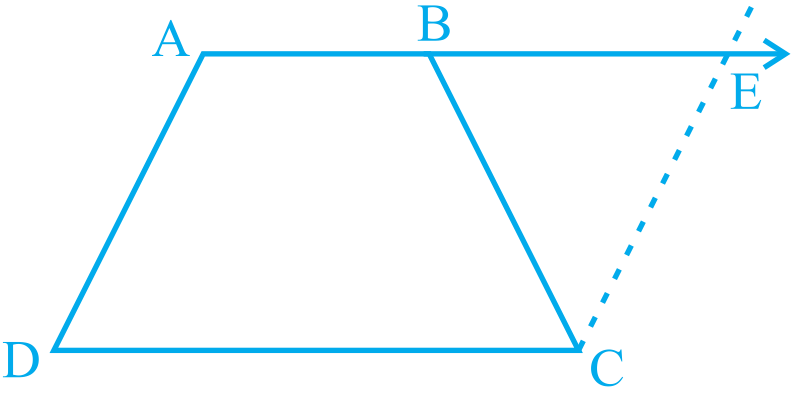
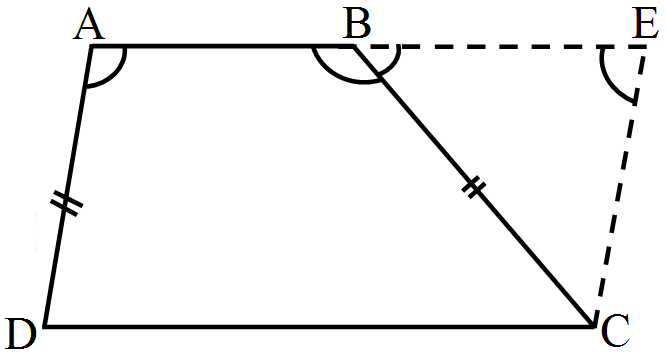
Construction: Draw a line through C parallel to DA intersecting AB produced at E.

  1. CE = AD (Opposite sides of a parallelogram)

AD = BC (Given)

Therefor, BC = CE

also,

$\angle\text{A}+\angle\text{CBE}=180^{0}$ (Angles on the same side of transversal and ∠CBE = ∠CEB)

$\angle\text{B}+\angle\text{CBE}=180^{0}$ (Linear pair)

$\angle\text{A}=\angle\text{B}$

  1. $\angle\text{A}+\angle\text{D}=\angle\text{B}+\angle\text{C}=180^{0}$ (Angles on the same side of transversal)

$\angle\text{A}+\angle\text{D}=\angle\text{B}+\angle\text{C}$

$\angle\text{D}=\angle\text{C}$

  1. In $\angle\text{ABC}$ and $\angle\text{BAD}$

AB = AB (Common)

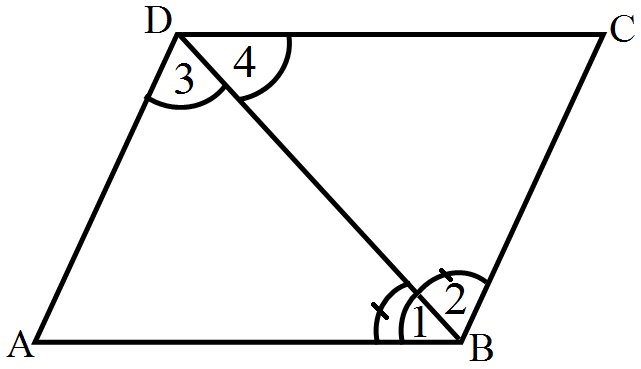
$\angle\text{DBA}=\angle\text{CBA}$

AD = BC (Given)

  1. Thus, by SAS $\angle\text{DBA}=\angle\text{CBA}$ Congruence condition.
View full question & answer
Question 474 Marks
Answer
  1. In $\triangle\text{ADC}$ and R are the mid-points of sides AD and CD respectively.

In a triangle, the line segment joining the mid-points of any two sides of the triangle is parallel to the third side and is half of it.

SR || AC and SR $=\frac{1}{2}\text{AC}\ ...(\text{i})$

  1. In $\triangle\text{ABC}$ and Q are mid - points of sides AB and BC respectively. Therefore, by using mid - point theorem,

PQ || AC and PQ $=\frac{1}{2}\text{AC}\ ...(\text{ii})$

Using equations (i) and (ii), we obtain

PQ || SR and PQ = SR ...(iii)

⇒ PQ = SR

  1. From equation (3), we obtained

PQ || SR and PQ = SR

Clearly, one pair of opposite sides of quadrilateral PQRS is parallel and equal.

Hence, PQRS is a parallelogram.

View full question & answer
Question 484 Marks
In a quadrilateral ABCD, bisectors of angles A and B intersect at O such that $\angle\text{AOB}=75^\circ,$ then write the value of $\angle\text{C}+\angle\text{D}.$
View full question & answer
Question 494 Marks
In the adjoining figure, ABCD is a square and $\triangle\text{EDC}$ is an equilateral triangle. Prove that:
  1. AE = BE,
  2. $\angle\text{DAE}=15^{\circ}.$
Answer
Given: ABCD is a square in which AB = BC = CD = DA. $\triangle\text{EDC}$ is an equilateral triangle in which ED = EC = DC and
$\angle\text{EDC}=\angle\text{DEC}=\angle\text{DCE}=60^{\circ}.$
To prove: $\text{AE = BE}$ and $\angle\text{DAE}=15^{\circ}$
Proof: in $\triangle\text{ADE}$ and $\triangle\text{BCE},$ we have:
$\text{AD = BC}$ [Sides of a square]
$\text{DE = EC}$ [Sides of an equilateral triangle]
$\angle\text{ADE}=\angle\text{BCE}=90^{\circ}+60^{\circ}=150^{\circ}$
$\therefore\triangle\text{ADE}\cong\triangle\text{BCE}$
i.e., $\text{AE = BE}$
Now, $\angle\text{ADE}=150^{\circ}$
$\text{DA = DC}$ [Sides of a square]
$\text{DC = DE}$ [Sides of an equilateral triangle]
So, $\text{DA = DE}$
$\triangle\text{ADE}$ and $\triangle\text{BCE}$ are isosceles triangle.
i.e., $\angle\text{DAE}=\angle\text{DEA}=\frac{1}{2}(180^{\circ}-150^{\circ})=\frac{30^{\circ}}{2}=15^{\circ}$
View full question & answer
Question 504 Marks
View full question & answer
Question 514 Marks
Answer
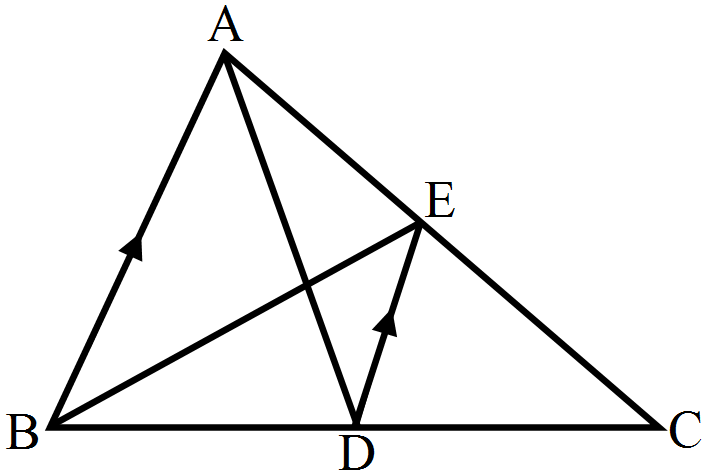
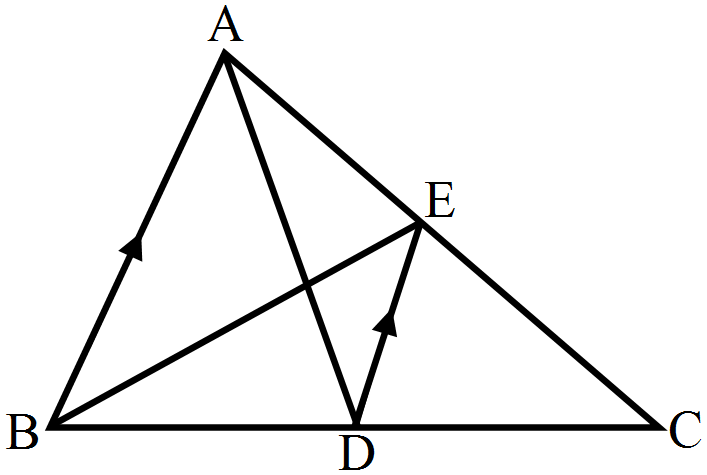
Given In figure AB || DE and AC || DF, also AB = DE and AC = DF

To prove BC || EF and BC = EF

Proof In quadrilateral ABED, AB || DE and AB = DE

So, ABED is a parallelogram. AD || BE and AD = BE

Now, in quadrilateral ACFD, AC || FD and AC = FD …(i)

Thus, ACFD is a parallelogram.

AD || CF and AD = CF …(ii)

From Eqs. (i) and (ii), AD = BE = CF and CF || BE …(iii)

Now, in quadrilateral BCFE, BE = CF

and BE || CF [from Eq. (iii)]

So, BCFE is a parallelogram. BC = EF and BC || EF. Hence proved.

View full question & answer
Question 524 Marks
E and F are respectively the mid-points of the non-parallel sides AD and BC of a trapezium ABCD. Prove that EF || AB and$\text{EF}=\frac{1}{2}(\text{AB}=\text{CD})$
[Hint: Join BE and produce it to meet CD produced at G.]
View full question & answer
Question 534 Marks
Prove that the quadrilateral formed by the bisectors of the angles of a parallelogram is a rectangle.
Answer
Given Let ABCD be a parallelogram and AP, BR, CR, be are the bisectors of $\angle\text{A},\ \angle\text{B},\ \angle\text{C}$ and $\angle\text{D},$ respectively.

To prove Quadrilateral PQRS is a rectangle.

Proof Since, ABCD is a parallelogram, then DC || AB and DA is a transversal.

$\angle\text{A}+\angle\text{B}=180^\circ$

[sum of cointerior angles of a parallelogram is 180°]

$\Rightarrow\ \frac{1}{2}\angle\text{A}+\frac{1}{2}\angle\text{D}=90^\circ$ [dividing both sides by 2]

$\angle\text{PAD}+\angle\text{PDA}=90^\circ$

$\angle\text{APD}=90^\circ$ [since,sum of all angles of a triangle is 180°]

$\Rightarrow\angle\text{SPQ}=90^\circ$ [vertically opposite angles]

$\angle\text{PQR}=90^\circ$

$\angle\text{QRS}=90^\circ$

and

$\angle\text{PSR}=90^\circ$

Thus, PQRS is a quadrilateral whose each angle is 90°.

Hence, PQRS is a rectangle.

View full question & answer
Question 544 Marks
ABCD is a quadrilateral in which AB || DC and AD = BC. Prove that $\angle\text{A}=\angle\text{B}$ and $\angle\text{C}=\angle\text{D}.$
View full question & answer
Question 554 Marks
In a parallelogram ABCD, if $\angle\text{A}=(3\text{x}-20)^\circ,\angle\text{B}=(\text{y}+15)^\circ,\angle\text{C}=(\text{x}+40)^\circ,$ then find the values of x and y.
Answer
In parallelogram ABCD$\angle\text{A}$ and $\angle\text{C}$ are opposite angles.
We know that in a parallelogram, the opposite angles are equal.
Therefore,
$\angle\text{C}=\angle\text{A}$
We have $\angle\text{A}=(3\text{x}-20)^\circ$ and $\angle\text{C}=(\text{x}+40)^\circ$
Therefore,
x + 40º = 3x - 20º
x - 3x = -40º - 20º
-2x = -60º
x = 30º
Therefore,
$\angle\text{A}=(3\text{x}-20)^\circ$
$\angle\text{A}=[3(30)-20]^\circ$
$\angle\text{A}=70^\circ$
Similarly,
$\angle\text{C}=70^\circ$
Also, $\angle\text{B}=(\text{y}+15)^\circ$
Therefore,
$\angle\text{D}=\angle\text{B}$
$\angle\text{D}=(\text{y}+15)^\circ$
By angle sum property of a quadrilateral, we have:
$\angle\text{A}+\angle\text{B}+\angle\text{C}+\angle\text{D}=360^\circ$
$70^\circ+(\text{y}+15)^\circ+70^\circ+(\text{y}+15)^\circ=360^\circ$
$140^\circ+2(\text{y}+15)^\circ=360^\circ$
$2(\text{y}+15)^\circ=360^\circ-140^\circ$
$2(\text{y}+15)^\circ=220^\circ$
$(\text{y}+15)^\circ=110^\circ$
$\text{y}=95^\circ$
Hence the required values for x and y are 30º and 95º respectively.
View full question & answer
Question 564 Marks
View full question & answer
Question 574 Marks
View full question & answer
Question 584 Marks
Answer
Given: ABCD is a quadrilateral in which AB = AD and BC = DC

  1. In $\triangle\text{ABC}$ and $\triangle\text{ADC},$ we have:

$\text{AB = AD}$ (Given)

$\text{BC = DC}$ (Given)

$\text{AC}$ is common.

i.e., $\triangle\text{ABC}\cong\triangle\text{ADC}$ (SSS congruence rule)

$\therefore\angle\text{BAC}=\angle\text{DAC}$ and $\angle\text{BCA}=\angle\text{DCA}$ (By C.P.C.T.)

Thus, AC bisects $\angle\text{A}$ and $\angle\text{C}.$

  1. Now, in $\triangle\text{ABE}$ and $\triangle\text{ADE},$ we have:

$\text{AB = AD}$ (Given)

$\angle\text{BAE}=\angle\text{DAE}$ (Proven above)

$\text{AE}$ is common.

$\therefore\triangle\text{ABE}\cong\triangle\text{ADE}$ (SAS congruence rule)

$\Rightarrow\text{BE = DE}$ (By C.P.C.T.)

  1. $\triangle\text{ABC}\cong\triangle\text{ADC}$ (Proven above)

$\therefore\angle\text{ABC}=\angle\text{ADC}$ (By C.P.C.T.)

View full question & answer
Question 594 Marks
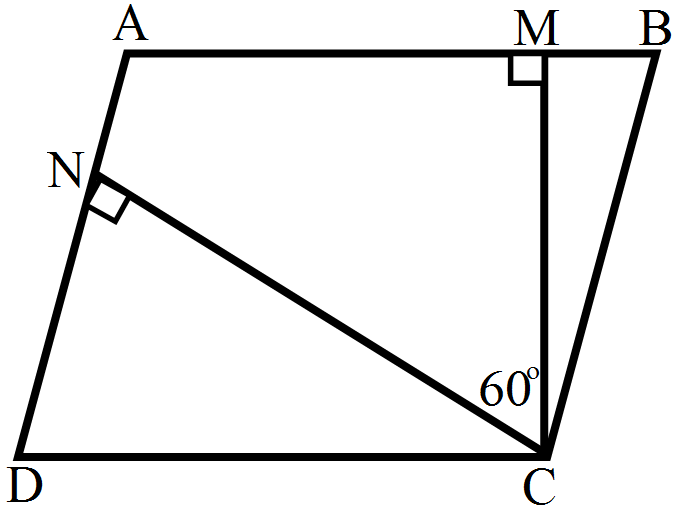
The angle between two altitudes of a parallelogram through the vertex of an obtuse angle of the parallelogram is 60°. Find the angles of the parallelogram.
View full question & answer
Question 604 Marks
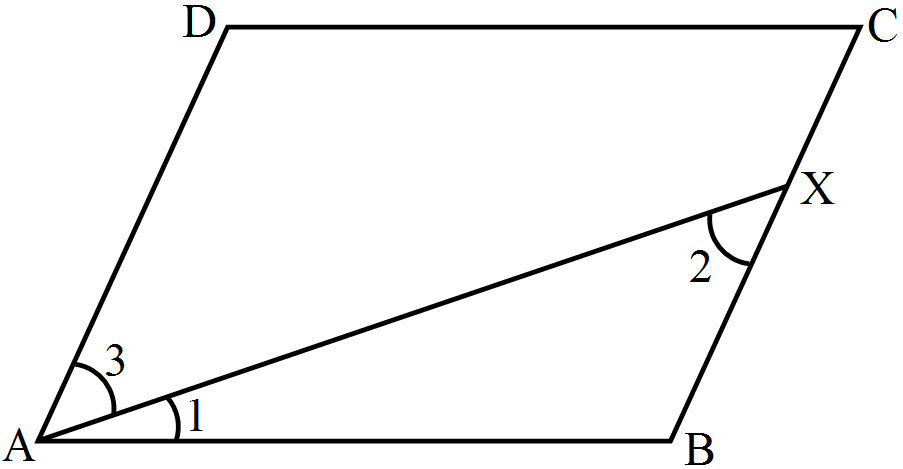
In a parallelogram ABCD, the bisector of $\angle\text{A}$ also bisects BC at X. Find AB : AD.
View full question & answer
Question 614 Marks
View full question & answer
Question 624 Marks
P is the mid-point of side BC of a parallelogram ABCD such that $\angle\text{BAP}=\angle\text{DAP}$ Prove that AD = 2CD.
Answer

Given in a parallelogram ABCD, P is a mid-point of BC such that $\angle\text{BAP}=\angle\text{DAP}.$

To prove AD = 2CD

Proof Since, ABCD is a parallelogram.

So, AD || BC and AB is transversal, then

$\angle\text{A}+\angle\text{B}=180^\circ$ (sum of cointerior angles is 180°)

$\angle\text{B}=180^\circ-\angle\text{A}\ ...(\text{i})$

in $\Delta\text{ABP}$ $\angle\text{PAB}+2\angle\text{B}+\angle\text{BPA}=180^\circ$[by angle sum property of a triangle)

$\Rightarrow\ \frac{1}{2}\angle\text{A}+180^\circ-\angle\text{A}+\angle\text{BPA}=180^\circ$ [from Eq. (i)]

$\Rightarrow\ \angle\text{BPA}=\frac{\angle\text{A}}{2}=0$

$\Rightarrow\ \angle\text{BPA}=\frac{\angle\text{A}}{2}\ ...\text{(ii)}$

$\Rightarrow\angle\text{BPA}=\angle\text{BAP}$

$\Rightarrow\ \text{AB}=\text{BP}$ [opposite sides of equal angles are equal]

On multiplying both sides by 2, we get

$2\text{AB}=2\text{BP}$

$\Rightarrow\ 2\text{AB}=\text{BP}$ (since Pis the mid-point of BC)

$\Rightarrow\ 2\text{CD}=\text{AD}$

(since, ABCD is a parallelogram, then AB = CD and BC = AD)

View full question & answer
Question 634 Marks
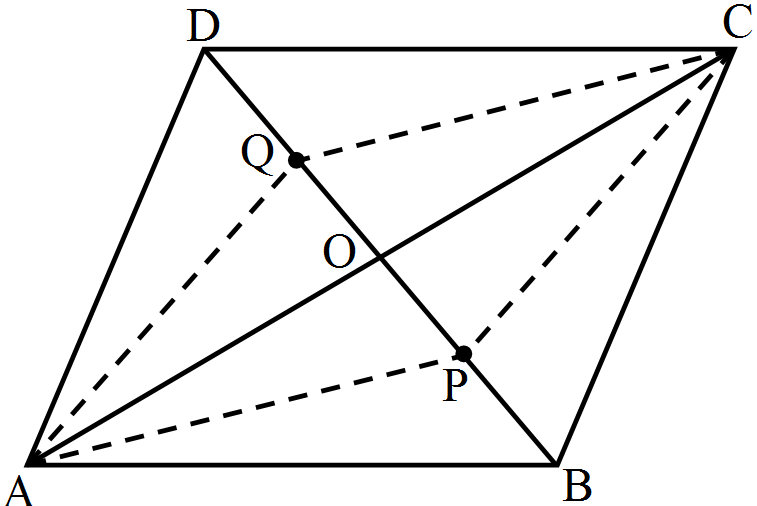
P and Q are the point of trisection of the diagonal BD of a parallelogram ABCD. prove that CQ is parallel to AP. prove also that AC bisects PQ.
View full question & answer
Question 644 Marks
Answer
Given:

AB = AC and CD ∥ BA and AP is the bisector of exterior $\angle\text{CAD}$ of $\triangle\text{ABC}$

To prove:

  1.  $\angle\text{PAC}=\angle\text{BCA}$

  2.  ABCP is a parallelogram.

Proof:

  1.  We have,

AB = AC

$\Rightarrow\angle\text{CAD}=\angle\text{ABC}$ [Opposite angles of equal sides of triangle are equal]

Now, $\angle\text{CAD}=\angle\text{ABC}+\angle\text{ACB}$

$\Rightarrow\angle\text{PAC}+\angle\text{PAD}=\angle\text{ACB}$ $[\therefore\angle\text{PAC}=\angle\text{PAD}]$ 

$\Rightarrow2\angle\text{PAC}=2\angle\text{ACB}$

$\Rightarrow\angle\text{PAC}=\angle\text{ACB}$

  1. Now,

$\angle\text{PAC}=\angle\text{BCA}$

$\Rightarrow\angle\text{AP}||\text{BC}$ and $\text{CP}||\text{BA}$ [Given]

Therefore, ABCP is a parallelogram.

View full question & answer
Question 654 Marks
Answer
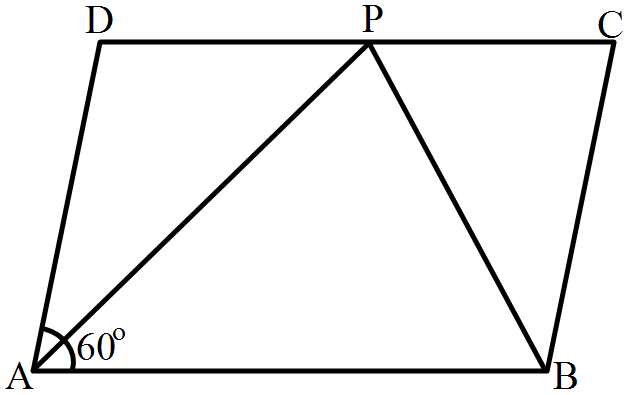
AP bisects $\angle\text{A}$
Then, $\angle\text{DAP} = \angle\text{PAB} = 30^\circ$
Adjacent angles are supplementary
Then, $\angle\text{A}+\angle\text{B}=180^\circ$
$\angle\text{B}+60^\circ=180^\circ$
$\angle\text{B}=180^\circ-60^\circ$
$\angle\text{B}=120^\circ$ 
BP bisects $\angle\text{B}$
Then, $\angle\text{PBA} = \angle\text{PBC} = 30^\circ$
$\angle\text{PAB} = \angle\text{APD} = 30^\circ$ [Alternate interior angles]
Therefore, AD = DP [Sides opposite to equal angles are in equal length]
Similarly,
$\angle\text{PAB} = \angle\text{APD} = 60^\circ$ [Alternate interior angles]
Therefore, PC = BC
DC = DP + PC
DC = AD + BC [Since, DP = AD and PC = BC]
DC = 2AD [Since, AD = BC, opposite sides of a parallelogram are equal]
View full question & answer
Question 664 Marks
If ABCD is a rhombus with $\angle\text{ABC}=56^\circ,$ find the measure of $\angle\text{ACD}.$
View full question & answer
Question 674 Marks
Let ABC be an isosceles triangle in which AB = AC. If D, E, F be the mid points of the, sides BC, CA and AB respectively, show that the segment AD and EF bisect each other at right angles.
View full question & answer
Question 684 Marks
Prove that the line joining the mid-points of the diagonals of a trapezium is parallel to the parallel sides of the trapezium.
View full question & answer
Question 694 Marks
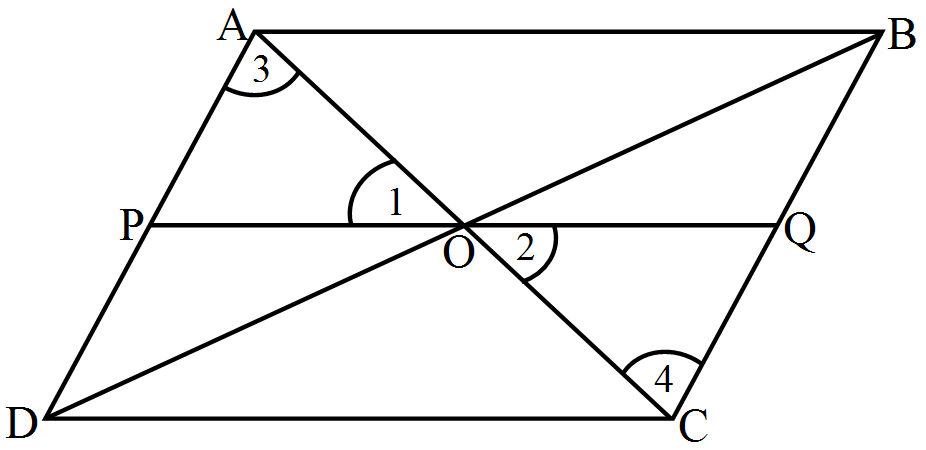
P and Q are points on opposite sides AD and BC of a parallelogram ABCD such that PQ passes through the point of intersection O of its diagonals AC and BD. Show that PQ is bisected at O.
View full question & answer
Question 704 Marks
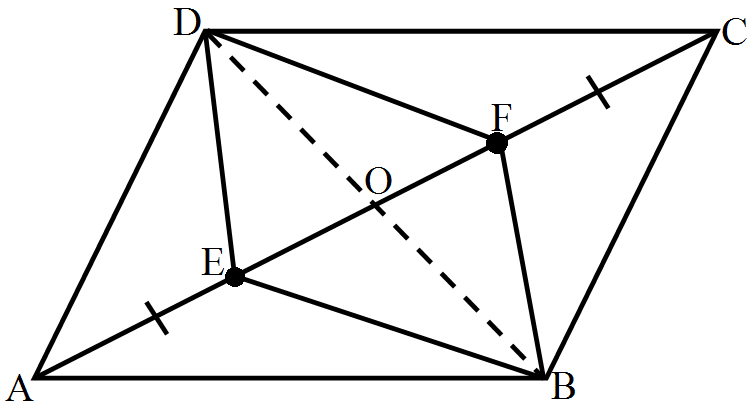
E and F are points on diagonal AC of a parallelogram ABCD such that AE = CF. Show that BFDE is a parallelogram.
View full question & answer
Question 714 Marks
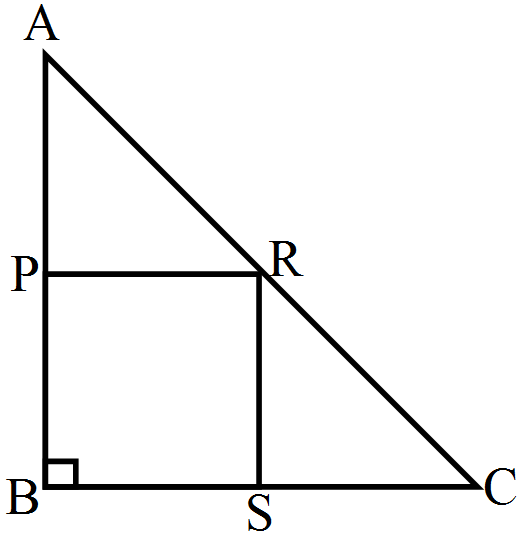
A square is inscribed in an isosceles right triangle so that the square and the triangle have one angle common. Show that the vertex of the square opposite the vertex of the common angle bisects the hypotenuse.
View full question & answer
Question 724 Marks
In a rhombus ABCD, the altitude from D to the side AB bisects AB. Find the angles of the rhombus.
View full question & answer
Question 734 Marks
If measures opposite angles of a parallelogram are (60 - x)° and (3x - 4)°, then find the measures of angles of the parallelogram.
Answer
Let ABCD be a parallelogram, with $\angle\text{A}=(60^\circ-\text{x})^\circ$ and $\angle\text{C}=(3\text{x}-4)^\circ.$
We know that in a parallelogram, the opposite angles are equal.
Therefore,
$\angle\text{A}=\angle\text{C}$
60 - x = 3x - 4
-x - 3x = -4 - 60
-4x = -64
x = 16
Thus, the given angles become
$\angle\text{A}=(60^\circ-\text{x})^\circ$
$=(60-16)^\circ$
$=44^\circ$
Similarly,
$\angle\text{C}=44^\circ$
Also, adjacent angles in a parallelogram form the consecutive interior angles of parallel lines, which must be supplementary.
Therefore,
$\angle\text{A}+\angle\text{B}=180^\circ$
$44^\circ+\angle\text{B}=180^\circ$
$\angle\text{B}=180^\circ-44^\circ$
$\angle\text{B}=136^\circ$
similarly,
$\angle\text{D}=\angle\text{B}$
$\angle\text{D}=136^\circ$
Thus, the angles of a parallelogram are 44º, 136º, 44º, and 136º.
View full question & answer
Question 744 Marks
In a rhombus ABCD show that diagonal AC bisects $\angle\text{A}$ as well as $\angle\text{C}$ and diagonal BD bisects $\angle\text{B}$ as well as $\angle\text{D}.$
View full question & answer
Question 754 Marks
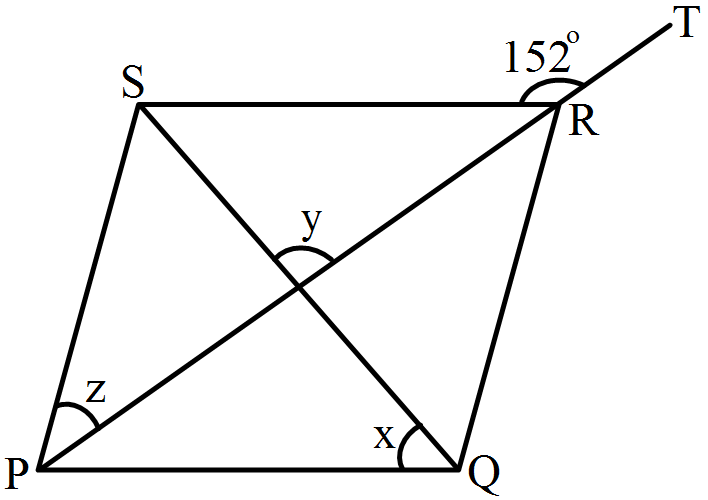
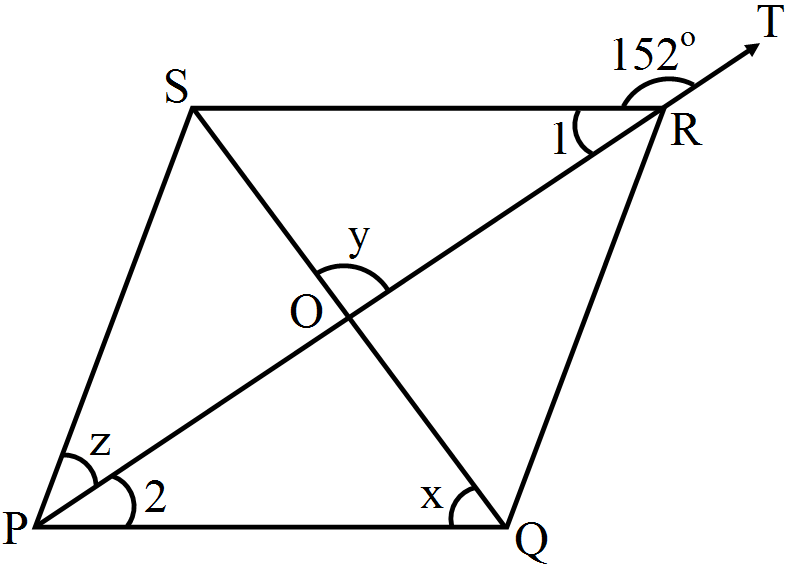
In the given figure, ABCD is a rectangle in which diagonal AC is produced to E. If $\angle\text{ECD}=146^\circ,$ find $\angle\text{AOB}.$
View full question & answer
Question 764 Marks
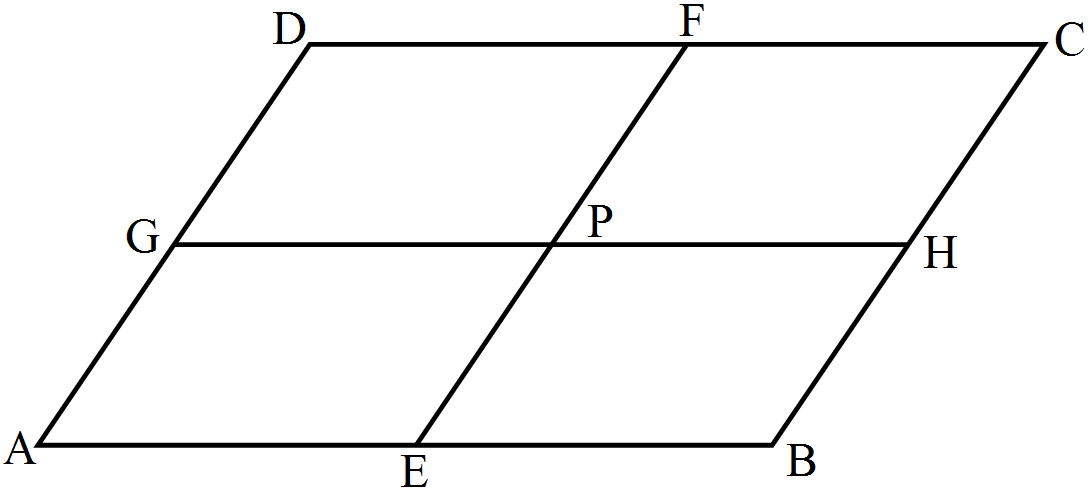
ABCD is a parallelogram; E and f are the mid-points of AB and CD respectively. GH is any line intersecting AD, EF and BC at G, P and H respectively. Prove that GP = PH.
View full question & answer
Question 774 Marks
View full question & answer
Question 784 Marks
ABC is a Triangle. D is a point on Ab such that $\text{AD}=\frac{1}{4}\text{AD}$ and E is a point on AC such that $\text{AE}=\frac{1}{4}\text{AC.}$ prove that $\text{DE}=\frac{1}{4}\text{BC}.$
View full question & answer
Question 794 Marks
ABCD is a rhombus, EABF is a straight line such that EA = AB = BF. Prove that ED and FC when produced meet at right angles.
View full question & answer
Question 804 Marks
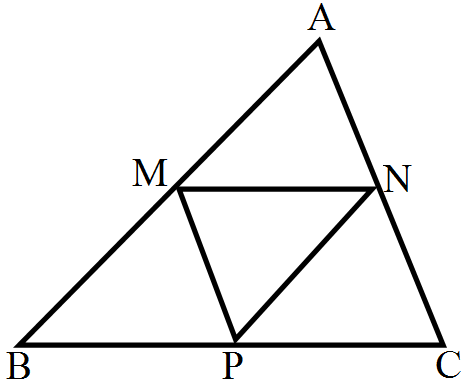
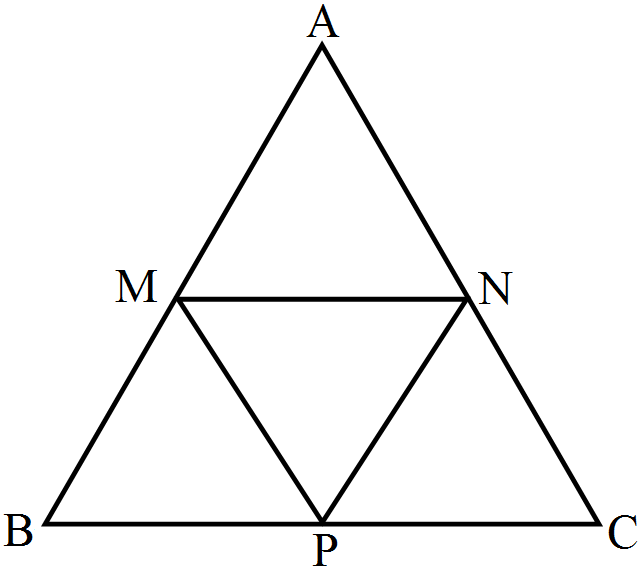
D, E and F are respectively the mid-points of the sides AB, BC and CA of a triangle ABC. Prove that by joining these mid-points D, E and F, the triangles ABC is divided into four congruent triangles.
View full question & answer
Question 814 Marks
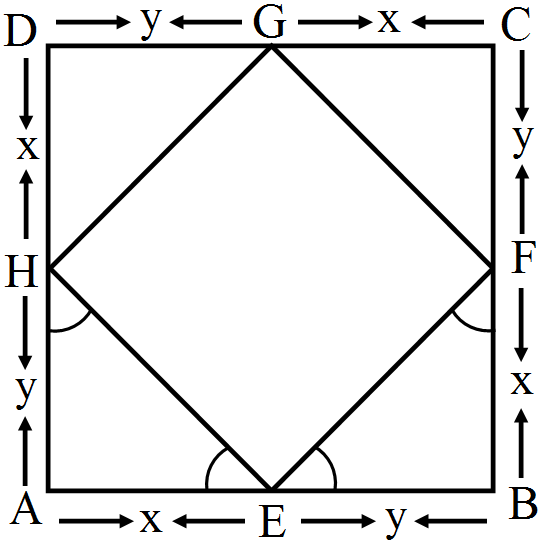
Show that the quadrilateral formed by joining the mid-points of the consecutive sides of a square is also a square.
View full question & answer
Question 824 Marks
View full question & answer
Question 834 Marks
The angle between two altitudes of a parallelogram through the vertex of an obtuse angle of the parallelogram is 60º. Find the angles of the parallelogram.
View full question & answer
Question 844 Marks
Answer
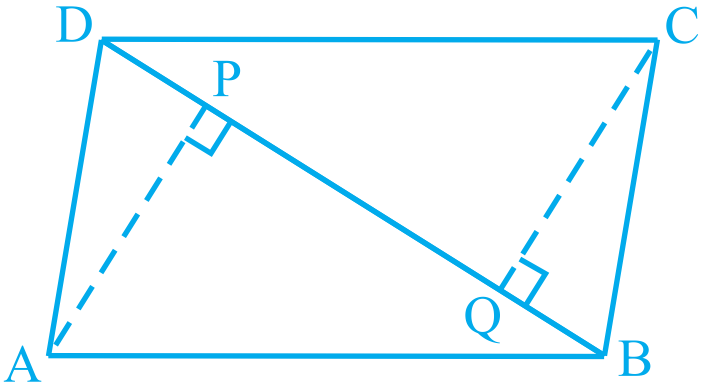
  1. In $\triangle\text{APB}$ and $\triangle\text{CQD}$

$\angle\text{ABP}=\angle\text{CDQ}$ (Alternate interior angles)

$\angle\text{ABP}=\angle\text{CDQ}$ (equal to right angles as AP and CQ are perpendiculars)

AB = CD (ABCD is a parallelogram)

Thus, $\angle\text{ABP}=\angle\text{CDQ}$ by AAS congruence condition
  1. AP = CQ by CPCT as $\angle\text{ABP}=\angle\text{CDQ}.$
View full question & answer
Question 854 Marks
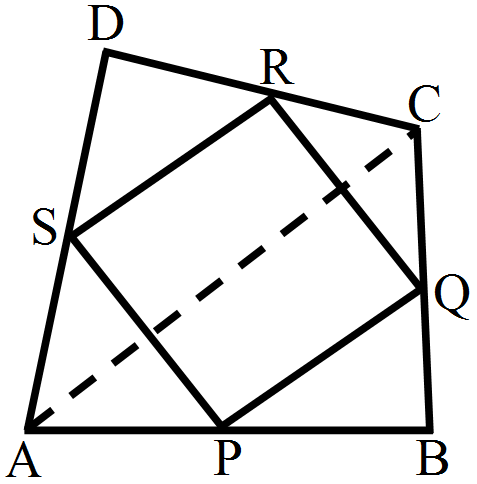
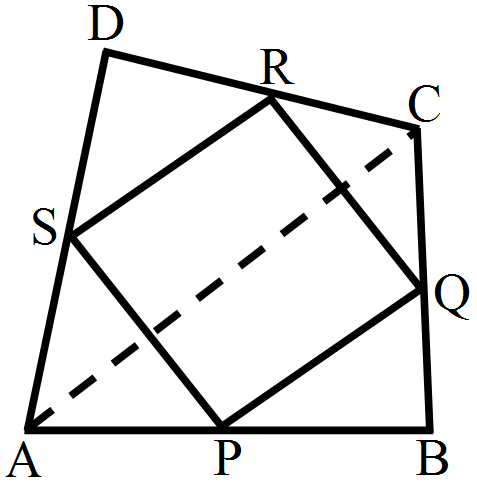
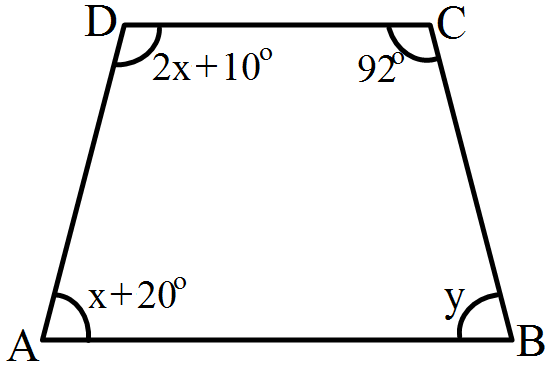
ABCD is a square E, F, G and H are points on AB, BC, CD, and DA respectively, such that AE = BF = DH. prove that EFGH is a square.
View full question & answer
Question 864 Marks
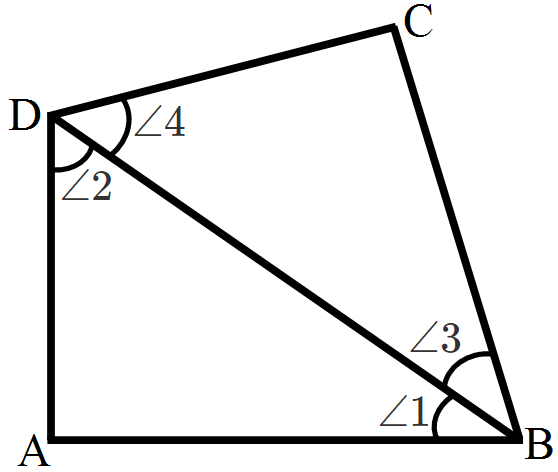
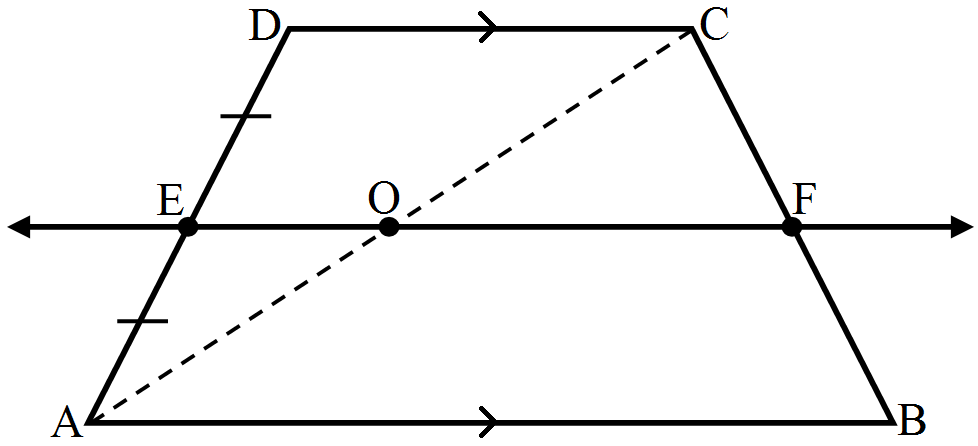
Show that, the line segments joining the mid-points of opposite sides of a quadrilateral bisects each other.
View full question & answer
Question 874 Marks
P, Q, R and S are respectively the mid-points of the sides AB, BC, CD and DA of a quadrilateral ABCD such that$\text{AC}\bot\text{BD}.$ Prove that PQRS is a rectangle.
View full question & answer
Question 884 Marks
P, Q, R and S are respectively the mid-points of the sides AB, BC, CD and DA of a quadrilateral ABCD in which AC = BD. Prove that PQRS is a rhombus.
View full question & answer
Question 894 Marks
Prove that the sum of all the angles of a quadrilateral is 360°.
View full question & answer
Question 904 Marks
Answer
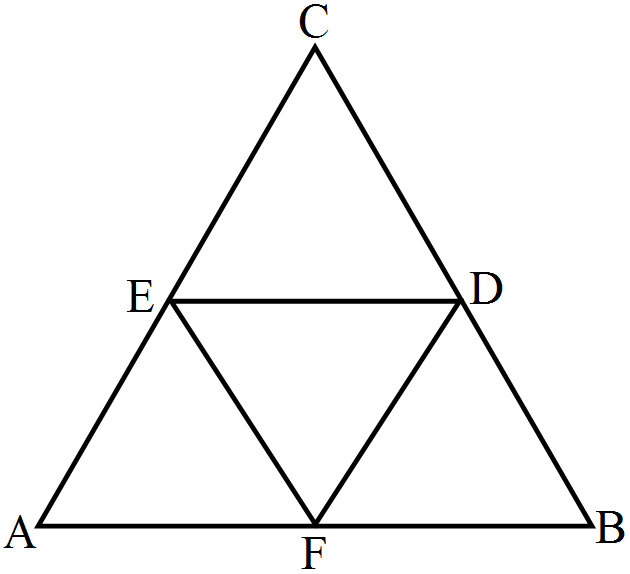
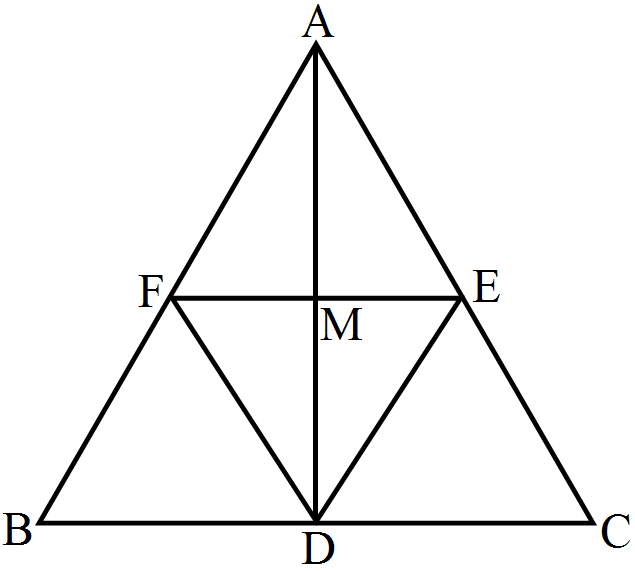
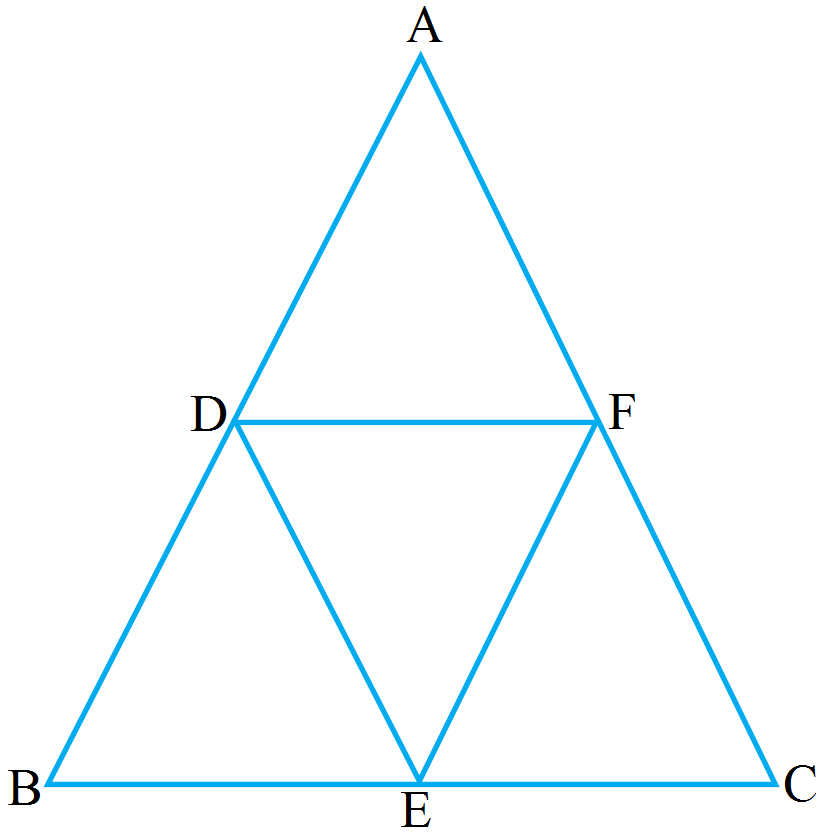
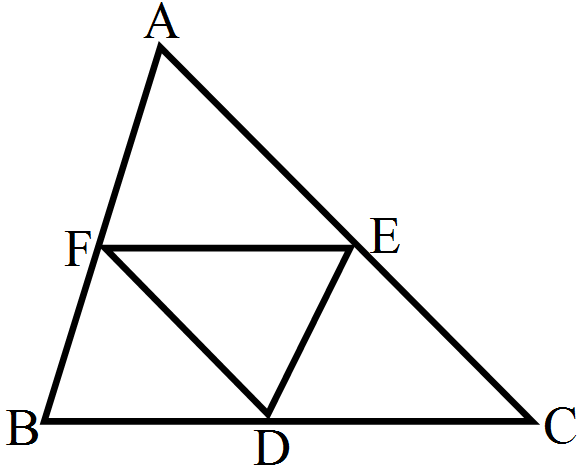
$\triangle\text{ABC}$ is shown below. D, E and F are the midpoints of sides BC, CA and AB, respectively.
As F and E are the mid points of sides AD and AC of $\triangle\text{ABC}.$
$\therefore$ FE || BC (By mid point theorem)
Similarly, DE || FB and FD || AC.
Therefore, AFDE, BDEF and DCEF are all parallelograms.
In parallelogram AFDE, we have:
$\angle\text{A}=\angle\text{EDF}$ (Opposite angle are equal)
In parallelogram BDEF, we have:
$\angle\text{B}=\angle\text{DEF}$ (Opposite angles are equal)
In parallelogram DCEF, we have:
$\angle\text{C}=\angle\text{DFE}$ (Opposite angles are equal)
View full question & answer
Question 914 Marks
The lengths of the diagonals of a rhombus are 24cm and 18cm respectively. Find the length of each side of the rhombus.
View full question & answer