Question
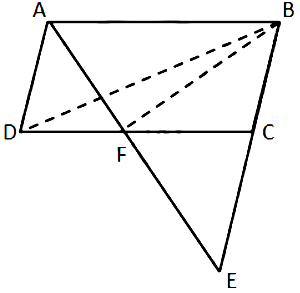
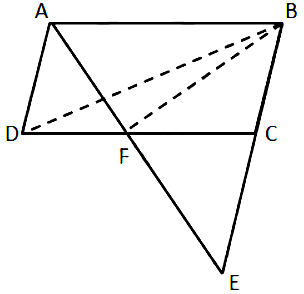
$\text{ABCD}$ is a parallelogram in which $BC$ is produced to $E$ such that $CE = BC$ and $AE$ intersects $CD$ at $F.$

If $ar.(\triangle DFB) = 30 \ cm^2$; find the area of parallelogram.

Answer


$BC = CE\dots .... ($given$)$
Also, in parallelogram $\text{ABCD}, BC = AD$
$\Rightarrow AD = CE$
Now, in $\triangle ADF$ and $\triangle ECF,$ We have
$AD = CE$
$\angle ADF = \angle ECF\dots .....($Alternate angles$)$
$\angle DAF = \angle CEF \dots......($Alternate angles$)$
$\therefore \triangle ADF \cong \triangle ECF ..\dots....(\text{ASA}$ Criterion$)$
$\Rightarrow $ Area$( \triangle ADF ) =$ Area$( \triangle ECF )\dots ....(1)$
Also, in $\triangle FBE, FC$ is the median $\dots....($Since $BC = CE)$
$\Rightarrow $ Area$( \triangle BCF ) =$ Area($\triangle ECF)\dots .....(2)$
From $(1)$ and $(2)$
Area$(\triangle ADF) = $Area$(\triangle BCF) \dots......(3)$
Again, $\triangle ADF$ and $\triangle BDF$ are on the base $DF$ and between parallels $DF$ and $A B$.
$\Rightarrow$ Area$(\triangle BDF)=$Area$(\triangle ADF )$
From$ (3)$ and $(4),$
Area$(\triangle BDF )=$Area$(\triangle BCF)=30 \ cm^2$
$Area(\triangle BCD )=$Area$(\triangle BDF)+$Area$(\triangle BCF)=30+30=60 \ cm^2$
Hence, Area of parallelogram $\text{ABCD}=2 \times$ Area $(\triangle B C D)=2 \times 60=120 \ cm^2$.

Need a full question paper?

Generate a complete, print-ready paper with questions like this in minutes — across 16+ boards, with answer keys.

Start Generating Free

Similar questions

Simplify by rationalising the denominator in the following.$\frac{42}{2 \sqrt{3}+3 \sqrt{2}}$
In the following, find the values of $a$ and $b:\frac{7 \sqrt{3}-5 \sqrt{2}}{4 \sqrt{3}+3 \sqrt{2}}=a-b \sqrt{6}$
$\text{ABCD}$ is a trapezium in which side $A B$ is parallel to side $D C . P$ is the mid$-$point of side $A D$. IF $Q$ is a point on the Side $B C$ such that the segment $P Q$ is parallel to $D C$, prove that $P Q=\frac{1}{2}(A B+D C)$.
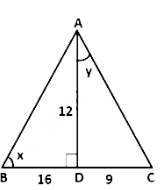
In the given figure, $AD$ is perpendicular to $BC.$ Find $: 5\cos x - 12\sin y +\tan x$
Image
Case Study II : The following data gives the weights (in grams) of some marbles picked up randomly from 3 boxes. The data was presented in the tabular form as below :
Weight (in g)No. of marbles
50 - 555
55 - 607
60 - 658
65 - 706
70 - 752
75 - 801
80 - 851
Based on the above information, answer the following questions :
1. Class size of the given distribution is :
(a) 5 (b) 10 (c) 50 (d) 85
2. Class mark of the 3rd class is :
(a) 60 (b) 65 (c) 125 (d) 62.5
3. The number of marbles whose weight is more than or equal to 75 g is:
(a) 0 (b) 1 (c) 2 (d) 28
4. The number of marbles whose weight is less than 70 g is:
(a) 26 (b) 28 (c) 4 (d) 2
5. The class boundaries of the 7th class interval are :
(a) 80, 85 (b) 80.5, 85.5 (c) 79.5, 85.5 (d) 80, 85.5
Draw the graph of the lines represented by the equations $2x - y = 8$ and $4x + 3y = 6$ on the same graph. Find the co$-$ordinates of the point where they intersect.
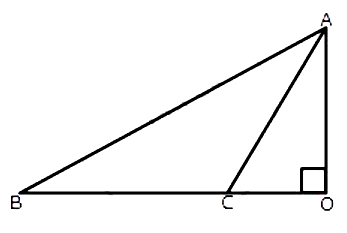
In $\triangle A B C$, given below, $A B=8 \ cm , B C=6 \ cm$ and $A C=3 \ cm$. Calculate the length of $O C$.
Two circles touch each other externally. The sum of their areas is $58\pi \ cm^2$ and the distance between their centres us $10\ cm$. Find the radii of the two circles.
In each of the following, one trigonometric ratio is given. Find the values of the other trigonometric.$\operatorname{cosec}=\frac{15}{11}$
A chord of length $24 \ cm$ is at a distance of $5 \ cm$ from the center of the circle. Find the length of the chord of the same circle which is at a distance of $12 \ cm$ from the center.