Questions

[5 marks sum]

🎯

Test yourself on this topic

17 questions · timed · auto-graded

Question 15 Marks
In parallelogram $\text{ABCD, E}$ is a point in $AB$ and $DE$ meets diagonal $AC$ at point $F$. If $DF: FE = 5:3$ and area of $\triangle ADF$ is $60 \ cm^2$; find,$(i)$ area of $\triangle ADE.(ii)$ if $AE: EB = 4:5$, find the area of $\triangle ADB.(iii)$ also, find the area of parallelogram $\text{ABCD}.$
Answer
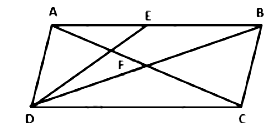
$\triangle ADF$ and $\triangle AFE$ have the same vertex $A$ and their bases are on the same straight line $DE.$
$\therefore \frac{ A (\Delta ADF )}{ A (\Delta AFE )}=\frac{ DF }{ FE }$
$\Rightarrow \frac{60}{ A (\Delta AFE )}=\frac{5}{3}$
$\Rightarrow A(\triangle A F E)=\frac{60 \times 3}{5}=36 \ cm ^2$
Now, $A(\triangle ADE) = A(\triangle ADF) + A(\triangle AFE) = 60 + 36 = 96 \ cm^2.$
$\triangle ADE$ and $\triangle EDB$ have the same vertex $D$ and their bases are on the same straight line $AB.$
$\therefore \frac{ A (\Delta ADE )}{ A (\Delta EDB )}=\frac{ AE }{ EB }$
$\Rightarrow \frac{96}{ A (\Delta EDB )}=\frac{4}{5}$
$\Rightarrow A (\Delta EDB )=\frac{96 \times 5}{4}=120 \ cm ^2$
Now, $A( \triangle ADB )$ and $\|^m \text{ABCD}$ are on the same base $AB$ and between the same parallels $AB$ and $DC.$
$\therefore A(\triangle A D B)=\frac{1}{2} A\left(\|^m A B C D\right)$
$\Rightarrow 216=\frac{1}{2} A \left(\|^{ m } ABCD \right)$
$\Rightarrow A( \|^m ABCD ) = 2 \times 216 = 432 \ cm^2 .$
View full question & answer
Question 25 Marks
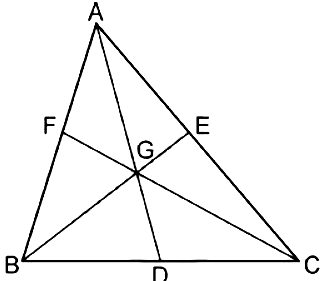
The medians of a $\triangle ABC$ intersect each other at point $G$. If one of its medians is $AD$,prove that:$(i)$ Area $( \triangle ABD ) = 3 \times$ Area $( \triangle BGD );(ii)$ Area $( \triangle ACD ) = 3 \times$ Area $( \triangle CGD )(iii)$ Area $( \triangle BGC ) = \frac{1}{3} \times$ Area $( \triangle ABC ).$
Answer
$(i)$ The figure is shown below

$(i)$ Medians intersect at centroid.
Given that C is the point of intersection of medians and hence $G$ is the centroid of the $\triangle ABC.$
Centroid divides the medians in the ratio $2: 1$
That is $AG: GD = 2: 1.$
Since $BG$ divides $AD$ in the ratio $2: 1$, we have,
$`"A( \triangle AGB )"/"A( \triangle BGD)" = 2/1`$
$\Rightarrow $ Area$( \triangle AGB ) = 2$Area$( \triangle BGD )$
From the figure, it is clear that,
Area$( \triangle ABD ) =$ Area$( \triangle AGB ) +$ Area$( \triangle BGD )$
$\Rightarrow $ Area$( \triangle ABD ) = 2$Area$( \triangle BGD ) +$ Area$( \triangle BGD )$
$\Rightarrow $ Area$( \triangle ABD ) = 3$Area$( \triangle BGD ) ......(1)$
$(ii)$ Medians intersect at centroid.
Given that $G$ is the point of intersection of medians and hence $G$ is the centroid of the $\triangle ABC.$
Centroid divides the medians in the ratio $2: 1$
That is $AG: GD = 2: 1.$
Since $CG$ divides $AD$ in the ratio $2: 1$, we have,
$`"A( \triangle AGC )"/"A( \triangle CGD)" = 2/1`$
$\Rightarrow $ Area$( \triangle AGC ) = 2$Area$( \triangle CGD )$
From the figure, it is clear that,
Area$( \triangle ACD ) =$ Area$( \triangle AGC ) +$ Area$( \triangle CGD )$
$\Rightarrow $ Area$( \triangle ACD ) = 2$Area$( \triangle CGD ) +$ Area$( \triangle CGD )$
$\Rightarrow $ Area$( \triangle ACD ) = 3$Area$( \triangle CGD ) ......(2)$
$(iii)$ Adding equations $(1)$ and $(2)$, We have,
Area$( \triangle ABD ) +$ Area$( \triangle ACD ) = 3$Area$( \triangle BGD ) + 3$Area$( \triangle CGD )$
$\Rightarrow $ Area$( \triangle ABC ) = 3[$ Area$( \triangle BGD ) +$ Area$( \triangle CGD ) ]$
$\Rightarrow $ Area$( \triangle ABC ) = 3[$ Area$( \triangle BGC ) ]$
$\Rightarrow `"$Area$( \triangle ABC )"/3 = [$ Area$( \triangle BGC )]`$
$\Rightarrow $ Area$( \triangle BGC ) = `1/3`$ Area$( \triangle ABC )$
View full question & answer
Question 35 Marks
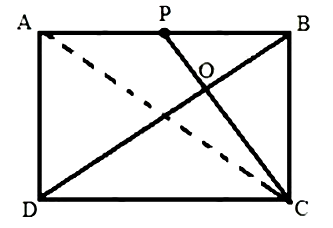
In parallelogram $\text{ABCD, P}$ is the mid$-$point of $AB. CP$ and $BD$ intersect each other at point $O$. If the area of $\triangle POB = 40 \ cm^2$, and $OP: OC = 1:2,$ find:$(i)$ Areas of $\triangle BOC$ and $\triangle PBC;(ii)$ Areas of $\triangle ABC$ and parallelogram $\text{ABCD}.$
Answer
$(i)$ Joining $AC$ we have the following figure

Consider the triangles $\triangle POB$ and $\triangle COD$
$\angle POB = \angle DOC ...[$ vertically opposite angles $]$
$\angle OPB = \angle ODC ...[ AB$ and $DC$ are parallel, $CP$ and $BD$ are the transversals, alternate interior angles are equal $]$
Therefore, by Angle$-$Angle similarly criterion of congruence, $\triangle POB \sim \triangle COD$
Since $P$ is the mid$-$point $AP = BP,$ and $AB = CD,$ we have $CD = 2 BP$
Therefore, We have,
$\frac{ BP }{ CD }=\frac{ OP }{ OC }=\frac{ OB }{ OD }=\frac{1}{2}$
$\Rightarrow OP : OC = 1: 2$
$(ii)$ Since from part $( i ),$ we have
$\frac{ BP }{ CD }=\frac{ OP }{ OC }=\frac{ OB }{ OD }=\frac{1}{2}$,
The ratio between the areas of two similar triangles is equal to the ratio between the square of the corresponding sides.
Here, $\triangle DOC$ and $\triangle POB$ are similar triangles.
Thus, we have ,
$\frac{ Ar \cdot(\Delta DOC )}{ Ar \cdot(\Delta POB )}=\frac{ DC ^2}{ PB ^2}$
$\Rightarrow \frac{ Ar \cdot(\Delta DOC )}{ Ar \cdot(\Delta POB )}=\frac{(2 PB )^2}{ PB ^2}$
$\Rightarrow \frac{ Ar \cdot(\Delta DOC )}{\operatorname{Ar} \cdot(\Delta POB )}=\frac{4 PB ^2}{ PB ^2}$
$\Rightarrow \frac{ Ar \cdot(\Delta DOC )}{ Ar \cdot(\Delta POB )}=4$
$\Rightarrow Ar.( \triangle DOC ) = 4Ar, ( \triangle POB )$
$= 4 \times 40$
$= 160 \ cm^2$
Now consider $ Ar. ( \triangle DBC ) = Ar. ( \triangle DOC ) + Ar. (\triangle BOC )$
$= 160 + 80$
$= 160 \ cm^2$
Two triangles are equal in the area if they are on equal bases and between the same parallels.
Therefore, $Ar. ( \triangle DBC ) = Ar. ( \triangle ABC ) = 240 \ cm^2$
The median divides the triangles into areas of two equal triangles.
Thus, $CP$ is the median of the .$\triangle ABC.$
Hence, $Ar. ( \triangle ABC ) = 2 Ar. ( \triangle PBC )$
$Ar. (\triangle PBC )=\frac{\operatorname{Ar} \cdot(\Delta ABC )}{2}$
$Ar. ( \triangle PBC ) = 120 \ cm^2$​​​​​​​
$( iii )$ From part $(ii)$ we have,
$Ar. ( \triangle ABC ) = 2Ar. ( PBC ) = 240 \ cm^2​​​​​​​$​​​​​​​
The area of a triangle is half the area of the parallelogram if both are on equal bases and between the same parallels.
Thus, $Ar. ( \triangle ABC ) = \frac{1}{2} Ar. [ \| gm \text{ABCD} ]$
$AR. [ \| gm \text{ABCD} ] = 2 Ar. ( \triangle ABC )$
$AR. [ \| gm \text{ABCD} ] = 2 \times 240$
$AR. [ \| gm \text{ABCD} ]= 480 \ cm^2​​​​​​​$​​​​​​​
View full question & answer
Question 45 Marks
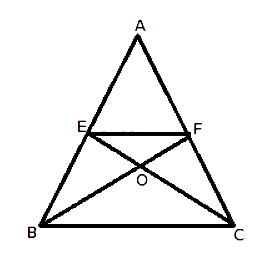
In $ΔABC, E$ and $F$ are mid$-$points of sides $AB$ and $AC$ respectively. If $BF$ and $CE$ intersect each other at point $O$,prove that the $ΔOBC$ and quadrilateral $\text{AEOF}$ are equal in area.
Answer
$E$ and $F$ are the midpoints of the sides $AB$ and $AC.$
Consider the following figure.

Therefore, by midpoint theorem, we have, $EF \| BC$
Triangles $\text{BEF}$ and $\text{CEF}$ lie on the common base $EF$ and between the parallels, $EF$ and $BC$
Therefore, $Ar.( \triangle BEF ) = Ar.( \triangle COF )$
$\Rightarrow Ar.( \triangle BOE ) + Ar.( \triangle EOF ) = Ar.( \triangle EOF ) + Ar.( \triangle COF )$
$\Rightarrow Ar.(\triangle BOE ) = Ar.( \triangle COF )$
Now $BF$ and $CE$ are the medians of the $\triangle ABC$
Medians of the triangle divide it into two equal areas of triangles.
Thus, we have, $Ar. (\triangle ABF) = Ar. (\triangle CBF)$
Subtracting $Ar. \triangle BOE$ on both the sides, we have
$Ar. (\triangle ABF) - Ar. (\triangle BOE) = Ar. (\triangle CBF) - Ar. (\triangle BOE)$
Since, $Ar. ( \triangle BOE ) = Ar. ( \triangle COF ),$
$Ar. (\triangle ABF) - Ar. (\triangle BOE) = Ar. (\triangle CBF) - Ar. (\triangle COF)$
$Ar. ( \text{AEOF} ) = Ar. ( \triangle OBC )$ , hence proved
View full question & answer
Question 55 Marks
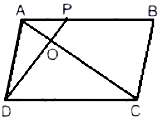
The given figure shows a parallelogram $\text{ABCD}$ with area $324 sq. \ cm. P$ is a point in $AB$ such that $AP: PB = 1:2$.Find The area of $\triangle APD.$
Answer
$(i)$ The ratio of the area of triangles with the same vertex and bases along the same line is equal to the ratio of their respective bases.
So, we have
$\frac{\text { Area of } \triangle APD }{\text { Area of } \triangle BPD }=\frac{ AP }{ BP }=\frac{1}{2}$
Area of parallelogram $\text{ABCD} = 324 sq.cm$
The area of the triangles with the same base and between the same parallels are equal.
We know that the area of the triangle is half the area of the parallelogram if they lie on the same base and between the parallels.
Therefore, we have,
Area $( \triangle ABD ) = \frac{1}{2} \times$ Area $[\| gm \text{ABCD} ]$
$=\frac{324}{2}$
$= 162 sq.cm$
From the diagram it is clear that,
Area $(\triangle ABD ) =$ Area $( \triangle APD ) +$ Area $( \triangle BPD )$
$\Rightarrow 162 =$ Area $( \triangle APD ) + 2$Area $( \triangle APD )$
$\Rightarrow 162 = 3$Area $( \triangle APD )$
$\Rightarrow$ Area $( \triangle APD ) =\frac{162}{3}$
$\Rightarrow$ Area $( \triangle APD ) = 54 sq.cm$
$(ii)$ Consider the triangle $\triangle AOP$ and $\triangle COD$
$\angle AOP = \angle COD \dots....[$ vertically opposite angles $]$
$\angle CDO = \angle APD \dots.....[ AB$ and $DC$ are parallel and $DP$ is the transversal, alternate interior angles are equal $]$
Thus, by Angle$-$Angle similarly,
$\triangle AOP \sim \triangle COD.$
Hence the corresponding sides are proportional.
$\frac{ AP }{ CD }=\frac{ OP }{ OD }=\frac{ AP }{ AB }$
$=\frac{ AP }{ AP + PB }$
$=\frac{ AP }{3 AP }$
$=\frac{1}{3}$
View full question & answer
Question 65 Marks
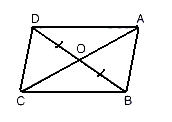
In the given figure, the diagonals $AC$ and $BD$ intersect at point $O$. If $OB = OD$ and $AB \| DC$,show that:$(i)$ Area $(\triangle DOC) =$ Area $(\triangle AOB).(ii)$ Area $(\triangle DCB) =$ Area $(\triangle ACB).(iii) \text{ABCD}$ is a parallelogram.
Answer
$(i)$ The ratio of the area of triangles with the same vertex and bases along the same line is equal to the ratio of their respective bases. So, we have:
$\frac{\text { Area of } \triangle DOC }{\text { Area of } \triangle BOC }=\frac{D O}{B O} = 1 \dots.....(i)$
Similarly
$\frac{\text { Area of } \triangle DOA }{\text { Area of } \triangle BOA }=\frac{D O}{B O} = 1 \dots......(ii)$
We know that the area of triangles on the same base and between the same parallel lines are equal.
Area of $\triangle ACD =$ Area of $\triangle BCD$
Area of $\triangle AOD +$ Area of $\triangle DOC =$ Area of $\triangle DOC +$ Area of $\triangle BOC$
$\Rightarrow$ Area of $\triangle AOD =$ Area of $\triangle BOC\dots .....(iii)$
From $1, 2$ and $3$ we have
Area $(\triangle DOC) =$ Area $(\triangle AOB)$
Hence Proved.
$(ii)$ Similarly, from $1, 2$ and $3$, we also have
Area of $\triangle DCB =$ Area of $\triangle DOC +$ Area of $\triangle BOC =$ Area of $\triangle AOB +$ Area of $\triangle BOC =$ Area of $\triangle ABC$
So Area of $\triangle DCB =$ Area of $\triangle ABC$
Hence Proved.
$(iii)$ We know that the area of triangles on the same base and between the same parallel lines are equal.
Given: triangles are equal in the area on the common base, so it indicates $AD \| BC.$
So,$\text{ABCD}$ is a parallelogram.
Hence Proved.
View full question & answer
Question 75 Marks
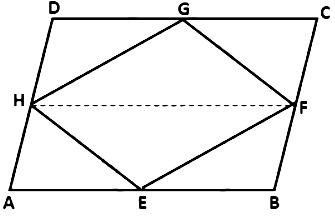
$E, F, G,$ and $H$ are the midpoints of the sides of a parallelogram $\text{ABCD}$.Show that the area of quadrilateral $\text{EFGH}$ is half of the area of parallelogram $\text{ABCD}.$
Answer

Since $H$ and $F$ are mid$-$points of $AD$ and $BC$ respectively,
$\therefore AH =\frac{1}{2} AD$ and $BF =\frac{1}{2} BC$
Now, $ABCD$ is a parallelogram.
$⇒ AD = BC$ and $AD \| BC$
$\Rightarrow \frac{1}{2} AD =\frac{1}{2} BC$ and $AD \| BC$
$⇒ AH = BF$ and $AH \| BF$
$⇒ \text{ABFH}$ is a parallelogram.
Since parallelogram $\text{FHAB}$ and $ΔFHE$ are on the same base $FH$ and between the same parallels $HF$ and $AB,$
$A (\Delta FHE )=\frac{1}{2} A \left(\|^{ m } \text{FHAB} \right)\dots.....(i)$
Similarly,
$A (\Delta FHG )=\frac{1}{2} A \left(\|^{ m } \text{FHDC} \right)\dots ......(ii)$
Adding $(i)$ and $(ii)$, We get,
$A (\Delta FHE )+ A (\Delta FHG )=\frac{1}{2} A \left(\|^m \text{FHAB} \right)+\frac{1}{2} A \left(\|^{ m } \text{FHDC} \right)$
$\Rightarrow A ( \text{EFGH} )=\frac{1}{2}\left[ A \left(\|^{ m } \text{FHAB} \right)+ A \left(\|^{ m } \text{FHDC} \right)\right]$
$\Rightarrow A(\text{EFGH})=\frac{1}{2} A\left(\|^m \text{ABCD}\right)$
View full question & answer
Question 85 Marks
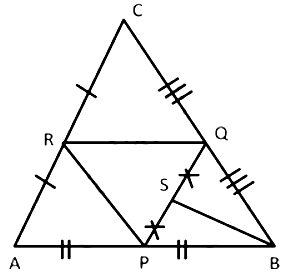
The following figure shows a $\triangle ABC$ in which $P, Q$, and $R$ are mid$-$points of sides $AB, BC$ and $CA$ respectively. $S$ is mid$-$point of $PQ$:Prove that: $ar. ( \triangle ABC ) = 8 \times ar. ( \triangle QSB $)
Answer
In $\triangle ABC,$
$R$ and $Q$ are the mid$-$points of $AC$ and $BC$ respectively.
$\Rightarrow RQ \| AB$
that is $RQ \| PB$
So, area $( \triangle PBQ ) =$ area$( \triangle APR )\dots ....(i)($ Since $AP = PB$ and triangles on the same base and between the same parallels are equal in area. $)$
Since $P$ and $R$ are the mid$-$points of $AB$ and $AC$ respectively.
$\Rightarrow PR \| BC$
that is $PR \| BQ$
So, quadrilateral $\text{PMQR}$ is a parallelogram.
Also, area$( \triangle PBQ ) =$ area$( \triangle PQR ) \dots....(ii)($ diagonal of a parallelogram divide the parallelogram into two triangles with the equal area $)$
From $(i)$ and $(ii)$
area$( \triangle PQR ) =$ area $( \triangle PBQ ) =$ area$( \triangle APR ) ....(iii)$
Similarly, $P$ and $Q$ are the mid$-$points of $AB$ and $BC$ respectively.
$\Rightarrow PQ \| AC$
that is $PQ \| RC$
So, quadrilateral $\text{PQRC}$ is a parallelogram.
Also, area$( \triangle RQC ) =$ area$( \triangle PQR )\dots .....(iv)($ diagonal of a parallelogram divide the parallelogram into two triangles with the equal area $)$
From $(iii)$ and $(iv),$
area$( \triangle PQR ) =$ area$( \triangle PBQ ) =$ area$( \triangle RQC ) =$ area$( \triangle APR )$
So, area$( \triangle PBQ ) = `1/4`$ area$( \triangle ABC ) \dots....(v)$
Also, since $S$ is the mid$-$point of $PQ,$
$BS$ is the median of $\triangle PBQ$
SO, area$( \triangle QSB ) = `1/2`$area$( \triangle PBQ )$
From $(v),$
area$( \triangle QSB ) = `1/2 xx 1/4`$ area$( \triangle ABC )$
$\Rightarrow $ area$( \triangle ABC ) = 8$ area$( \triangle QSB ).$
View full question & answer
Question 95 Marks
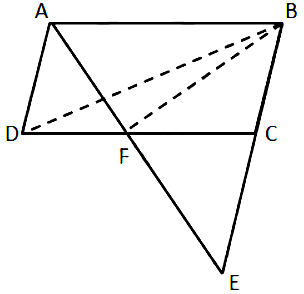
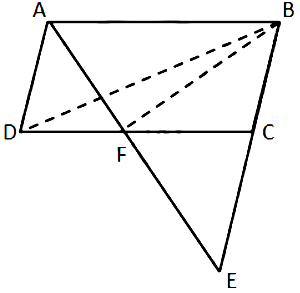
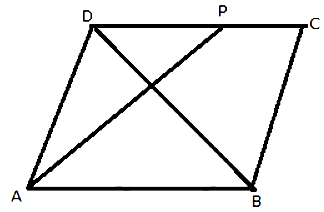
$\text{ABCD}$ is a parallelogram in which $BC$ is produced to $E$ such that $CE = BC$ and $AE$ intersects $CD$ at $F.$

If $ar.(\triangle DFB) = 30 \ cm^2$; find the area of parallelogram.
Answer

$BC = CE\dots .... ($given$)$
Also, in parallelogram $\text{ABCD}, BC = AD$
$\Rightarrow AD = CE$
Now, in $\triangle ADF$ and $\triangle ECF,$ We have
$AD = CE$
$\angle ADF = \angle ECF\dots .....($Alternate angles$)$
$\angle DAF = \angle CEF \dots......($Alternate angles$)$
$\therefore \triangle ADF \cong \triangle ECF ..\dots....(\text{ASA}$ Criterion$)$
$\Rightarrow $ Area$( \triangle ADF ) =$ Area$( \triangle ECF )\dots ....(1)$
Also, in $\triangle FBE, FC$ is the median $\dots....($Since $BC = CE)$
$\Rightarrow $ Area$( \triangle BCF ) =$ Area($\triangle ECF)\dots .....(2)$
From $(1)$ and $(2)$
Area$(\triangle ADF) = $Area$(\triangle BCF) \dots......(3)$
Again, $\triangle ADF$ and $\triangle BDF$ are on the base $DF$ and between parallels $DF$ and $A B$.
$\Rightarrow$ Area$(\triangle BDF)=$Area$(\triangle ADF )$
From$ (3)$ and $(4),$
Area$(\triangle BDF )=$Area$(\triangle BCF)=30 \ cm^2$
$Area(\triangle BCD )=$Area$(\triangle BDF)+$Area$(\triangle BCF)=30+30=60 \ cm^2$
Hence, Area of parallelogram $\text{ABCD}=2 \times$ Area $(\triangle B C D)=2 \times 60=120 \ cm^2$.
View full question & answer
Question 105 Marks
In a parallelogram $\text{ABCD}$, point $P$ lies in $DC$ such that $DP: PC = 3:2$. If the area of $\triangle DPB = 30 sq. \ cm$.find the area of the parallelogram $\text{ABCD}.$
Answer
The ratio of the area of triangles with the same vertex and bases along the same line is equal to the ratio of their respective bases. So, we have
$\frac{\text { Area of } DPB }{\text { Area of PCB }}=\frac{ DP }{ PC }=\frac{3}{2}$
Given: Area of $\triangle DPB = 30 sq. \ cm$
Let $'x\ '$ be the area of the $\triangle PCB$
Therefore, We have,
$\Rightarrow \frac{30}{x}=\frac{3}{2}$
$\Rightarrow x=\frac{30}{3} \times 2 = 20 sq.cm.$
So area of $\triangle PCB = 20 sq. \ cm$
Consider the following figure.

From the diagram, it is clear that,
Area$( \triangle CDB ) =$ Area$( \triangle DPB ) +$ Area$( \triangle CDB )$
$= 30 + 20 = 50 sq.cm.$
The diagonal of the parallelogram divides it into two triangles $\triangle ADB$ and $\triangle CDB$ of equal area.
Therefore,
Area$($ parallelogram $ABCD ) = 2 \times \triangle CDB = 2 \times 50 = 100 sq.cm.$
View full question & answer
Question 115 Marks
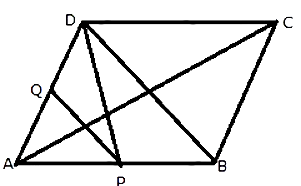
$\text{ABCD}$ is a parallelogram. $P$ and $Q$ are the mid$-$points of sides $AB$ and $AD$ respectively.Prove that area of $\triangle APQ =\frac{1}{8}$ of the area of parallelogram $\text{ABCD}.$
Answer
We have to join $PD$ and $BD.$

$BD$ is the diagonal of the parallelogram $\text{ABCD}$.
Therefore it divides the parallelogram into two equal parts.
$\therefore$ Area$( \triangle ABD )=$ Area $( \triangle DBC )$
$=\frac{1}{2}$ Area $($parallelogram $\text{ABCD})\dots ...(i)$
$DP$ is the median of $\triangle ABD$.
Therefore it will divide $\triangle ABD$ into two triangles of equal areas.
$\therefore$ Area$( \triangle APD )=$ Area $( \triangle DPB )$
$=\frac{1}{2}$ Area $( \triangle ABD )$
$=\frac{1}{2} \times \frac{1}{2}$ Area $($parallelogram $ABCD) \dots...[$from equation $(i)]$
$=\frac{1}{4}$ Area $($parallelogram $\text{ABCD}) \dots...(ii)$
in $\triangle APD, Q$ is the mid$-$point of $AD$.
Therefore $PQ$ is the median.
$\therefore$ Area$(\triangle APQ)=$ Area $(\triangle DPQ)$
$=\frac{1}{2}$ Area $(\triangle APD )$
$=\frac{1}{2} \times \frac{1}{4}$ Area $($parallelogram $\text{ABCD})\dots...[$from equation $(ii)]$
Area $(\triangle APQ) = \frac{1}{8}$ Area $($parallelogram $\text{ABCD}),$
hence proved.
View full question & answer
Question 125 Marks
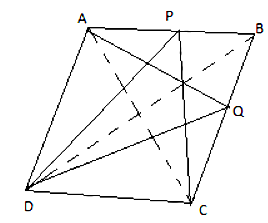
In parallelogram $\text{ABCD, P}$ is a point on side $AB$ and $Q$ is a point on side $BC$.Prove that:$(i) \triangle CPD$ and $\triangle AQD$ are equal in the area.$(ii)$ Area $(\triangle AQD) =$ Area $(\triangle APD) +$ Area $(\triangle CPB)$
Answer

Given $\text{ABCD}$ is a parallelogram.
$P$ and $Q$ are any points on the sides $AB$ and $BC$ respectively,
join diagonals $AC$ and $BD.$
proof:
$(i)$ since triangles with the same base and between the same set of parallel lines have equal areas
area $(CPD) =$ area$(BCD) \dots…… (1)$
again, diagonals of the parallelogram bisect area in two equal parts
area $(BCD) = (1/2)$ area of parallelogram$ ABCD\dots …… (2)$
from $(1)$ and $(2)$
area$(CPD) = 1/2$ area$(ABCD)\dots …… (3)$
similarly area $(AQD) =$ area$(ABD) = 1/2$ area$(\text{ABCD})\dots…… (4)$
from $(3)$ and $(4)$
area$(CPD) =$ area$(AQD),$
hence proved.
$(ii)$ We know that area of triangles on the same base and between same parallel lines are equal
So Area of $AQD=$ Area of $ACD=$ Area of $PDC =$ Area of $BDC =$ Area of $ABC=$Area of $APD +$ Area of $BPC$
Hence Proved
View full question & answer
Question 135 Marks
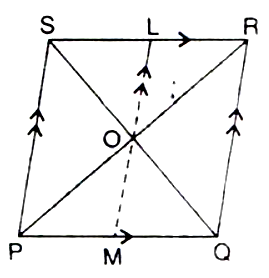
In the given figure, diagonals $PR$ and $QS$ of the parallelogram $PQRS$ intersect at point $O$ and $LM$ is parallel to $PS$. Show that:

$(i) 2$ Area$ (POS) =$ Area $(\| gm \text{PMLS}),(ii)$ Area $(POS) +$ Area $(QOR) =$ Area $(\| gm \text{PQRS}),(iii)$ Area $(POS) +$ Area $(QOR) =$ Area $(POQ) +$ Area $(SOR).$
Answer
$(i)$ Since $\text{POS}$ and parallelogram,$\text{PMLS}$ are on the same base $PS$ and between the same parallels i.e. $SP \| LM.$
As $O$ is the center of $LM$ and the Ratio of the area of triangles with the same vertex and bases along the same line is equal to the ratio of their respective bases.
The area of the parallelogram is twice the area of the triangle if they lie on the same base and in between the same parallels.
So $2($Area of $PSO)=$Area of $\text{PMLS}$
Hence Proved.
$(ii)$ Consider the expression: Area $(\triangle POS) +$ Area$(QOR):$
$LM$ is parallel to $PS$ and $PS$ is parallel to $RQ$,
$\therefore, LM$ is
Since $\triangle POS$ lie on the base $PS$ and in between the parallels $PS$ and $LM$, we have,
Area $(\triangle POS) = \frac{1}{2}$Area$(\square \text{PSLM})$
Since $\triangle QOR$ lie on the base $QR$ and in between the Parallels $LM$ and $RQ$, we have,
Area $(\triangle QOR) = \frac{1}{2}$Area$(\square \text{LMQR})$
Area$(\triangle POS) +$ Area$(\triangle QOR) = \frac{1}{2}$ Area$(\square PSLM )+\frac{1}{2}$ Area$(\square LMQR)$
$=\frac{1}{2}$Area$( PSLM )+$Area$(\square \text { LMQR })]$
$=\frac{1}{2}[$Area$(\square \text { PQRS })]$
$(iii)$ In a parallelogram, the diagonals bisect each other.
Therefore, $OS = OQ$
Consider the $\triangle PQS$,
since $OS = OQ, OP$ is the median of the $\triangle PQS.$
We know that the median of a triangle divides it into two triangles of equal area.
Therefore,
Area$(\triangle POS) =$ Area$(\triangle POQ)\dots ....(1)$
Similarly, since $OR$ is the median of the $\triangle QRS$,
we have, Area$(\triangle QOR) =$ Area$(\triangle SOR)\dots ....(2)$
Adding equations $(1)$ and $(2),$ we have,
Area $(\triangle POS) +$ Area$(\triangle QOR) =$ Area $(\triangle POQ) $+ Area$(SOR)$
Hence Proved.
View full question & answer
Question 145 Marks
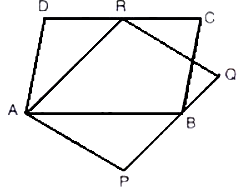
The given figure shows the parallelograms $\text{ABCD}$ and $\text{APQR}$.Show that these parallelograms are equal in the area.$[$ Join $B$ and $R ]$
Answer
Join $B$ and $R$ and $P$ and $R.$
We know that the area of the parallelogram is equal to twice the area of the triangle if the triangle and the parallelogram are on the same base and between the parallels.
Consider $\text{ABCD}$ parallelogram:Since the parallelogram $\text{ABCD}$ and the $\triangle ABR$ lie on $AB$ and between the parallels $AB$ and $DC$, we have
Area$(\square ABCD)=2 \times$Area$(\triangle ABR) \dots....(1)$
We know that the area of triangles with the same base and between the same parallel lines are equal.
Since the triangles $\text{ABR}$ and $\text{APR}$ lie on the same base $AR$ and between the parallels $AR$ and $QP,$ we have,
Area $(\triangle ABR) =$ Area $(\triangle APR) \dots....(2)$
From equations $(1)$ and $(2)$, we have,
Area$(\square ABCD )=2 \times$ Area$(\triangle APR )\dots .....(3)$
Also, the $\triangle APR$ and the parallelograms, $AR$ and $QR,$ lie on the same base $AR$ and between the parallels, $AR$ and $QP,$
Area$(\triangle APR)=\frac{1}{2} \times$ Area$(\square ARQP)\dots....(4)$
Using $(4)$ in equation $(3),$ We have,
Area$(\square \text{ABCD})=2 \times \frac{1}{2} \times$ Area$(\square \text{ARQP})$
Are$a(\square \text{ABCD})=$Area$(\square \text{ARQP})$
Hence Proved.
View full question & answer
Question 155 Marks
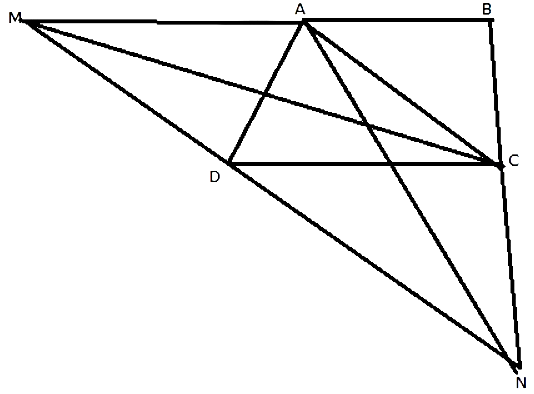
$\text{ABCD}$ is a trapezium with $AB \| DC$. A line parallel to $AC$ intersects $AB$ at point $M$ and $BC$ at point $N$.Prove that: area of $\triangle ADM =$ area of $\triangle ACN.$
Answer
Given: $\text{ABCD}$ is a trapezium.

$AB \| CD, MN \| AC$
Join $C$ and $M$
We know that the area of triangles on the same base and between the same parallel lines are equal.
So Area of $\triangle AMD =$ Area of $\triangle AMC$
Similarly, consider the $\text{AMNC}$ quadrilateral where $MN \| AC.$
$\triangle ACM$ and $\triangle ACN$ are on the same base and between the same parallel lines.
​​​​​​​ So areas
are equal.
So, Area of $\triangle ACM =$ Area of $\triangle CAN$
From the above two equations, we can say
Area of $\triangle ADM =$ Area of $\triangle CAN$
Hence Proved.
View full question & answer
Question 165 Marks
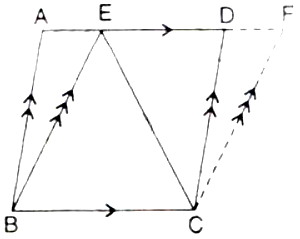
$\text{ABCD}$ and $\text{BCFE}$ are parallelograms. If area of triangle $EBC = 480 \ cm^2; AB = 30 \ cm$ and $BC = 40 \ cm.$

Calculate :$(i)$ Area of parallelogram $\text{ABCD};(ii)$ Area of the parallelogram $\text{BCFE};(iii)$ Length of altitude from $A$ on $CD;(iv)$Area of $\triangle ECF.$
Answer
$(i)$ Since $\triangle EBC$ and parallelogram $\text{ABCD}$ are on the same base $BC$ and between the same parallels i.e. $BC \| AD.$
$\therefore A( \triangle EBC ) = \frac{1}{2} \times A ($parallelogram $\text{ABCD})$
parallelogram $\text{ABCD} = 2 \times A(\triangle EBC)$
$= 2 \times 480 \ cm^2$
$= 960 \ cm^2$
$(ii)$ Parallelograms on same base and between same parallels are equal in area.
Area of $\text{BCFE}=$ Area of $\text{ABCD} = 960 \ cm^2$
$(iii)$ Area of $\triangle A C D=480=\frac{1}{2} \times 30 \times$ Altitude
Altitude $= 32 \ cm$
$(iv)$ The area of a triangle is half that of a parallelogram on the same base and between the same parallels.
Therefore
Area $(\triangle ECF)=\frac{1}{2}$Area$(\square \text{CBEF})$
Similarly, Area $(\triangle BCE)=\frac{1}{2}$Area$(\square \text{CBEF})$
$\Rightarrow$ Area$( \triangle ECF)=$ Area$\triangle BCE)=480 \ cm^2$.
View full question & answer
Question 175 Marks
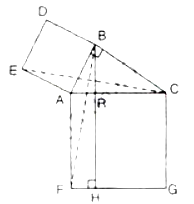
In the figure given alongside, squares $\text{ABDE}$ and $\text{AFGC}$ are drawn on the side $AB$ and the hypotenuse $AC$ of the right $\triangle ABC.$

If $BH$ is perpendicular to $FG$prove that:$(i) \triangle EAC \cong \triangle BAF.(ii)$ Area of the square $\text{ABDE} \Rightarrow$ Area of the rectangle $\text{ARHF}.$
Answer
$(i) \angle EAC = \angle EAB + \angle BAC$
$\angle EAC = 90^\circ + \angle BAC\dots ....(i)$
$\angle BAF = \angle FAC + \angle BAC$
$\angle BAF = 90^\circ + \angle BAC \dots.....(ii)$
From $(i)$ and $(ii)$, we get
$\angle EAC = \angle BAF$
In $\triangle EAC$ and $\triangle BAF$, we have,$ EA = AB$
$\angle EAC = \angle BAF$ and $AC = AF$
$\therefore \triangle EAC ≅ \cong\triangle BAF\dots ....(\text{SAS}$ axiom of congruency)
$(ii)$ Since $\triangle ABC$ is a right triangle, We have,
$AC^2 = AB^2 + BC^2 \dots....($Using pythagoras theorm in $\triangle ABC)$
$\Rightarrow AB^2 = AC^2 - BC^2$
$\Rightarrow AB^2 = (AR + RC)^2 - (BR^2 + RC^2) \dots....($ Since $AC = AR + RC$ and Using Pythagoras Theorem in $\triangle BRC)$
$\Rightarrow AB^2 = AR^2 + 2AR \times RC + RC^2 - (BR^2 + RC^2) \dots....($Using the identity$)$
$\Rightarrow AB^2 = AR^2 + 2AR \times RC + RC^2 - (AB^2 - AR^2 + RC^2)\dots ...($Using Pythagoras Theorem in $\triangle ABR )$
$\Rightarrow 2AB^2 = 2AR^2 + 2AR \times RC$
$\Rightarrow AB^2= AR( AR + RC )$
$\Rightarrow AB^2= AR + AC$
$\Rightarrow AB^2= AR \times AF$
$\Rightarrow$ Area $(`$square$`ABDE ) =$ Area$($ rectangle $ARHF).$
View full question & answer
[5 marks sum] - MATHEMATICS STD 9 Questions - Vidyadip