Question
ABCD is a parallelogram whose diagonals intersect at O .If P is any point on BO, prove that:
  1. $\text{ar}(\triangle\text{ADO})=\text{ar}(\triangle\text{CDO})$
  2. $\text{ar}(\triangle\text{ABP})=\text{ar}(\triangle\text{CBP})$
Answer

Given that ABCD is the parallelogram To Prove:
  1. $\text{ar}(\triangle\text{ADO})=\text{ar}(\triangle\text{CDO}).$
  2. $\text{ar}(\triangle\text{ABP})=\text{ar}(\triangle\text{CBP}).$
Proof: we know that diagonals of parallelogram bisect each other$\therefore$ AO = OC and BO = OD
  1. In $\triangle\text{DAC},$ since DO is a median.
Then $\text{ar}(\triangle\text{ADO})=\text{ar}(\triangle\text{CDO}).$
  1. In $\triangle\text{BAC},$ since BO is a median.
Then $\text{ar}(\triangle\text{BAO})=\text{ar}(\triangle\text{BCO})\ ....(1)$
In $\triangle\text{PAC},$ since PO is a median.
Then $\text{ar}(\triangle\text{PAO})=\text{ar}(\triangle\text{PCO})\ .....(2)$
Subtract equation 2 from 1.
$\Rightarrow\text{ar}(\triangle\text{BAO})−\text{ar}(\triangle\text{PAO})\\ \ =\text{ar}(\triangle\text{BCO})−\text{ar}(\triangle\text{PCO})$
$\Rightarrow\text{ar}(\triangle\text{ABP})=2\text{ar}(\triangle\text{CBP}).$

Need a full question paper?

Generate a complete, print-ready paper with questions like this in minutes — across 16+ boards, with answer keys.

Start Generating Free

Similar questions

If ABCD is a parallelogram, then prove that$\text{ar}(\triangle\text{ABD})=\text{ar}(\triangle\text{BCD})\\ \ =\text{ar}(\triangle\text{ABC})=\text{ar}(\triangle\text{ACD})=\frac{1}{2}\text{ar}$ $(||^{gm} ABCD)$
The record of marks out of 20 in Mathematics in the first unit test is as follows.
20, 6, 14, 10, 13, 15, 12, 14, 17, 17, 18, 11, 19, 9, 16, 18, 14, 7, 17, 20,
8, 15, 16, 10, 15, 12, 18, 17, 12, 11, 11, 10, 16, 14, 16, 18, 10, 7, 17, 14,
20, 17, 13, 15, 18, 20, 12, 12, 15, 10

What is the above information called ?

What is each of the numbers in the data called ?

Answer the following questions, from the above information.

(i) How many students scored 15 marks ?

(ii) How many students scored more than 15 marks ?

(iii) How many students scored less than 15 marks ?

(iv) What is the lowest score of the group ?

(v) What is the highest score the group ?

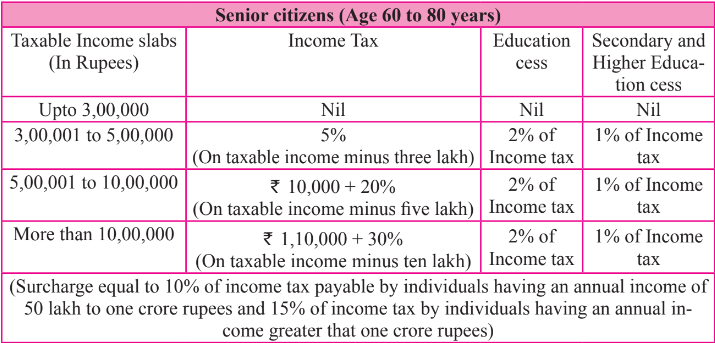
Mr. Ahmed, a 62 year old senior citizen is employed in a private company. His total annual income is Rs.6,20,000. He has contributed Rs. 1,00,000 to the Public Provident Fund and paid a premium of Rs. 80,000 for the year for health insurance and a donation of Rs. 10,000 to CM's Relief Fund. What is tax payable ?
Prove the Theorem : If both the pairs of opposite angles of a quadrilateral are congruent then it is a parallelogram.
Mrs. Hinduja's age is 50 years. Last year her taxable income was Rs. 16,30,000. How much income tax has she to pay ?
Prove the Theorem : If two angles of a triangle are congruent then the sides opposite to them are congruent.
Mr. Mhatre is 50 years old. His gross total income is Rs. 12,00,000. He has invested in
the following amounts in different schemes.
(i) Insurance premium : ₹ 90,000
(ii) Investment in provident fund : ₹ 25,000
(iii) Investment in PPF : ₹ 15,000
(iv) National Savings Certificate : ₹ 20,000
Find out the permissible deductions, taxable income, and the income tax payable.

Image
Mr. Pandit is 75 years of age. Last year his annual income was 13,25,000 rupees. How much is his taxable income ? How much tax does he have to pay ?
Prove the Theorem : If two sides of a triangle are congruent then the angles opposite to them are congruent.

Image

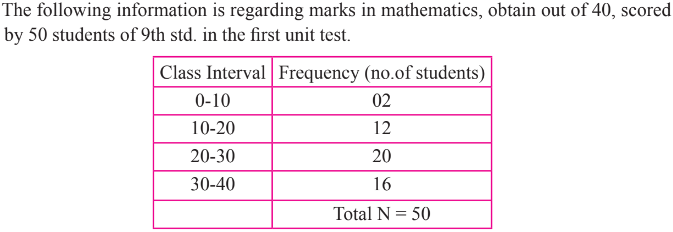
From the table, fill in the blanks in the following statements.
(i) For class interval 10-20 the lower class limit is? and upper class limit is?
(ii) How many students obtained marks less than 10 ?
(iii) How many students obtained marks less than 20 ?
(iv) How many students obtained marks less than 30 ?
(v) How many students obtained marks less than 40 ?