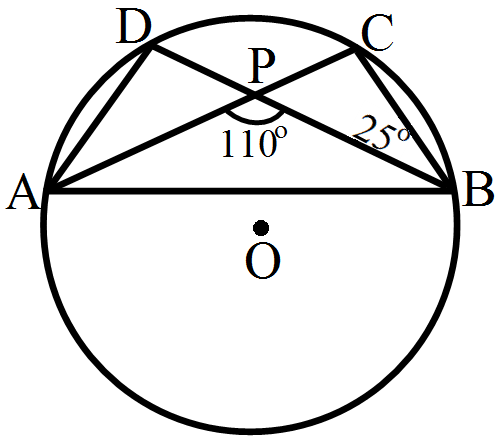
Question
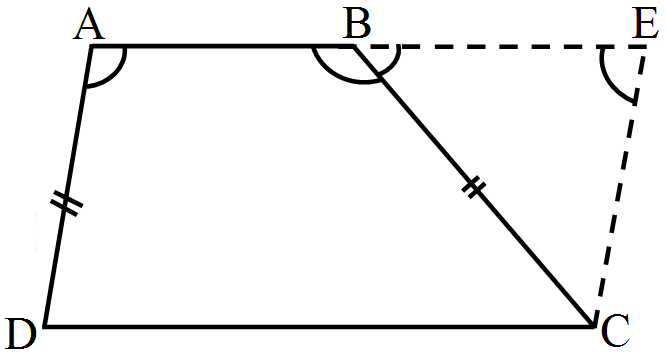
ABCD is a quadrilateral in which AB || DC and AD = BC. Prove that $\angle\text{A}=\angle\text{B}$ and $\angle\text{C}=\angle\text{D}.$

Need a full question paper?

Generate a complete, print-ready paper with questions like this in minutes — across 16+ boards, with answer keys.
Start Generating Free

Similar questions

Two chords AB, CD of lengths 5cm, 11cm respectively of a circle are parallel. If the distance between AB and CD is 3cm, find the radius of the circle.
Read the bar graph given in figure and answer the following questions:

$i.$ What information is given by the bar graph?
$ii.$ What was the expenditure on health and family planning in the year $1982-83?$
$iii.$ In which year is the increase in expenditure maximum over the expenditure in the previous year? What is the maximum increase?
In a rhombus ABCD, the altitude from D to the side AB bisects AB. Find the angles of the rhombus.
In a $\triangle\text{ABC},$ it is given that $\text{AB}=\text{AC}$ and the bisectors of $B$ and $C$ intersect at $O$. If $M$ is a point on $BO$ produced, prove that $\angle\text{MOC}=\angle\text{ABC}.$
ABCD is a rhombus. Show that diagonal AC bisects $\angle\text{A}$ as well as $\angle\text{C}$ and diagonal BD bisects $\angle\text{B}$ as well as $\angle\text{D}.$ 
A cuboidal vessel is 10m long and 8m wide. How high must it be made to hold 380 cubic metres of a liquid?
Given, $\sqrt{2}=1.414$ and $\sqrt{6}=2.449,$ find the value of $\frac{1}{\sqrt{3}-\sqrt{2}-1}$ correct to $3$ places of decimal.
Prove that the line joining the mid-points of the diagonals of a trapezium is parallel to the parallel sides of the trapezium.
If measures opposite angles of a parallelogram are $(60 - x)^\circ$ and $(3x - 4)^\circ$, then find the measures of angles of the parallelogram.