Question
$ABCD$ is a rectangle in which diagonal $BD$ bisects $\angle\text{B}.$ Show that $ABCD$ is a square.
Answer

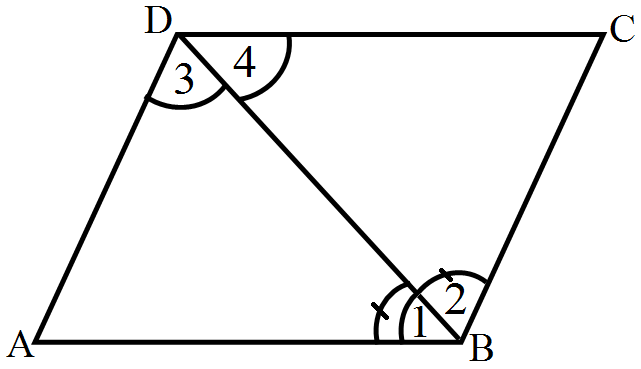
Given: A rectangle $ABCD$ in which diagonal $BD$ bisects $\angle\text{B}$

To prove: $ABCD$ is a square.
Proof: $DC || AB [$Opposite sides of a rectangle are parallel$]$
$\Rightarrow\ \angle4=\angle1\ ...(\text{i})$ [Alternate interior angles]
Similarly, $\angle3=\angle2\ ...(\text{ii})$ [Alternate interior angles]
And $\angle1=\angle2\ ...(\text{iii})$ [Given]
From equation $(1), (2)$ and $(3),$ we get
$\angle3=\angle4$
In $\Delta\text{BAD}$ and $\Delta\text{BDC}$ we have
$\angle1=\angle2$[Given]
$BD = BD[$Common side$)$
$\angle3=\angle4$ [proved above]
So, By ASA criterion of congruence, we have
$\Delta\text{BAD}\cong\Delta\text{BCD}$
$\therefore\ \text{AB}=\text{BC} [CPCT]$
As, adjacent sides of rectangle are equal. So, $ABCD$ is a square.

Need a full question paper?

Generate a complete, print-ready paper with questions like this in minutes — across 16+ boards, with answer keys.
Start Generating Free

Similar questions

$P$ is a point on the bisector of an $\angle\text{ABC}.$ If the line through $P$ parallel to $AB$ meets $BC$ at $Q$, prove that triangle $BPQ$ is isosceles.
The cost of preparing the walls of a room $12m$ long at the rate of $₹ 1.35$ per square meter is $₹ 340.20$ and the cost of matting the floor at $85$ paise per square meter is $₹ 91.80$. Find the height of the room.
 Hameed has built a cubical water tank with lid for his house, with each other edge $1.5\ m$ long. He gets the outer surface of the tank excluding the base, covered with square tiles of side $25\ cm$ . Find how much he would spend for the tiles if the cost of tiles is $₹ 360$ per dozen.
The curved surface area of a cylinder is $4400\ cm^2$ and the circumference of its base is $110\ cm$ . Find the height and the volume of the cylinder.
$BM$ and $CN$ are perpendiculars to a line passing through the vertex $A$ of triangle $ABC$. If $L$ is the mid-point of $BC$, prove that $LM = LN$.
If $ABC$ is an equilateral triangle inscribed in a circle and $P$ be any point on the minor arc $BC$ which does not coincide with $B$ or $C,$ prove that $PA$ is angle bisector of $\angle\text{BPC}.$
Draw a line segment of length $8.6\ cm$. Bisect it and measure the length of each part.
Find the area of the of the blades of the magnetic compass shown in Fig. below $\big($ Take $\sqrt{11}=3.32\big).$
The marks obtained (out of $100$) by a class of $80$ students are given below:
Marks
Number of Student
$10-20$
$20-30$
$30-50$
$50-70$
$70-100$
$6$
$17$
$15$
$16$
$26$
Construct a histogram to represent the data above.