Question 14 Marks
$P$ is the mid-point of the side $CD$ of a parallelogram $ABCD.$ A line through $C$ parallel to $PA$ intersects $AB$ at $Q$ and $DA$ produced at $R.$ Prove that $DA = AR$ and $CQ = Q$
AnswerGiven in a perallelogram $ABCD,$
$P$ is the mid-point of $DC.$
To prove $DA = AR$ and $CQ = QR$ proof $ABCD$ is a parallelogram
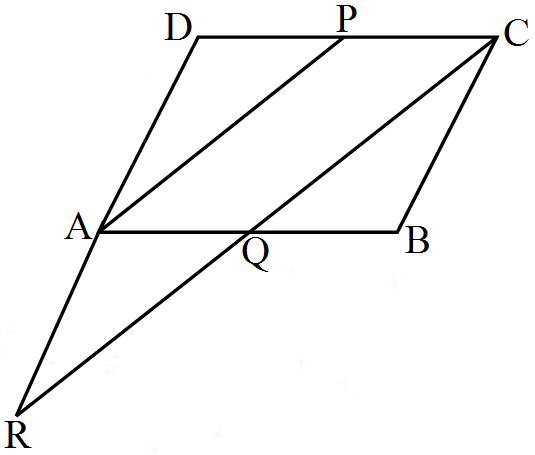
$\therefore BC = AD$ and $BC || AD$ Also $DC = AB$ and $DC || AB$
Since, $P$ is the mid-point of $DC.$
$\therefore\ \text{DP}=\text{PC}=\frac{1}{2}\text{DC}$
now, $QC || AP$ and $PC || AQ$ So, $APCQ$ is a parallelogram.
$\therefore\ \text{AQ}=\text{PC}=\frac{1}{2}\text{DC} $
$=\frac{1}{2}\text{AB}=\text{BQ}$
$[\therefore DC = AB ...(i)]$ Now, in $\Delta\text{AQR}$ and $\Delta\text{BQC}, AQ = BQ [$from eq. $...(i)]$
$\angle\text{AQR}=\angle\text{BQR}$ [veetically opposite angles] and $\angle\text{ARQ}=\angle\text{BCQ} [$Alternate interior angaes$]$
$\therefore\ \Delta\text{AQR}=\Delta\text{BQR}$ [by AAS congruence rile]
$\therefore AR = BC [$ by $CPCT$ rule$]$ But $AR =DA$
$\therefore AR = DA$
Also, $CQ = QR [$by $CPCt$ rule$]$ hence proved. View full question & answer→Question 24 Marks
A diagonal of a parallelogram bisects one of its angles. Show that it is a rhombus.
Answer$ABCD$ ois a parallelogram and diagonal $AC$ bisect $\angle\text{A}.$ we have to show that $ABCD$ is a ehombus.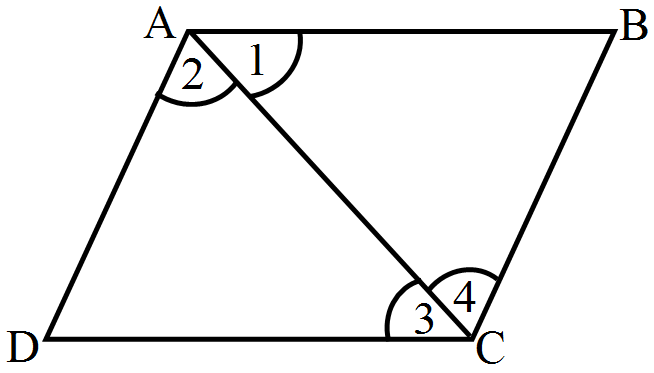
$\angle1=\angle2\ ...(1) [ \because AC$ bisect $\angle\text{A} ] \angle2=\angle4\ ...(2)$
[Alt. interior angle] From $(1)$ and $(2),$
we get $\angle1=\angle4$ Noe, in $\Delta\text{ABC},$
we have $\angle1=\angle4 [$proved adove$]$
$\therefore BC = AB [ \because$ side. Opp. to equal $\angle\text{S}$ are equal$]$
Also, $AB = DC$ and $AD = BC [\because$ Opposite sides of a parallelogram are equal$]$
So, $ABCD$ is a parallelogram in which its sides $AB = BC = CD = AD.$
Hence, $ABCD$ is arhombus. View full question & answer→Question 34 Marks
$E$ is the mid-point of a median $AD$ of $\Delta\text{ABC}$ and $BE$ is produced to meet $AC$ at $F.$ Show that $\text{AF}=\frac{1}{3}\text{AC}.$
AnswerGiven: $\Delta\text{ABC}$ in which $E$ is the mid-point of a medien $AD$ of $\Delta\text{ABC}$ and $BE$ is produced to meet $AC$ at $F.$
show that $\text{AF}=\frac{1}{3}\text{AC}$
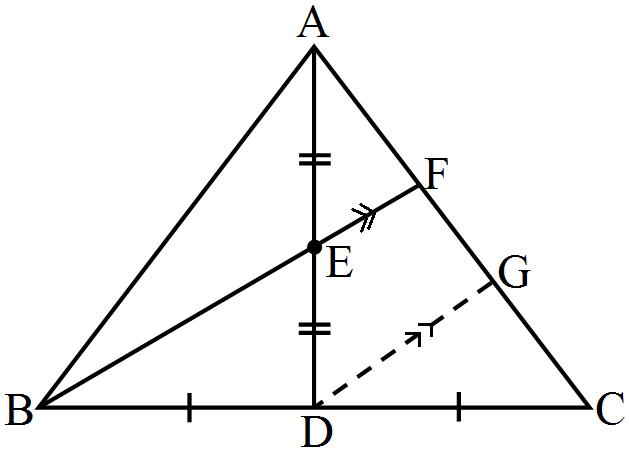
to prove: $\text{AF}=\frac{1}{3}\text{AC}$
Construction: Draw $DG || BF$ intersecting $AC$ at $G.$
Proof: In $\Delta\text{ADG}, E$ is the mid-point of $AD$ and $EF || DG.$
$\therefore AF = FG ...(1) [$Converse of mid-point theorem$]$
In $\Delta\text{FBC}, D$ is the mid-point of $BC$ and $DG || BF.$
$\therefore FG = GC ...(2) ($Converse of mid-point theorem$)$
From equation $(1)$ and $(2),$ we get
$AF = FG = GC ...(3)$
But, $AC = AF + FG + GC$
$\Rightarrow AC = AF + AF + AF[$Using $(3)]$
$\Rightarrow AC = 3AF$
$\Rightarrow\ \text{AF}=\frac{1}{3}\text{AC}$
Hence, proved. View full question & answer→Question 44 Marks
$P, Q, R$ and $S$ are respectively the mid-points of sides $AB, BC, CD$ and $DA$ of quadrilateral $ABCD$ in which $AC = BD$ and $\text{AC}\bot\text{BD}.$ Prove that $PQRS$ is a square.
AnswerGiven: A quadrilateral $ABCD$ is which $AC = BD$ and $\text{AC}\bot\text{BD}.$ $P, Q, R$ and $S$ respectively the mid-points of sides $AB, BC, CD$ and $DA$ of quadrilateral $ABCD.$
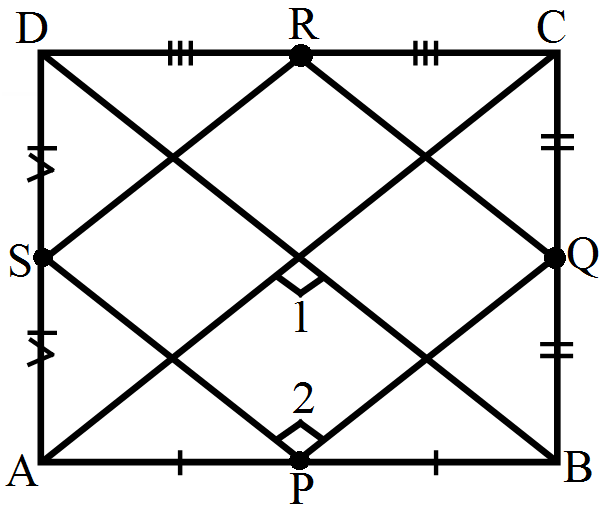
To prove: $PQRS$ is a pquare. proof: parallelogram $PQRS$ is a rectangle. $[$same as in $Q4]$
$\text{PQ}=\frac{1}{2}\text{AC}\ ...(\text{i}) [$proved as in $Q4]$
$PS$ joins mid-points of sides $AB$ and $AD$ respectively.
$\text{PS}=\frac{1}{2}\text{BD}...(\text{ii})$ [mid-point theorem]
But, $\text{AC}=\text{BD}\ ...(\text{iii})[$Given$]$ From $(i), (ii)$ and $(iii),$
we get $PS = PQ$ since adjacent sides of a rectangle are equal.
$\Rightarrow$ Rectangle PQRS is a square. View full question & answer→Question 54 Marks
Through $A, B$ and $C,$ lines $RQ, PR$ and $QP$ have been drawn, respectively parallel to sides $BC, CA$ and $AB$ of a $\Delta\text{ABC}$ as shown Show that $\text{BC}=\frac{1}{2}QR.$
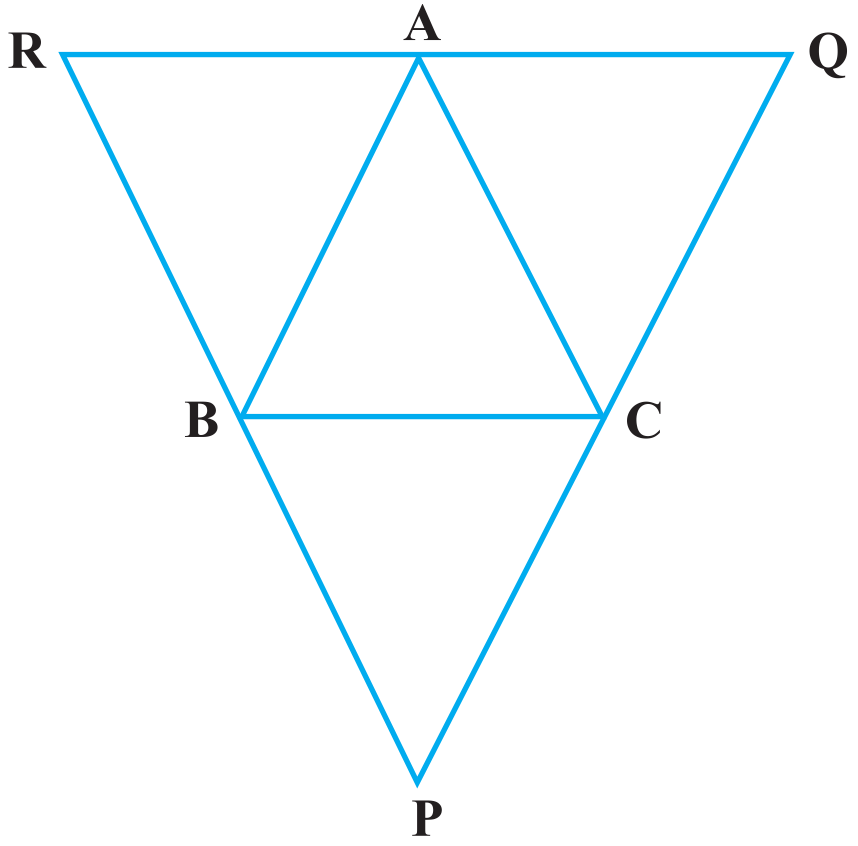
AnswerGiven In $\Delta\text{ABC} PQ || AB$ and $PR || AC$ and $RQ || BC.$
To show $\text{BC}\frac{1}{2}\text{QR}$ Proof In quadrilateral $BCAR, BR || CA$ and $BC|| RA$
So, quadrilateral, $BCAR$ is a parallelogram. $BC = AR …(i)$
Now, in quadrilateral $BCQA, BC || AQ$ and $AB||QC$
So, quadrilateral $BCQA$ is a parallelogram, $BC = AQ …(ii)$
On adding Eqs. $(i)$ and $(ii),$ we get $2BC = AR+ AQ$
$\Rightarrow 2 BC = RQ$
$\Rightarrow\ \text{BC}=\frac{1}{2}\text{QR}$
Now, $BEDF$ is a quadrilateral,
in which $\Delta\text{BED}=\Delta\text{BFD}=90^\circ$
$\Delta\text{FSE}=360^\circ-(\Delta\text{FDE}+\Delta\text{BED})=360^\circ-(60^\circ+90^\circ+90^\circ)$
$ = 360^\circ - 240^\circ = 120^\circ $
View full question & answer→Question 64 Marks
$ABCD$ is a rhombus in which altitude from $D$ to side $AB$ bisects $AB$. Find the angles of the rhombus.
AnswerLet sides of a rhombus be $AB = BC = CD = DA = x$ New, join $DB$
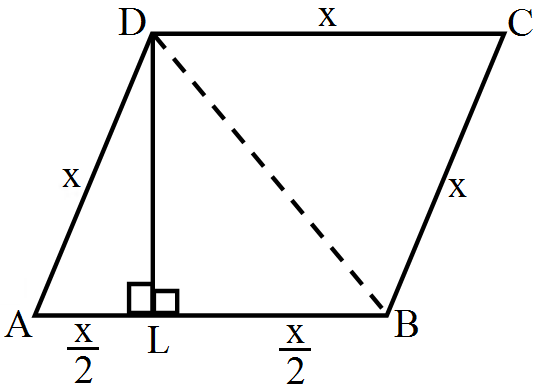
in $\Delta\text{ALD}$ and $\Delta\text{BLD},\angle\text{DLA}=\angle\text{DLB}=90^\circ$
$[$since, $DL$ is a perpendicular bisector of AB] $\text{AL}=\text{BL}=\frac{\text{x}}{2}$ and $DL = DL [$common side$]$
$\therefore\ \Delta\text{ALD}=\Delta\text{BLD} [$by $SAS$ cogeuence rule$] AD = BD [$by $CPCt]$
Now, in $\Delta\text{ADB}, AD = AB = DB = x$
Then, $\Delta\text{ADB}$ is an equilateral triangle.
$\therefore\ \angle\text{C}=\angle\text{BCD}=\angle\text{DBC}=60^\circ$
Similarly, $\Delta\text{DBC}$ is an equilateral triangle.
$\therefore\ \angle\text{C}=\angle\text{BDC}=\angle\text{DBC}=60^\circ$
Also, $\angle\text{A}=\angle\text{C}$
$\therefore\ \angle\text{D}=\angle\text{B}=180^\circ-60^\circ=120^\circ [$since, sum of interior angles is $180^\circ ]$ View full question & answer→Question 74 Marks
In a parallelogram $ABCD, AB = 10cm$ and $AD = 6cm.$ The bisector of $\angle\text{A}$meets $DC$ in $E. AE$ and $BC$ produced meet at $F.$ Find the length of $CF.$
Answer$ABCD$ is a parallelogram. in wgich $AB = 10cm$ and $AD = 6cm.$ the bisector of$\angle\text{A}$ meets $DC$ in $E. AE$ and $BC$ produced meer at $F.$
$$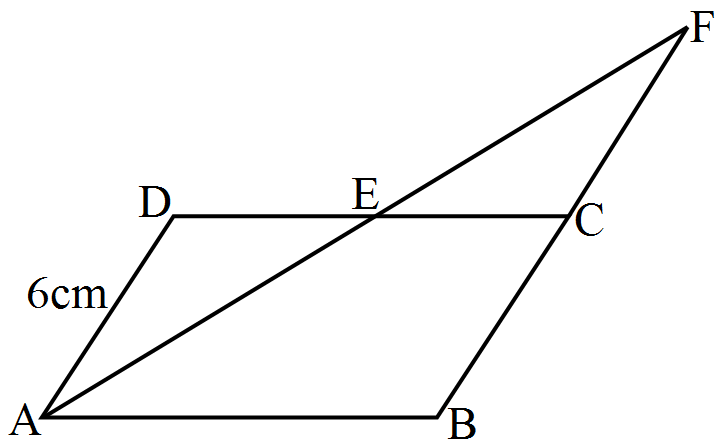
$\angle\text{BAE}=\angle\text{EAD}\ ...(\text{i})$ [$\therefore$ bisect of $\angle\text{A}$]
$\angle\text{EAD}=\angle\text{EFB}\ ...(\text{ii})$[Alt. $\angle\text{s}$]
$\Rightarrow\ \angle\text{BAE}=\angle\text{EFB} [$From $(i)$ and $(ii)]$
$\Rightarrow\ \text{BF}=10\text{cm}[\because\text{AB}=10\text{cm}]$
$\Rightarrow\ \text{BF}+\text{CF}=10\text{cm}\ \Rightarrow\ 6\text{cm}$ [$\because\ \text{BC}=\text{AD}=6\text{cm}$
opposite sides of $a || gm]$
$\Rightarrow\ \text{CF}=10-6\text{cm}=4\text{cm}$ View full question & answer→Question 84 Marks
$E$ is the mid-point of the side $AD$ of the trapezium $ABCD$ with $AB || DC$. A line through $E$ drawn parallel to $AB$ intersect $BC$ at $F.$ Show that $F$ is the mid-point of $BC. [$Hint: Join $AC]$
AnswerGiven: A trapezium $ABCD$ in which $AB || CD$ and $E$ is mid-point of the side $AB.$ Also, $EF ||AB.$ To prove: $F$ is the mid-point of $BC.$
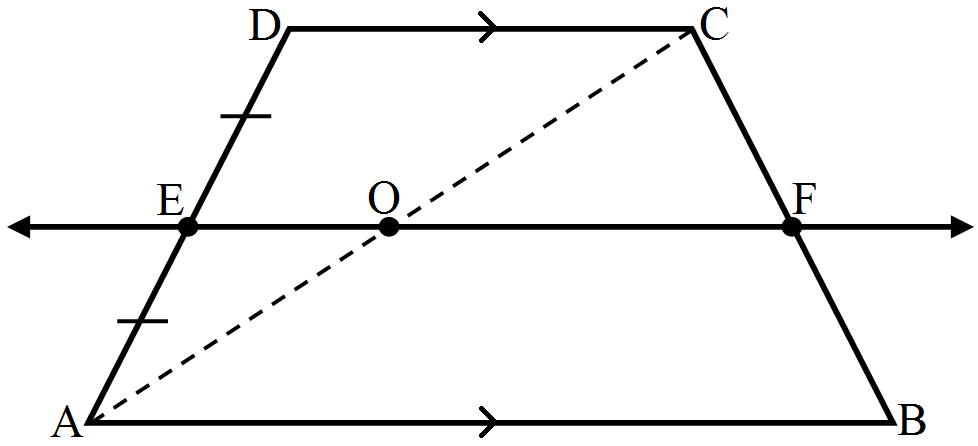
Construction: join $AC$ Which intersect $EF$ at $o.$
Proof: in $\Delta\text{ADC}, E$ is the mid-point of $AD$ and $EF || DC.$ [$\therefore$ $EF || AB$ and $DC || AB$
$\Rightarrow AB || EF || DC]$
$\therefore O$ is the mid- point of $AC. [$Converse of mid- point theorem$]$
Now, in $\Delta\text{CAB0},$ O is mid- point of AC and $OF || AB.$
$\Rightarrow OF$ bisects $BC. [$Converse of mid-point threorem$]$ Or F$$ is the mid- point of bc. Hence, proved. View full question & answer→Question 94 Marks
$ABCD$ is a rectangle in which diagonal $BD$ bisects $\angle\text{B}.$ Show that $ABCD$ is a square.
AnswerGiven: A rectangle $ABCD$ in which diagonal $BD$ bisects $\angle\text{B}$
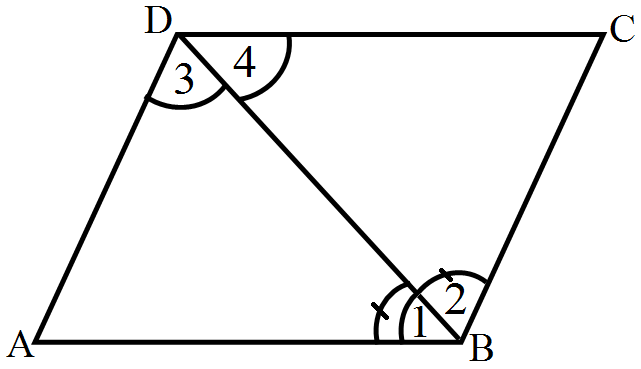
To prove: $ABCD$ is a square.
Proof: $DC || AB [$Opposite sides of a rectangle are parallel$]$
$\Rightarrow\ \angle4=\angle1\ ...(\text{i})$ [Alternate interior angles]
Similarly, $\angle3=\angle2\ ...(\text{ii})$ [Alternate interior angles]
And $\angle1=\angle2\ ...(\text{iii})$ [Given]
From equation $(1), (2)$ and $(3),$ we get
$\angle3=\angle4$
In $\Delta\text{BAD}$ and $\Delta\text{BDC}$ we have
$\angle1=\angle2$[Given]
$BD = BD[$Common side$)$
$\angle3=\angle4$ [proved above]
So, By ASA criterion of congruence, we have
$\Delta\text{BAD}\cong\Delta\text{BCD}$
$\therefore\ \text{AB}=\text{BC} [CPCT]$
As, adjacent sides of rectangle are equal. So, $ABCD$ is a square. View full question & answer→Question 104 Marks
$P$ and $Q$ are the mid-points of the opposite sides $AB$ and $CD$ of a parallelogram $ABCD. AQ$ intersects $DP$ at $S$ and $BQ$ intersects $CP$ at $R.$ Show that $PRQS$ is a parallelogram.
AnswerGiven: $A$ quadrilateral $ABCD$ in which $P$ and $Q$ are the mid-points of the sides $AB$ and $CD$ respectively. $AQ$ intersect $DP$ at $S$ and $BQ$ intersect $CP$ at $R.$
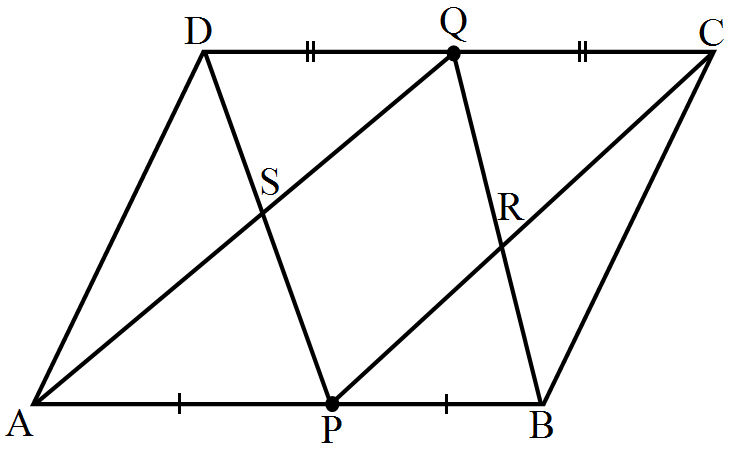
To prove: $PRQS$ is a parallelogram.
Proof: $DC||AB [\therefore$ Opposite sides of a parallelogram are parallel$]$
$\Rightarrow AP || QC$
$DC = AB [\because$ Opposite sides of a parallelogram are equal$]$
$\Rightarrow\ \frac{1}{2}\text{DC}=\frac{1}{2}\text{AB}$
$\Rightarrow QC = AP [\because P$ is the mid-point of $AB$ and $Q$ is mid-point of $CD]$
$\Rightarrow APCQ$ is a parallelogram.$ [\because AP || CQ$ and $QC = AP]$
$\therefore AQ||PC [\because$ Opposite sides of $a || gm$ are parallelogram$)$
$\Rightarrow SQ || PR$
Similarly, $SP || QR$
$\therefore$ Qudrilateral $PRQS$ is a parallogram.
Hence. proved View full question & answer→Question 114 Marks
$AB || DE, AB = DE, AC || DF$ and $AC = DF.$ Prove that $BC || EF$ and $BC = EF.$
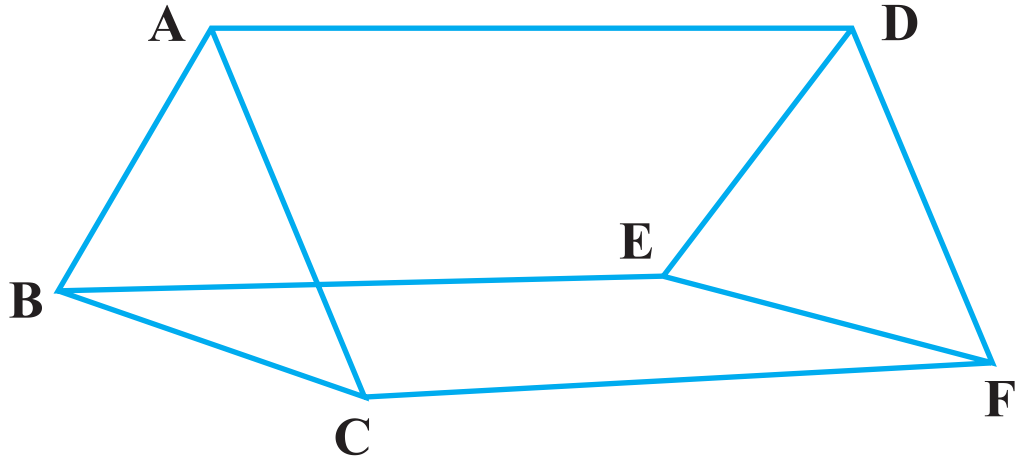
AnswerGiven In figure $AB || DE$ and $AC || DF,$
also $AB = DE$ and $AC = DF$ To prove $BC || EF$ and $BC = EF$
Proof In quadrilateral $ABED, AB || DE$ and $AB = DE$
So, $ABED$ is a parallelogram. $AD || BE$ and $AD = BE$
Now, in quadrilateral $ACFD, AC || FD$ and $AC = FD …(i)$
Thus, $ACFD$ is a parallelogram.
$AD || CF$ and $AD = CF …(ii)$
From Eqs. $(i)$ and $(ii), AD = BE = CF$ and $CF || BE …(iii)$
Now, in quadrilateral $BCFE, BE = CF$
and $BE || CF [$from Eq. $(iii)]$
So, $BCFE$ is a parallelogram. $BC = EF$ and $BC || EF.$ Hence proved.
View full question & answer→Question 124 Marks
$E$ and $F$ are respectively the mid-points of the non-parallel sides $AD$ and $BC$ of a trapezium $ABCD.$ Prove that $EF || AB$ and$\text{EF}=\frac{1}{2}(\text{AB}=\text{CD})$
$[$Hint: Join $BE$ and produce it to meet $CD$ produced at $G.]$
Answer
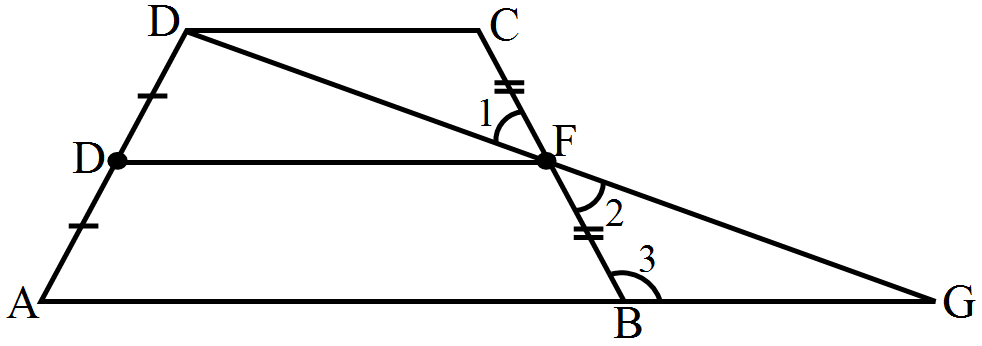
$($Change $D$ to $E$ in mid points of $AD)$
Given: A trapezium $ABCD$ in which $E$ and $F$ are repectively the mid -points of the mid poient of the non-parallel sides $AD$ and $BC.$
to prove: $EF || AB$ and $\text{EF}=\frac{1}{2}(\text{AB}=\text{CD})$
construction: join $DF$ and produce it to intersect $AB$ produced at $G.$
proof: in $\Delta\text{CFD}$ and $\Delta\text{BFG},$ we have
$DC || AB$
$\therefore\ \angle\text{C}=\therefore\ \angle\text{3}$ [Alternate interior angles]
$CF = BF$
$\therefore\ \angle\text{1}=\therefore\ \angle\text{2}$ [Vertically opposite angles]
[so, by ASA critertion of congruence, we have]
$\Delta\text{CFD}\cong\Delta\text{BFG}$
$\therefore CD || BG [CPCT]$
In $\Delta\text{DAG},$ EF joins mid-points $AD$ and $GD$ repectively
$\therefore EF || AG [ \because$ mid-point therem$]$
$\Rightarrow EF || AB$
so, $\text{EF}=\frac{1}{2}\text{AG} [$mid-point therem$]$
$\text{EF}=\frac{1}{2}(\text{AB}+\text{BG})$
$\Rightarrow\ \text{EF}=\frac{1}{2}(\text{AB}+\text{CD})[\because\ \text{CD}=\text{BG}]$
Hence, proved. View full question & answer→Question 134 Marks
Prove that the quadrilateral formed by the bisectors of the angles of a parallelogram is a rectangle.
AnswerGiven Let $ABCD$ be a parallelogram and $AP, BR, CR,$ be are the bisectors of $\angle\text{A},\ \angle\text{B},\ \angle\text{C}$ and $\angle\text{D},$ respectively.To prove Quadrilateral $PQRS$ is a rectangle.
Proof Since, $ABCD$ is a parallelogram, then $DC || AB$ and $DA$ is a transversal.
$\angle\text{A}+\angle\text{B}=180^\circ$
[sum of cointerior angles of a parallelogram is $180^\circ ]$
$\Rightarrow\ \frac{1}{2}\angle\text{A}+\frac{1}{2}\angle\text{D}=90^\circ [$dividing both sides by $2]$
$\angle\text{PAD}+\angle\text{PDA}=90^\circ$
$\angle\text{APD}=90^\circ [$since,sum of all angles of a triangle is $180^\circ ]$
$\Rightarrow\angle\text{SPQ}=90^\circ [$vertically opposite angles$]$
$\angle\text{PQR}=90^\circ$
$\angle\text{QRS}=90^\circ$
and
$\angle\text{PSR}=90^\circ$
Thus, $PQRS$ is a quadrilateral whose each angle is $90^\circ .$
Hence, $PQRS$ is a rectangle.
View full question & answer→Question 144 Marks
$ABCD$ is a quadrilateral in which $AB || DC$ and $AD = BC$. Prove that $\angle\text{A}=\angle\text{B}$ and $\angle\text{C}=\angle\text{D}.$
Answer$ABCD$ is a quadrilaateral such that $AB || DC$ and $AD = BC$
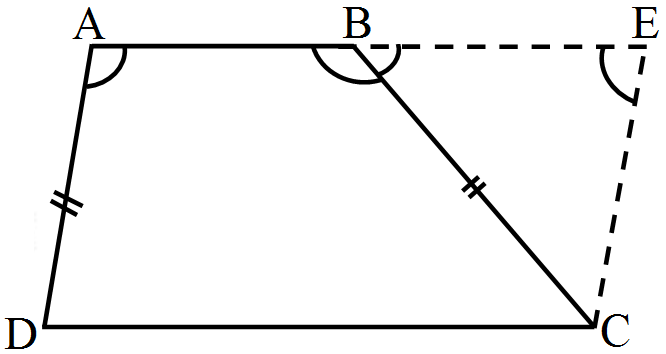
Construction Extend $AB$ to $E$ and draw a line $CE$ parallet to $AD.$ proos since, $AD || CE$ and transverrsal $AE$ cuts then at $A$ and $E$ repectively.
$\therefore\angle\text{A}+\angle\text{E}=180^\circ [$since, sum of cointerios angles is $180^\circ ]$
$\Rightarrow\ \angle\text{A}=180^\circ-\angle\text{E}\ ...(\text{i})$
So, quadrilateral $AECD$ is a parallelogram.
$\Rightarrow\ \text{AD}=\text{CE}\Rightarrow\text{BC}=\text{CE}$ [$\because\ \text{AD}=\text{BC}$ given]
Now, in $\Delta\text{BCE}$
$\text{CE}=\text{BC}$ [proved above]
$\Rightarrow\ \angle\text{CBE}=\angle\text{CEB}$ [opposite angles of equal side are equal]
$\Rightarrow\ 180^\circ-\angle\text{B}=\angle\text{E}$
$[\because\angle\text{B}+\angle\text{CBE}=180^\circ]$
$\Rightarrow\ 180^\circ-\angle\text{E}=\angle\text{B}\ ...(\text{ii})$
From Eqs. $(i)$ and $(ii) \angle\text{A}=\angle\text{B}$ H
ence proved. View full question & answer→Question 154 Marks
$P$ is the mid-point of side $BC$ of a parallelogram $ABCD$ such that $\angle\text{BAP}=\angle\text{DAP}$ Prove that $AD = 2CD.$
AnswerGiven in a parallelogram $ABCD, P$ is a mid-point of $BC$ such that $\angle\text{BAP}=\angle\text{DAP}.$
To prove $AD = 2CD$
Proof Since, $ABCD$ is a parallelogram.
So, $AD || BC$ and $AB$ is transversal, then
$\angle\text{A}+\angle\text{B}=180^\circ ($sum of cointerior angles is $180^\circ )$
$\angle\text{B}=180^\circ-\angle\text{A}\ ...(\text{i})$
in $\Delta\text{ABP}$
$\angle\text{PAB}+2\angle\text{B}+\angle\text{BPA}=180^\circ$[by angle sum property of a triangle)
$\Rightarrow\ \frac{1}{2}\angle\text{A}+180^\circ-\angle\text{A}+\angle\text{BPA}=180^\circ [$from Eq. $(i)]$
$\Rightarrow\ \angle\text{BPA}=\frac{\angle\text{A}}{2}=0$
$\Rightarrow\ \angle\text{BPA}=\frac{\angle\text{A}}{2}\ ...\text{(ii)}$
$\Rightarrow\angle\text{BPA}=\angle\text{BAP}$
$\Rightarrow\ \text{AB}=\text{BP}$ [opposite sides of equal angles are equal]
On multiplying both sides by $2, $ we get
$2\text{AB}=2\text{BP}$
$\Rightarrow\ 2\text{AB}=\text{BP} ($since Pis the mid-point of $BC)$
$\Rightarrow\ 2\text{CD}=\text{AD}$
$($since, $ABCD$ is a parallelogram, then $AB = CD$ and $BC = AD)$
View full question & answer→Question 164 Marks
Show that the quadrilateral formed by joining the mid-points of the consecutive sides of a square is also a square.
AnswerGiven in a square $ABCD, P Q R$ and $S$ are the mid-points of $AB, BC, CD$ and $DA,$ respectively.
To show $PQRS$ is a square.
Construction Join $AC$ and $BD.$
Proof Since, $ABCD$ is a square.
$\therefore AB = BC = CD = AD$
Also, $P. Q. R$ and $S$ are the mid-points of $AB, BC, CD$ and $DA$
respectively.
Then, in $\Delta\text{ADC}$
and $\text{SR}=\frac{1}{2}=\text{AC} [$by mid-point theorem$]...(i)$
In $\Delta\text{ABC}, PQ || AC$
and $\text{PQ}=\frac{1}{2}\text{AC}\ ...(\text{ii})$
From Eqs. $(i)$ and $(ii).$
$SR || PQ$ and $\text{SR}=\text{PQ}=\frac{1}{2}\text{AC}\ ...(\text{iii})$
Similarly, $SP || BD$ and $BD || RQ$
$\therefore SP || RQ$ and $\text{SP}=\frac{1}{2}\text{BD}$
and $\text{RQ}=\frac{1}{2}\text{BD}$
$\therefore\ \text{SP}=\text{RQ}=\frac{1}{2}\text{BD}$
Since, diagonals of a square bisect each other at right angle.
$\therefore AC = BD$
$\text{SP}=\text{RQ}=\frac{1}{2}\text{AC}\ ...(\text{iv})$
From Eqs. $(i)$ and $(iv).$ $\text{SR}=\text{PQ}=\text{SP}=\text{RQ}$ [all side are equal]
Now, in quadrilateral $OERF,$
$OE || FR$ and $OF || ER$
$\angle\text{EOF}=\angle\text{ERF}=90^\circ$
Hence, $PQRS$ is a square. Hence proved.
View full question & answer→Question 174 Marks
Prove that the line joining the mid-points of the diagonals of a trapezium is parallel to the parallel sides of the trapezium.
AnswerGiven Let $ABCD $ be a trapezium in which $AB|| DC$ and let $M$ and $N$ be the mid-points of the diagonals $AC$ and $BD,$ respectively.
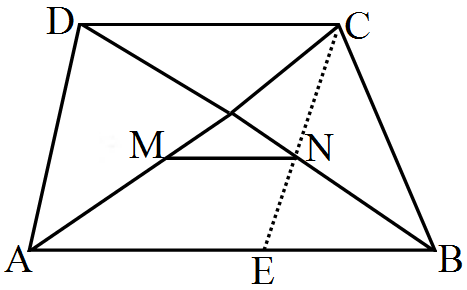
To prove $MN || AB || CD$ Consttruction join $CN$ and Produce it to meet $AB$ at $E.$
$DN = BN [$since, $N$ is mid-point of $BD]$
$\angle\text{DCN}=\angle\text{BEN}$ [alternate interior angles] and
$\angle\text{CDN}=\angle\text{EBN}$ [alternate interior angles]
$\therefore\ \Delta\text{CDN}\cong\Delta\text{EBN} [$by $CPCT$ rule$]$
Thus, in $\Delta\text{CAE},$ the points $M$ and $N$ are the mid-points of $AC$ and $CE,$ resoectivrly
$\therefore Mn || AE [$by mid-point therem$]$
$\Rightarrow Mn || AB || CD $ Hence, proved View full question & answer→Question 184 Marks
$P$ and $Q$ are points on opposite sides $AD$ and $BC$ of a parallelogram $ABCD$ such that $PQ$ passes through the point of intersection $O$ of its diagonals $AC$ and $BD.$ Show that $PQ$ is bisected at $O.$
Answer$ABCD$ is a parallelogram. Its diagonal $AC$ and $BD$ bisect each other at $O.\ PQ$ passes through the point of intersection $O$ of its diagonal $AC$ and $BD.$
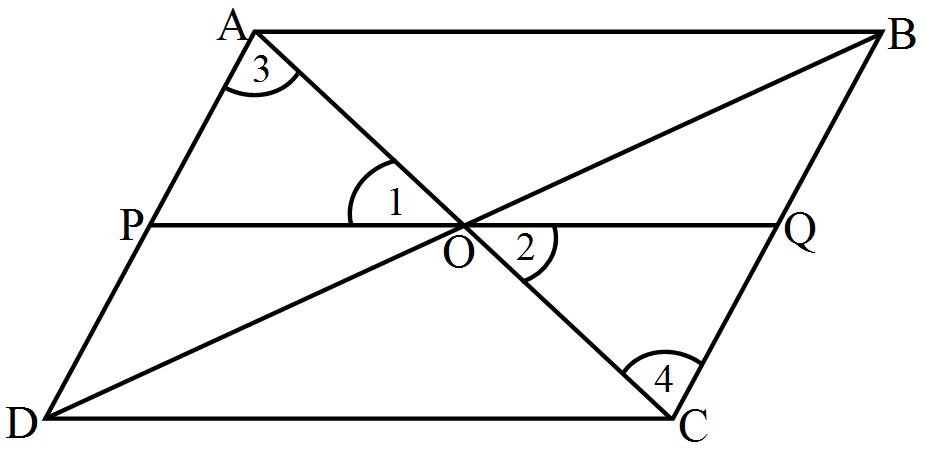
In $\Delta\text{AOP}$ and $\Delta\text{COQ},$ we have
$\angle3=\angle4$ [Alternate int. $\angle\text{s}$]
$OA || OC[$Diagonais of a || gm bisects each other$]$
$\angle1=\angle2$ [vertically opposite angles]
$\therefore\ \Delta\text{AOP}\cong\Delta\text{COQ}[$ By $ASA$ Congruence rule$]$
So, $OP [CPCT]$
Hence, $PQ$ is bisected at $O.$ View full question & answer→Question 194 Marks
$E$ and $F$ are points on diagonal $AC$ of a parallelogram $ABCD$ such that $AE = CF.$ Show that $BFDE$ is a parallelogram.
AnswerGiven: $A$ parallelogram $ABCD: E$ and $F$ are points of diagonal $AC$ of parallelpgram $ABCD$ such that $AE = CF.$ 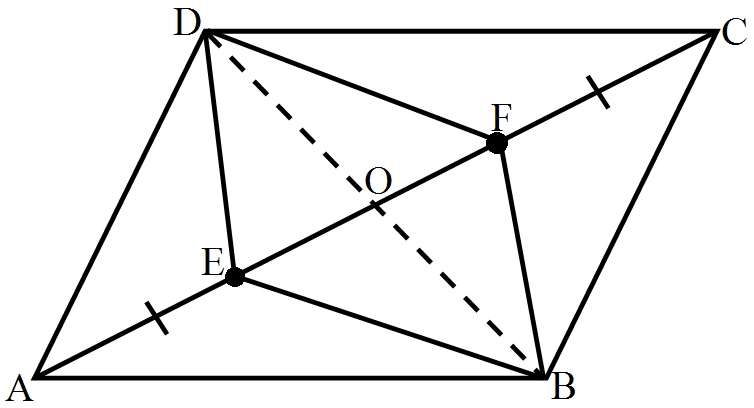
To prove: $BFDE$ is parallelogram. Proof: $ABCD$ is a parallelogram.
$\therefore OD = OB...(1) [\therefore$ Diagonals of parallelogram bisect each other$]$
$OA = OC...(2)(\because$ Diagonals of parallelogram bisect each other$]$
$AE = CF...(3)[$Given$]$
Subtracting $(3)$ from $(2),$ we get
$OA - AE = OC - CF$
$\Rightarrow OE = OF...(4)$
$\therefore BFDE$ is parallelogram.$ [\therefore OD = OB$ and $OE = OF]$
Hence, proved. View full question & answer→Question 204 Marks
A square is inscribed in an isosceles right triangle so that the square and the triangle have one angle common. Show that the vertex of the square opposite the vertex of the common angle bisects the hypotenuse.
AnswerGiven In isosceles triangle $ABC,$ a square $\Delta\text{DEF}$ is inscribed.To prove $CE = BE$
Proof In an isosceles $\Delta\text{ABC},\ \angle\text{A}=90^\circ$
and $AB=AC …(i)$
Since, $\Delta\text{DEF}$ is a square.
$AD = AF [$all sides of square are equal$] … (ii)$
On subtracting Eq. $(ii)$ from Eq. $(i),$ we get
$AB – AD = AC- AF$
$BD = CF ….(iii)$
Now, in $\Delta\text{CFE}$ and $\Delta\text{BDE}$
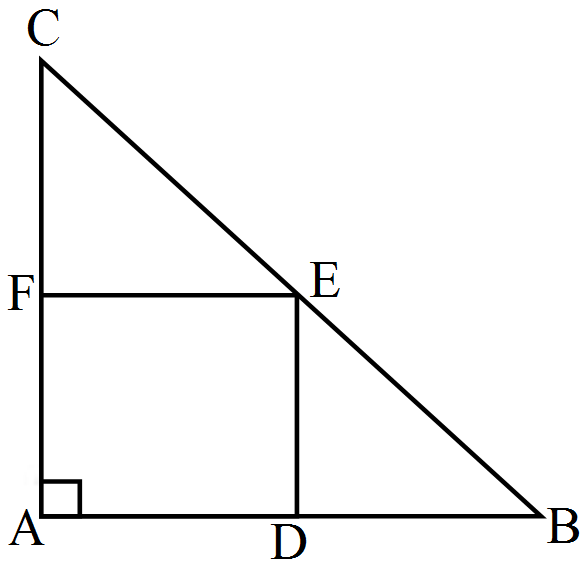
$BD = CF [$from Eq $(iii)]$
$DE = EF [$sides of a square$]$
and $\angle\text{CEF}=\angle\text{BDE}[$by $SAS$ conguencerule$]$
$\therefore CE = BE [$by $CPCT]$
Hence, vertex $E$ of the square bisects the hypotenuse $BC.$ View full question & answer→Question 214 Marks
Points $P$ and $Q$ have been taken on opposite sides $AB$ and $CD,$ respectively of a parallelogram $ABCD$ such that$ AP = CQ$ Show that $AC$ and $PQ$ bisect each other.
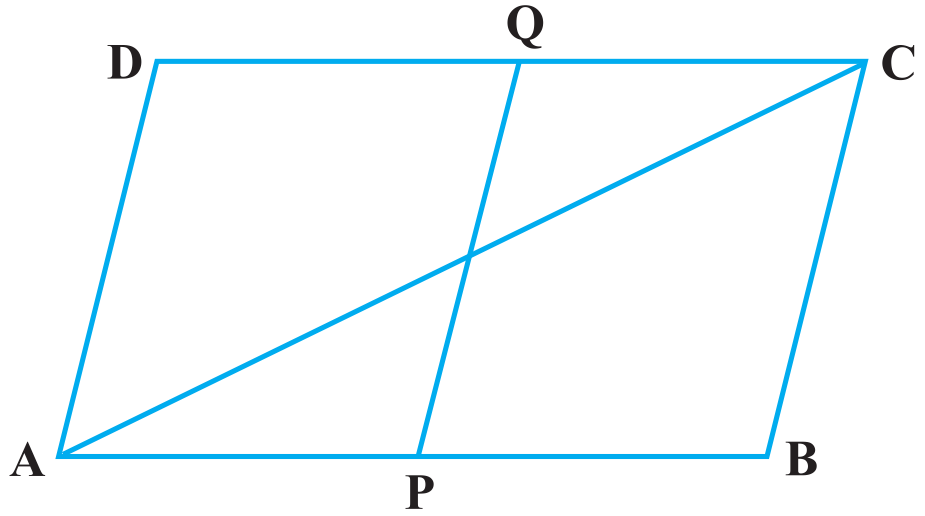
AnswerGiven $ABCD$ is a parallelogram and $AP = CQ$ To show $AC$ and $PQ$ bisect each other.
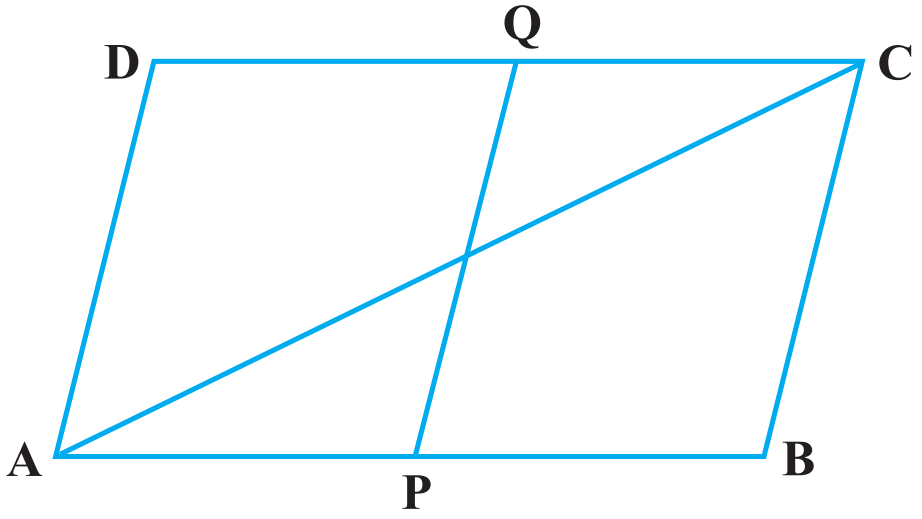
proof in $\Delta\text{AMP}$ and $\Delta\text{CMQ}$
$\angle\text{MAP}=\angle\text{MCQ} [$altemate inerior angles$]$
$\text{AP}=\text{CQ}$ [given] and $\angle\text{APM}=\angle\text{CQM} [$alternate interior angles$]$
$\therefore\ \Delta\text{AMP}=\Delta\text{CMQ} [$by $ASA$ congruence rule$]$
$\Rightarrow\ \text{AM}=\text{CM} [$by $CPCT$ rule$]$ and $\text{PM}=\text{MQ} [$by $CPCT$ rule$]$
Hence, $AC$ and $PQ$ bisech each other. $[$Hence proved.$]$ View full question & answer→Question 224 Marks
$D, E$ and $F$ are respectively the mid-points of the sides $AB, BC$ and $CA$ of a triangle $ABC.$ Prove that by joining these mid-points $D, E$ and $F,$ the triangles $ABC$ is divided into four congruent triangles.
AnswerGiven In a $\Delta\text{ABC} D, E$ and $F$ are respectively the mid-points of the sides $AB, BC$ and $CA.$ To prove $\Delta\text{ABC}$ is divided into four congruent triangles. Proof Since, $ABC$ is a triangle and $D, E$ and $F$ are the mid-points of sides $AB, BC$ and $CA,$ respectively.
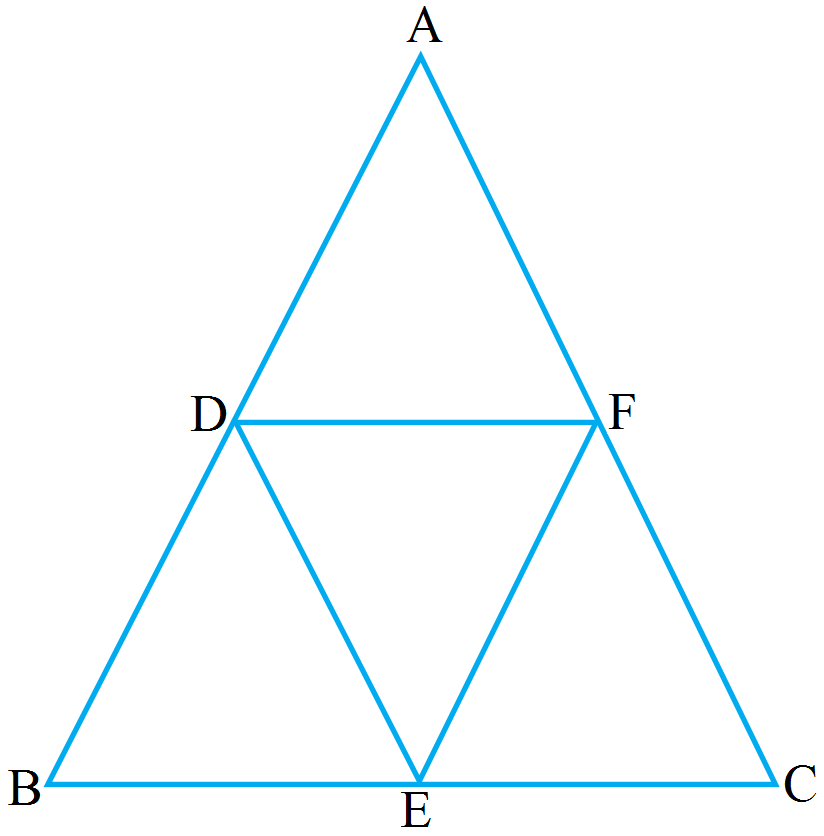
Then, $\text{AD}=\text{BD}=\frac{1}{2}\text{AB},\ \text{BE}=\text{EC}=\frac{1}{2}\text{BC}$
and $\text{AF}=\text{CF}=\frac{1}{2}\text{AC}$
Now, using the mid -point therem, $Ef || AB$ and $\text{EF}=\frac{1}{2}\text{AB}=\text{AD}=\text{BD} ED || AC$ and
$\text{ED}=\frac{1}{2}\text{AC}=\text{AF}=\text{CF}$ and $DF || BC$ and $\text{DF}=\frac{1}{2}\text{BC}=\text{BE}=\text{CE}$
in $\Delta\text{ADF}$ and $\Delta\text{EFD,}$
$AD = EF AF = DE$ and $DE = FD [$common$]$
$\therefore\ \Delta\text{ADF}\cong\Delta\text{EFD} [$by $SSS$ congruence rule$]$
Similarly, $\Delta\text{DEF}\cong\Delta\text{EDB}$ and $\Delta\text{DEF}\cong\Delta\text{CFE}$
So, $\Delta\text{ACB}$ is divided into four congruent triangles. Hence prodev. View full question & answer→Question 234 Marks
Show that the quadrilateral formed by joining the mid-points of the consecutive sides of a square is also a square.
AnswerGiven in a square $ABCD, P Q R$ and $S$ are the mid-points of $AB, BC, CD$ and $DA,$ respectively.
To show $PQRS$ is a square.
Construction Join $AC$ and $BD.$
Proof Since, $ABCD$ is a square.
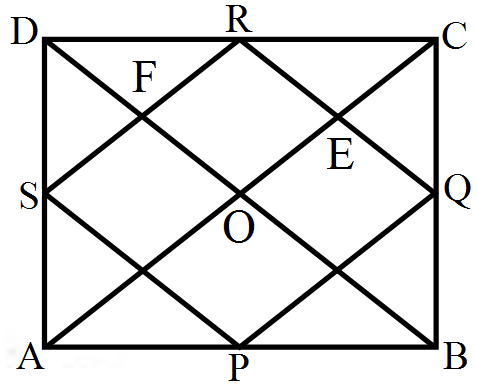
$\therefore AB = BC = CD = AD$
Also, $P. Q. R$ and $S$ are the mid-points of $AB, BC, CD$ and $DA$
respectively.
Then, in $\Delta\text{ADC}$
and $\text{SR}=\frac{1}{2}=\text{AC} [$by mid-point theorem$]...(i)$
In $\Delta\text{ABC}, PQ || AC$
and $\text{PQ}=\frac{1}{2}\text{AC}\ ...(\text{ii})$
From Eqs. $(i)$ and $(ii).$
$SR || PQ$ and $\text{SR}=\text{PQ}=\frac{1}{2}\text{AC}\ ...(\text{iii})$
Similarly, $SP || BD$ and $BD || RQ$
$\therefore SP || RQ$ and $\text{SP}=\frac{1}{2}\text{BD}$
and $\text{RQ}=\frac{1}{2}\text{BD}$
$\therefore\ \text{SP}=\text{RQ}=\frac{1}{2}\text{BD}$
Since, diagonals of a square bisect each other at right angle.
$\therefore AC = BD$
$\text{SP}=\text{RQ}=\frac{1}{2}\text{AC}\ ...(\text{iv})$
From Eqs. $(i)$ and $(iv).$ $\text{SR}=\text{PQ}=\text{SP}=\text{RQ}$ [all side are equal]
Now, in quadrilateral $OERF,$
$OE || FR$ and $OF || ER$
$\angle\text{EOF}=\angle\text{ERF}=90^\circ$
Hence, $PQRS$ is a square. Hence proved. View full question & answer→Question 244 Marks
The angle between two altitudes of a parallelogram through the vertex of an obtuse angle of the parallelogram is $60^\circ .$ Find the angles of the parallelogram.
AnswerLet the parallelogram be $ABCD,$ in which $\angle\text{ADC}$ and $\angle\text{ABC}$ are obtuse angles. Now, $DE$ and $DF$ are two altitudes of parallelogram and angle between them is $60^\circ .$
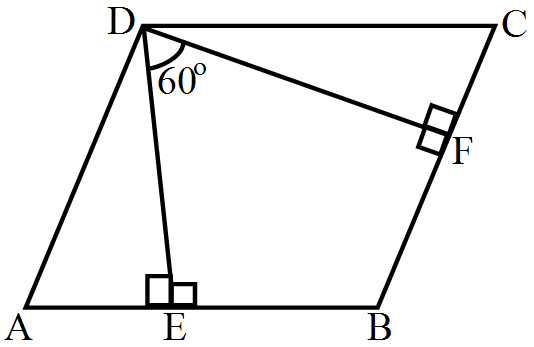
Now, $BEDF$ is a quadrilateral, in which $\angle\text{BED}=\angle\text{BFD}=90^\circ$
$\therefore\ \angle\text{FBE}=360^\circ(\angle\text{FDE}+\angle\text{BED}+\angle\text{BFD)}$
$=360^\circ-(60^\circ+90^\circ+90^\circ)$
$=360^\circ-240^\circ=120^\circ$
Since, $ABCD$ is a parallelogram.
$\therefore\ \angle\text{ADC}=120^\circ$
Now, $\angle\text{A}+\angle\text{B}=180^\circ [$sum of two cointerior angles is $180^\circ ]$
$\therefore\ \angle\text{A}=180^\circ-\angle\text{B}$
$5=180^\circ-120^\circ$
$[\because\angle\text{FBE}=\angle\text{B}]$
$\Rightarrow\ \angle\text{A}=60^\circ$
Also, $\angle\text{C}=\angle\text{A}=60^\circ$
Hence, angles of the parallelogram are $60^\circ , 120^\circ , 60^\circ ,$ and $120^\circ ,$ respevtively. View full question & answer→Question 254 Marks
$P, Q, R$ and $S$ are respectively the mid-points of the sides $AB, BC, CD$ and $DA$ of a quadrilateral $ABCD$ such that$\text{AC}\bot\text{BD}.$ Prove that $PQRS$ is a rectangle.
AnswerGiven In quadrilateral $ABCD, P, O, S$ and $S$ are the mid-points of the sides $AB, BC, CD$ and $DA$, respectively. Also,$\text{AC}\bot\text{BD}$ To prove $PQRS$ is a rectangle. Proof Since, $\text{AC}\bot\text{BD}$
$\angle\text{COD}=\angle\text{AOD}=\angle\text{AOB}=\angle\text{COB}=90^\circ$ in $\Delta\text{ADC}, S$ and $R$ are the mid-points od $AD$ and $DC$ repectively, then by mid-point theorem $SR || AC$ and $\text{SR}=\frac{1}{2}\text{AC}\ ...(\text{i})$
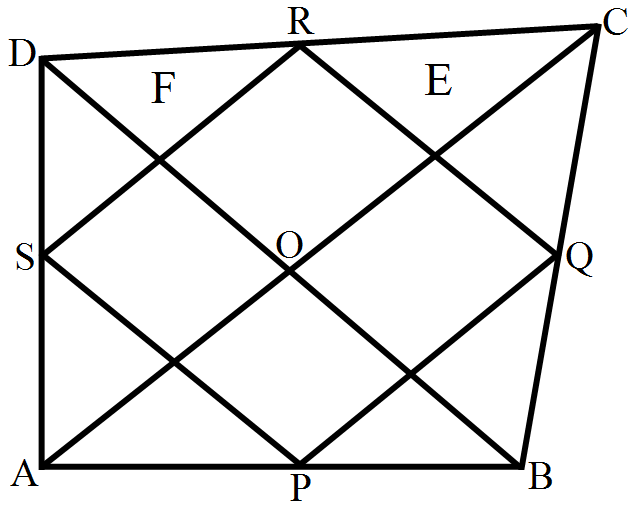
in $\Delta\text{ABC}, P$ and $Q$ are the mid-points of $AB$ and $BC$ repectively,
then by mid-point therem $PQ || AC$ and $\text{PQ}=\frac{1}{2}\text{AC}\ ...(\text{ii})$ From eqs. $(i) $ and $(ii).$
$PQ || SR$ and $\text{PQ}=\text{SR}=\frac{1}{2}\text{AC}\ ...(\text{iii})$
Similarly, $SP || RQ$ and $\text{SP}=\text{RQ}=\frac{1}{2}\text{BD}\ ...(\text{iv})$
Now, inquadrilaterral $EOFR. OE || FR, OF|| ER$
$\therefore\angle\text{EOF}=\angle\text{ERF}=90^\circ$
$[\because\angle\text{COD}=90^\circ]\Rightarrow\angle\text{EOF}=90^\circ]\ ...(\text{v})$
So, $PQRS$ is a rectangle. Hence proved. View full question & answer→Question 264 Marks
$P, Q, R$ and $S$ are respectively the mid-points of the sides $AB, BC, CD$ and $DA$ of a quadrilateral $ABCD$ in which $AC = BD.$ Prove that $PQRS$ is a rhombus.
AnswerGiven In a quadrilateral $ABCD, P, Q, R$ and $S$ are the mid-points of sides $AB, BC, CD$ and $DA$, respectively. Also, $AC = BD$ To prove $PQRS$ is a rhombus.
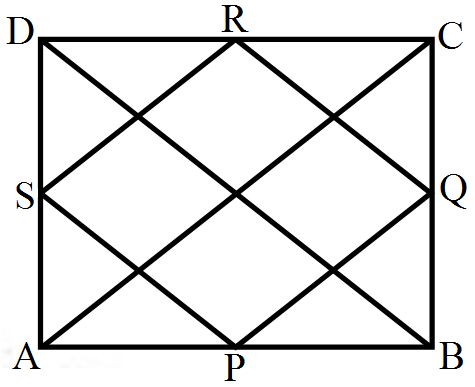
Proof In $\Delta\text{ADC}, S$ and $R$ are the mid-points of $AD$ and $DC$ respectively. Then, by mid-point theorem.
$SR || AC$ and $\text{SR}=\frac{1}{2}\text{AC}\ ...(\text{i})$
In $\Delta\text{ABC}, P$ and $Q$ are the mid-points of $AB$ and $BC$ respectively. Then, by mid-point theorem.
$PQ || AC$ and $\text{PQ}=\frac{1}{2}\ ...(\text{ii})$
From Eqs. $(i)$ and $(ii).$
$\text{SR}=\text{PQ}=\frac{1}{2}\text{AC}\ ...(\text{iii})$
Similarly, in $\Delta\text{BCD}$ $RQ|| BD$ and $\text{RQ}=\frac{1}{2}\text{BD}\ ...(\text{iv})$
and in $\Delta\text{BAD} SP || BD $ and $\text{SP}=\frac{1}{2}\text{BD}\ ...(\text{v})$
From Eqs. $(iv)$ and $(v).$
$\text{SP}=\text{RQ}=\frac{1}{2}\text{BD}=\frac{1}{2}\text{AC} ($given, $AC = BD]...(vi)$
From Egs. $(ii)$ and $(vi). $
$SR = PQ = SP = RQ$
It shows that all sides of a quadrilateral $PQRS$ are equal. Hence, $PQRS$ is a rhombus.
Hence proved. View full question & answer→