Question
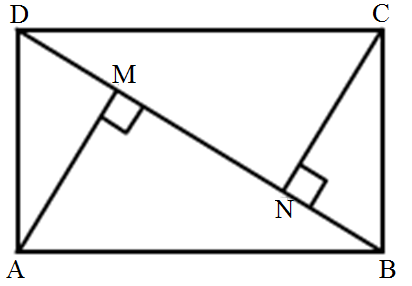
ABCD is a rectangle. Points M and N are on BD such that $\text{AM}\perp\text{BD}$ and $\text{CN}\perp\text{BD}.$ Prove that $BM^2 + BN^2= DM^2+ DN^2.$
Answer

Given: A rectangle ABCD where $\text{AM}\perp\text{BD}$ and $\text{CN}\perp\text{BD}.$
To prove: $BM^2 + BN^2 = DM^2 + DN^2$​​​​​​​
Proof:

Apply Pythagoras Theorem in $\triangle\text{AMB}$ and $\triangle\text{CND},$
$AB^2 = AM^2 + MB^2$
$CD^2 = CN^2 + ND^2​​​​​​​$​​​​​​​
Since $AB = CD, AM^2 + MB^2 = CN^2 + ND^2$
$\Rightarrow AM^2 - CN^2 = ND^2 − MB^2 … (i)$
Again apply Pythagoras Theorem in $\triangle\text{AMD}$ and $\triangle\text{CNB},$
$AD^2 = AM^2 + MD^2$
$CB^2 = CN^2 + NB^2​​​​​​​$​​​​​​​
Since $AD = BC, AM^2 + MD^2 = CN^2 + NB^2$
$\Rightarrow AM^2 - CN^2 = NB^2 - MD^2 … (ii)$
Equating (i) and (ii),
$ND^2 - MB^2 = NB^2 - MD^2$
I.e., $BM^2 + BN^2 = DM^2 + DN^2​​​​​​​$​​​​​​​
This proves the given relation.

Need a full question paper?

Generate a complete, print-ready paper with questions like this in minutes — across 16+ boards, with answer keys.
Start Generating Free

Similar questions

Construct a triangle similar to a given $\triangle\text{ABC}$ such that each of its sides is $\Big(\frac{5}{7}\Big)^{\text{th}}$ of the corresponding sides of $\triangle\text{ABC}.$ It is given that AB - 5cm, BC = 7cm and $\angle\text{ABC} = 50^\circ.$
Prove the following trigonometric identities.
$\frac{\tan^2\text{A}}{1+\tan^2\text{A}}+\frac{\cot^2\text{A}}{1+\cot^2\text{A}}=1$
Two years ago, Salim was thrice as old as his daughter and six years later, he will be four years older than twice her age. How old are they now?
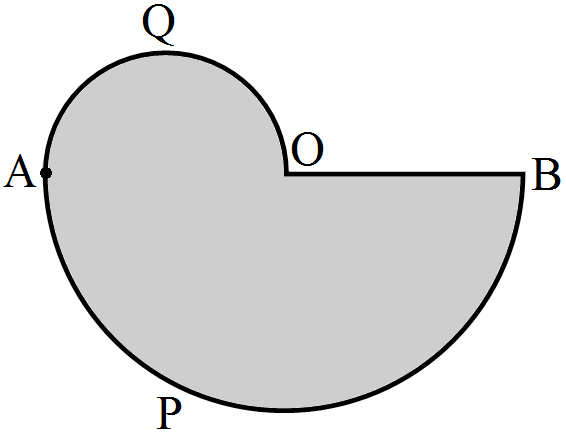
In the given figure, APB and AQO ar semicircles and AO = OB. if the perimeter of the figure is 40cm, find the area of the shaded region.
Prove the following trigonometric identities.
If $\text{T}_\text{n}=\sin^\text{n}\theta+\cos^\text{n}\theta,$ porve that $\frac{\text{T}_3-\text{T}_5}{\text{T}_1}=\frac{\text{T}_5-\text{T}_7}{\text{T}_3}.$
Show graphically that each of the following given systems of equations has infinitely many solutions:
3x - y = 5, 6x - 2y = 10
Show that the square of any positive integer cannot be of the form 6m + 2 or 6m + 5 for any integer m.
The mean of the following frequency distribution is 62.8 and the sum of all the frequencies is 50. Compute the missing frequency.
Class
0-20
20-40
40-60
60-80
80-100
100-120
Frequency
5
$f_1$
10
$f_2​​​​​​​$
7
8
Fill in the blanks in the following table, given that a is the first term, $d$ is the common difference and $a_n$ is the $n^{\text {th }}$ term of the AP:
  a d n $a_n$​​​​​​​
i 7 3 8 ...
ii -18 ... 10 0
iii ... -3 18 -5
iv -18.9 2.5 ... 3.6
v 3.5 0 105 ...
Form the pair of linear equations in the following problems, and find their solution graphically:
10 students of class X took part in Mathematics quiz. If the number of girls is 4 more than the number of boys, find the number of boys and girls who took part in the quiz.