MCQ
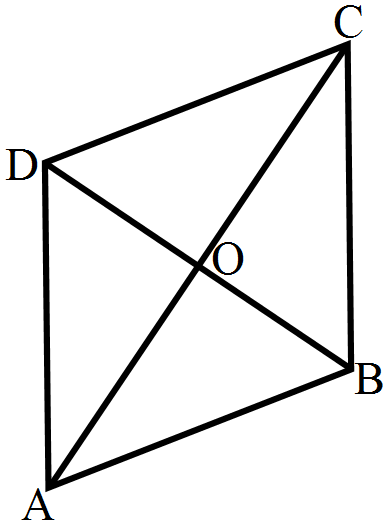
$\text{ABCD}$ is a rhombus in which $\angle\text{C}=60^\circ.$ Then, $\text{AC : BD} = ?$​​​​​​​

  • $\sqrt{3}:1$
  • B
    $\sqrt{3}:\sqrt{2}$
  • C
    $3:1$
  • D
    $3:2$

Answer

Correct option: A.
$\sqrt{3}:1$
Given that $\text{ABCD}$ is a rhombus.
$\text{BC = CD} [$Since all the sides of a rhombus are equal$]$
$\Rightarrow\ \angle\text{BDC}=\angle\text{BCD} [$Angles opposite equal sides are equal$]$
In $\triangle\text{BCD},$
$\angle\text{BDC}+\angle\text{BCD}+\angle\text{CBD}=180^\circ [$Angle sum property$]$
$\Rightarrow\ \angle\text{BDC}+60^\circ+\angle\text{BDC}=180^\circ$
$\Rightarrow\ 2\angle\text{BDC}=120^\circ$
$\Rightarrow\ \angle\text{BDC}=60^\circ$
$\Rightarrow\ \angle\text{BDC}=\angle\text{BCD}=60^\circ$
So, $\triangle\text{BCD},$ is an equilateral triangle.
$\therefore B D=B C=C D=x \text { (say) }$
We know that the diagonals of a rhombus are perpendicular bisectors of each other.
In right $\triangle AOB$,
$A B^2=A O^2+O B^2[B y$ Pythagoras theoram $]$
$\Rightarrow A O^2=A B^2-O B^2$
$\Rightarrow\ \text{AO}^2=\text{x}^2-\Big(\frac{\text{x}}{2}\Big)^2$
$\Rightarrow\ \text{AO}^2=\text{x}^2-\Big(\frac{\text{x}^2}{4}\Big)$
$\Rightarrow\ \text{AO}^2=\frac{3\text{x}^2}{4}$
$\Rightarrow\ \text{AO}=\frac{\sqrt{3}\text{x}}{2}$
So, $\text{AC}=\sqrt{3}\text{x}$
Thus,
$\frac{\text{AC}}{\text{BD}}=\frac{\sqrt{3}\text{x}}{\text{x}}=\frac{\sqrt{3}}{1}$
Hence,
$\text{AC}:\text{BD}=\sqrt{3}:1.$

Need a full question paper?

Generate a complete, print-ready paper with questions like this in minutes — across 16+ boards, with answer keys.
Start Generating Free