Question
✓
Answer
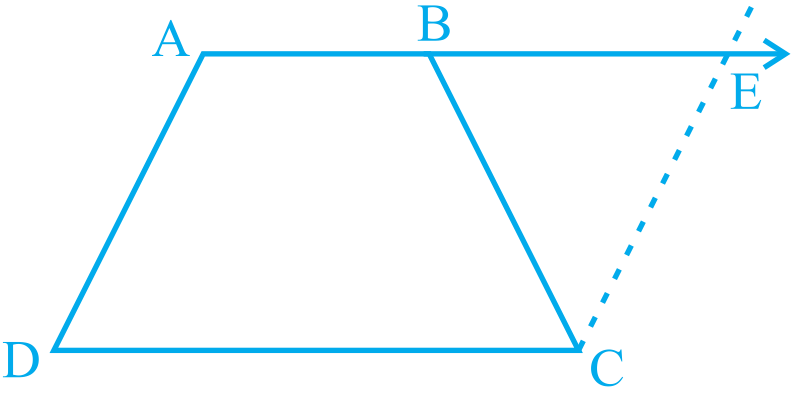
Construction: Draw a line through C parallel to DA intersecting AB produced at E.
- CE = AD (Opposite sides of a parallelogram)
AD = BC (Given)
Therefor, BC = CE
also,
$\angle\text{A}+\angle\text{CBE}=180^{0}$ (Angles on the same side of transversal and ∠CBE = ∠CEB)
$\angle\text{B}+\angle\text{CBE}=180^{0}$ (Linear pair)
$\angle\text{A}=\angle\text{B}$
- $\angle\text{A}+\angle\text{D}=\angle\text{B}+\angle\text{C}=180^{0}$ (Angles on the same side of transversal)
$\angle\text{A}+\angle\text{D}=\angle\text{B}+\angle\text{C}$
$\angle\text{D}=\angle\text{C}$
- In $\angle\text{ABC}$ and $\angle\text{BAD}$
AB = AB (Common)
$\angle\text{DBA}=\angle\text{CBA}$
AD = BC (Given)
- Thus, by SAS $\angle\text{DBA}=\angle\text{CBA}$ Congruence condition.
Need a full question paper?
Generate a complete, print-ready paper with questions like this in minutes — across 16+ boards, with answer keys.
Explore more
Similar questions
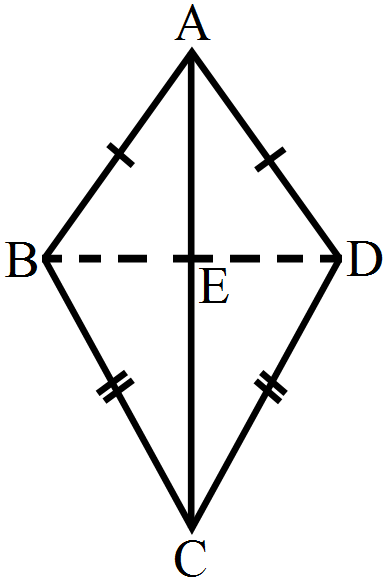
In the given figure, $\text{ABCD}$ is a quadrilateral in which $AB = AD$ and $BC = DC$. Prove that
$i. AC$ bisects $\angle\text{A}$ and $\angle\text{C},$
$ii. BE = DE$,
$iii. \angle\text{ABC}=\angle\text{ADC}.$
→$i. AC$ bisects $\angle\text{A}$ and $\angle\text{C},$
$ii. BE = DE$,
$iii. \angle\text{ABC}=\angle\text{ADC}.$
A cylinder and a cone have equal radii of their base and equal heights. If their curved surface area are in the ratio $8 : 5$, show that the radius of each is to the height of each as $3 : 4$
→A die is thrown $100$ times. If the probability of getting an even number is $\frac{2}{5}.$ How many times an odd number is obtained?
→If the bisectors of two adjacent angles $A$ and $B$ of a quadrilateral $ABCD$ intersect at a point $O$ such that $\angle\text{C}+\angle\text{D}=\text{k}\angle\text{AOB},$ then find the value of $k.$
→Factorize the following expressions: $(a + b)^3 - 8(a - b)^3$
→→
The production of saleable steel in some of the steel plants of our country during $1999$ is given below:
Construct a bar graph to represent the above data on a graph paper by using the scale $1$ big divisions $= 20$ thousand tones.
→|
Plant
|
Bhilai
|
Durgapur
|
Rourkela
|
Bokaro
|
|
Production (in thousands)
|
$160$
|
$80$
|
$200$
|
$150$
|
Read the bar graph given in figure and answer the following questions:
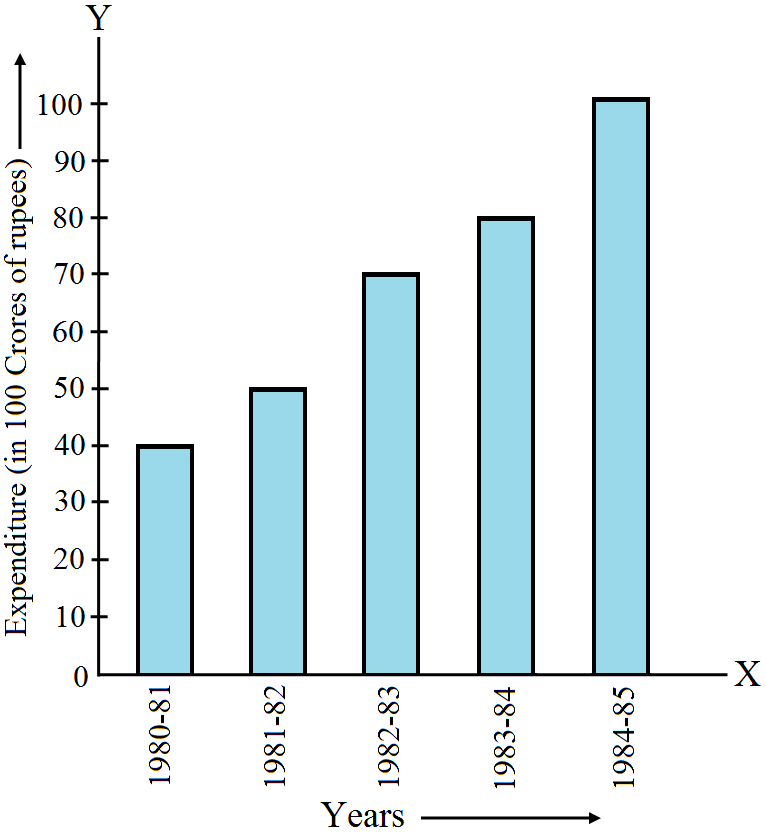
$i.$ What information is given by the bar graph?
$ii.$ What was the expenditure on health and family planning in the year $1982-83?$
$iii.$ In which year is the increase in expenditure maximum over the expenditure in the previous year? What is the maximum increase?
→$i.$ What information is given by the bar graph?
$ii.$ What was the expenditure on health and family planning in the year $1982-83?$
$iii.$ In which year is the increase in expenditure maximum over the expenditure in the previous year? What is the maximum increase?
Simplify by rationalising the denominator: $\frac{7\sqrt{3}-5\sqrt{2}}{\sqrt{48}+\sqrt{18}}$
→In a rhombus $ABCD$ show that diagonal $AC$ bisects $\angle\text{A}$ as well as $\angle\text{C}$ and diagonal $BD$ bisects $\angle\text{B}$ as well as $\angle\text{D}.$
→