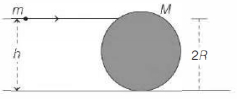
Abody performs simple harmonic oscillations along the straight line $ABCDE$ with $C$ as the midpoint of $AE.$ Its kinetic energies at $B$ and $D$ are each one fourth of its maximum value. If $AE = 2R,$ the distance between $B$ and $D$ is

Diffcult
Download our app for free and get started
$\frac{1}{2} k\left(A^{2}-x^{2}\right)=\frac{1}{4}\left(\frac{1}{2} k A^{2}\right)$
$\therefore x=\frac{\sqrt{3}}{2} A$
$\therefore C D=C B=\frac{\sqrt{3}}{2} R$
or $B D=2(C D)$
or $2(C B)=\sqrt{3} R$
Download our app
and get started for free
Experience the future of education. Simply download our apps or reach out to us for more information. Let's shape the future of learning together!No signup needed.*
A block of mass $0.1\, kg$ is connected to an elastic spring of spring constant $640\, Nm^{-1}$ and oscillates in a damping medium of damping constant $10^{-2}\, kg\,s^{-1}$ . The system dissipates its energy gradually. The time taken for its mechanical energy of vibration to drop to half of its initial value, is closest to ..... $s$
Two particles execute $SHM$ of same amplitude of $20\, cm$ with same period along the same line about the same equilibrium position. The maximum distance between the two is $20\, cm.$ Their phase difference in radians is
A particle of mass m is executing oscillations about the origin on the $X-$axis. Its potential energy is $U(x) = k{[x]^3}$, where $k$ is a positive constant. If the amplitude of oscillation is $a$, then its time period $T$ is
A particle executes linear simple harmonic motion with an ampilitude of $3\,cm$ . When the particle is at $2\,cm$ from the mean position , the magnitude of its velocity is equal to that of its acceleration. Then its time period in seconds is
A particle of mass $10\, gm$ moves in a field where potential energy per unit mas is given by expression $v = 8 \times 10^4\, x^2\, erg/gm$. If the total energy of the particle is $8 \times 10^7\, erg$ then the relation between $x$ and time $t$ is
Two damped spring-mass oscillating systems have identical spring constants and decay times. However, system $A's$ mass $m_A$ is twice system $B's$ mass $m_B$ . How do their damping constants, $b$ , compare ?
Two simple harmonic motions of angular frequency $100$ and $1000\,\,rad\,s^{-1}$ have the same displacement amplitude. The ratio of their maximum acceleration is