MCQ
Abody performs simple harmonic oscillations along the straight line $ABCDE$ with $C$ as the midpoint of $AE.$ Its kinetic energies at $B$ and $D$ are each one fourth of its maximum value. If $AE = 2R,$ the distance between $B$ and $D$ is

  • A
    $\frac{\sqrt{3} R}{2}$
  • B
    $\frac{R}{\sqrt{2}}$
  • $\sqrt{3} R$
  • D
    $\sqrt{2} R$

Answer

Correct option: C.
$\sqrt{3} R$
c
$\frac{1}{2} k\left(A^{2}-x^{2}\right)=\frac{1}{4}\left(\frac{1}{2} k A^{2}\right)$

$\therefore x=\frac{\sqrt{3}}{2} A$

$\therefore C D=C B=\frac{\sqrt{3}}{2} R$

or $B D=2(C D)$

or $2(C B)=\sqrt{3} R$

Need a full question paper?

Generate a complete, print-ready paper with questions like this in minutes — across 16+ boards, with answer keys.

Start Generating Free

Similar questions

The displacement of a particle from its mean position (in metre) is given by $y = 0.2\sin (10\pi t + 1.5\pi )\cos (10\pi t + 1.5\pi )$. The motion of particle is
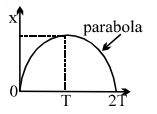
 The $x-t$ graph of a particle moving along a straight line is shown in figure The $v-t$ graph of the particle is correctly shown by
Which one of the following possesses potential energy?
A thermally insulted vessel contains $150\, g$ of water at $0\,^oC$. Then the air from the vessel is pumped out a adiabatically. A fraction of water turns into ice and the rest evaporates at $0\,^oC$ itself. The mass of evaporated water will be closes to ....... $g$ (Latent heat of vaporization of water $= 2.10 \times10^6\, Jkg^{-1}$ and Laten heat of Fusion of water $ = 3.36 \times10^5\,Jkg^{-1}$ )
Heat is not being exchanged in a body. If its internal energy is increased, then
For a perfectly black body, its absorptive power is
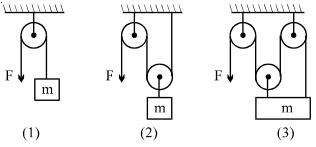
Equal force $F ( > mg)$ is applied to string in all the $3$ cases. Starting from rest, the point of application of force moves a distance of $2 m$ down in all cases. In which case the block has maximum kinetic energy?
A beaker containing a liquid is kept inside a big closed jar. If the air inside the jar is continuously pumped out, the pressure in the liquid near the bottom of the liquid will
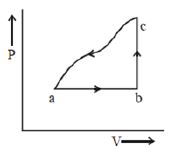
A sample of an ideal gas is taken through the cyclic process $abca$ as shown in the figure. The change in the internal energy of the gas along the path $ca$ is $-180\, J$. The gas absorbs $250\, J$ of heat along the path $ab$ and $60\, J$ along the path $bc$. The work done by the gas along the path $abc$ is ..... $J$
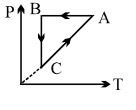
A cyclic process $ABCA$ is shown in $PT$ diagram. When presented on $PV$, it would