MCQ
According to $C.E.$ van der Waal, the interatomic potential varies with the average interatomic distance $(R)$ as
  • A
    $R^{-1}$
  • B
    $R^{-2}$
  • C
    $R^{-4}$
  • $R^{-6}$

Answer

Correct option: D.
$R^{-6}$
d
(d)

Interatomic potential varies with average interatomic distance as $R^{-6}$ which is a fact.

Need a full question paper?

Generate a complete, print-ready paper with questions like this in minutes — across 16+ boards, with answer keys.
Start Generating Free

Similar questions

A vessel of volume V contains a mixture of 1 mole of hydrogen and 1 mole of oxygen (both considered as ideal). Let f1(v)dv denotes the fraction of molecules with speed between v and (v + dv) with f2(v)dv, similarly for oxygen. Then,
  1. f1(v) + f2(v) = f (v) obeys the Maxwell’s distribution law.
  2. f1(v), f2(v) will obey the Maxwell’s distribution law separately.
  3. Neither f1(v)nor f2(v)will obey the Maxwell’s distribution law.
  4. f2(v) and f1(v)will be the same.
The distance travelled by a body is directly proportional to the square of the time taken. Its acceleration:
A wire suspended vertically from one end, is stretched by attaching a weight 200N to the lower end. The weight stretches the wire by 1mm. The energy gained by the wire is:
A particle is placed at the lowest point of a smooth wire frame in the shape of a parabola, lying in the vertical $xy-$ plane having equation $x^2 = 5y$ $(x, y$ are in meter). After slight displacement, the particle is set free. Find angular frequency of oscillation.....$rad/s$  (in $rad/sec$ ) (take $g = 10\ m/s^2$ ) 
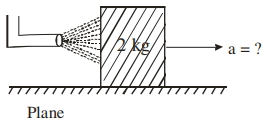
A block of metal weighing $2 \,kg$ is resting on a frictionless plane (as shown in figure). It is struck by a jet releasing water at a rate of $1 \,kgs ^{-1}$ and at a speed of $10 \,ms ^{-1}$. Then, the initial acceleration of the block, in $ms ^{-2}$, will be .................
A stone is projected with a velocity $20 \sqrt{2}\,m / s$ at an angle of $45^{\circ}$ to the horizontal. The average velocity of stone during its motion from starting point to its maximum height is $..........\,m/s$ (take $g=10\,m / s ^2$ )
The surface tension of a liquid at its boiling point:
Two particles in same vertical plane are thrown to strike at same time. One from ground and other from height $h$ vertically above it. Ground particle is thrown obliquly and it achives a maximum height $H$. The second particle is thrown horizontally with same speed. What can be maximum $h$ so that two particles strike in air.
A particle is performing $SHM$ according to the equation $x = (3\, cm)$ $\sin \,\left( {\frac{{2\pi t}}{{18}} + \frac{\pi }{6}} \right)$ where $t$ is in seconds. The distance travelled by the particle in $36\, s$ is ..... $cm$
Displacement x , of a body moving in one-dimensional motion depends on time $t$ as follows : $x=a_0+a_1 t+a_2 t^2+a_3 t^3$ where $a_0, a_1, a_2, a_3$ are fixed.
Then the correct statement is :