MCQ
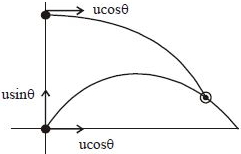
Two particles in same vertical plane are thrown to strike at same time. One from ground and other from height $h$ vertically above it. Ground particle is thrown obliquly and it achives a maximum height $H$. The second particle is thrown horizontally with same speed. What can be maximum $h$ so that two particles strike in air.
  • A
    $H$
  • B
    $2H$
  • C
    $3H$
  • $4H$

Answer

Correct option: D.
$4H$
d
$\frac{\mathrm{h}}{\mathrm{u} \sin \theta} \leq \frac{2 \mathrm{u} \sin \theta}{\mathrm{g}} \Rightarrow \mathrm{h} \leq \frac{2 \mathrm{u}^{2} \sin ^{2} \theta}{\mathrm{g}}=4 \mathrm{H}$

Need a full question paper?

Generate a complete, print-ready paper with questions like this in minutes — across 16+ boards, with answer keys.

Start Generating Free

Similar questions

Mark the correct statements for a particle going on a straight line:
  1. If the velocity and acceleration have opposite sign, the object is slowing down.
  2. If the position and velocity have opposite sign, the particle is moving towards the origin.
  3. If the velocity is zero at an instant, the acceleration should also be zero at that instant.
  4. If the velocity is zero for a time interval, the acceleration is zero at any instant within the time interval.
If a black body is heated at a high temperature, it seems to be
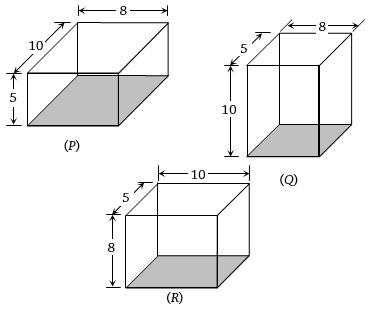
A rectangular block of size $10\,cm \times 8\,cm \times 5\,cm$ is kept in three different positions $P, Q$ and $R$ in turn as shown in the figure. In each case, the shaded area is rigidly fixed and a definite force $F$ is applied tangentially to the opposite face to deform the block. The displacement of the upper face will be
The length of a spring is $l$ and its force constant is $k$. When a weight $W$ is suspended from it, its length increases by $x$. If the spring is cut into two equal parts and put in parallel and the same weight $W$ is suspended from them, then the extension will be
From a solid sphere of mass $M$ and radius $R$ a cube of maximum possible volume is cut. Moment of inertia of cube about an axis passing through its center and perpendicular to one of its faces is
If a simple pendulum is made to oscillate in water, then the time period :
An unknown nucleus collides with a ${}^4He$ nucleus, and after the collision the two nuclei travel in perpendicular directions relative to each other. If kinetic energy is lost in the collision, the unknown nucleus must be 
A thin rod having a length of $1\; m$ and area of cross-section $3 \times 10^{-6}\,m ^2$ is suspended vertically from one end. The rod is cooled from $210^{\circ}\,C$ to $160^{\circ}\,C$. After cooling, a mass $M$ is attached at the lower end of the rod such that the length of rod again becomes $1\,m$. Young's modulus and coefficient of linear expansion of the rod are $2 \times 10^{11} Nm ^{-2}$ and $2 \times 10^{-5} K ^{-1}$, respectively. The value of $M$ is $.......kg .\left(\right.$ Take $\left.g=10\,m s ^{-2}\right)$
Number of degrees present in one radian is
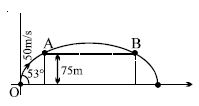
At $t = 0$ a projectile is fired from a point $O$(taken as origin) on the ground with a speed of $50\,\, m/s$ at an angle of $53^o$ with the horizontal. It just passes two points $A \& B$ each at height $75 \,\,m$ above horizontal as shown The distance (in metres) of the particle from origin at $t = 2$ sec.