Question
According to classical theory, path of electron in Rutherford model :

Answer

(D) - Spinal curve

Need a full question paper?

Generate a complete, print-ready paper with questions like this in minutes — across 16+ boards, with answer keys.
Start Generating Free

Similar questions

The energy stored in a condenser of capacity $C$ which has been raised to a potential $V$ is given by
The reason of current flow in P-N junction in forward bias is(a) Drifting of charge carriers(b) Minority charge carriers(c) Diffusion of charge carriers(d) All of these
   
   
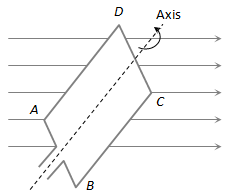
A rectangular coil $\ce{ABCD}$ is rotated anticlockwise with a uniform angular velocity about the axis shown in diagram below. The axis of rotation of the coil as well as the magnetic field $B$ are horizontal. The induced $e.m.f.$ in the coil would be maximum when
 
A graph is plotted between the potential difference (applied across the ends of a conductor) and the current (following through the conductor). The graph is a straight line
The period of oscillation of a magnet in vibration magnetometer is 2 sec. The period of oscillation of a magnet whose magnetic moment is four times that of the first magnet is(a) 1 sec(b) 4 sec(c) 8 sec  (d) 0.5 sec
       
The current flow in a Zener diode is mainly due to
When a straight wire is moved up and down rapidly between two poles of a horseshoe magnet then _______ is produced in the wire.
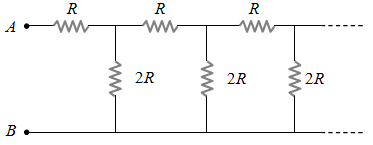
An infinite ladder network is arranged with resistances $R$ and $2 R$ as shown.  The effective resistance between terminals $A$ and $B$ is
Cathode ray consists of:
Assertion   :   Two electric bulbs of 50 and 100 W are given. When connected in series 50 W bulb glows more but when connected parallel 100 W bulb glows more. 
Reason      : In series combination, power is directly proportional to the resistance of circuit. But in parallel combination, power is inversely proportional to the resistance of the circuit.(a) If both assertion and reason are true and the reason is the correct explanation of the assertion.(b) If both assertion and reason are true but reason is not the correct explanation of the assertion.(c) If assertion is true but reason is false.(d) If the assertion and reason both are false.