MCQ
According to Lenz's law there is conversion of:
- AMomentum.
- BCollision.
- CVoltage.
- DEnergy.
Explanation:
Lenz's law deals with conversion of mechanical energy into electromagnetic energy in case of electromagnetic induction. Hence Lenz's law is basically a conversion of energy from one form to another.
Generate a complete, print-ready paper with questions like this in minutes — across 16+ boards, with answer keys.
A circular coil of diameter 7cm has 24 turns of wire carrying current of 0.75A. The magnetic moment of the coil is
|
(a) 6.9 |
(b) 2.3 |
|
(c) |
(d) |
The ratio of thermionic currents (I/I0) for a metal when the temperature is slowly increased  to T as shown in figure. (I and I0 are currents at T and respectively). Then which one is correct?

| (a) A | (b) B | (c) C | (d) D |
Two coherent sources of intensities, I1 and I2 produce an interference pattern. The maximum intensity in the interference pattern will be
|
(a) I1 + I2 |
(b) |
(c) (I1 + I2)2 |
(d) |
For electron moving in nth orbit of H-atom the angular velocity is proportional to
|
(a) n |
(b) 1/n |
(c) n3 |
(d) 1/n3 |
A beam of light is converging towards a point I on a screen. A plane glass plate whose thickness in the direction of the beam = t, refractive index = μ, is introduced in the path of the beam. The convergence point is shifted by
|
(a) |
(b) |
(c) |
(d) |
A thin oil layer floats on water. A ray of light making an angle of incidence of 40° shines on oil layer. The angle of refraction of light ray in water is ( )
)
|
(a) 36 .1° |
(b) 44.5° |
(c) 26. 8° |
(d) 28.9° |
The ionisation energy of 10 times ionised sodium atom is
|
(a) 13.6 eV |
(b) 13.6 × 11 eV |
(c) |
(d) 13.6 × (11)2 eV |
The maximum value of stopping potential in the following diagram is
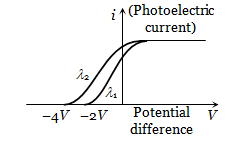
|
(a) – 4V |
(b) – 1V |
(c) – 3V |
(d) – 2V |
A 5 ℃ rise in the temperature is observed in a conductor by passing some current. When the current is doubled, then rise in temperature will be equal to
|
(a) 5 ℃ |
(b) 10 ℃ |
(c) 20 ℃ |
(d) 40 ℃ |




