MCQ
According to second law of thermodynamics:
  • A
    A heat engine cannot have efficiency equal to 1.
  • B
    A refrigerator (or heat pump) could have infinite value of coefficient of performance.
  • C
    A heat engine can convert heat fully in to work.
  • D
    Heat can flow from cold to hot body.

Answer

  1. A heat engine cannot have efficiency equal to 1.

Explanation:

Second law puts limitation on the efficiency of a heat engine and on the coefficient of performance of a refrigerator. Heat engine cannot have efficiency equal to 1 and a refrigerator cannot have infinite value of coefficient of performance.

Need a full question paper?

Generate a complete, print-ready paper with questions like this in minutes — across 16+ boards, with answer keys.

Start Generating Free

Similar questions

A ball is bouncing elastically with a speed 1m/s between walls of a railway compartment of size 10m in a direction perpendicular to walls. The train is moving at a constant velocity of 10m/s parallel to the direction of motion of the ball. As seen from the ground,
  1. The direction of motion of the ball changes every 10 seconds.
  2. Speed of ball changes every 10 seconds.
  3. Average speed of ball over any 20 second interval is fixed.
  4. The acceleration of ball is the same as from the train.
Two balls are thrown simultaneously in air. The acceleration of the centre of mass of the two balls while in air:
  1. Depends on the direction of the motion of the balls.
  2. Depends on the masses of the two balls.
  3. Depends on the speeds of the two balls.
  4. Is equal to g.
A particle moves in $x-y$ plane according to rule $x = {\rm{asin}}\omega t$ and $\;y = {\rm{acos}}\omega t$. The particle follows  
A particle moves from a point $\left( { - 2\hat i + 5\hat j} \right)$  to $\left( {4\hat i + 3\hat j} \right)$ when a force of $\left( {4\hat j + 3\hat k} \right)$ is applied. How much work has been done by the force ?......$J$
A boy throws balls into air at regular interval of $2$ second. The next ball is thrown when the velocity of first ball is zero. How high do the ball rise above his hand is ...... $m$ [Take $g=9.8 \,m / s ^2$ ]
Given that $\overrightarrow A + \overrightarrow B + \overrightarrow C= 0$ out of three vectors two are equal in magnitude and the magnitude of third vector is $\sqrt 2 $ times that of either of the two having equal magnitude. Then the angles between vectors are given by
Match the columns

  Column $-I$
    $R/H_{max}$
  Column $-II$
  Angle of projection $\theta $
   $A.$ $1$    $1.$ ${60^o}$
   $B.$ $4$    $2.$ ${30^o}$
   $C.$ $4\sqrt 3$    $3.$ ${45^o}$
   $D.$ $\frac {4}{\sqrt 3}$    $4.$ $tan^{-1}\,4\,=\,{76^o}$


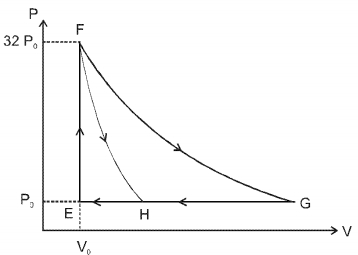
One mole of a monatomic ideal gas is taken along two cyclic processes $E \rightarrow F \rightarrow G \rightarrow E$ and $E \rightarrow F \rightarrow H \rightarrow$ E as shown in the $PV$ diagram. The processes involved are purely isochoric, isobaric, isothermal or adiabatic. $Image$

Match the paths in List $I$ with the magnitudes of the work done in List $II$ and select the correct answer using the codes given below the lists.

List $I$ List $I$
$P.$ $\quad G \rightarrow E$ $1.$ $\quad 160 P_0 V_0 \ln 2$
$Q.$ $\quad G \rightarrow H$ $2.$ $\quad 36 P _0 V _0$
$R.$ $\quad F \rightarrow H$ $3.$ $\quad 24 P _0 V _0$
$S.$ $\quad F \rightarrow G$ $4.$ $\quad 31 P_0 V_0$

Codes: $ \quad  \quad P \quad Q \quad R \quad S $ 

A body of mass $5 \times 10^{3} \,kg$ moving with speed $2\, m / s$ collides with a body of mass $15 \times 10^{3} \,kg$ in elastically and sticks to it. Then loss in $K. E.$ of the system will be (in $KJ$)
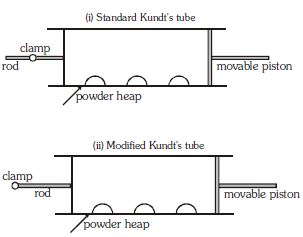
In the Kundts tube experiment (shown in fig. $(i)$), the rod is clamped at the end instead of clamping it at the center as shown in fig. $(ii).$ It is known that speed of sound in air is $330\  m/s$, powder piles up at successive distance of $0.6\  m$ and length of rod used is $1\ m$, speed of sound in rod is .... $\frac{m}{s}$