MCQ 11 Mark
Consider a cycle followed by an engine: 1 to 2 is isothermal. 2 to 3 is adiabatic. 3 to 1 is adiabatic. Such a process does not exist because:
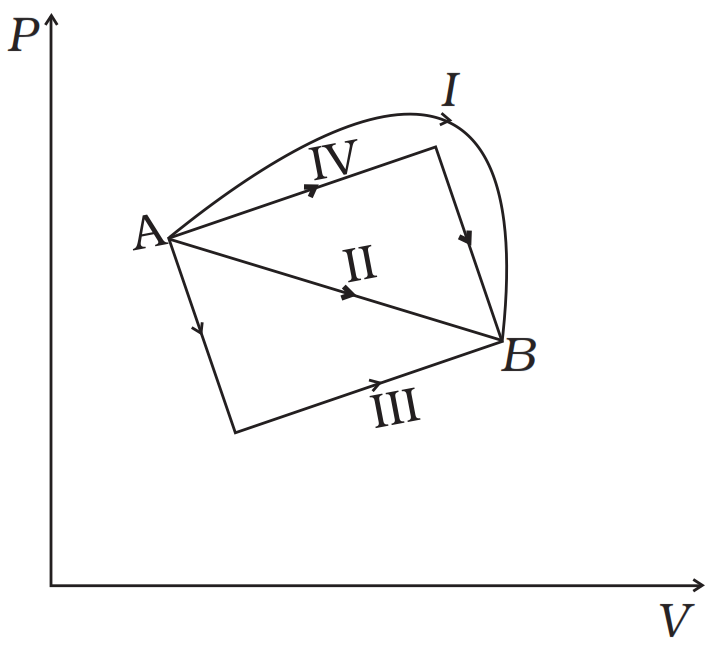
- Aheat is completely converted to mechanical energy in such a process, which is not possible.
- Bmechanical energy is completely converted to heat in this process, which is not possible.
- Ccurves representing two adiabatic processes don’t intersect.
- D
Answer
View full question & answer→- heat is completely converted to mechanical energy in such a process, which is not possible.
- curves representing two adiabatic processes don’t intersect.
Explanation:
- The given process is a cyclic process, i.e. it returns to the original state 1. And change in internal energy in a cyclic process is always zero as for cyclic process$\text{U}_\text{f}=\text{U}_\text{i}\ \text{So},\Delta\text{U}=\text{U}_\text{f}-\text{U}_\text{i}=0$ Hence, total heat is completely converted to mechanical energy. Such a process is not possible by second law of thermodynamics.
- Here, two curves are intersecting, when the gas expands adiabatically from 2 to 3. It is not possible to return to the same state without being heat supplied, hence the process 3 to 1 cannot be adiabatic. So, we conclude that such a process does not exist because curves representing two adiabatic processes do not intersect.
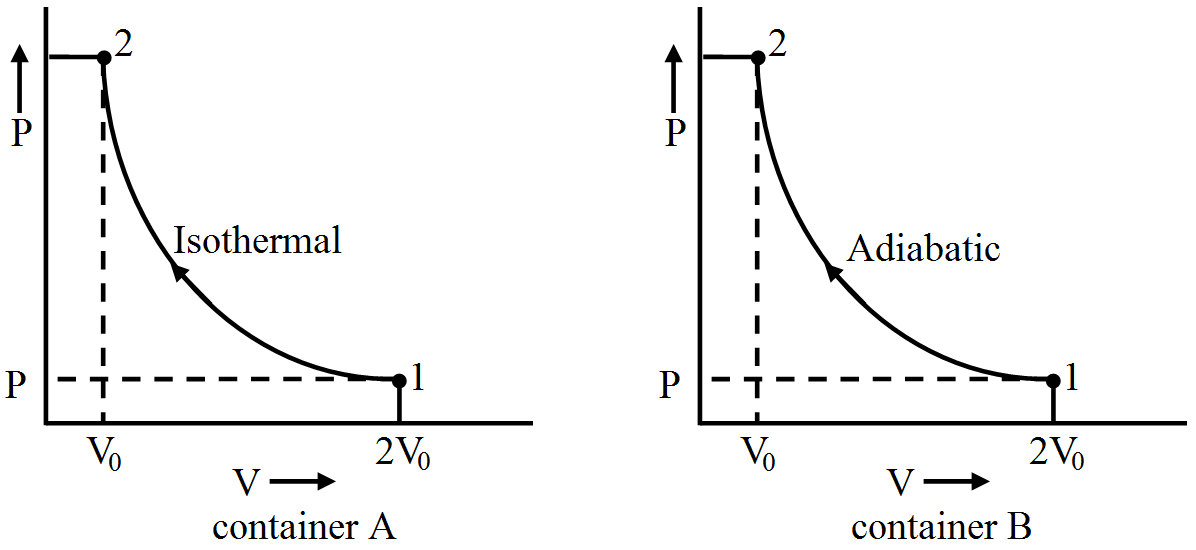
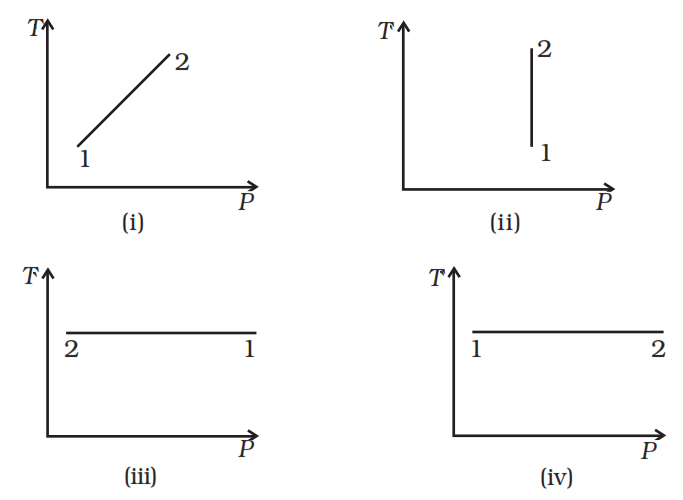
 Out of the following diagrams which represents the T-P diagram?