Questions

2 Marks Questions

Take a timed test

28 questions · self-marked practice — reveal the answer and mark yourself.

Question 12 Marks
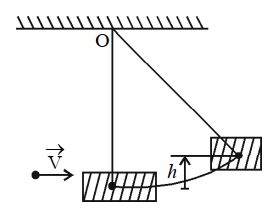
A sphere of mass $m kg$ moving with velocity $v$ stops after sinking into a hanging sand bag. If the mass of sand bag is $M$ and it rises to a height of $h$ then find the velocity of sphere.
View full question & answer
Question 22 Marks
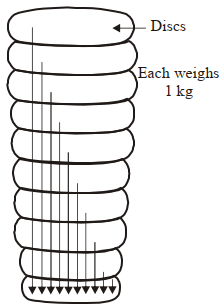
Ten identical discs each weighing 1 kg are placed one above the other on a horizontal page. Find out :
(i) Reaction force on the first disc from the top.
(ii) Reaction on force on the seventh disc from the top, $g=9.8 m / s ^2$.
(iii) Show all the forces acting on the tenth disc from the top.
View full question & answer
Question 32 Marks
A $5 0 0 g$ hammer hits to end of a nail with velocity of $m / s$. This pushes the nail 5 cm inward. If mass of nail is neglected then find :(i) Acceleration after hitting(ii) Time taken for hitting(iii) Value of impulse
Answer
 (i) Momentum $P =m v$
$\begin{aligned}
& =\frac{500}{1000} \times 6 \\
& =3 kg ms^{-1} \\
\frac{1}{2} m v^2 & =F \times s \\
\Rightarrow \quad \frac{1}{2} \times \frac{500}{1000} \times(6)^2 & =F \times \frac{5}{100} \\
\Rightarrow \quad 9 & =\frac{F}{20} \\
\Rightarrow \quad F & =9 \times 20=180 N
\end{aligned}$
Acceleration $a=\frac{ F }{m}=\frac{180}{0.5}$
$=300 m / s^2\quad \text { Ans. }$
(ii) We know that,
$\begin{aligned}
F \times t & =P \\
180 \times t & =3
\end{aligned}$
$\therefore \quad t=\frac{3}{180}=\frac{1}{60} sec . \quad Ans.$
(iii)
$\begin{aligned}
\text { Impulse } J & =F \times t \\
& =180 \times \frac{1}{60} \\
J & =3 N-s \quad Ans.
\end{aligned}$

View full question & answer
Question 42 Marks
A 2 kg block is kept at rest on a flat surface. A horizontal force $F$ on the block is gradually increased. When the value of $F$ becomes 8 N the block starts moving. Once the motion starts, it starts moving at a uniform speed only with the help of 7N force. Find out :
(i) Static and dynamic friction coefficient.
(ii) When the value of $F$ is 5 N , then the static friction force acting on the block is.
(iii) When the value of $F$ is again 8 N the acceleration of moving block. ( $g = 9 . 8 ~ m / s ^2$ )
Answer
 It is given :
$\text { (i) } \begin{aligned}
\text { Mass of block }(m) & =2 kg \\
\text { Static friction force } F_s & =m g \mu_s \\
8 & =2 \times 10 \mu_s \\
\therefore \quad & \mu_s \\
\therefore \quad & =\frac{8}{20}=\frac{4}{10}=0.4 \\
\mu_s & =0.4\quad \text { Ans. }
\end{aligned}$
Dynamic/kinetic friction force $\left( F _k\right)$
$\begin{aligned}
& =\mu_k m g \\
7 & =2 \times 10 \mu_k \\
\mu_k & =\frac{7}{20}=0.35\quad \text { Ans. }
\end{aligned}$
(ii) The magnitude of static friction force is equal to applied force but the directions are opposite. So on applying force of 5 N ,
$\therefore \quad$ Static friction force $=5 N\quad \text { Ans. }$
(iii) When a force of 8 N is applied on a moving block the force on the block $=($ applied force $)-($ friction force on moving object)
$=8 N-7 N=1 N$
$\therefore$ Acceleration of moving block
$\begin{aligned}
a & =\frac{F}{m} \\
& =\frac{1}{2}=0.5 m / s^2\quad \text { Ans. }
\end{aligned}$ 
View full question & answer
Question 52 Marks
A vehicle travels at $20 m / s$ on a flat road. If the coefficient of static friction between the road and the tires is $\mu=0.4$ then find the minimum distance in which the vehicle can be stopped
Answer
 Given, $u=20 m / s$
Coefficient of static friction $\left(\mu_s\right)=0.4$
Let mass of vechicle $=m kg$
Reaction force of road $( R )=m g$
$\begin{array}{l}
=m \times 10 \quad \because g=10 ms^{-2} \\
=10 mN N
\end{array}$
$\begin{aligned}
\text { Friction force } & =\mu_s \times R \\
& =0.4 \times 10 m \because R=10 m \\
& =4 mN
\end{aligned}$
Deceleration due to friction force $=\frac{4 m}{m}$
$=4 m / s^2$
From third equation of motion :
$\begin{aligned}
v^2 & =u^2+2 a s \\
0 & =(20)^2+2(-4) \times s \\
8 s & =400 \\
s & =\frac{400}{8}=50 m
\end{aligned}$
Hence, minimum distance $=50 m\quad \text { Ans. }$
View full question & answer
Question 62 Marks
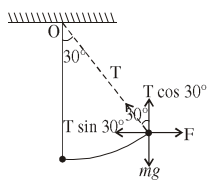
A body of mass 30 grams is tied to a long thread. A horizontal force displaces the body in such a way that the thread is now making an angle of $30^{\circ}$ with the vertical direction. Calculate the magnitude of the force.
View full question & answer
Question 72 Marks
Two forces of 3 N each are acting simultaneously on a 6 kg wooden bundle.
(i) If these forces makes an angle of $90^{\circ}$ with each other then find the magnitude and direction of the acceleration produced in cart.
(ii) If the force in one direction what will be the acceleration?
(iii) What will be acceleration if the forces are acting in opposite directions?
Answer
(i) When the forces are at $90^{\circ}$ then resultant force :
$\begin{aligned}
F & =\sqrt{(3)^2+(3)^2}=\sqrt{9+9} \\
& =\sqrt{18}=\sqrt{9 \times 2}=3 \sqrt{2} N \\
m & =6 kg \\
a & =\frac{F}{m}=\frac{3 \sqrt{2}}{6}=\frac{\sqrt{2}}{2} \\
& =\frac{1}{\sqrt{2}} m / s^2
\end{aligned}$
(ii) When forces are in same direction then total force
$\begin{aligned}
& =3+3=6 N \\
a & =\frac{F}{m}=\frac{6}{6}=1 m / s^2
\end{aligned}$
(iii) When forces are in opposite directions then resultant force $=0$
$\therefore \quad a=0$
View full question & answer
Question 82 Marks
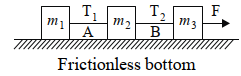
In the figure, three blocks are tied with two strings $A$ and $B . m_1=10 kg, m_2=5 kg, m_3=5 kg$. The bottom is frictionless. If $m _3$ is pulled to the right by applying a horizontal force of 50 N then calculate the tension in the strings.
Image
Answer

Image
$\begin{array}{l}m_1=10 kg \\ m_2=5 kg \\ m_3=5 kg\end{array}$
$\begin{aligned} \text { Acceleration } a & =\frac{ F }{m_1+m_2+m_3}=\frac{50}{10+5+5}=\frac{50}{20} \\ a & =2.5 m / s ^2 \\ T_1 & =m_1 a \\ & =10 \times 2.5=25 N \\ T _2- T _1 & =m_2 a \quad=5 \times 2.5 \\ \therefore \quad T_2- T _1 & =12.5 N \\ T _2 & =12.5 N+ T _1 \\ & =12.5+25=37.5 N \quad \text { Ans. }\end{aligned}$
View full question & answer
Question 92 Marks
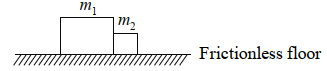
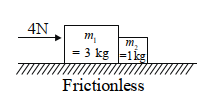
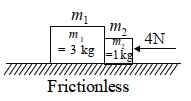
In the figure, the blocks are in contact with each other $m_1=3 kg, m_2=1 kg$. A horizontal force $F = 4 \mathrm { N }$. How much force can be applied :(i) On $m_1$ from the right side,
(ii) On $m_2$ from the left side? What will be the contact force between the two blocks?
View full question & answer
Question 102 Marks
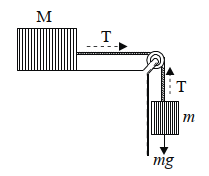
According to the figure, if the coefficient of static friction between block of mass 2 kg and the table is $\mu_s=0.2$ then what should be the maximum value of $m$ so that the block does not move while the pulley is light and frictionless.
Image
Answer
 Given
$\begin{array}{l}
M=2 kg \\
\mu_s=0.2
\end{array}$
Maximum value of $m=$ ?
$\begin{array}{rlrl}
\Rightarrow & Mg \times \mu_s & =m g \\
\Rightarrow & M \times \mu_s & =m \\
\therefore & m  =2 \times 0.2 \\
&=0.4 kg\quad \text { Ans. }
\end{array}$
View full question & answer
Question 112 Marks
A lineman of mass 80 kg slides down a cylindrical iron pole. If the friction force is constant, i.e., 720 N then find the acceleration of moving lineman
Answer
 Downward force on lineman
$\begin{array}{l}
=\text { Mass of lineman } \times g-\text { friction force } \\
=80 \times 10-720 \\
=800-720 \\
=80 N
\end{array}$
Acceleration of lineman
$\begin{array}{l}
=\frac{\text { Downward force }}{\text { Mass }} \\
=\frac{80}{80}=1 m / s^2 \quad Ans.
\end{array}$
View full question & answer
Question 122 Marks
The velocity of the jet of rocket is $9 km / s$. If 300 kg gas is deposited every second, find the force applied on the rocket
Answer
 It is given,
$\begin{aligned}
v & =9 km / s \\
v & =9000 m / s \\
\frac{d m}{d t} & =300 kg / sec
\end{aligned}$
Force applied on rocket :
$\begin{aligned}
F & =v \times \frac{d m}{d t} \\
& =9000 \times 300\\
\Rightarrow \quad & =27 \times 10^5 N \\
\Rightarrow \quad F & =2.7 \times 10^6 N\quad \text { Ans. }
\end{aligned}$
View full question & answer
Question 132 Marks
The velocity of an object of mass 5 kg changes from $0.85 m / s$ to $0.25 m / s$ in 0.03 sec . Find the resistance force required to do this
Answer
 It is given,
$\begin{aligned}
m & =5 kg \\
u & =0.85 m / s \\
v & =0.25 m / s \\
t & =0.03 s
\end{aligned}$
$\begin{aligned}
\text { Deceleration } & =\frac{u-v}{t} \\
& =\frac{0.85-0.25}{0.03}=\frac{0.60}{0.03} \\
& =20 m / s^2
\end{aligned}$
Required resistance force
$\begin{array}{l}
=\text { mass } \times \text { deceleration } \\
=5 \times 20=100 N\quad \text { Ans. }
\end{array}$ 
View full question & answer
Question 142 Marks
A bullet of $1 0 0$ grams moving with a velocity of $120 m / s$. It crosses a 20 cm thick wooden plank and hits the second target. If the wooden strap exerting an average resistance force of 1100 N then at what velocity will the bullet hit the second target?
Answer
It is given,
$\begin{aligned}
u & =120 m / s \\
m & =100 g=100 \times 10^{-3} kg \\
s & =20 cm=20 \times 10^{-2} m \\
F & =1100 N
\end{aligned}$
Average decelaration of bullet :
$\begin{array}{l}
a=\frac{F}{m}=\frac{1100}{0.1} \\
a=110.00 m / s^2
\end{array}$
$m=100 \times 10^{-3} kg$. Let the velocity of bullet after coming out of wooden plank is v then from equation of motion,
$\begin{aligned}
v^2 & =u^2+2 a s \\
& =(120)^2-2 \times(11000) \times 20 \times 10^{-2} \\
& =14400-2 \times 110 \times 20 \\
& =14400-4400 \\
v^2 & =10000 \\
v & =\sqrt{10000}=100 m / s . \quad \text { Ans. }
\end{aligned}$
View full question & answer
Question 152 Marks
What do you understand by angle of friction and angle of repose? Tell the relationship between them
Answer
For any two planes, the static coefficient is equal to the tangent of friction.$
\Rightarrow \quad \lambda=\tan ^{-1}\left(\mu_{s}\right)
$
This is called angle of friction.
The maximum angle of inclination of the inclined plane with the horizontal direction at which the object remains in a state of perfect equilibrium on the inclined plane is called angle of repose.Angle of friction = Angle of repose.
Hence angle of friction and angle of repose both are equal.
View full question & answer
Question 162 Marks
Write the laws of friction.
Answer
(1) Frictional force always opposes the movement
of the object, that is, it works in the opposite direction to the external force applied on the object.
(2) The value of limiting friction force doesn't depend on area of contact surfaces. It depend on nature of the surfaces of the objects.
(3) The maximum value $f_{s, \max }$ of static friction force is proportional to normal reaction (R).
i.e., $\quad f_{ s , \max } \propto R$
or $\quad f_{s, \max }=\mu_s R$
(iv) When the object starts sliding on the surface, the friction force reduces to kinetic friction force $f_{ K }$, where $f_{ K }=\mu_{ K } R$.
View full question & answer
Question 172 Marks
What are the measures to reduce the effect of friction? Explain. Explain the usefulness of lubricants.
Answer
    The smoother the surface, the less will be the friction force. By pouring oil etc. between two surfaces greatly reduces the friction force. Due to friction forces, more heat is generated in moving parts of continuously running engines due to which many of their parts melt or become soft or smooth. Therefore, they try to reduce the friction force by adding lubricant oil or grease etc. and keep reducing the heat by circulating coolants like air, water etc. in them Friction force is also reduced by using ball bearings.
   Usefulness of lubricants: Viscous liquid poured between two solid surfaces are called lubricants which reduces the effect of friction by forming a thin viscous layer between the two contacting objects. Generally, the surfaces of objects are not smooth, when objects are kept in contact with each other. The raised part of the first object sit into the depressions of the second object due to which internal looking occurs between the objects. As a result, objects are not able to slide on each other. By adding lubricant, internal locking is reduced and friction effect is reduced. Due to presence of intermolecular forces in liquids as compared to solids, the effect of friction force is less when lubricant is applied between two solid objects in contact. Thin oils are used as lubricants in light machines like sewing machines, mixers etc. whearas in heavy machines and vechicles thick oil or grease is used as lubricants. Compressed air is also used as lubricant.
View full question & answer
Question 182 Marks
What is meant by limiting friction force?
View full question & answer
Question 192 Marks
What is the difference between static friction, kinetic friction and rolling friction?
Answer
 Static friction : The friction force that acts on the planes in contact before relative motion occurs on them is called static friction.
kinetic friction : The force of friction for a moving object is less than that of stationary object. The limiting frictional force exerted on a moving object is called kineticfriction. Its value is always less than static friction. At the moment of commencement of motion the value of limiting friction decreases and becomes equal to kinetic friction.
Rolling friction : When an object rotates on a plane, the friction generated is called rolling friction. This friction is less than sliding friction.
View full question & answer
Question 202 Marks
State the law of conservation of momentum:
Answer
  Law of conservation of momentum :
According to Newton's second law, if
$\overrightarrow{F_1}$ is the total external force on any object or system then its rate of change is as follows
$\frac{d \overrightarrow{P}}{d t}=\overrightarrow{F}$
If total external force on system is zero then
$\frac{d \overrightarrow{P}}{d t}=0 \text { or } \overrightarrow{P}=\text { Constant }$
Therefore, if total external force on any system or object is zero then the momentum of that system remain unchanged in magnitude and direction. This is called the law of conservation of linear momentum
View full question & answer
Question 212 Marks
State the impulse-momentum theorem.
Answer
 
Impulse of a force is equal to change in momentum due to that force. This is called impulse momentum theroem. According this theorem is the change in momentum of an object is constant then its impulse will also be constant.
$\overrightarrow{J}=\left(\overrightarrow{P_2}-\overrightarrow{P_1}\right)
$
That is, if the forces $\vec{F}_1$ and $\vec{F}_2$ are applied to produce the same impulse of an object for time $t_1$ and $t_2$ respectively then,
$\overrightarrow{F_1} t_1=\overrightarrow{F_2} t_2$
View full question & answer
Question 222 Marks
If the kinetic energy of a light and heavy body is equal, then whose momentum is less?
Answer
  Let
$\begin{aligned} m _1 & > m _2 \\ \frac{1}{2} m_1 v _1^2 & =\frac{1}{2} m_2 v _2^2 \\ \frac{m_1}{m_2} & =\left(\frac{ v _2}{ v _1}\right)^2\end{aligned}$
Hence, $\quad\left( m _1 v_1\right) v _1=\left( m _2 v_2\right) v_2$

Hence, $\quad P _1 v _1= P _2 v _2$
But,
$\frac{v_2}{v_1}=\sqrt{\frac{m_1}{m_2}}=\frac{P_1}{P_2}$

But, $m_1>m_2$ so $v _2> v _1$

Hence,$P_1>P_2$
View full question & answer
Question 232 Marks
(i) A motor cycle and a car is moving with the same velocity. Which of these have more momentum?
(ii) A motorcycle and car moving with same momentum. Which of these will have greater speed?
View full question & answer
Question 242 Marks
Give any two examples to explain Newton's third law.
Answer
Newton's third law : "Action and reaction forces are equal in magnitude and opposite in direction but theseforces act on different objects." When an object applies force to another object it is called action. The force that second object exerts on the first object is called reaction force.
For example: (i) When a swimmer performs an action by pushing water backwards with his hands, the pushed water pushes the swimmer forward with the same reaction.
(ii) The action by which the person rowing the boat pushes the water back is equal to reaction that the water provides to the boat to move forward. Many other incidences of daily life can also be understood on basis of Newton's third law of motion.
View full question & answer
Question 252 Marks
According to Newton's third law of motion, the force with which the earth pulls the object towards itself, the object pulls the earth towards itself then why does the object fall towards the earth, why does the earth not fall towards the object.
Answer
When the earth pull the object towards itself it exert a force on object due to which the object starts falling towards earth at a fast speed of course, due to the object, a force is being applied on earth in the form of reaction, that is, the object pulls the earth towards itself with the same force. Due to this force, the earth moves rapidly towards the object but we don't experience this motion that is the earth doesn't fall towards the object because according to Newton's second law, the acceleration produced in the object when force is applied is equal to inversely praprotional to its mass. The mass of earth is much greater than that of the object. The acceleration produced in the earth is negligible compared to acceleration produced by the object. Therefore, the object falls towards the earth. Earth does not fall towards the object.
View full question & answer
Question 262 Marks
In general terrestrial experiments, which of the following observers are inertial and which are non-inertial?
(i) Pilot of an aircraft in flight.
(ii) A driver driving at a high steady speed of 200 km/h in a sports car on a straight road.
(iii) A cyclist taking a scissor turn.
(iv) The guard of a train slowing down and stopping at the station.
(v) A child moving in a big circle
Answer
 (i) Due to acceleration of the aircraft while flying its pilot is an non-inertial observer.
(ii) Since there is no acceleration in steady motion, the driver is inertial.
(iii) Centripetal acceleration on a cyclist while taking a scissor turn works so the driver is non-inertial observer.
(iv) The guard of a slow train is a non-inertial observer.
(v) Since it has non-inertial observer
View full question & answer
Question 272 Marks
How many types of inertia are there? Explain by example.
Answer
 There are three types of inertia:
(i) Inertia of rest: When the object is at rest relative to its surroundings then it is called inertia of rest. This situation can be changed only by applying external force, e.g., if an object kept in a house remains at the same place for days or years unless someone moves it from its position by applying force, it is an example of inertia of rest.
(ii) Inertia of motion: When an object is moved on a frictionless surface or thrown into a vacuum, it will continue to move on its original path unless an external force is applied. In real situation, air or floor etc. create friction on a moving object hence we are not able to see frictionless motion. This type of inertia in which the object keeps moving is called the inertia of motion.
(iii) Inertia of direction: In the above example, we see that unless an external force acts, the object or particle keeps moving in its direction. This property of motion is called inertia of direction.
View full question & answer
Question 282 Marks
What is inertia? Explain with examples
Answer
 Inertia: An object remains at rest or moves in a straight line with uniform speed if no external force acts on it. Here force means unbalanced force.
    This property of an object due to which it resists change in its state of rest or motion is called inertia. If the mass of the object is greater the inertia of object will also be greater.
    Two objects of equal mass (one of which is moving and other is stationary) have the same inertia because inertia depends only on mass. It does not depend on velocity and size of object. It has no unit or dimension
Example: (i) we place a smooth card on a glass and place a coin on it. If we hit the card with our finger, the card slides forward but the coin remains at its place due to inertia, hence it falls into glass.
   (ii) The principle of inertia is take advantage of unloading grains from sea ships and loading them into goods trains. The grain falls from the ship on a wide belt, which rotates rapidly with the help of rollers. At the other end, the grain runs forward rapidly on the same surface and falls into the compartment of goods train.
View full question & answer
Generate Paper FreeAll PART - 1 CH - 4 Laws of Motion topics