MCQ
According to the Rutherford's atomic model, the electrons inside the atom are
  • A
    Stationary
  • Not stationary
  • C
    Centralized
  • D
    None of these

Answer

Correct option: B.
Not stationary

Need a full question paper?

Generate a complete, print-ready paper with questions like this in minutes — across 16+ boards, with answer keys.
Start Generating Free

Similar questions

The Doppler's effect is applicable for
An open pipe of length $I$ vibrates in fundamental mode. The pressure variation is maximum at
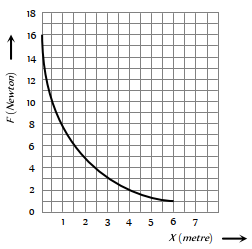
The relation between the displacement $X$ of an object produced by the application of the variable force $F$ is represented by a graph shown in the figure. If the object undergoes a displacement from $X=0.5 \mathrm{~m}$ to $X=2.5 \mathrm{~m}$ the work done will be approximately equal to
Image
The specific heat at constant pressure and at constant volume for an ideal gas are $C_p$ and $C_v$ and its adiabatic and isothermal elasticities are $E_\phi$ and $E_\theta$ respectively. The ratio of $E_\phi$ to $E_\theta$ is
The coefficient of linear expansion of brass and steel are $\alpha_1$ and $\alpha_2$. If we take a brass rod of length $l_1$ and steel rod of length $l_2$ at $0^{\circ} C$, their difference in length $\left(l_2-l_1\right)$ will remain the same at a temperature if
A block of mass $0.1 \mathrm{~kg}$ is held against a wall by applying a horizontal force of $5 \mathrm{~N}$ on the block. If the coefficient of friction between the block and the wall is $0.5,$ the magnitude of the frictional force acting on the block is
A symmetric double convex lens is cut in two equal parts by a plane perpendicular to the principal axis. If the power of the original lens was $4 D$, the power of a cut lens will be
A ball is projected with kinetic energy $E$ at an angle of $45^{\circ}$ to the horizontal. At the highest point during its flight, its kinetic energy will be
A train is moving with velocity $20\  m / sec$. on this dust is falling at the rate of $50\  kg /$ minute. The extra force required to move this train with constant velocity will be
Consider two hot bodies $B_1$ and $B_2$ which have temperatures $100^{\circ} \mathrm{C}$ and $80^{\circ} \mathrm{C}$ respectively at $t=0$. The temperature of the surroundings is $40^{\circ} \mathrm{C}$. The ratio of the respective rates of cooling $R_1$ and $R_2$ of these two bodies at $t=0$ will be