MCQ 11 Mark
The energy of the highest energy photon of Balmer series of hydrogen spectrum is close to
- A
$13.6 eV$
- ✓
$3.4 eV$
- C
$1.5 eV$
- D
$0.85 eV$
AnswerCorrect option: B. $3.4 eV$
$E=13.6\left[\frac{1}{n_1^2}-\frac{1}{n_2^2}\right]$.
For highest energy in Balmer series $n_1=2$ and $n_2=\infty \Rightarrow E=13.6\left[\frac{1}{(2)^2}-\frac{1}{(\infty)^2}\right]=3.4 \mathrm{eV}$
View full question & answer→MCQ 21 Mark
In the spectrum of hydrogen atom, the ratio of the longest wavelength in Lyman series to the longest wavelength in the Balmer series is
- ✓
$5 / 27$
- B
$1 / 93$
- C
$4 / 9$
- D
$3 / 2$
AnswerCorrect option: A. $5 / 27$
In Lyman series $\lambda_{\max }=\frac{4}{3 R}$In Balmer series $\lambda_{\max }=\frac{36}{5 R}$.
So required ratio $=\frac{5}{27}$
View full question & answer→MCQ 31 Mark
The ratio of the wavelengths for $2 \rightarrow 1$ transition in $L i, H e$ and $H$ is
- A
$1: 2: 3$
- B
$1: 4: 9$
- ✓
$4: 9: 36$
- D
$3: 2: 1$
AnswerCorrect option: C. $4: 9: 36$
$ \frac{1}{\lambda}=R Z^2\left(\frac{1}{n_1^2}-\frac{1}{n_2^2}\right) \Rightarrow \lambda \propto \frac{1}{Z^2}$
$ \lambda_{L^{++}}: \lambda_{H e^{+}}: \lambda_H=4: 9: 36$
View full question & answer→MCQ 41 Mark
In the following transitions, which one has higher frequency
Answer$3-1$ transition has higher energy so it has higher frequency$\left(v=\frac{E}{h}\right)$
View full question & answer→MCQ 51 Mark
Energy of an electron in an excited hydrogen atom is $-3.4 eV$. Its angular momentum will be: $h=6.626 \times 10^{-34} J -s$
- A
$1.11 \times 10^{34} J sec$
- B
$1.51 \times 10^{-31} J sec$
- ✓
$2.11 \times 10^{-34} J sec$
- D
$3.72 \times 10^{-34} J sec$
AnswerCorrect option: C. $2.11 \times 10^{-34} J sec$
The electron is in the second orbit $(n=2)$
Hence $L=\frac{n h}{2 \pi}=\frac{2 h}{2 \pi}=\frac{6.6 \times 10^{-34}}{\pi}=2.11 \times 10^{-34} \mathrm{~J}-\mathrm{sec}$
View full question & answer→MCQ 61 Mark
Which of the following statements are true regarding Bohr's model of hydrogen atom$(1)$ Orbiting speed of electron decreases as it shifts to discrete orbits away from the nucleus$(11)$ Radii of allowed orbits of electron are proportional to the principal quantum number$(111)$ Frequency with which electrons orbits around the nucleus in discrete orbits is inversely proportional to the principal quantum number $(IV)$ Binding force with which the electron is bound to the nucleus increases as it shifts to outer orbits Select correct answer using the codes given below Codes :
- ✓
$1$ and $111$
- B
$11$ and $1 V$
- C
$1, 11$ and $111$
- D
$11, 111$ and $1 V$
AnswerCorrect option: A. $1$ and $111$
Orbital speed varies inversely as the radius of the orbit. Energy increases with the increase in quantum number.
View full question & answer→MCQ 71 Mark
Who discovered spin quantum number
MCQ 81 Mark
What will be the angular momentum of a electron, if energy of this electron in $H$-atom is $1.5 eV$ (in $/$-sec) $\quad$
- A
$1.05 \times 10^{-34}$
- B
$2.1 \times 10^{-34}$
- ✓
$3.15 \times 10^{-34}$
- D
$-2.1 \times 10^{-34}$
AnswerCorrect option: C. $3.15 \times 10^{-34}$
Energy of electron in $H$ atom $E_n=\frac{-13.6}{n^2} \mathrm{eV}$
$\Rightarrow-1.5=\frac{-13.6}{n^2} \Rightarrow n^2=\frac{13.6}{1.5}=3$
Now angular momentum$p=n \frac{h}{2 \pi}=\frac{3 \times 6.6 \times 10^{-34}}{2 \times 3.14}=3.15 \times 10^{-34} \mathrm{~J} \times \mathrm{sec}$
View full question & answer→MCQ 91 Mark
If $\lambda_{\text {max }}$ is $6563 \mathring A$, then wave length of second line for Balmer series will be
- ✓
$\lambda=\frac{16}{3 R}$
- B
$\lambda=\frac{36}{5 R}$
- C
$\lambda=\frac{4}{3 R}$
- D
AnswerCorrect option: A. $\lambda=\frac{16}{3 R}$
For Balmer series $\frac{1}{\lambda}=R\left(\frac{1}{2^2}-\frac{1}{n^2}\right)$ where $n=3,4,5$
For second line $n=4$
So $\frac{1}{\lambda}=R\left(\frac{1}{2^2}-\frac{1}{4^2}\right)=\frac{3}{16} R \Rightarrow \lambda=\frac{16}{3 R}$
View full question & answer→MCQ 101 Mark
If scattering particles are $56$ for $90^{\circ}$ angle then this will be at $60^{\circ}$ angle
AnswerAccording to scattering formula
$ N \propto \frac{1}{\sin ^4(\theta / 2)} \Rightarrow \frac{N_2}{N_1}=\left[\frac{\sin \left(\theta_1 / 2\right)}{\sin \left(\theta_2 / 2\right)}\right]^4$
$\Rightarrow \frac{N_2}{N_1}=\left[\frac{\sin \frac{90^{\circ}}{2}}{\sin \frac{60^{\circ}}{2}}\right]^4=\left[\frac{\sin 45^{\circ}}{\sin 30^{\circ}}\right]^4 $
$\Rightarrow N_2=(\sqrt{2})^4 \times N_1=4 \times 56=224$
View full question & answer→MCQ 111 Mark
Which one of the series of hydrogen spectrum is in the visible region
AnswerBalmer series lies in the visible region.
View full question & answer→MCQ 121 Mark
lonization energy of hydrogen is $13.6\ eV$. If $h=6.6 \times 10^{-34} J - sec$, the value of $R$ will be of the order of
- A
$10^{10} m ^{-1}$
- ✓
$10^7 m ^{-1}$
- C
$10^4 m ^{-1}$
- D
$10^{-7} m ^{-1}$
AnswerCorrect option: B. $10^7 m ^{-1}$
$ E=-R c h \Rightarrow R=-\frac{E}{c h}=-\frac{13.6 \times 1.6 \times 10^{-19}}{3 \times 10^8 \times 6.6 \times 10^{-34}} $
$ =1.098 \times 10^7 \text { per } m$
View full question & answer→MCQ 131 Mark
The first line of Balmer series has wavelength $6563 \mathring A$. What will be the wavelength of the first member of Lyman series
- ✓
$1215.4 \mathring A$
- B
$2500 \mathring A$
- C
$7500 \mathring A$
- D
$600 \mathring A$
AnswerCorrect option: A. $1215.4 \mathring A$
$ \frac{1}{\lambda_{\text {Balmer }}}=R\left[\frac{1}{2^2}-\frac{1}{3^2}\right]=\frac{5 R}{36}, \frac{1}{\lambda_{\text {Lyman }}}=R\left[\frac{1}{1^2}-\frac{1}{2^2}\right]=\frac{3 R}{4} $
$ \therefore \lambda_{\text {Lyman }}=\lambda_{\text {Balmer }} \times \frac{5}{27}=1215.4 \mathring A$
View full question & answer→MCQ 141 Mark
With the increase in principle quantum number, the energy difference between the two successive energy levels
- A
- ✓
- C
- D
Sometimes increases and sometimes decreases
View full question & answer→MCQ 151 Mark
When the wave of hydrogen atom comes from infinity into the first orbit then the value of wave number is
- ✓
$109700 cm$
- B
$1097 cm$
- C
$109 cm$
- D
AnswerCorrect option: A. $109700 cm$
$ \text { Wave number } \bar{v}=\frac{1}{\lambda}=R\left[\frac{1}{n_1^2}-\frac{1}{n_2^2}\right] ; n_2=\infty \quad \text { and } n_1=1 $
$ \Rightarrow \bar{v}=R=1.097 \times 10^7 \mathrm{~m}^{-1}=109700 \mathrm{~cm}^{-1}$
View full question & answer→MCQ 161 Mark
Which of the following is true for number of spectral lines in going form Layman series to Pfund series
- A
- ✓
- C
- D
May decreases or increases
AnswerMaximum number of spectral lines are observed in Lymen series.
View full question & answer→MCQ 171 Mark
Orbital acceleration of electron is
- ✓
$\frac{n^2 h^2}{4 \pi^2 m^2 r^3}$
- B
$\frac{n^2 h^2}{2 n^2 r^3}$
- C
$\frac{4 n^2 h^2}{\pi^2 m^2 r^3}$
- D
$\frac{4 n^2 h^2}{4 \pi^2 m^2 r^3}$
AnswerCorrect option: A. $\frac{n^2 h^2}{4 \pi^2 m^2 r^3}$
$m v r=\frac{n h}{2 \pi} \Rightarrow v=\frac{n h}{2 \pi m r} \Rightarrow \frac{v^2}{r}=\frac{n^2 h^2}{4 \pi^2 m^2 r^3}$.
View full question & answer→MCQ 181 Mark
Energy of electron in a orbit of $H-$atom is
Answer$E_n=-\frac{13.6}{n^2} \mathrm{eV}$
View full question & answer→MCQ 191 Mark
The energy of electron in first excited state of $H-$atom is $-3.4 eV$ its kinetic energy is
- A
$-3.4 eV$
- ✓
$+3.4 eV$
- C
$-6.8 eV$
- D
$6.8 eV$
AnswerCorrect option: B. $+3.4 eV$
Kinetic energy $=\mid$ Total energy $\mid$
View full question & answer→MCQ 201 Mark
For electron moving in $n$ orbit of $H$-atom the angular velocity is proportional to
- A
$n/1$
- B
$1 / n$
- C
$n$
- ✓
$1 / n$
AnswerCorrect option: D. $1 / n$
View full question & answer→MCQ 211 Mark
The third line of Balmer series of an ion equivalent to hydrogen atom has wavelength of $108.5 nm$. The ground state energy of an electron of this ion will be
- A
$3.4 eV$
- B
$13.6 eV$
- ✓
$54.4 eV$
- D
$122.4 eV$
AnswerCorrect option: C. $54.4 eV$
For third line of Balmer series $n_1=2, n_2=5$
$\therefore \frac{1}{\lambda}=R Z^2\left[\frac{1}{n_1^2}-\frac{1}{n_2^2}\right]$ gives $Z^2=\frac{n_1^2 n_2^2}{\left(n_2^2-n_1^2\right) \lambda R}$
On putting values $Z=2$From $E=-\frac{13.6 Z^2}{n^2}=\frac{-13.6(2)^2}{(1)^2}=-54.4 \mathrm{eV}$
View full question & answer→MCQ 221 Mark
The extreme wavelengths of Paschen series are
- A
$0.365 \mu m$ and $0.565 \mu m$
- ✓
$0.818 \mu m$ and $1.89 \mu m$
- C
$1.45 \mu m$ and $4.04 \mu m$
- D
$2.27 \mu m$ and $7.43 \mu m$
AnswerCorrect option: B. $0.818 \mu m$ and $1.89 \mu m$
Similarly $\lambda_{\min }=\frac{9}{R}=\frac{9}{1.1 \times 10^7}=0.818 \mu \mathrm{m}$
$ \text { In Paschen series } \frac{1}{\lambda_{\max }}=R\left[\frac{1}{(3)^2}-\frac{1}{(4)^2}\right]$
$ \Rightarrow \lambda_{\max }=\frac{144}{7 R}=\frac{144}{7 \times 1.1 \times 10^7}=1.89 \times 10^{-6} \mathrm{~m}=1.89 \mu \mathrm{m}$
View full question & answer→MCQ 231 Mark
An ionic atom equivalent to hydrogen atom has wavelength equal to $1 / 4$ of the wavelengths of hydrogen lines. The ion will be
- ✓
$He ^{+}$
- B
$Li ^{++}$
- C
$Ne e^{9+}$
- D
$Na a^{10+}$
AnswerCorrect option: A. $He ^{+}$
$\bar{v} \propto \frac{1}{\lambda} \propto Z^2 \Rightarrow \lambda Z^2=$ constant $\Rightarrow \lambda=\frac{\lambda}{4} Z^2 \Rightarrow Z=2$
View full question & answer→MCQ 241 Mark
Which of the following spectral series in hydrogen atom give spectral line of $4860 \mathring A$
View full question & answer→MCQ 251 Mark
The ratio of the kinetic energy to the total energy of an electron in a Bohr orbit is
MCQ 261 Mark
The angular momentum of electron in $\pi$ orbit is given by
- A
$n h$
- B
$\frac{h}{2 \pi n}$
- ✓
$n \frac{h}{2 \pi}$
- D
$n^2 \frac{h}{2 \pi}$
AnswerCorrect option: C. $n \frac{h}{2 \pi}$
According to Bohr's second postulate.
View full question & answer→MCQ 271 Mark
Taking Rydberg's constant $R_H=1.097 \times 10^7 m$ first and second wavelength of Balmer series in hydrogen spectrum is
- A
$2000 \mathring A, 3000\mathring A$
- B
$1575 \mathring A, 2960 \mathring A$
- C
$6529 \mathring A, 4280 \mathring A$
- ✓
$6563 \mathring A, 4861 \mathring A$
AnswerCorrect option: D. $6563 \mathring A, 4861 \mathring A$
$\frac{1}{\lambda}=R\left[\frac{1}{n_1^2}-\frac{1}{n_2^2}\right]$.
For first wavelength, $n_1=2, n_2=3$
$\Rightarrow \lambda_1=6563 \mathring A$.
For second wavelength, $n_1=2, n_2=4$
$\Rightarrow \lambda_2=4861 \mathring A$
View full question & answer→MCQ 281 Mark
The wavelength of light emitted from second orbit to first orbits in a hydrogen atom is
- ✓
$1.215 \times 10^{-7} m$
- B
$1.215 \times 10^{-5} m$
- C
$1.215 \times 10^{-4} m$
- D
$1.215 \times 10^{-3} m$
AnswerCorrect option: A. $1.215 \times 10^{-7} m$
Energy radiated $E=10.2 \mathrm{eV}=10.2 \times 1.6 \times 10^{-19} \mathrm{~J}$
$\Rightarrow E=\frac{h c}{\lambda} \Rightarrow \lambda=1.215 \times 10^{-7} \mathrm{~m}$
View full question & answer→MCQ 291 Mark
An electron jumps from $5^*$ orbit to $4^*$ orbit of hydrogen atom. Taking the Rydberg constant as $10^7$ per metre. What will be the frequency of radiation emitted
- A
$6.75 \times 10^{12} Hz$
- B
$6.75 \times 10^{14} Hz$
- ✓
$6.75 \times 10^{13} Hz$
- D
AnswerCorrect option: C. $6.75 \times 10^{13} Hz$
$ \text { By using } v=R C\left[\frac{1}{n_1^2}-\frac{1}{n_2^2}\right]$
$ \Rightarrow v=10^7 \times\left(3 \times 10^8\right)\left[\frac{1}{4^2}-\frac{1}{5^2}\right]=6.75 \times 10^{13} \mathrm{Hz}$
View full question & answer→MCQ 301 Mark
In a hydrogen atom, the distance between the electron and proton is $2.5 \times 10^{-11} m$. The electrical force of attraction between them will be
- A
$2.8 \times 10^{-7} N$
- ✓
$3.7 \times 10^{-7} N$
- C
$6.2 \times 10^{-7} N$
- D
$9.1 \times 10^{-7} N$
AnswerCorrect option: B. $3.7 \times 10^{-7} N$
$F=\frac{9 \times 10^9 \times 1.6 \times 10^{-19} \times 1.6 \times 10^{-19}}{\left(2.5 \times 10^{-11}\right)^2}=3.7 \times 10^{-7} \mathrm{~N}$
View full question & answer→MCQ 311 Mark
The concept of stationary orbits was proposed by
MCQ 321 Mark
The energy required to excite an electron from the ground state of hydrogen atom to the first excited state, is
- A
$1.602 \times 10^{-14} J$
- B
$1.619 \times 10^{-16} J$
- ✓
$1.632 \times 10^{-18} J$
- D
$1.656 \times 10^{-20} J$
AnswerCorrect option: C. $1.632 \times 10^{-18} J$
View full question & answer→MCQ 331 Mark
The energy of electron in the $n$th orbit of hydrogen atom is expressed as $E_n-\frac{e V}{n}$. The shortest and longest wavelength of Lyman series will be
- ✓
$910 \mathring A, 1213 \mathring A$
- B
$5463 \mathring A, 7858 \mathring A$
- C
$1315 \mathring A, 1530 \mathring A$
- D
AnswerCorrect option: A. $910 \mathring A, 1213 \mathring A$
$ \frac{1}{\lambda_{\max }}=R\left[\frac{1}{(1)^2}-\frac{1}{(2)^2}\right] \Rightarrow \lambda_{\max }=\frac{4}{3 R} \approx 1213 \mathring A $
$ \text { and } \frac{1}{\lambda_{\min }}=R\left[\frac{1}{(1)^2}-\frac{1}{\infty}\right] \Rightarrow \lambda_{\min }=\frac{1}{R} \approx 910 \mathring A$
View full question & answer→MCQ 341 Mark
The kinetic energy of electron in the first Bohr orbit of the hydrogen atom is
- A
$-6.5 eV$
- B
$-27.2 eV$
- ✓
$13.6 eV$
- D
$-13.6 eV$
AnswerCorrect option: C. $13.6 eV$
K.E. $=-($ Total energy $)=-(-13.6 \mathrm{eV})=+13.6 \mathrm{eV}$
View full question & answer→MCQ 351 Mark
The ionisation potential of hydrogen atom is $13.6$ volt. The energy required to remove an electron in the $n=2$ state of the hydrogen atom is
- A
$27.2 eV$
- B
$13.6 eV$
- C
$6.8 eV$
- ✓
$3.4 eV$
AnswerCorrect option: D. $3.4 eV$
Energy required to remove electron in the $n=2$ state $=+\frac{13.6}{(2)^2}=+3.4 \mathrm{eV}$
View full question & answer→MCQ 361 Mark
If $m$ is mass of electron, $v$ its velocity, $r$ the radius of stationary circular orbit around a nucleus with charge $Z e$, then from Bohr's first postulate, the kinetic energy $K=\frac{1}{2} m v^2$ of the electron in C.G.S. system is equal to
AnswerCorrect option: A. $\frac{1}{2} \frac{Z e^2}{r}$
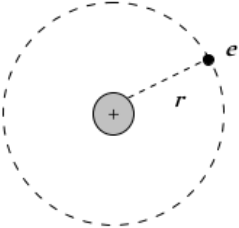
in the revolution of electron, coulomb force provide the necessry centripetal force
$\Rightarrow \frac{z e^2}{r^2}=\frac{m v^2}{r} \Rightarrow m v^2=\frac{z e^2}{r}$
$\therefore \text { K.E. }=\frac{1}{2} m v^2=\frac{z e^2}{2 r}$ View full question & answer→MCQ 371 Mark
The wavelength of the first line of Balmer series is $6563 \mathring A$. The Rydberg constant for hydrogen is about
- ✓
(a) $1.09 \times 10^7$ per $m$
- B
(b) $1.09 \times 10^8$ per m
- C
(c) $1.09 \times 10^9$ per m
- D
(d) $1.09 \times 10^5$ per m
AnswerCorrect option: A. (a) $1.09 \times 10^7$ per $m$
$ \frac{1}{\lambda}=R\left[\frac{1}{4}-\frac{1}{9}\right]=\frac{5 R}{36} $
$ \therefore R=\frac{36}{5 \lambda}=\frac{36}{5 \times 6563 \times 10^{-10}}=1.09 \times 10^7 \mathrm{~m}^{-1}$
View full question & answer→MCQ 381 Mark
The Rydberg constant $R$ for hydrogen is
- A
$R=-\left(\frac{1}{4 \pi \varepsilon_0}\right) \cdot \frac{2 \pi^2 m e^2}{c h^2}$
- B
$R=\left(\frac{1}{4 \pi \varepsilon_0}\right) \cdot \frac{2 \pi^2 m e^4}{c h^2}$
- C
$R=\left(\frac{1}{4 \pi \varepsilon_0}\right)^2 \cdot \frac{2 \pi^2 m e^4}{c^2 h^2}$
- ✓
$R=\left(\frac{1}{4 \pi \varepsilon_0}\right)^2 \cdot \frac{2 \pi^2 m e^4}{c h^3}$
AnswerCorrect option: D. $R=\left(\frac{1}{4 \pi \varepsilon_0}\right)^2 \cdot \frac{2 \pi^2 m e^4}{c h^3}$
$ R=\frac{2 \pi^2 k^2 e^4 m}{c h^3}=\left(\frac{1}{4 \pi \varepsilon_0}\right)^2 \frac{2 \pi^2 m e^4}{c h^3}$
View full question & answer→MCQ 391 Mark
The shortest wavelength in the Lyman series of hydrogen spectrum is $912 \mathring A$ corresponding to a photon energy of $13.6 eV$. The shortest wavelength in the Balmer series is about
- ✓
$3648 \mathring A$
- B
$8208 \mathring A$
- C
$1228 \mathring A$
- D
$6566 \mathring A$
AnswerCorrect option: A. $3648 \mathring A$
In Lyman series $\left(\lambda_{\min }\right)_L=\frac{1}{R}$ and $\left(\lambda_{\min }\right)_B=\frac{4}{R}$
$\Rightarrow\left(\lambda_{\min }\right)_B=4 \times\left(\lambda_{\min }\right)_L=4 \times 912=3648 \mathring A$
View full question & answer→MCQ 401 Mark
Which of the following is quantised according to Bohr's theory of hydrogen atom
- A
Linear momentum of electron
- ✓
Angular momentum of electron
- C
Linear velocity of electron
- D
Angular velocity of electron
AnswerCorrect option: B. Angular momentum of electron
View full question & answer→MCQ 411 Mark
An electron in the $n=1$ orbit of hydrogen atom is bound by $13.6 eV$ energy is required to ionize it is
- ✓
$13.6 eV$
- B
$6.53 eV$
- C
$5.4 eV$
- D
$1.51 eV$
AnswerCorrect option: A. $13.6 eV$
lonization energy $=$ Binding energy.
View full question & answer→MCQ 421 Mark
The possible quantum number for $3 d$ electron are
- A
$n=3, l=1, m_l=+1, m_s=-\frac{1}{2}$
- ✓
$n=3, l=2, m_l=+2, m_s=-\frac{1}{2}$
- C
$n=3, l=1, m_l=-1, m_s=+\frac{1}{2}$
- D
$n=3, l=0, m_l=+1, m_s=-\frac{1}{2}$
AnswerCorrect option: B. $n=3, l=2, m_l=+2, m_s=-\frac{1}{2}$
View full question & answer→MCQ 431 Mark
When the electron in the hydrogen atom jumps from $2^{-}$orbit to $1^{-}$ orbit, the wavelength of radiation emitted is $\lambda$. When the electrons jump from 3 orbit to 1 orbit, the wavelength of emitted radiation would be
- ✓
$\frac{27}{32} \lambda$
- B
$\frac{32}{27} \lambda$
- C
$\frac{2}{3} \lambda$
- D
$\frac{3}{2} \lambda$
AnswerCorrect option: A. $\frac{27}{32} \lambda$
$\frac{1}{\lambda}=R\left[\frac{1}{n_1^2}-\frac{1}{n_2^2}\right]$
First condition $\frac{1}{\lambda}=R\left[\frac{1}{1^2}-\frac{1}{2^2}\right] \Rightarrow R=\frac{4}{3 \lambda}$
Second condition $\frac{1}{\lambda^{\prime}}=R\left[\frac{1}{1^2}-\frac{1}{3^2}\right]$
$\Rightarrow \lambda^{\prime}=\frac{9}{8 R} \Rightarrow \lambda^{\prime}=\frac{9}{8 \times \frac{4}{3 \lambda}}=\frac{27 \lambda}{32}$
View full question & answer→MCQ 441 Mark
Four lowest energy levels of $H$-atom are shown in the figure. The number of possible emission lines would be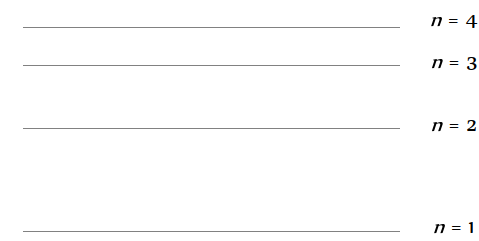
AnswerNumber of possible emission lines $=\frac{n(n-1)}{2}$
Where $n=4$; Number $=\frac{4(4-1)}{2}=6$.
View full question & answer→MCQ 451 Mark
The ratio of the speed of the electron in the first Bohr orbit of hydrogen and the speed of light is equal to (where $e, h$ and $c$ have their usual meanings)
- A
$2 \pi h c / e^2$
- B
$e^2 h / 2 \pi c$
- C
$e^2 c / 2 \pi h$
- ✓
$2 \pi e^2 / h c$
AnswerCorrect option: D. $2 \pi e^2 / h c$
Speed of electron in $n$ orbit (in CGS)$v_n=\frac{2 \pi Z e^2}{n h}(k=1)$
For first orbit $H_2 ; n=1$ and $Z=1$
So $v=\frac{2 \pi e^2}{h} \Rightarrow \frac{v}{c}=\frac{2 \pi e^2}{h c}$
View full question & answer→MCQ 461 Mark
The radius of the Bohr orbit in the ground state of hydrogen atom is $0.5 \mathring A$. The radius of the orbit of the electron in the third excited state of $He ^{+}$will be
- ✓
$8 \mathring A$
- B
$4 \mathring A$
- C
$0.5 \mathring A$
- D
$0.25 \mathring A$
AnswerCorrect option: A. $8 \mathring A$
$8 \mathring A$
View full question & answer→MCQ 471 Mark
If the ionisation potential of helium atom is $24.6$ volt, the energy required to ionise it will be
- ✓
$24.6\ eV$
- B
$24.6\ V$
- C
$13.6\ V$
- D
$13.6\ eV$
AnswerCorrect option: A. $24.6\ eV$
Energy required to ionise helium atom $=24.6\ \mathrm{eV}$
View full question & answer→MCQ 481 Mark
In terms of Rydberg's constant $R$, the wave number of the first Balmer line is
- A
$R$
- B
$3 R$
- ✓
$\frac{5 R}{36}$
- D
$\frac{8 R}{9}$
AnswerCorrect option: C. $\frac{5 R}{36}$
Wave number$=\frac{1}{\lambda}=R\left(\frac{1}{n_1^2}-\frac{1}{n_2^2}\right)$For first Balmer line $n=2, n=3$
$\therefore \text { Wave number }=R\left(\frac{1}{2^2}-\frac{1}{3^2}\right)=R\left(\frac{9-4}{9 \times 4}\right)=\frac{5 R}{36}$
View full question & answer→MCQ 491 Mark
Which of the following statements about the Bohr model of the hydrogen atom is false
- ✓
Acceleration of electron in $n=2$ orbit is less than that in $n=1$ orbit
- B
Angular momentum of electron in $n=2$ orbit is more than that in $n=1$ orbit
- C
Kinetic energy of electron in $n=2$ orbit is less than that in $n= 1$ orbit
- D
Potential energy of electron in $n=2$ orbit is less than that in $n$ $=1$ orbit
AnswerCorrect option: A. Acceleration of electron in $n=2$ orbit is less than that in $n=1$ orbit
Potential energy of electron in $n=2$ orbit is less than that in $n$ $=1$ orbit
View full question & answer→MCQ 501 Mark
An electron in the $n=1$ orbit of hydrogen atom is bound by $13.6 eV$. If a hydrogen atom is in the $n=3$ state, how much energy is required to ionize it
- A
$13.6\ eV$
- B
$4.53\ eV$
- C
$3.4\ eV$
- ✓
$1.51\ eV$
AnswerCorrect option: D. $1.51\ eV$
Required energy $E_3=\frac{+13.6}{3^2}=1.51 \mathrm{eV}$
View full question & answer→