MCQ
According to the uncertainty principle for an electron, time measurement will become uncertain if which of the following is measured with high certainty?
- AEnergy
- BMomentum
- CLocation
- DVelocity
Explanation:
According to the uncertainty principle,
$\triangle\text{E}.\triangle\text{t}>=\frac{\text{h}}{2\pi}.$
Thus the time measured will become uncertain if $\triangle\text{E}$ is measured with high certainty.
Generate a complete, print-ready paper with questions like this in minutes — across 16+ boards, with answer keys.
Energy of an electron in an excited hydrogen atom is – 3.4 eV. Its angular momentum will be: h = 6.626 
|
(a) 1.11 |
(b) 1.51 |
(c) 2.11 |
(d) 3.72 |
Assertio : In the phenomenon of mutual induction, self induction of each of the coils persists.
Reason : Self induction arises when strength of current in same coil changes. In mutual induction, current is changing in both the individual coils.
|
(a) If both assertion and reason are true and the reason is the correct explanation of the assertion. |
|
(b) If both assertion and reason are true but reason is not the correct explanation of the assertion. |
|
(c) If assertion is true but reason is false. |
|
(d) If the assertion and reason both are false. |
An electric fan and a heater are marked as 100 watt, 220 volt and 1000 watt, 220 volt respectively. The resistance of the heater is
|
(a) Zero |
(b) Greater than that of the fan |
|
(c) Less than that of the fan |
(d) Equal to that of the fan |
To convert a 800 mV range milli voltmeter of resistance 40 W into a galvanometer of 100 mA range, the resistance to be connected as shunt is
|
(a) 10 W |
(b) 20 W |
(c) 30 W |
(d) 40 W |
An electric dipole has the magnitude of its charge as q and its dipole moment is p. It is placed in a uniform electric field E. If its dipole moment is along the direction of the field, the force on it and its potential energy are respectively
|
(a) 2q.E and minimum |
(b) q.E and p.E |
(c) Zero and minimum |
(d) q.E and maximum |
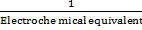
According to Faraday's laws of electrolysis, the amount of decomposition is proportional to
|
(a) |
(b) Electrochemical equivalent of the substance |
|
(c) |
(d) |
Two similar spheres having +q and -q charge are kept at a certain distance. F force acts between the two. If in the middle of two spheres, another similar sphere having +q charge is kept, then it experience a force in magnitude and direction as
|
(a) Zero having no direction |
(b) 8F towards +q charge |
|
(c) 8F towards -q charge |
(d) 4F towards +q charge |