Questions · Page 1 of 5

M.C.Q [1M]

🎯

Test yourself on this topic

50 questions · timed · auto-graded

MCQ 11 Mark
Which of the following statements is not correct according to Rutherford model?
  • A
    Most of the space inside an atom is empty.
  • B
    The electrons revolve around the nucleus under the influence of coulomb force acting on them.
  • C
    Most part of the mass of the atom and its positive charge are concentrated at its centre.
  • D
    The stability of atom was established by the model.
Answer
  1. The stability of atom was established by the model.

Explanation:

According to Rutherford model as he was not able to explain stability of atom.
View full question & answer
MCQ 21 Mark
The value of scattering angle of alpha particle for minimum value of impact parameter is-
  • $180^{\circ}$
  • B
    $90^{\circ}$
  • C
    $0^{\circ}$
  • D
    $120^{\circ}$
Answer
Correct option: A.
$180^{\circ}$
A
View full question & answer
MCQ 41 Mark
The ground state energy of hydrogen atom is -13.6 eV. The kinetic and potential energies of the electron in this state are:
  • A
    -13.6 eV, 27.2 eV
  • B
    13.6 eV,-13.6 eV
  • C
    13.6 eV,-27.2 eV
  • D
    27.2 eV,-27.2 eV
Answer
  1. 13.6 eV,-27.2 eV
View full question & answer
MCQ 51 Mark
The property of cathode rays used in the monitor of a computer is:
  • A
    High velocity of the rays
  • B
    High ionization power of the rays
  • C
    The property to cause fluorescence
  • D
    Rectilinear propagation
Answer
  1. The property to cause fluorescence
View full question & answer
MCQ 61 Mark
In which of the following fields cathode rays show minimum deflection?
  • A
    Electric field
  • B
    Magnetic field
  • C
    Plasma field
  • D
    Gravitational field
Answer
  1. Gravitational field

Explanation:

Gravitational field applies minimum force on cathode rays because gravitational forces are proportional to masses but not charges.

View full question & answer
MCQ 71 Mark
Find the true statement.
  • A
    An electron will not lose energy when jumping from the 1st orbit to the 3rd orbit.
  • B
    An electron will not give energy when jumping from the 1st orbit to the 3rd orbit.
  • C
    An electron will release energy when jumping from the 1st orbit to the 3rd orbit.
  • D
    An electron will absorb energy when jumping from the 1st orbit to the 3rd orbit.
Answer
  1. An electron will absorb energy when jumping from the 1st orbit to the 3rd orbit.

Explanation:

An electron will absorb energy when jumping from the 1st orbit to the 3rd orbit.

Only by absorbing energy, an electron will be able to jump from the first orbit to the third orbit in the atomic spectrum.

View full question & answer
MCQ 81 Mark
The concept of stationary orbits was proposed by:
  • A
    J. J. Thomson
  • B
    Rutherford
  • C
    Neil Bohr
  • D
    LNewton
Answer
  1. Neil Bohr

Explanation:

Neil Bohr proposed the concept of stationary orbits in 1913, which is now called the Bohr model of atom. The electron can only orbit stably, without radiating, in certain orbits at a certain discretesct of distance from the nucleus.

View full question & answer
MCQ 91 Mark
Check the wrong statement:
  • A
    Line spectrum is characteristic of the element
  • B
    Absorption line spectrum is characteristic of the element
  • C
    Continuous spectrum is characteristic of the source of light
  • D
    There are two prominent yellow lines in the spectrum of sodium
Answer
  1. Absorption line spectrum is characteristic of the element

Explanation:

Line respectrum is characteristic of the element because it obtained of atoms only. Continous spectrum is characteristics of the source of light.

In the spectrum of sodium, there are two prominent yellow lines of wavelength 589.0 nm and 589.6 nm.
Absorption line spectrum is not characteristic of the element.

View full question & answer
MCQ 101 Mark
Which of the following series in the spectrum of hydrogen atom lies in the visible region of the electromagnetic spectrum?
  • A
    Paschen series
  • B
    Balmer series
  • C
    Lyman series
  • D
    Brackett series
Answer
  1. Balmer series

Explanation:

Transition from higher states to n = 2 lead to emission of radiation with wavelengths 656.3nm and 365.0nm.

These wavelengths fall in the visible region and constitute the Balmer series.

View full question & answer
MCQ 111 Mark
According to kinetic theory of matter, a molecule is the smallest particle of a substance and it possesses :
  • A
    All the properties of the substance
  • B
    Some of the properties of the substance
  • C
    None of the properties of the substance
  • D
    Both a and b are true
Answer
  1. All the properties of the substance

Explanation:

A molecule is defined as the smallest particle which possesses all the properties of the substance.

View full question & answer
MCQ 121 Mark
Consider aiming a beam of free electrons towards free protons. When they scatter, an electron and a proton cannot combine to produce a H-atom:
  • A
    Because of energy conservation.
  • B
    Without simultaneously releasing energy in the from of radiation.
  • C
    Because of momentum conservation.
  • D
    Because of angular momentum conservation.
Answer
  1. Because of energy conservation.
  2. Without simultaneously releasing energy in the from of radiation.

​​​​​​​Solution:

When a beam of free electrons is aiming towards free protons, then, they scatter but an electron and a proton cannot combine to produce a hydrogen atom because of energy conservation and without simultaneously releasing energy in the form of radiation.

View full question & answer
MCQ 131 Mark
An ionised H-molecule consists of an electron and two protons. The protons are separated by a small distance of the order of angstrom. In the ground state:
  • A
    The electron would not move in circular orbits.
  • B
    The energy would be (2)4 times that of a H-atom.
  • C
    The electrons, orbit would go arround the protons.
  • D
    The molecule will soon decay in a proton and a H-atom.
Answer
  1. The electron would not move in circular orbits.
  1. The electrons, orbit would go arround the protons.

​​​​​​​Solution:

In a hydrogen atom, electron revolves around a fixed proton nucleus in circular path. This can be explained by Bohr model. But in case of ionised H-molecule which consists of two protons in nucleus and where protons are separated by a small distance of the order of angstrom, cannot be explained by Bohr model. Hence in this case the ground state the electron would not move in circular orbits, the electrons orbit would go around the protons.

View full question & answer
MCQ 141 Mark
When an electron jumps from the fourth orbit to the second orbit, one gets the:
  • A
    Second line of Paschen series.
  • B
    Second line of Balmer series.
  • C
    First line of Pfund series.
  • D
    Second line of Lyman series.
Answer
  1. Second line of Balmer series.
View full question & answer
MCQ 151 Mark
According to classical theory, the path of an electron in Rutherford atomic model is:
  • A
    Spiral.
  • B
    Circular.
  • C
    Parabolic.
  • D
    Straight line.
Answer
  1. Spiral.
View full question & answer
MCQ 161 Mark
Which of the following series in the spectrum of hydrogen atom lies in the visible region of the electromagnetic spectrum?
  • A
    Paschen series.
  • B
    Balmer series.
  • C
    Lyman series.
  • D
    Brackett series.
Answer
  1. Balmer series.
View full question & answer
MCQ 171 Mark
The possible values of ml​ are:
  • A
    from -1 to + 1
  • B
    from 0 to 8
  • C
    from zero to + 1
  • D
    none of these
Answer
  1. from -1 to + 1

Explanation:

Values for the quantum number ml​ are -1, 0, + 1

View full question & answer
MCQ 181 Mark
When an electron jumps from its orbit to another orbit, energy is:
  • A
    Emitted
  • B
    Absorbed
  • C
    Both absorbed and emitted
  • D
    Depends on the energy levels of the orbits
Answer
  1. Depends on the energy levels of the orbits

Explanation:

When an electron jumps from lower energy level to higher energy level it absorbs energy and when it jumps from higher energy level to lower energy level it emits energy.

So whether the electron emits or absorbs energy depends on the energy levels of the orbit

View full question & answer
MCQ 191 Mark
What causes spectral lines?
  • A
    The transition of electrons between two energy levels.
  • B
    The transition of electrons between two wavelength ranges.
  • C
    Magnetic and electric field exiting in an atom.
  • D
    The transition of electrons from electric to magnetic field.
Answer
  1. The transition of electrons between two energy levels.

Explanation:

The observed spectral lines are caused by the transition of electrons between two energy levels in an atom.

The emission spectrum of the hydrogen atom is divided into many spectral series, with wavelengths that are given by Rydberg’s formula.

View full question & answer
MCQ 201 Mark
The first model of atom in 1898 was proposed by:
  • A
    Ernst Rutherford
  • B
    Albert Einstein
  • C
    J.J. Thomson
  • D
    Niels Bohr
Answer
  1. J.J. Thomson
View full question & answer
MCQ 211 Mark
The possible values of orbital quantum numbers are:
[n is the principle quantum number]
  • A
    from 0 to (n - 1)
  • B
    from 0 to n
  • C
    from 0 to (n + 1)
  • D
    all of the above
Answer
  1. from 0 to (n - 1)

Explanation:

The orbital quantum number, l, divides the shells up into smaller groups of subshells called orbitals. The orbital quantum number describes shape of subshells. The principal quantum number(n) determines the possible values of l. For n = 1 i.e. K-shell there is no subshell so, l = 0 i.e. (n − 1). Hence, The possible values of orbital quantum numbers are from 0 to (n − 1).

View full question & answer
MCQ 221 Mark
An unknown hot gas emits radiation of wavelengths 46.0nm, 82.8nm and 103.5nm only. Assume that the atoms have only two excited states and the difference between consecutive energy levels decreases as energy is increased. Taking the energy of the highest energy state to be zero, find the energies of the ground state and the first excited state.
  • A
    –27eV, –12eV.
  • B
    –6eV, –3eV.
  • C
    –11eV, –8eV.
  • D
    –9eV, –3eV.
Answer
  1. –27eV, –12eV.
View full question & answer
MCQ 231 Mark
Which of the following series of hydrogen spectrum is in visible range?
  • A
    Lyman series
  • B
    Balmer se
  • C
    Paaschen series
  • D
    Brackett series
Answer
  1. Balmer se
View full question & answer
MCQ 241 Mark
The significant result deduced from the Rutherford's scattering experiment is that:
  • A
    Whole of the positive charge is concentrated at the centre of atom.
  • B
    There are neutrons inside the nucleus.
  • C
    Electrons are embedded in the atom.
  • D
    Electrons are revolving around the nucleus.
Answer
  1. Whole of the positive charge is concentrated at the centre of atom.
View full question & answer
MCQ 251 Mark
Who gave the Quantum model of hydrogen atom?
  • A
    S.N. Bose
  • B
    Niels Bohr
  • C
    James clerk Maxwell
  • D
    R. A. Millikan
Answer
  1. Niels Bohr

Explanation:

Niels Bohr introduced the atomic Hydrogen model in 1913.

Neils Bohr developed the Bohr model of the atom, in which he proposed that energy levels of electrons are discrete and that the electrons revolve in stable orbits around the atomic nucleus but can jump from one energy level (or orbit) to another.

View full question & answer
MCQ 261 Mark
The Rutherford α-particle experiment shows that most of the α-particles pass through almost unscattered while some are scattered through large angles. What information does it give about the structure of the atom?
  • A
    Atom is hollow.
  • B
    The whole mass of the atom is concentrated in a small centre called nucleus.
  • C
    Nucleus is positively charged.
  • D
    All of the above.
Answer
  1. All of the above.
View full question & answer
MCQ 271 Mark
Solar spectrum is an example of:
  • A
    Line emission spectrum
  • B
    Band absorption spectrum
  • C
    Line absorption spectrum
  • D
    Continuous emission spectrum
Answer
  1. Line absorption spectrum

Explanation:

Solar spectrum is a line absorption spectrum which is also called as Fraunhofer lines of missing wavelengths.

View full question & answer
MCQ 281 Mark
Two electrons in an atom are moving in orbit of radii R and 9R respectively. The ratio of their frequencies will be:
  • A
    1 : 8
  • B
    8 : 1
  • C
    1 : 27
  • D
    27 : 1
Answer
  1. 27 : 1

Explanation:

Radius is directly proportional to square of n.

Therefore, ratio of principal quantum number is 1 : 3.

Hence, ratio of frequencies is 27 : 1.

View full question & answer
MCQ 291 Mark
The energy of an atom (or ion) in its ground state is -54.4eV. It may be:
  • A
    Hydrogen.
  • B
    Deuterium.
  • C
    He+
  • D
    Li++
Answer
  1. He+

Explanation:

The total energy of a hydrogen-like ion, having Z protons in its nucleus, is given by,

$\text{E}=-\frac{13.6\text{Z}^2}{\text{n}^2}\text{eV}$

Here, n = Principal quantum number.

For ground state, n = 1

$\therefore$ Total energy, E = -13.6Z2eV

For hydrogen, Z = 1

$\therefore$ Total energy, E = -13.6eV

For deuterium, Z = 1

$\therefore$ Total energy, e = -13.6eV

For He+, Z = 2

$\therefore$ Total energy E = -13.6 × 22 = -54.4eV

For Li++,

Z = 3

$\therefore$ Total energy, E = -13.6 × 32 = -122.4eV

Hence, the ion having an energy of -54.4eV in its ground state may be He+

View full question & answer
MCQ 301 Mark
A) Line spectra is due to atoms in gaseous state:
B) Band spectra is due to molecules:
  • A
    Both A and B are false
  • B
    A is true but B is false
  • C
    A is false but B is true
  • D
    Both A and B are true.
Answer
  1. Both A and B are true.

Explanation:

The light emitted by one kind of atoms generally have widely separated wavelength components. When such a light is dispersed, we get certain sharp bright lines on a dark background. Such a spectrum is called line emission spectrum.The wavelength emitted by the molecules are grouped, each group being well separated from the other. The wavelengths in a group are close to one another and appear as continuous.The spectrum looks like separate bands of varying colors. Such a spectrum is called a band emission spectrum.So, line spectra are due to atoms in a gaseous state and band spectra are due to molecules.

View full question & answer
MCQ 311 Mark
Of the following properties, the photon does not process:
  • A
    Rest mass
  • B
    Momentum
  • C
    Energy
  • D
    Frequency
Answer
  1. Rest mass

Explanation:

A particle representing a quantum of light or other electromagnetic radiation.

A photon carries energy proportional to the radiation frequency but has zero rest mass.

View full question & answer
MCQ 321 Mark
Corpuscles are the tiny particles of:
  • A
    Light
  • B
    Sound
  • C
    Waves
  • D
    Radiation
Answer
  1. Light

Explanation:

According to the Corpuscles theory, corpuscles are the tiny particles of light.

View full question & answer
MCQ 331 Mark
Suppose potential energy between electron and proton at separation r is given by U = K ln (r), where K is a constant. For such a hypothetical hydrogen atom, the ratio of energy difference between energy levels (n = 1 and n = 2) and (n = 2 and n = 4) is?
  • A
    1.
  • B
    2.
  • C
    3.
  • D
    4.
Answer
  1. 1.
View full question & answer
MCQ 341 Mark
Name a device which is commonly used to convert an electric signal into a visual signal:
  • A
    Polariser
  • B
    RMS converter
  • C
    Cathode ray tube
  • D
    None of the above
Answer
  1. Cathode ray tube

Explanation:

Cathode ray tube is commonly used to convert an electrical signal into a visual signal. A cathode ray tube is a vacuum tube consisted of electron gun and a phosphorescent screen and is used to display images. It accelerates and deflects electron beam to create images.

View full question & answer
MCQ 351 Mark
In Bohr’s model electrons are revolving in a circular orbits around the nucleus called as:
  • A
    Stationary orbits.
  • B
    Non radiating orbits.
  • C
    Bohr’s orbits.
  • D
    All of these.
Answer
  1. All of these.
View full question & answer
MCQ 361 Mark
In terms of Bohr radius r0, the radius of the second Bohr orbit of a hydrogen atom is given by:
  • A
    4r0.
  • B
    8r0.
  • C
    2r.
  • D
    2r.
Answer
  1. 4r0.
View full question & answer
MCQ 371 Mark
When an alpha particle is emitted from a radioactive source:
  • A
    Its atomic number increases by 4
  • B
    Its atomic number decreases by 2
  • C
    Its atomic number increases by 2
  • D
    It atomic number decreases by 4
Answer
  1. Its atomic number decreases by 2

Explanation:

When an alpha particle is emitted from a radioactive source or substance, its atomic number decreases by 2 and its atomic mass decreases by 4, which is same as that of helium ion.

View full question & answer
MCQ 381 Mark
According to the classical theory, the circular path of the electrons is:
  • A
    Circular
  • B
    Parabolic
  • C
    Spiral
  • D
    Straight line
Answer
  1. Spiral

Explanation:

According to classical theory, the circular path of the electrons is spiral.

View full question & answer
MCQ 391 Mark
The largest wavelength in the ultraviolet region of the hydrogen spectrum is 122nm. The smallest wavelength in the infrared region of the hydrogen spectrum (to the nearest integer) is?
  • A
    802nm.
  • B
    823nm.
  • C
    1882nm.
  • D
    1648nm.
Answer
  1. 823nm.
View full question & answer
MCQ 401 Mark
According to the Rutherford’s atomic model, the electrons inside the atom are:
  • A
    Stationary.
  • B
    Not stationary.
  • C
    Centralized.
  • D
    None of these.
Answer
  1. Not stationary.
View full question & answer
MCQ 411 Mark
The angular speed of the electron in the nth orbit of Bohr hydrogen atom is?
  • A
    Directly proportional to n.
  • B
    Inversely proportional to n.
  • C
    Inversely proportional to n2.
  • D
    Inversely proportional to n3.
Answer
  1. Inversely proportional to n3.
View full question & answer
MCQ 431 Mark
The Balmer series for the H-atom can be observed:
  • A
    If we measure the frequencies of light emitted when an excited atom falls to the ground state.
  • B
    If we measure the frequencies of light emitted due to transitions between excited states and the first excited state.
  • C
    In any transition in a H-atom.
  • D
    As a sequence of frequencies with the higher frequencies getting closely packed.
Answer
  1. If we measure the frequencies of light emitted due to transitions between excited states and the first excited state.
  1. A​​​​s a sequence of frequencies with the higher frequencies getting closely packed.

Solution:

Key concept: The vatious lines in the atomic spectra are produced when electrons jump fron higher energy state to a lower energy state and photons are emitted. These spectral lines are called emission lines.

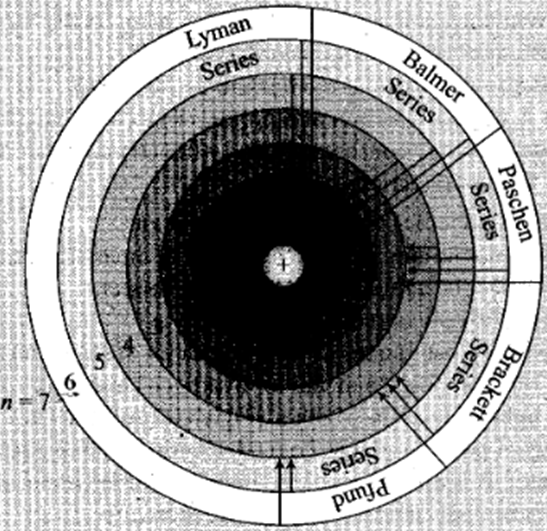
  1. Mainly there are five series and each series is named after its discoverer as Lyman series, Balmer series, Paschan series, Bracket series and Pfund series.
  2. According to the Bohr's theory the wavelength of the radiations emitted from hydrogen atom is given by

$\frac{1}{\lambda}=\text{R}\bigg[\frac{1}{\text{n}_1^2}-\frac{1}{\text{n}_2^2}\bigg]$

$\Rightarrow\ \lambda=\frac{\text{n}_1^2\text{n}_2^2}{(\text{n}_2^2-\text{n}_1^2)\text{R}}=\frac{\text{n}_1^2}{\Big(1-\frac{\text{n}_1^2}{\text{n}_2^2}\Big)\text{R}}$

where n2 = outer orbit (electron jumps from this orbit), n1 = inner orbit (electron falls in this orbit)

  1. First line of the series is called first member, for this lines wavelength is maximum $(\lambda_\text{max})$.
  2. For maximum wavelength if n1 = n, then n2 = n + 1.
  3. So $\lambda_\text{max}=\frac{\text{n}^2(\text{n}+1)^2}{(2\text{n}+1)\text{R}}$.
  4. Last line of the series is called series limit, for this line wavelength is minimum $(\lambda_\text{max})$.
  5. Foe minimum wavelength $\text{n}_2=\infty,\text{n}_1=\text{n}.\text{ So}\lambda_\text{min}=\frac{\text{n}^2}{\text{R}}.$
  6. The radio of first member and series limit can be calculated as $\frac{\lambda_\text{max}}{\lambda_\text{min}}=\frac{(\text{n}+1)^2}{(2\text{n}+1)}$.

Different spectral series

 
Spectral Series
Transition
$\lambda_\text{max}$
$\lambda_\text{min}$
$\frac{\lambda_\text{max}}{\lambda_\text{min}}$
Region
1.
Lyman series
$\text{n}_2=2,3,4 \ ....\infty$
$\text{n}_1=1$
$\frac{4}{3\text{R}}$
$\frac{1}{\text{R}}$
$\frac{4}{3}$
Ultraviolet region
2.
Blamer series
$\text{n}_2=3,4,5 \ ....\infty$
$\text{n}_1=2$
$\frac{36}{5\text{R}}$
$\frac{4}{\text{R}}$
$\frac{9}{5}$
Visible region
3.
Paschen series
$\text{n}_2=4,5,6 \ ....\infty$
$\text{n}_1=3$
$\frac{144}{7\text{R}}$
$\frac{9}{\text{R}}$
$\frac{16}{7}$
Infrared region
4.
Bracket series
$\text{n}_2=5,6,7 \ ....\infty$
$\text{n}_1=4$
$\frac{400}{9\text{R}}$
$\frac{16}{\text{R}}$
$\frac{25}{9}$
Infrared region
5
Pfund series
$\text{n}_2=6,7,8 \ ....\infty$
$\text{n}_1=5$
$\frac{900}{11\text{R}}$
$\frac{25}{\text{R}}$
$\frac{36}{11}$
Infrared region

From above discussion we can say Balmer series for the H-atom can be observed if we measure the frequencies of light emitted due to transitions between higher excited states and the first excited state and as a sequence of frequencies with the higher frequencies getting closely packed.

View full question & answer
MCQ 441 Mark
Excitation energy of a hydrogen like ion in its excitation state is 40.8 eV. Energy needed to remove the electron from the ion in ground state is:
  • A
    54.4eV.
  • B
    13.6eV.
  • C
    40.8eV.
  • D
    27.2eV.
Answer
  1. 54.4eV.
View full question & answer
MCQ 461 Mark
Anti-particle of proton is:
  • A
    Electron
  • B
    Antiproton
  • C
    Positron
  • D
    Neutron
Answer
  1. Antiproton

Explanation:

antiparticle of proton is antiproton.

View full question & answer
MCQ 471 Mark
The radius of the shortest orbit in a one-electron system is 18 pm. It may be
  • A
    Hydrogen.
  • B
    Deuterium.
  • C
    He+
  • D
    Li++
Answer
  1. Li++

Explanation:

The radius of the nth orbit in one electron system is given by,

$\text{r}_\text{n}=\frac{\text{n}^2\text{a}_0}{\text{Z}}$

Here, a0 = 53 pm

For the shortest orbit, n = 1

For hydrogen, Z = 1

$\therefore$ Radius of the first state of hydrogen atom = 53 pm

For deuterium, Z = 1

$\therefore$ Radius of the first state of deuterium atom = 53 pm

For He+, Z = 2

$\therefore$ Radius of He+ atom $=\frac{53}{2}\text{ pm}=26.5\text{ pm}$

For Li++, Z = 3

$\therefore$ Radius of Li++ atom $=\frac{53}{3}\text{ pm}=17.66\approx18\text{ pm}$ 

The given one-electron system having radius of the shortest orbit to be 18 pm may be Li++

View full question & answer
MCQ 481 Mark
What is the purpose of anode in a Cathode ray tube?
  • A
    To provide potential energy to electrons
  • B
    To provide kinetic energy to protons
  • C
    To provide potential energy to protons
  • D
    To provide kinetic energy to electrons
Answer
  1. To provide kinetic energy to electrons

Explanation:

In a Cathode ray tube electrons comes out from cathode. After cathode, anode is placed, which as being +ively charged, accelerates electrons and provide them kinetic energy.

View full question & answer
MCQ 491 Mark
Rydberg’s constant is:
  • A
    Same for all elements.
  • B
    Different for different elements.
  • C
    A universal constants.
  • D
    Is different for lighter elements but same for heavier elements.
Answer
  1. Different for different elements.
View full question & answer
MCQ 501 Mark
An electron with kinetic energy 5eV is incident on a hydrogen atom in its ground state. The collision:
  • A
    Must be elastic.
  • B
    May be partially elastic.
  • C
    Must be completely inelastic.
  • D
    May be completely inelastic.
Answer
  1. Must be elastic.

Explanation:

The minimum energy required to excite a hydrogen atom from its ground state to 1st excited state is approximately 10eV. As the incident electron energy is not sufficient for excitation of the hydrogen atom so electron will not get absorbed in the hydrogen atom so it can not be an inelastic collision. Also this collision can not be partially elastic because in an partially elastic collision, there is a net loss on kinetic energy. If the energy is lost then corresponding amount of heat should have been produced but it is not so which implies that the collision is completely elastic.

View full question & answer