MCQ
According to Wein's law
  • ${\lambda _m}T$= constant
  • B
    $\frac{{{\lambda _m}}}{T}$= constant
  • C
    $\frac{T}{{{\lambda _m}}}$= constant
  • D
    $T + {\lambda _m}$= constant

Answer

Correct option: A.
${\lambda _m}T$= constant
a
(a) Wien's displacement law states that the black body radiation curve for different temperatures peak at a wavelength inversely proportional to temperature.

When the temperature of a blackbody radiator increases, the overall radiated energy increases and the peak of the radiation curve moves to shorter wavelengths.

The relation is presented as $\lambda_{m} T=$ constant

Need a full question paper?

Generate a complete, print-ready paper with questions like this in minutes — across 16+ boards, with answer keys.
Start Generating Free

Similar questions

The value of $C_V$ for one mole of neon gas is
A liquid of mass $M$ and specific heat $S$ is at a temperature $2t$. If another liquid of thermal capacity $1.5$ times, at a temperature of $\frac{t}{3}$ is added to it, the resultant temperature will be
A body of mass $2$ kg is moving on the ground comes to rest after some time. The coefficient of kinetic friction between the body and the ground is $0.2$. The retardation in the body is ...... $m/s^2$ 
Value of one light year distance:
A cubical block of wood of edge $10$ $cm$ and mass $0.92$ $kg$ floats on a tank of water with oil of rel. density $0.6$ to a depth of $4$ $cm$ above water. When the block attains equilibrium with four of its sides edges vertical
A particle starts moving along a line from zero initial velocity and comes to rest after moving distance $d$. During its motion, it had a constant acceleration $f$ over $2 / 3$ of the distance and covered the rest of the distance with constant retardation. The time taken to cover the distance is
The property utilized in the manufacture of lead shots is
The angular velocity of a wheel is $70\, rad/sec$. If the radius of the wheel is $0.5\, m$, then linear velocity of the wheel is ....... $m/sec$
A neutron exerts a force on a proton which is:
  1. Gravitational.
  2. Electromagnetic.
  3. Nuclear.
  4. Weak.
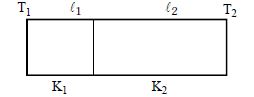
One end of a thermally insulated rod is kept at a temperature $T_1$ and the other at $T_2$. The rod is composed of two sections of lengths $l_1$ and $l_2$ and thermal conductivities $K_1$ and $K_2$ respectively. The temperature at the interface of the two sections is