MCQ
Value of one light year distance:
  • A
    9.46 x 10¹⁰ km
  • 9.46 x 10¹² km
  • C
    9.46 x 10¹² m
  • D
    9.46 x 1015 cm

Answer

Correct option: B.
9.46 x 10¹² km
B
$\begin{aligned} \text { One light year } & =3 \times 10^8 \times 365 \times 24 \times 60 \times 60 \mathrm{~m} \\ & =9.46 \times 10^{15} \mathrm{~m} \\ & =9.46 \times 10^{12} \mathrm{~km}\end{aligned}$

Need a full question paper?

Generate a complete, print-ready paper with questions like this in minutes — across 16+ boards, with answer keys.
Start Generating Free

Similar questions

$A$ thin uniform rod of mass $M$ and length $L$ has its moment of inertia $I_1$ about its perpendicular bisector. The rod is bend in the form of a semicircular arc. Now its moment of inertia through the centre of the semi circular arc and perpendicular to its plane is $I_2$. The ratio of $I_1 : I_2$ will be
Three weights $W, 2W$ and $3W$ are connected to identical springs suspended from a rigid horizontal rod. The assembly of the rod and the weights fall freely. The positions of the weights from the rod are such that
A graph of the square of the velocity against the square of the acceleration of a given simple harmonic motion is
A mixture of hydrogen and oxygen has volume $500\, {cm}^{3}$, temperature $300\, {K}$, pressure $400\, {kPa}$ and mass $0.76\, {g}$. The ratio of masses of oxygen to hydrogen will be :-
If heat is supplied to an ideal gas in an isothermal process:
A motor car moving at a speed of $72\,km / h$ cannot come to a stop in less than $3.0\,s$ while for a truck this time interval is $5.0\,s$. On a highway, the car is behind the truck both moving at $72\,km / h$. The truck gives a signal that it is going to stop at emergency. At what distance the car should be from the truck so that it does not bump onto (collide with) the truck. Human response time is $0.5\,s ...........\,m$
The work per unit volume to stretch the length by $1\%$ of a wire with cross sectional area of $1\,m{m^2}$ will be. $[Y = 9 \times {10^{11}}\,N/{m^2}]$
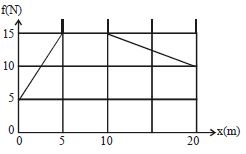
Figure here shows the frictional force versus displacement for a particle in motion. The loss of kinetic energy in travelling over $s = 0$ to $20\, m$ will be......$J$
A stone ties to the end of a string $1\,m$ long is whirled in a horizontal circle with a constant speed. If the stone makes $22$ revolution in $44$ seconds, what is the magnitude and direction of acceleration of the stone
A cricket ball of mass $150g$ has an initial velocity $\text{u}=(3\hat{\text{i}}+4\hat{\text{j}})\text{m s}^{-1}$ and a final velocity $\text{v}=-(3\hat{\text{i}}+4\hat{\text{j}})\text{m s}^{-1}$ after being hit. The change in momentum $($final momentum$-$initial momentum$)$ is $($in $kg m s^1):$