MCQ
Acetylene can be prepared from
- APotassium fumarate
- BCalcium carbide
- CEthylene bromide
- ✓All of these
$\begin{array}{*{20}{l}}
{CH} \\
{|\,|\,|} \\
{\underbrace {CH}_{Anode}}
\end{array} + 2\,C{O_2} + 2\,KOH + \underbrace {{H_2}}_{{\text{Cathode}}}$
$Ca{C_2} + 2\,{H_2}O \to Ca{\left( {OH} \right)_2} + CH \equiv CH$
$\,\mathop {\mathop {C{H_2}}\limits_{|\,\,\,\,\,\,\,\,\,} }\limits_{Br\,\,\,\,\,} - \mathop {C{H_2}}\limits_{\mathop {|\,\,\,\,\,\,\,\,\,}\limits_{Br\,\,\,\,} } + 2\,KOH \to CH \equiv CH + 2\,KBr + 2\,{H_2}O$
Generate a complete, print-ready paper with questions like this in minutes — across 16+ boards, with answer keys.
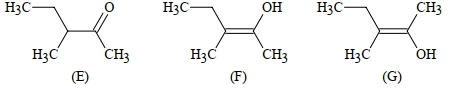
$(A)$ $E, F$ and $\mathrm{G}$ are resonance structures
$(B)$ $E, F$ and $E, G$ are tautomers
$(C)$ $\mathrm{F}$ and $\mathrm{G}$ are geometrical isomers
$(D)$ $\mathrm{F}$ and $\mathrm{G}$ are diasteromers