MCQ 11 Mark
Given below are two statements:
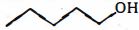
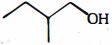
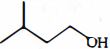
Statement $I$ : The boiling point of three isomeric pentanes follows the order
n-pentane $>$ isopentane $>$ neopentane
Statement $II$ : When branching increases, the molecule attains a shape of sphere. This results in smaller surface area for contact, due to which the intermolecular forces between the spherical molecules are weak, thereby lowering the boiling point.
In the light of the above statements, choose the most appropriate answer from the options given below:
- A
Both Statement $I$ and Statement $II$ are incorrect
- B
Statement $I$ is correct but Statement $II$ is incorrect
- C
Statement $I$ is incorrect but Statement $II$ is correct
- ✓
Both Statement $I$ and Statement $II$ are correct
AnswerCorrect option: D. Both Statement $I$ and Statement $II$ are correct
d
Both statement $I$ and statement $II$ are correct.
Boiling point of n-pentane $=309 \mathrm{~K} $
isopentane $=301 \mathrm{~K} $
neopentane $ =282.5$
As branching increases molecules attain the shape of a sphere results in smaller area of contact thus weak intermolecular forces between spherical molecules, which are overcome at relatively lower temperature. Leading to decrease in boiling point.
View full question & answer→MCQ 21 Mark
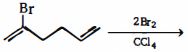
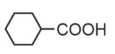
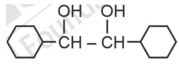
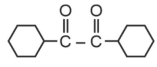
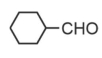
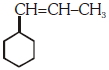
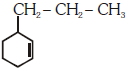
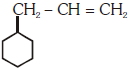
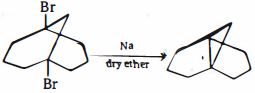
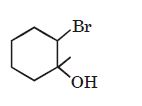
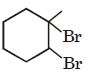
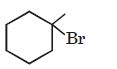
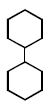
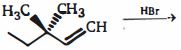
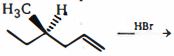
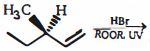
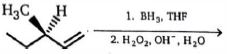
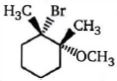
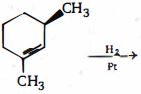
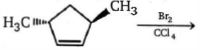
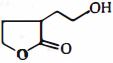
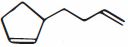
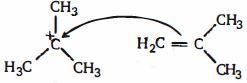
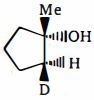
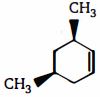
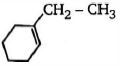
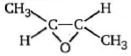
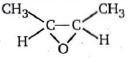
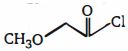
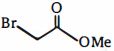
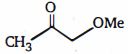
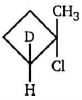
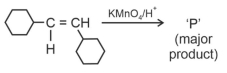
For the given reaction:
$Image$
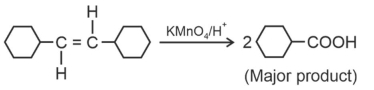
$P$ is
Answera
View full question & answer→MCQ 31 Mark
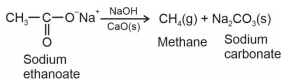
Weight $(g )$ of two moles of the organic compound, which is obtained by heating sodium ethanoate with sodium hydroxide in presence of calcium oxide is :
Answerc
This reaction is called soda lime decarboxylation
Molar mass of $CH _4=16\,g / mol$
Weight of 2 moles of $CH _4=16 \times 2$
$=32\,g$
View full question & answer→MCQ 41 Mark
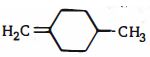
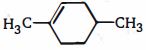
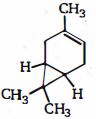
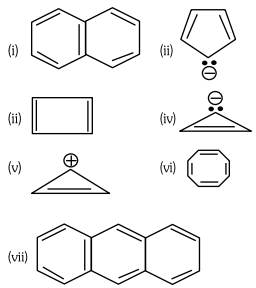
Consider the following compounds/species:
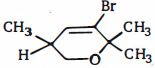
The number of compounds/species which obey Huckel's rule is $..........$
Answerb
Huckle's rule $=(4 n+2) \pi$ electrons Comp $(i), (ii), (v), (vii)$ obey Huckle's rule.
View full question & answer→MCQ 51 Mark
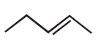
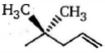
Compound $X$ on reaction with $O _{3}$ followed by $Zn /$ $H _{2} O$ gives formaldehyde and $2-$methyl propanal as products. The compound $X$ is :
- A
$2-$Methylbut$-1-$ene
- B
$2-$Methylbut$-2-$ene
- C
Pent$-2-$ene
- ✓
$3-$Methylbut$-1-$ene
AnswerCorrect option: D. $3-$Methylbut$-1-$ene
d
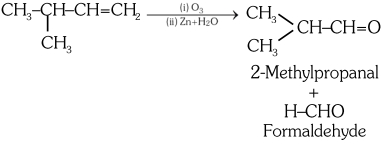
View full question & answer→MCQ 61 Mark
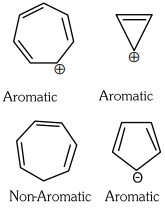
Which compound amongst the following is not an aromatic compound?
Answerc
View full question & answer→MCQ 71 Mark
$\mathrm{CH}_{3} \mathrm{CH}_{2} \mathrm{COO}^{-} \mathrm{Na}^{+} \xrightarrow[\mathrm{Heat}]{\mathrm{NaOH},+?} \mathrm{CH}_{3} \mathrm{CH}_{3}+ \mathrm{Na}_{2} \mathrm{CO}_{3} .$
Consider the above reaction and identify the missing reagent/chemical.
AnswerCorrect option: C. $\mathrm{CaO}$
c
$\mathrm{CH}_{3}-\mathrm{CH}_{2}-\mathrm{COONa} \xrightarrow[\Delta]{\mathrm{NaOH}+?} \mathrm{CH}_{3}-\mathrm{CH}_{3}$
It's decarboxylation in presence of sodalime so missing reagent is $\mathrm{CaO} .$ $(\mathrm{NaOH}+\mathrm{CaO})$ sodalime
View full question & answer→MCQ 81 Mark
Which of the following alkane cannot be made in good yield by Wurtz reaction$?$
- A
n$-$Butane
- B
n$-$Hexane
- C
$2,3 -$Dimethylbutane
- ✓
n$-$Heptane
AnswerCorrect option: D. n$-$Heptane
d
n$-$Heptane can not be made in good yield using Wurtz reaction since it is unsymmetrical alkane.
View full question & answer→MCQ 91 Mark
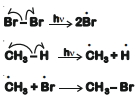
Which of the following is a free radical substitution reaction?
- A
Propene with $HBr /\left( C _{6} H _{5} COO \right)_{2}$
- B
Benzene with $Br _{2} / AlCl _{3}$
- C
Acetylene with $HBr$
- ✓
Methane with $Br _{2} / hv$
AnswerCorrect option: D. Methane with $Br _{2} / hv$
d
Reaction of methane with $Br _{2}$ in the presence of light is a free radical substitution reaction.
View full question & answer→MCQ 101 Mark
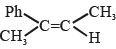
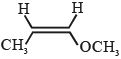
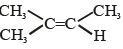
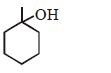
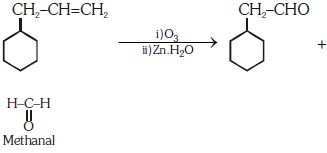
An alkene on ozonolysis gives methanal as one of the product. Its structure is
Answerd
View full question & answer→MCQ 111 Mark
Urea reacts with water to form $A$ which will decompose to form $B. B$ when passed through $Cu ^{2+}( aq ),$ deep blue colour solution $C$ is formed. What is the formula of $C$ from the following$?$
AnswerCorrect option: C. $\left[ Cu \left( NH _{3}\right)_{4}\right]^{2+}$
c
$NH _{2} CONH _{2}+ H _{2} O \rightarrow CO _{2}+ NH _{4} OH$
$(A)$
$NH _{4} OH \stackrel{\Delta}{\longrightarrow} NH _{3}+ H _{2} O$
$(B)$
$Cu ^{+2}( aq )+4 NH _{3} \rightarrow\left[ Cu \left( NH _{3}\right)_{4}\right]^{+2}($ deep blue $)$
$(C)$
View full question & answer→MCQ 121 Mark
The alkane that gives only one mono-chloro product on chlorination with $Cl_2$ in presence of diffused sunlight is
- A
$2,2-$dimethylbutane
- ✓
- C
$n-$pentane
- D
View full question & answer→MCQ 131 Mark
The number of sigma ( $\sigma$ ) and pi ( $\pi$ ) bonds in pent$- 2 -$en$- 4 -$yne is
- ✓
$10\sigma $ bonds and $3\pi$ bond
- B
$8\sigma $ bonds and $5\pi$ bond
- C
$11\sigma $ bonds and $2\pi$ bond
- D
$13\sigma $ bonds and $\pi$ bond
AnswerCorrect option: A. $10\sigma $ bonds and $3\pi$ bond
a
$\begin{array}{*{20}{c}} {{\text{H}}\,\,\,\,\,\,\,\,\,\,\,\,\,\,\,\,\,\,\,\,\,\,\,\,\,\,} \\ {|\,\,\,\,\,\,\,\,\,\,\,\,\,\,\,\,\,\,\,\,\,\,\,\,\,\,} \\ {{\text{H - C - C = C - C}} \equiv {\text{C - H}}} \\ {|\,\,\,\,\,\,\,\,\,|\,\,\,\,\,\,\,\,\,|\,\,\,\,\,\,\,\,\;\;\,\,\,\,\,\,\,\,\,\,} \\ {{\text{H}}\,\,\,\,\,\,{\text{H}}\,\,\,\,\,\,{\text{H}}\,\,\,\,\;\;\,\,\,\,\,\,\,\,\,\,\,\,\,} \end{array}$
Number of sigma bonds $=10$
Number of $\pi$ -bonds $=3$
View full question & answer→MCQ 141 Mark
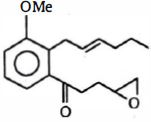
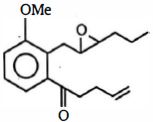
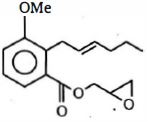
The most suitable reagent for the following conversion is
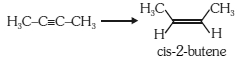
- A
$Na/lquid\; NH_{3}$
- ✓
$\mathrm{H}_{2}, \mathrm{Pd} / \mathrm{C},$ quinoline
- C
$Zn/HCl$
- D
$\mathrm{Hg}^{2+} / \mathrm{H}^{+}, \mathrm{H}_{2}O$
AnswerCorrect option: B. $\mathrm{H}_{2}, \mathrm{Pd} / \mathrm{C},$ quinoline
b
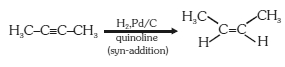
View full question & answer→MCQ 151 Mark
In the following reaction,
$\mathrm{C}\mathrm{H}_{3} -\mathrm{C} \equiv \mathrm{CH} \xrightarrow[873\;K]{\text { red hot iron tube}} \mathrm{A}$
the number of sigma$(\sigma)$ bonds present in the product $A$ is
Answera
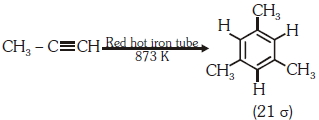
View full question & answer→MCQ 161 Mark
Match the catalyst with the process
| Catalyst |
Process |
| $(i) \;\mathrm{Na}_{2} \mathrm{O}$ |
$(a)$ The oxidation of ethyne to ethanal |
| $(ii) \;\mathrm{TiCl}_{4}+ \mathrm{Al(CH_3)}_{3}$ |
$(b)$ Polymerisation of alkynes |
|
$(iii)\;\mathrm{PdCl_2} $
|
$(c)$ Oxidation of $SO_2$ in the manufacture of $H_2SO_4$ |
| $(iv)\;$Nickel complexes |
$(d)$ Polymerisation of ethylene |
Which of the following is the correct option ?
- ✓
$i-c, ii-d, iii-a, iv-b$
- B
$i-a, ii-b, iii-c, iv-d$
- C
$i-a, ii-c, iii-b, iv-d$
- D
$i-c, ii-a, iii-d, iv-b$
AnswerCorrect option: A. $i-c, ii-d, iii-a, iv-b$
View full question & answer→MCQ 171 Mark
An alkene $A$ on reaction with $\mathrm{O}_{3}$ and $\mathrm{Zn}-\mathrm{H}_{2} \mathrm{O}$ gives propanone and ethanal in equimolar ratio. Addition of $HCl$ to alkene $A$ gives $B$ as the major product. The structure of product $B$ is:
- A
$Cl - C{H_2} - C{H_2} - \begin{array}{*{20}{c}}
{C{H_3}} \\
{|\,\,\,\,\,} \\
{CH} \\
{|\,\,\,\,\,} \\
{C{H_3}}
\end{array}$
- B
$\begin{array}{*{20}{c}}
{\,\,\,\,\,\,\,\,\,\,\,\,\,\,\,\,\,\,\,\,\,\,\,C{H_2}Cl} \\
{\,\,\,\,\,\,\,\,\,\,\,|} \\
{C{H_3} - C{H_2} - CH - C{H_3}}
\end{array}$
- ✓
$C{H_3} - C{H_2} - \begin{array}{*{20}{c}}
{C{H_3}\,\,\,\,\,\,\,\,} \\
{|\,\,\,\,\,\,\,\,\,\,\,\,\,\,\,\,\,} \\
{C - C{H_3}} \\
{|\,\,\,\,\,\,\,\,\,\,\,\,\,\,\,\,} \\
{Cl\,\,\,\,\,\,\,\,\,\,\,\,\,\,}
\end{array}$
- D
$\begin{array}{*{20}{c}}
{\,\,\,\,\,\,\,\,\,\,\,\,\,\,\,\,\,\,\,\,\,\,\,{H_3}C} \\
{\,\,\,\,\,\,\,\,\,\,\,\,\,\,\,\,\,\,\,\,\,\,\,\,\,\,\,\,\,\,|} \\
{C{H_3} - CH - CH} \\
{\,\,\,\,\,\,\,\,\,\,|\,\,\,\,\,\,\,\,\,\,\,\,\,\;\;|} \\
{\,\,\,\,\,\,\,Cl\,\,\,\;{H_3}C}
\end{array}$
AnswerCorrect option: C. $C{H_3} - C{H_2} - \begin{array}{*{20}{c}}
{C{H_3}\,\,\,\,\,\,\,\,} \\
{|\,\,\,\,\,\,\,\,\,\,\,\,\,\,\,\,\,} \\
{C - C{H_3}} \\
{|\,\,\,\,\,\,\,\,\,\,\,\,\,\,\,\,} \\
{Cl\,\,\,\,\,\,\,\,\,\,\,\,\,\,}
\end{array}$
c
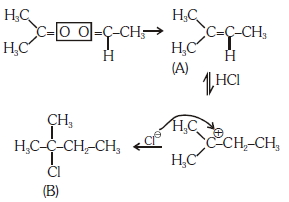
View full question & answer→MCQ 181 Mark
Hydrocarbon $(A)$ reacts with bromine by substitution to form an alkyl bromide which by Wurtz reaction is converted to gaseous hydrocarbon contalning less than four carbon atoms. $(\mathrm{A})$ is
- A
$CH\equiv CH$
- B
$CH_2= CH_2$
- C
$CH_3-CH_3$
- ✓
$CH_4$
AnswerCorrect option: D. $CH_4$
d
$\mathrm{CH}_{4} \xrightarrow[hv]{Br_2}-\mathrm{CH}_{3}-\mathrm{Br} \xrightarrow[ether]{Na} \mathrm{CH}_{3}-\mathrm{CH}_{3}$
(less than four 'C)
View full question & answer→MCQ 191 Mark
With respect to the conformers of ethane, which of the following statements is true ?
- A
Bond angle changes but bond length resame.
- B
Both bond angle and bond length change.
- ✓
Both bond angle and bond length remain same.
- D
Bond angle resame but bond length changes.
AnswerCorrect option: C. Both bond angle and bond length remain same.
c
In conformation bond angle and bond length remain same.
View full question & answer→MCQ 201 Mark
Predict the correct intermediate and product in the following reaction :
${H_3}C - C \equiv CH\,\xrightarrow[{HgS{O_4}}]{{{H_2}O,\,{H_2}S{O_4}}}\,\mathop {Intermediate}\limits_{(A)} \,$$ \to \,\mathop {\Pr oduct}\limits_{(B)} $
- A
$A \,: \, \begin{array}{*{20}{c}}
{{H_3}C - C = C{H_2}} \\
| \\
{OH}
\end{array}$ $ B\,\, :\, \begin{array}{*{20}{c}}
{{H_3}C - C = C{H_2}} \\
| \\
{S{O_4}}
\end{array}$
- B
$A\,\, :\,\begin{array}{*{20}{c}}
{{H_3}C - C - C{H_3}} \\
{|\,|} \\
O
\end{array}$ $B\,\,:\, H_3C-C=CH$
- ✓
$A \,: \, \begin{array}{*{20}{c}}
{{H_3}C - C = C{H_2}} \\
| \\
{OH}
\end{array}$ $B\,\, :\,\begin{array}{*{20}{c}}
{{H_3}C - C - C{H_3}} \\
{|\,|} \\
O
\end{array}$
- D
$ A\,\, :\, \begin{array}{*{20}{c}}
{{H_3}C - C = C{H_2}} \\
| \\
{S{O_4}}
\end{array}$ $B\,\, :\,\begin{array}{*{20}{c}}
{{H_3}C - C - C{H_3}} \\
{|\,|} \\
O
\end{array}$
AnswerCorrect option: C. $A \,: \, \begin{array}{*{20}{c}}
{{H_3}C - C = C{H_2}} \\
| \\
{OH}
\end{array}$ $B\,\, :\,\begin{array}{*{20}{c}}
{{H_3}C - C - C{H_3}} \\
{|\,|} \\
O
\end{array}$
c
$C{{H}_{3}}-C\equiv CH\xrightarrow[HgS{{O}_{4}}]{{{H}_{2}}O.{{H}_{2}}S{{O}_{4}}}\begin{matrix}
C{{H}_{3}}-C=C{{H}_{2}} \\
|\,\, \\
\,\,\,OH \\
\end{matrix}$ $\xrightarrow{Tautomerism}\begin{matrix}
CH3-C-C{{H}_{3}} \\
|| \\
O \\
\end{matrix}$
View full question & answer→MCQ 211 Mark
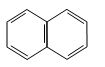
Amongst the following compounds the one which is most easily sulphonated is
MCQ 221 Mark
Which one is the correct order of acidity ?
- ✓
$CH\equiv CH > CH_{3}-C\equiv CH$$ > CH_2=CH_2 > CH_{3}-CH_3$
- B
$CH\equiv CH > CH_2=CH_2 $$> CH_{3}-C\equiv CH > CH_{3}-CH_3$
- C
$CH_{3}-CH_3 > CH_2CH_2 $$> CH_{3}-C \equiv CH > CH \equiv CH$
- D
$CH_2=CH_2 > CH_{3}-CH= CH_2 $$> CH_{3}-C \equiv CH > CH \equiv CH$
AnswerCorrect option: A. $CH\equiv CH > CH_{3}-C\equiv CH$$ > CH_2=CH_2 > CH_{3}-CH_3$
a
$\mathrm{CH} \equiv \mathrm{CH}>\mathrm{CH}_{3}-\mathrm{C} \equiv \mathrm{CH}>$$\mathrm{CH}_{2}=\mathrm{CH}_{2}>\mathrm{CH}_{3}-\mathrm{CH}_{3}$
acc. to EN and Inductive effect.
View full question & answer→MCQ 231 Mark
The correct statement regarding the comparison of staggered and eclipsed conformations of ethane, is
- A
the eclipsed conformation of ethane ismore stable than staggered conformation even though the eclipsed conformation has torsional strain
- ✓
the staggered conformation of ethane is more stable than eclipsed conformation, because staggered conformation has no torsional strain
- C
the staggered conformation of ethane is less stable than eclipsed conformation, because staggered conformation has torsional strain
- D
the eclipsed conformation of ethane is more stable than staggered conformation, because eclipsed conformation has notorsional strain.
AnswerCorrect option: B. the staggered conformation of ethane is more stable than eclipsed conformation, because staggered conformation has no torsional strain
b
Magnitude of torsional strain depends upon the angle of rotation about $\mathrm{C}-\mathrm{C}$ bond. Staggered form has the least torsional strain and the eclipsed form has the maximum torsional strain. So, the staggered conformation of ethane is more stable than the eclipsed conformation.
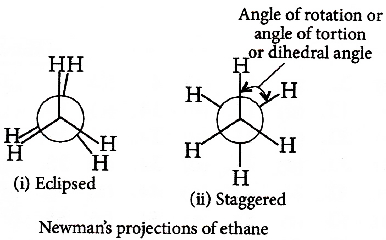
View full question & answer→MCQ 241 Mark
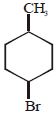
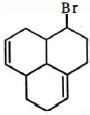
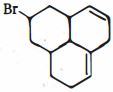
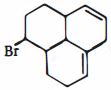
Which of the following compounds shall not produce propene by reaction with $HBr$ followed by elimination or direct only elimination reaction ?
- A
- B
$H_3C-CH_2-CH_2OH$
- ✓
$H_2C = C=O$
- D
$H_3C-CH_2-CH_2Br$
AnswerCorrect option: C. $H_2C = C=O$
c
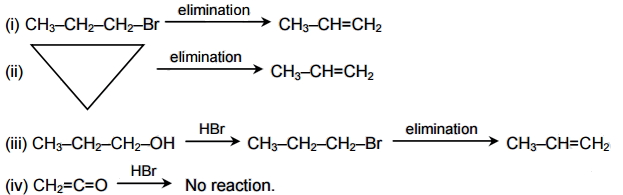
View full question & answer→MCQ 251 Mark
The compound that will react most readily with gaseous bromine has the formula
- ✓
$C_3H_6$
- B
$C_2H_2$
- C
$C_4H_{10}$
- D
$C_2H_4$
AnswerCorrect option: A. $C_3H_6$
a
Propene is most reactive towards $B r_{2}$ (gaseous) than $C H_{2}=C H_{2}, H C=C H \&$ butane due to most electron density.
View full question & answer→MCQ 261 Mark
The pair of electrons in the given carbanion, $CH_3C \equiv C^-,$ is present in which of the following orbitals ?
Answerb
$\mathrm{CH}_{3}-\stackrel{sp}{\mathrm{C}}\equiv \stackrel{sp}{\mathrm{C}^{-}}$
Thus, pair of electrons is present in sp-hybridised orbital.
View full question & answer→MCQ 271 Mark
Which of the following can be used as the halide component for Friedel-Crafts reaction ?
Answerd
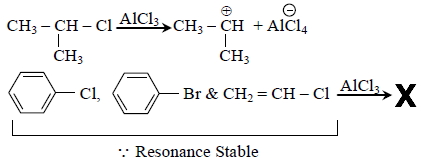
View full question & answer→MCQ 281 Mark
In which of the following molecules, all atoms are coplanar ?
Answera
Biphenyl is coplanar as all $C-$atoms are sp $^{2}$ hybridised and its geometry is trigonal planar.
View full question & answer→MCQ 291 Mark
In pyrrole the electron density is maximum on

- A
$2$ and $3$
- B
$3$ and $4$
- C
$2$ and $4$
- ✓
$2$ and $5$
AnswerCorrect option: D. $2$ and $5$
d
Pyrrole has highest electron density at $C_{2}$ and $C_{5}$ due to highest stability of protonated intermediate

View full question & answer→MCQ 301 Mark
Consider the nitration of benzene using mixed conc. $H_2SO_4$ and $HNO_3. $ If a large amount of $KHSO_4$ is added to the mixture, the rate of nitration will be
Answerd
$\mathrm{H}_{2} \mathrm{SO}_{4}+\stackrel{\oplus}{\mathrm{H}} \longrightarrow \mathrm{NO}_{2}+\mathrm{H \stackrel{\ominus}{S}O}_{4}+\mathrm{H}_{2} \mathrm{O}$
$\mathrm{KHSO}_{4} \longrightarrow \mathrm{K}^{\oplus}+\mathrm{H\stackrel{\ominus}{S}O}_{4}$
Due to common ion effect backward reaction will take so the formation $\mathrm{NO}_{2}^{+}$ decrease so nitration process will become slower.
View full question & answer→MCQ 311 Mark
In the reaction
$H - C\, \equiv CH\,\xrightarrow[{(ii)\,C{H_3}C{H_2}Br}]{{(i)\,NaN{H_2}\,/\,liq.\,N{H_3}}}\,X$
$\xrightarrow[{(ii)\,C{H_3}C{H_2}Br}]{{(i)\,NaN{H_2}\,/\,liq.\,N{H_3}}}\,Y$
$X$ and $Y$ are
- A
$X= {2-}$Butyne$,\, Y = {2-}$Hexyne
- B
$X= 1-$Butyne$,\, Y = {2-}$Hexyne
- ✓
$X= 1-$Butyne$,\, Y = {3-}$Hexyne
- D
$X= {2-}$Butyne$, \,Y = {3-}$Hexyne.
AnswerCorrect option: C. $X= 1-$Butyne$,\, Y = {3-}$Hexyne
c
$H-C\equiv C-H\xrightarrow[liq.\,N{{H}_{3}}]{Na\,N{{H}_{2}}/}HC\equiv C\,Na$ $\xrightarrow[-NaBr]{C{{H}_{3}}C{{H}_{2}}-Br}CH\equiv C-C{{H}_{2}}-C{{H}_{3}}$
$C{{H}_{3}}-C{{H}_{2}}-C\equiv CH\xrightarrow[liq.\,N{{H}_{3}}]{Na\,N{{H}_{2}}/}$ $C{{H}_{3}}-C{{H}_{2}}-C\equiv C\,Na\xrightarrow[-NaBr]{C{{H}_{3}}C{{H}_{2}}-Br}$ $\underset{3-Hexyne}{\mathop{C{{H}_{3}}-C{{H}_{2}}-C\equiv C-C{{H}_{2}}-C{{H}_{3}}}}\,$
View full question & answer→MCQ 321 Mark
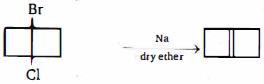
In the given reaction, the product $P$ is
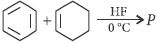
Answerc
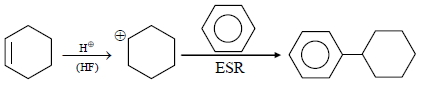
View full question & answer→MCQ 331 Mark
In the reaction with $HCl,$ an alkene reacts in accordance with the Markovnikov's rule to give a product $1-$chloro${-1}$ methylcyclohexane. The possible alkene is
AnswerCorrect option: C. $(A)$ and $(B)$
c
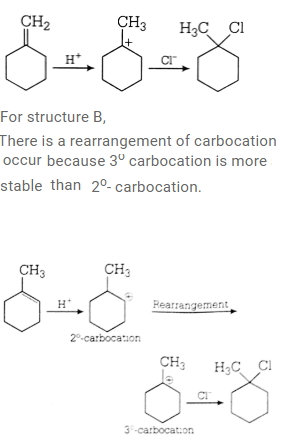
View full question & answer→MCQ 341 Mark
The oxidation of benzene by $V_2O_5$ in the presence of air produces and high tempreture
Answera
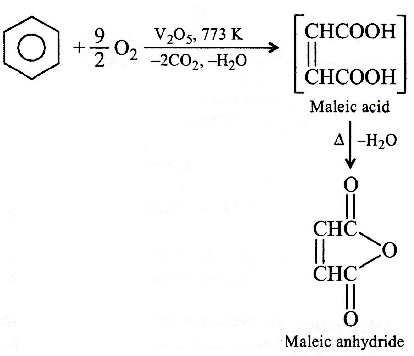
View full question & answer→MCQ 351 Mark
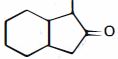
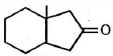
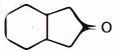
A single compound of the structure, is obtainable from ozonolysis of which of the following cyclic compounds?
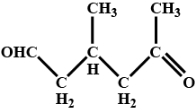
Answerc
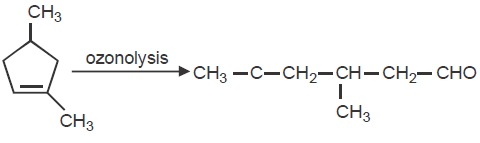
View full question & answer→MCQ 361 Mark
Identify $Z$ in the sequence of reactions :
$CH_3 CH_2 CH=CH_2 \xrightarrow{{HBr/{H_2}{o_2}}}\,Y\,\xrightarrow{{{C_2}{H_5}ONa}}Z$
- ✓
$CH_{3}-(CH_2)_3 - O - CH_2CH_3$
- B
$(CH_3)_2CH - O - CH_2CH_3$
- C
$CH_3(CH_2)_4 - O - CH_3$
- D
$CH_3CH_2 - CH(CH_3) - O - CH_2CH_3$
AnswerCorrect option: A. $CH_{3}-(CH_2)_3 - O - CH_2CH_3$
a
$C{{H}_{3}}C{{H}_{2}}CH=C{{H}_{2}}\xrightarrow[(peroxide\,or\,anti-Markovnikov's\,effect)]{HBr/{{H}_{2}}{{O}_{2}}}$ $\underset{(Y)}{\mathop{\underset{1-Bromobu\tan e}{\mathop{\begin{matrix}
\,\,\,\,\,\,\,\,\,\,\,\,\,\,\,\,\,\,\,\,\,\,\,\,\,\,\,\,\,\,\,\,\,\,\,\,\,\,\,\,Br \\
\,\,\,\,\,\,\,\,\,\,\,\,\,\,\,\,\,\,\,\,\,\,\,\,\,\,\,\,\,\,\,\,\,\,\,\,\,\,| \\
C{{H}_{3}}C{{H}_{2}}-CH-C{{H}_{2}} \\
\,\,\,\,| \\
\,\,\,\,\,H \\
\end{matrix}}}\,}}\,\xrightarrow[\Delta ]{{{C}_{2}}{{H}_{5}}ONa}$ $\underset{(Z)}{\mathop{C{{H}_{3}}{{(C{{H}_{2}})}_{3}}-O-C{{H}_{2}}C{{H}_{3}}}}\,$
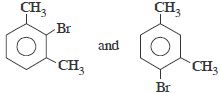
View full question & answer→MCQ 371 Mark
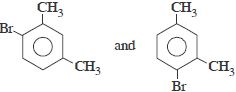
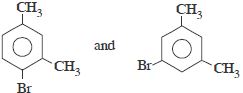
What products are formed when the following compound is treated with $Br_2$ in the presence of $FeBr_3$ ?

Answerc
$-\mathrm{CH}_{3}$ group is o.p-directing. Because of crowding, no substitution occurs at the carbon atom between the two $-\mathrm{CH}_{3}$ groups in $\mathrm{m}$ -Xylene, even though two $-\mathrm{CH}_{3}$ groups activate that position.
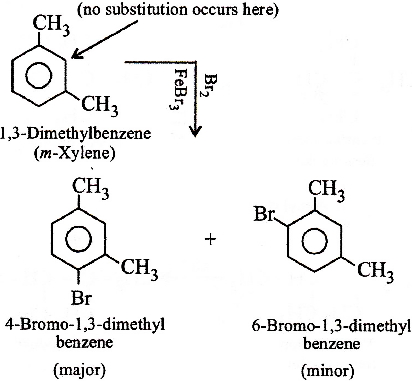
View full question & answer→MCQ 381 Mark
Which of the following organic compounds has same hybridization as its combustion product $(CO_2)\,?$
Answerb
Hybridisation of carbon $=s p^{3-n u m b e r\;of\; \pi -bonds}$ $\ln C O_{2}, \begin{array}{l}{\left(O =C=O\right)} \\ { { \quad 1\pi } \;\;\;\;1 \pi }\end{array}$ hybridisation of carbon
$=s p^{3-2}=s p$
In ethyne or acetylene, $C_{2} H_{2},\left(H-C_{2 \pi}^{=} C-H\right)$
hybridisation of carbon $=s p^{3-2}=s p$
View full question & answer→MCQ 391 Mark
In the following reaction:
$HC \equiv CH\,\xrightarrow[{H{g^{2 + }}}]{{{H_2}S{O_4}}}\,'P'$
Product $'P'$ will not give
View full question & answer→MCQ 401 Mark
Which of the following compounds will not undergo Friedal-Craft's reaction easily?
Answera
Friedal Craft reaction fails when strong deactivating group is attached with benzene ring.
View full question & answer→MCQ 411 Mark
Which of the following chemical system is non aromatic ?
Answerd
The molecules which do not satisfy Huckel rule or $(4 n+2) \pi$ -electron rule are said to be nonaromatic. The compound (d) has total $4 \pi e^-$. It does not follow $(4n + 2)$ rule. So it is non-aromatic compound. All other compounds $(a, b, c)$ are planar and have $6 \pi e^{-},$ so they are aromatic.
View full question & answer→MCQ 421 Mark
Some $meta-$ directing substituents in aromatic substitution are given. Which one is most deactivating?
- A
$- COOH$
- ✓
$- NO_2$
- C
$- C\equiv N$
- D
$- SO_3H$
AnswerCorrect option: B. $- NO_2$
b
$-\mathrm{NO}_{2}$ is most deactivating due to - $\mathrm{I}$ and $-\mathrm{M}$ effect.
View full question & answer→MCQ 431 Mark
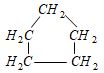
Cycloalkane has the formula
- A
${C_n}{H_{2n + 2}}$
- B
${C_n}{H_{2n - 2}}$
- ✓
${C_n}{H_{2n}}$
- D
${C_{2n}}{H_2}$
AnswerCorrect option: C. ${C_n}{H_{2n}}$
View full question & answer→MCQ 441 Mark
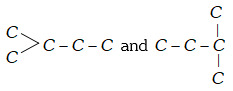
Which is the example of branch isomerization
- ✓
$\mathop {\mathop {\mathop {\mathop {C - C - C}\limits^| }\limits^C }\limits_{} }\limits_{} - C$ -C and $\mathop {\mathop {\mathop {\mathop {C - C - C}\limits^| }\limits^C }\limits_| }\limits_C $
- B
$\begin{array}{*{20}{c}}
{\,\,\,\,\,\,\,\,\,\,\,\,\,\,\,\,\,\,\,\,\,\,C} \\
{\,\,\,\,\,\,\,\,\,\,\,\,\,\,\,\,\,\,\,\,\,\,\,|} \\
{C - C - C} \\
| \\
C
\end{array}$ and $\begin{array}{*{20}{c}}
{C\,\,\,\,\,\,\,\,\,\,\,\,\,\,\,\,\,\,\,\,} \\
{|\,\,\,\,\,\,\,\,\,\,\,\,\,\,\,\,\,\,\,\,\,} \\
{C - C - C} \\
| \\
C
\end{array}$
- C
- D
$C - C - C - C$ and $\begin{array}{*{20}{c}}
{C - C - C} \\
{\,\,\,\,\,\,\,\,\,\,\,\,\,\,\,\,\,\,\,\,|} \\
{\,\,\,\,\,\,\,\,\,\,\,\,\,\,\,\,\,\,C}
\end{array}$
AnswerCorrect option: A. $\mathop {\mathop {\mathop {\mathop {C - C - C}\limits^| }\limits^C }\limits_{} }\limits_{} - C$ -C and $\mathop {\mathop {\mathop {\mathop {C - C - C}\limits^| }\limits^C }\limits_| }\limits_C $
View full question & answer→MCQ 451 Mark
The decreasing order of boiling points is
- ✓
$n-$ Pentane > iso-Pentane > neo-Pentane
- B
iso-Pentane > $ n-$ Pentane > neo-Pentane
- C
neo-Pentane > iso-Pentane >$ n-$ Pentane
- D
$n-$ Pentane > neo-Pentane > iso-Pentane
AnswerCorrect option: A. $n-$ Pentane > iso-Pentane > neo-Pentane
a
As the boiling point of an alkane depends on the surface area of a molecule, higher the surface is, higher the boiling point of alkane. The branched-chain isomer of an alkane has a lower surface area than that of its straight-chain isomer, so the branched-chain isomer of an alkane has a lower boiling point than its straight-chain isomer.
So, higher the branches, lower is the boiling point.
So, the order of boiling point of isomeric pentanes is $n -$ pentane $\,>\,$ iso $-$ pentane $\,>\,$ neo $-$ pentane.
View full question & answer→MCQ 461 Mark
To prepare a pure sample of $n-$ hexane using sodium metal as one reactant, the other reactant will be
- ✓
$n-$ propyl bromide
- B
Ethyl bromide and $ n-$ butyl bromide
- C
Ethyl chloride and $ n-$ butyl chloride
- D
Methyl bromide and $ n -$ pentyl chloride
AnswerCorrect option: A. $n-$ propyl bromide
a
(a) According to wurtz reaction
$2C{H_3}C{H_2}C{H_2}Br + 2Na\xrightarrow{{ether}}$ $C{H_3}{(C{H_2})_4}C{H_3} + 2NaBr$
View full question & answer→MCQ 471 Mark
Sodium acetate can be converted to ethane by
- A
Heating with $LiAl{H_4}$
- ✓
Electrolysing its aqueous solution
- C
- D
Heating with calcium acetate
AnswerCorrect option: B. Electrolysing its aqueous solution
b
(b) $\mathop {2C{H_3}COONa}\limits_{{\text{Sodium}}\,{\text{acetate}}} + 2{H_2}O\xrightarrow{{{\text{Electolysis}}}}\,C{H_3} - C{H_3} + 2C{O_2} + 2NaOH + {H_2}$
View full question & answer→MCQ 481 Mark
Which of the following compounds is used in antiknock compositions to prevent the deposition of oxides of lead on spark plug, combustion chamber and exhaust pipe
- A
- B
- ✓
$1, 2-$ dibromoethane
- D
AnswerCorrect option: C. $1, 2-$ dibromoethane
c
(c) $Pb{({C_2}{H_5})_4} \overset {heat} \longrightarrow Pb + \mathop {4C{H_3}CH_2^{}}\limits_{{\rm{Ethyl}}\,{\rm{radical}}} $
$\begin{array}{*{20}{c}}
{C{H_2} - C{H_2}} \\
{|\,\,\,\,\,\,\,\,\,\,\,\,\,\,\,|\,\,\,\,\,\,\,} \\
{\,Br\,\,\,\,\,\,\,\,Br\,\,\,\,\,\,}
\end{array}$ $ + Pb \to \mathop {C{H_2} = C{H_2}}\limits_{Ethene} + \mathop {PbB{r_2}}\limits_{Leadbromide} $
As leaded gasoline burns, lead metal gets deposited in the engine which is removed by adding ethylene dibromide. The lead bromide is volatile and is carried off with the exhaust gases from the engine
View full question & answer→MCQ 491 Mark
Which of petroleum corresponds to kerosene oil
- A
${C_{15}} - {C_{18}}$
- ✓
${C_{10}} - {C_{12}}$
- C
${C_5} - {C_9}$
- D
${C_1} - {C_9}$
AnswerCorrect option: B. ${C_{10}} - {C_{12}}$
b
Kerosene is a mixture of hydrocarbons. The chemical composition depends on its source of isolation, usually, it consists of about $10$ different hydrocarbons, each containing $11$ to $16$ carbon atoms per molecule.
The main constituents are saturated straight-chain and branched-chain hydrocarbons which are also called as paraffin, as well as ring-shaped cycloparaffins which are also known as naphthenes. Kerosene is less volatile liquid than gasoline.
View full question & answer→MCQ 501 Mark
In the reaction $C{H_3} - Br + 2Na + Br - C{H_3} \to $, the product called
Answera
Typically, you would react two alkyl halides to form an alkane that consists of their respective $R$ groups. So, as an example, you would have:
$CH _3 Br + CH _3 Cl \stackrel{ Na ( s )}{\longrightarrow} CH _3 CH _3$
(with loss of $NaCl$ and then $NaBr$ )
View full question & answer→MCQ 511 Mark
Iodoethane reacts with sodium in the presence of dry ether. The product is
Answerd
(d) ${C_2}{H_5}I + 2Na + I{C_2}{H_5} \xrightarrow[Dry]{Ether} \mathop {}\limits_{{\rm}} \mathop {{C_2}{H_5} - {C_2}{H_5}}\limits_{{\rm{Butane}}} + 2NaI$
View full question & answer→MCQ 521 Mark
Which of the following is oxidised by $KMn{O_4}$
Answerc
(c) ${(C{H_3})_3}CH \xrightarrow{KMnO_4} \,\,\,\mathop {{{(C{H_3})}_3}C - OH}\limits_{{\rm{tertiary \,butyl \,alcohol}}} $
View full question & answer→MCQ 531 Mark
The most volatile compound is
- ✓
$2, 2-$ dimethyl propane
- B
$2-$ methyl butane
- C
- D
$n-$ pentane
AnswerCorrect option: A. $2, 2-$ dimethyl propane
a
The boiling point is inversely proportional to the branch in the compound. Therefore, $2,2$-dimethyl propane has more branching, higher boiling point.
View full question & answer→MCQ 541 Mark
In Wurtz reaction, the reagent used is
- A
$Na$
- B
$Na$ / liquid $NH_3$
- ✓
$Na$ / Dry ether
- D
$Na$ / Dry alcohol
AnswerCorrect option: C. $Na$ / Dry ether
c
(c) $RCl + 2Na + RCl \xrightarrow[Ether]{Dry} \mathop {} 2NaCl + \mathop {R - R}\limits_{{\rm{Alkane}}} $
View full question & answer→MCQ 551 Mark
Which of the following has highest octane number
AnswerCorrect option: D. $2, 2, 4-$ trimethyl pentane
d
(d) iso-octane i.e. $2,2,4-$ trimethyl pentane has highest octane number.
View full question & answer→MCQ 561 Mark
The petrol having octane number $80$ has
- ✓
$20\%$ normal heptane + $80\%$ iso-octane
- B
$80\%$ normal heptane + $20\%$ iso-octane
- C
$20\%$ normal heptane + $80\%$ normal octane
- D
$80\%$ normal heptane + $20\%$ normal octane
AnswerCorrect option: A. $20\%$ normal heptane + $80\%$ iso-octane
a
Petrol, which has octane number $80$ contain $20 \,\%\, n$-heptane and $80\, \%$ isooctane.
View full question & answer→MCQ 571 Mark
Which of the following reactions will not give propane
- A
$C{H_3}C{H_2}C{H_2}Cl\mathop {}\limits_{} $ $ \xrightarrow[H_2O]{Mg/ether} $
- ✓
$C{H_3}COCl\mathop {}\limits_{} $ $ \xrightarrow[H_2O]{CH_3MgX} $
- C
$C{H_3}CH = C{H_2}\mathop {}\limits_{} $ $ \xrightarrow[B_2h_6]{CH_3COOH} $
- D
$\begin{array}{*{20}{c}}
{C{H_3}CH - C{H_3}} \\
{|\,\,\,\,\,\,\,\,} \\
{OH\,\,\,\,}
\end{array}$ $ \xrightarrow{P/HI} $
AnswerCorrect option: B. $C{H_3}COCl\mathop {}\limits_{} $ $ \xrightarrow[H_2O]{CH_3MgX} $
b
(b) With calculated amount of Grignard reagent, acetyl chloride forms ketones.

View full question & answer→MCQ 581 Mark
Which of the following shows only one brominated compound
- A
Butene $-2$
- ✓
$2, 2-$ dimethylpropane
- C
Butyne $-1$
- D
Butanol $-3$
AnswerCorrect option: B. $2, 2-$ dimethylpropane
b
Option $A$ will give $2$ mono brominated products, as $Br$ can go on $C _1 / C _2$.
Option $B$ will give $1$ mono brominated products, as $Br$ can go on $C _1$.
Option $C$ will give $1$ mono brominated products, as $Br$ can go on $C _1 / C _2 / C _3 / C _4$.
Option $D$ will give $2$ mono brominated products, as $Br$ can go on $C _1 / C _2 / C _3 / C _4$.
Therefore,Option $B$ is correct answer for this question.
View full question & answer→MCQ 591 Mark
Kerosene is used as fuel because it is
MCQ 601 Mark
$C{H_3} - C{H_2} - C{H_2} - C{H_3}\mathop {}\limits_{} {\rm{}}$ $ \xrightarrow[HBr]{AlCl_3} $ Product in above reaction is
- A
$\begin{array}{*{20}{c}}
{C{H_3} - CH - C{H_2} - C{H_3}} \\
{|\,\,\,\,\,\,\,\,\,\,\,\,\,\,\,\,\,\,} \\
{Br\,\,\,\,\,\,\,\,\,\,\,\,\,\,\,}
\end{array}$
- ✓
$C{H_3} - \mathop {\mathop {CH}\limits_{|\,\,\,\,\,\,} }\limits_{C{H_3}} - C{H_3}$
- C
$\mathop {\mathop {C{H_2}}\limits_{\,\,|\,\,\,\,\,\,\,\,\,\,} }\limits_{Br\,\,\,\,} - C{H_2} - \mathop {\mathop {C{H_2}}\limits_{|\,\,\,\,\,\,\,\,} }\limits_{C{H_3}} $
- D
AnswerCorrect option: B. $C{H_3} - \mathop {\mathop {CH}\limits_{|\,\,\,\,\,\,} }\limits_{C{H_3}} - C{H_3}$
b
$C{H_3} - C{H_2} - C{H_2} - C{H_3}\mathop {}\limits_{} {\rm{}}$ $ \xrightarrow[HBr]{AlCl_3} C{H_3} - \mathop {\mathop {CH}\limits_{|\,\,\,\,\,\,} }\limits_{C{H_3}} - C{H_3}$
When $n$-butane is heated in the presence of $AlCl _{3} / HBr$.
It will be converted into Iso-butane.
It is a rearrangement reaction.
View full question & answer→MCQ 611 Mark
The chemical added to leaded petrol to prevent the deposition of lead in the combustion chamber is
MCQ 621 Mark
Which of the following has the highest boiling point
- A
- B
$n-$ butane
- ✓
$n-$ heptane
- D
AnswerCorrect option: C. $n-$ heptane
c
The boiling point of $n$-heptane is $98.42$ degrees celsius.
The boiling point of $n$-butane is $-1$ degrees celsius.
The boiling point of neopentane is $9.5$ degrees celsius.
The boiling point of isobutane is $-11.7$ degrees celsius.
So $n$-heptane has the highest boiling point.
View full question & answer→MCQ 631 Mark
Which of the following does not react with $PC{l_5}$
- A
$C{H_3}OH$
- B
$C{H_3}COOH$
- C
$C{H_3}CHO$
- ✓
${C_2}{H_6}$
AnswerCorrect option: D. ${C_2}{H_6}$
d
$PCl _5$ usually used to replace - $OH$ group or oxygen of carbonyl group.
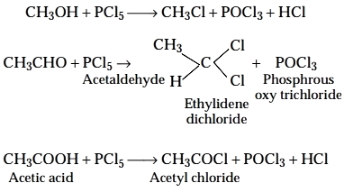
View full question & answer→MCQ 641 Mark
A reaction between methyl magnesium bromide and ethyl alcohol gives
Answera
(a)
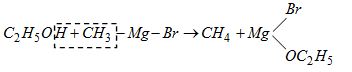
View full question & answer→MCQ 651 Mark
Methane and ethane both can be obtained in single step from
- ✓
$C{H_3}I$
- B
${C_2}{H_5}I$
- C
$C{H_3}OH$
- D
${C_2}{H_5}OH$
AnswerCorrect option: A. $C{H_3}I$
a
(a)$C{H_3}I + 2H \xrightarrow{Zn/HCl} C{H_4} + HI$
$C{H_3}I + 2Na + IC{H_3}\mathop {}\limits_{{\rm{}}} \xrightarrow[Ether]{Dry} C{H_3} - C{H_3} + 2NaI$
View full question & answer→MCQ 661 Mark
Petroleum consists mainly of
Answera
Liquefied Petroleum Gas or LPG (also called Autogas) consists mainly of Aliphatic hydrocarbons
(propane, propylene, butane, and butylene in various mixtures).
It is produced as a by-product of natural gas processing and petroleum refining.
Petroleum is a mixture of a very large number of different hydrocarbons; the most commonly found molecules are alkanes (paraffins), cycloalkanes (naphthenes), aromatic hydrocarbons, or more complicated chemicals like asphaltenes.
View full question & answer→MCQ 671 Mark
Petroleum ether can be used as
- ✓
Solvent for fat, oil, varnish and rubber
- B
- C
Both $(a)$ and $(b)$
- D
AnswerCorrect option: A. Solvent for fat, oil, varnish and rubber
a
(a)Solvent for fat, oil, varnish and rubber
View full question & answer→MCQ 681 Mark
Which of the following are produced from coal tar
Answerd
(d) Synthetic dyes, drugs, perfumes all are made from coal tar.
View full question & answer→MCQ 691 Mark
In alkanes, the bond angle is.....$^o$
- ✓
${109.5}$
- B
${109}$
- C
${120}$
- D
${180}$
AnswerCorrect option: A. ${109.5}$
a
(a) In alkanes, hybridization is $s{p^3}$. Hence bond angle is ${109^o}.5'$.
View full question & answer→MCQ 701 Mark
In the preparation of alkanes; a concentrated aqueous solution of sodium or potassium salts of saturated carboxylic acid are subjected to
Answerd
(d) $2C{H_3}COONa + 2{H_2}O\, \xrightarrow{Electrolysis} \,\,\,C{H_3} - C{H_3} + 2C{O_2} + 2NaOH + {H_2}$
View full question & answer→MCQ 711 Mark
Halogenation of alkanes is an example of
- A
Electrophilic substitution
- B
Nucleophilic substitution
- ✓
Free-radical substitution
- D
AnswerCorrect option: C. Free-radical substitution
c
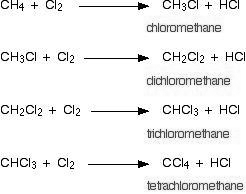
Halogenation of alkanes is carried out in the presence of photochemical conditions.
Under photochemical conditions, the halogens will break homolytically and forms radical. The halogen radical will abstract hydrogen from alkanes. Now the alkyl radical can combine with alkyl radical or it can also combine with halogen radical forming alkyl radicals.
View full question & answer→MCQ 721 Mark
Propionic acid is subjected to reduction with hydroiodic acid in the presence of a little P, the product formed is
Answerb
(b) $\mathop {C{H_3} - C{H_2} - COOH}\limits_{{\rm{Propanoic}}\,{\rm{acid}}} + 6HI \,\,\xrightarrow{Red P} \,\,\mathop {C{H_3} - C{H_2} - C{H_3}}\limits_{{\rm{Propane}}} + 2{H_2}O + 3{I_2}$
View full question & answer→MCQ 731 Mark
When ethyl iodide and propyl iodide react with $Na$ in the presence of ether, they form
Answerd
(d) $\mathop {C{H_3} - C{H_2} - C{H_3}}\limits_{{\rm{Propane}}} + 2{H_2}O + 3{I_2}$ $ \xrightarrow[Ether]{Dry} $ $\mathop {{C_2}{H_5} - {C_3}{H_7}}\limits_{{\rm{Pentane}}} + 2NaI$
${C_2}{H_5}I + 2Na + {C_2}{H_5}I\mathop {}\limits_{{\rm{}}} \xrightarrow[Ether]{Dry} \mathop {{C_2}{H_5} - {C_2}{H_5}}\limits_{{\rm{Butane}}} + 2NaI$
${C_3}{H_7}I + 2Na + {C_3}{H_7}I\mathop {\xrightarrow{{Dry}}}\limits_{Ether} \mathop {{C_3}{H_7} - {C_3}{H_7}}\limits_{{\text{Hexane}}} + 2NaI$
View full question & answer→MCQ 741 Mark
The alkane that yields two isomeric monobromo derivatives is
Answerd
Two isomeric monochloro derivatives of Propane are:
$1$-chloro propane $( CH _3- CH _2-CH_2(Cl))$ and $2$-chloro propane $( CH _3 - CH ( Cl )- CH _3 \text { ) }$
View full question & answer→MCQ 751 Mark
Answera
Kerosene is a thin, clear liquid formed from hydrocarbons obtained from the fractional distillation of petroleum between $150^{\circ} C$ and $275^{\circ} C$, resulting in a mixture with a density of $0.78-0.81\, g / cm ^3$.It is composed of carbon chains that typically contain between $6$ and $16$ carbon atoms per molecule. It is miscible in petroleum solvents but immiscible in water. Kerosene's major components are branched and straight chain alkanes and naphthenes (cycloalkanes), which normally account for at least $70 \,\%$ by volume.
View full question & answer→MCQ 761 Mark
When petroleum is heated the vapours contain mainly
Answerb
Petroleum ether because due to it's lowest boiling point
View full question & answer→MCQ 771 Mark
Iso-octane is mixed to the petrol
- A
To precipitate inorganic substances
- B
To prevent freezing of petrol
- C
To increase boiling point of petrol
- ✓
Answerd
One member of the octane family, isooctane, is used as a reference standard to benchmark the tendency of gasoline or $LPG$ fuels to resist self-ignition. For example, gasoline with the same knocking characteristics as a mixture of $90 \,\%$ iso-octane and $10 \,\%$ heptane would have an octane rating of $90$
View full question & answer→MCQ 781 Mark
Tetraethyl lead is used as
Answerc
Tetraethyl lead is used as petroleum additive to prevent knocking of engine.
View full question & answer→MCQ 791 Mark
Cyclohexane, a hydrocarbon floats on water because
- A
It is immiscible with water
- B
Its density is low as compared to water
- C
It is non-polar substance
- ✓
It is immiscible and lighter than water
AnswerCorrect option: D. It is immiscible and lighter than water
d
(d) Cyclohexane, is immiscible and lighter than water. Hence, floats on the surface of water.
View full question & answer→MCQ 801 Mark
Natural gas contains mainly
- ✓
- B
$n-$ butane
- C
$n-$ octane
- D
Answera
(a) Methane is the main component of natural gas.
View full question & answer→MCQ 811 Mark
The organic compound used as antiknock agent in petroleum is
- ✓
${({C_2}{H_5})_4}Pb$
- B
$TNT$
- C
$C{H_3}MgBr$
- D
${({C_2}{H_5})_2}Hg$
AnswerCorrect option: A. ${({C_2}{H_5})_4}Pb$
a
This abnormal combustion produces a specific type of sound, which we call knocking.
Knocking has adverse effects. It results in early wear-and-tear of the piston. Carbon is deposited in the inner part of the cylinders [Internal Combustion Engines have cylinders, inside which pistons move]. Also, Efficiency is reduced.
So we want to reduce knocking. We add something which can reduce it. Such substances are called Anti - knockingAgents.
A popular anti-knocking agent was Tetra Ethyl Lead (TEL) $\left( C _2 H _5\right)_4 Pb$.
View full question & answer→MCQ 821 Mark
In catalytic reduction of hydrocarbons which catalyst is mostly used
- ✓
$Pt /Ni$
- B
$Pd$
- C
$Si{O_2}$
- D
AnswerCorrect option: A. $Pt /Ni$
a
(a) $Pt./Ni$ is used in catalytic reduction of hydrocarbon.
View full question & answer→MCQ 831 Mark
Gasoline is obtained from crude petroleum oil by its
Answera
(a) Fractional distillation is used because the difference between the boiling point of different component is less.
View full question & answer→MCQ 841 Mark
Which of the following does not give alkane
AnswerCorrect option: D. Reaction of ethyl chloride with alco. $KOH$
d
(d) $C{H_3} - C{H_2} - Cl + \mathop {KOH}\limits_{{\rm{(alc}}{\rm{.)}}} \to \mathop {C{H_2} = C{H_2}}\limits_{{\rm{Ethene}}} + KCl + {H_2}O$
In presence of alc. $KOH$ dehydrohalogenation occur and alkene is formed.
View full question & answer→MCQ 851 Mark
$LPG$ is a mixture of
- A
${C_6}{H_{12}} + {C_6}{H_6}$
- ✓
${C_4}{H_{10}} + {C_3}{H_8}$
- C
${C_2}{H_4} + {C_2}{H_2}$
- D
${C_2}{H_4} + C{H_4}$
AnswerCorrect option: B. ${C_4}{H_{10}} + {C_3}{H_8}$
b
(b) Liquefied petroleum gas is a mixture of ethane, propane and butane. The main component is butane.
View full question & answer→MCQ 861 Mark
Carbon black, which is used in making printer's ink, is obtained by decomposition of
Answerd
(d) $C{{H}_{4}}+{{O}_{2}}\underset{\begin{smallmatrix}
\text{Limited} \\
\text{supply }
\\
\text{of air}
\end{smallmatrix}}{\mathop{\xrightarrow{\Delta }}}\,C+2{{H}_{2}}O$
It contains $98-99\%$ carbon. It is used in making black ink, paints and shoe polishes.
View full question & answer→MCQ 871 Mark
The addition of tetraethyl lead to petrol
- A
- ✓
- C
May raise or lower the octane number
- D
Has no effect on octane number
Answerb
(b)Tetraethyl lead is anti-knocking agent it increases the octane no. of the fuel.
View full question & answer→MCQ 881 Mark
Knocking sound occurs in engine when fuel
- A
- ✓
- C
- D
Is mixed with machine oil
Answerb
(b)Knocking - Sudden and irregular burning of the fuel mixture causing jerks against the piston and gives rise to violent sound. This is known as knocking.
View full question & answer→MCQ 891 Mark
Petroleum is mainly a mixture of
Answera
Petroleum is a mixture of a very large number of different hydrocarbons; the most commonly found molecules are alkanes (paraffins), cycloalkanes (naphthenes), aromatic hydrocarbons, or more complicated chemicals like asphaltenes.... They are the petroleum gases.
View full question & answer→MCQ 901 Mark
Aqueous solution of the following compound on electrolysis gives ethane
Answerc
(c) $\mathop {2C{H_3}COOK}\limits_{{\rm{Potassium acetate}}} + 2{H_2}O\,\, \xrightarrow{Electrolysis} \,\,\mathop {C{H_3} - C{H_3} + 2C{O_2}}\limits_{\,\,\,\,\,\,\,\,\,\,\,\,\,\,\,\,\,\,\,\,\,\,\,\,\,\,\,\,\,\,{\rm{Anode}}} + \mathop {2KOH + {H_2}}\limits_{\,\,\,\,\,\,\,\,\,\,\,\,{\rm{Cathode}}} $
View full question & answer→MCQ 911 Mark
Which of the following does not decolourise bromine solution in carbon disulphide
Answerc
(c)Ethane does not decolourise bromine solution because it is a saturated compound.
View full question & answer→MCQ 921 Mark
Anhydrous sodium acetate on heating with sodalime gives
Answerb
(b) $\mathop {C{H_3}COONa}\limits_{{\rm{Sodium acetate}}} + NaOH \xrightarrow{CaO} \mathop {C{H_4}}\limits_{{\rm{Methane}}} + N{a_2}C{O_3}$
View full question & answer→MCQ 931 Mark
- A
$CO + C{O_2}$
- B
$CO + {N_2}$
- ✓
$CO + {H_2}$
- D
$CO + {N_2} + {H_2}$
AnswerCorrect option: C. $CO + {H_2}$
c
The mixture of carbon monoxide $( CO )$ and hydrogen $\left( H _2\right)$ is called water gas.
Syn gas is a mixture of $CO , CO _2$ and $H _2$.
Producer gas is a mixture of flammable gases (principally carbon monoxide and hydrogen) and nonflammable gases (mainly nitrogen and carbon dioxide).
Semi-water gas is a mixture of water gas and producer gas made by passing a mixture of air and steam through heated coke.
View full question & answer→MCQ 941 Mark
A sample of gasoline contains $81\%$ iso-octane and $19\%$ $n-$ heptane. Its octane number will be
Answerb
(b) Octane number is related to the percentage of iso-octane since iso-octane is $81\%$ hence octane number is $81$.
View full question & answer→MCQ 951 Mark
The natural petroleum contains
- A
- B
Cyclic saturated hydrocarbons
- C
- ✓
Answerd
The hydrocarbons in crude oil are mostly alkanes (paraffins), cycloalkanes (naphthenes) and various aromatic hydrocarbons while the other organic compounds contain nitrogen, oxygen and sulfur, and trace amounts of metals such as iron, nickel, copper and vanadium.
View full question & answer→MCQ 961 Mark
The preparation of ethane by electrolysis of aqueous solution of potassium acetate is called as
- A
- B
Sabatier-Senderen's reaction
- ✓
- D
Answerc
(c) $2C{H_3}COOK + 2{H_2}O\xrightarrow{{{\text{Electrolysis}}}}$ $\underbrace {2C{O_2} + C{H_3} - C{H_3}}_{Anode} + \underbrace {2KOH}_{cathode} + {H_2}$
View full question & answer→MCQ 971 Mark
As the number of carbon atoms in a chain increases the boiling point of alkanes
Answera
(a) Boiling point of alkanes increases with the number of carbon atoms because surface area increases which increases the Vander Waal forces.
View full question & answer→MCQ 981 Mark
In the fractional distillation of crude petroleum
- A
Petrol condenses at the bottom of the column
- B
The gases condense at the top of the column
- ✓
High boiling constituents condense at the bottom of the column
- D
High boiling constituents condense at the top of the column
AnswerCorrect option: C. High boiling constituents condense at the bottom of the column
View full question & answer→MCQ 991 Mark
Which of the following is not an endothermic reaction
- A
- B
- ✓
- D
Change of chlorine molecule into chlorine atoms.
Answerc
(c)The enthalpy of combustion i.e., $\Delta H$ is always negative. It means combustion is an exothermic reaction.
View full question & answer→MCQ 1001 Mark
- A
- ✓
The gaseous constituents of petroleum
- C
The mixture of uncondensed gases produced in the distillation of crude oil
- D
The mixture of the residue and gas oil obtained in the distillation of crude oil
AnswerCorrect option: B. The gaseous constituents of petroleum
b
Gasoline, also spelled gasolene, also called gas or petrol, mixture of volatile, flammable liquid hydrocarbons derived from petroleum and used as fuel for internal-combustion engines. It is also used as a solvent for oils and fats.
View full question & answer→MCQ 1011 Mark
In the process of cracking
- A
Organic compounds decompose into their constituent elements
- B
Hydrocarbons decompose into carbon and hydrogen
- ✓
High molecular weight organic compounds decompose to give low molecular weight organic compounds
- D
Hydrocarbons yield alkyl radicals and hydrogen
AnswerCorrect option: C. High molecular weight organic compounds decompose to give low molecular weight organic compounds
View full question & answer→MCQ 1021 Mark
Octane number has $0$ value for
- A
- B
$n-$ hexane
- ✓
$n-$ heptane
- D
AnswerCorrect option: C. $n-$ heptane
c
$n$-heptane is defined as the zero point of the octane rating scale. $2,2,4-$Trimethylpentane has an octane rating of $100$ , whereas $n$-heptane has an octane rating of $0$. The octane number is based on an arbitrary scale which is a measure of its ability to resist knocking, as it burns on combustion.
View full question & answer→MCQ 1031 Mark
Dry distillation of sodium propanoate with sodalime gives
Answerc
(c) $C{H_3}C{H_2}COONa + NaOH \,\,\, \xrightarrow{CaO} {C_2}{H_6} + N{a_2}C{O_3}$
View full question & answer→MCQ 1041 Mark
Which of the following fractions of petroleum refining contains kerosene ? (Boiling ranges in $^oC$ are given below)
- A
$40 - 80$
- B
$80 - 200$
- ✓
$200 - 300$
- D
Above $300$
AnswerCorrect option: C. $200 - 300$
c
The fraction of petroleum refining containing Useful hydrocarbons like kerosene is found between a temperature $200-300^{\circ} C$. These products are highly volatile, have small molecules, have low boiling points, flow easily, and ignite easily.
View full question & answer→MCQ 1051 Mark
Which of the following statements is incorrect. The members of the homologous series of alkanes
AnswerCorrect option: A. Are all straight chain compounds
a
All the members of the homologous series of alkanes are not straight chain compounds they can be branched, but differ by $- CH _2$ group.
View full question & answer→MCQ 1061 Mark
A liquid hydrocarbon can be converted to gaseous hydrocarbon by
- ✓
- B
- C
- D
Distillation under reduced pressure
Answera
(a) $\underset{\text{Liquid}}{\mathop{\underset{\text{Hexane}}{\overset{{}}{\mathop{{{C}_{6}}{{H}_{14}}}}}\,}}\,\xrightarrow{\Delta }\underset{\text{Butane}}{\mathop{{{C}_{4}}{{H}_{10}}}}\,+\underset{\text{Gas}}{\mathop{\underset{\text{Ethene}}{\mathop{{{C}_{2}}{{H}_{2}}}}\,}}\,$
View full question & answer→MCQ 1071 Mark
Formation of alkane by the action of $Zn$ on alkyl halide is called
Answera
$(i)$ wurtz reaction
$2 RX +2 Na \stackrel{\text { Ether }}{\longrightarrow} \underset{\text { alkane }}{ R - R }$
$(ii)$ Kolbe's reaction
$RCOONa + H _2 O \stackrel{\text { Electrolysis }}{\longrightarrow} \underset{\text { alkane }}{ R - R }$
$(iii)$ Ulmann's reaction
$2 C _6 H _5 I +2 Cu \rightarrow \underset{\text { biphenyl } }{ C _6 H _5}- C _6 H _5$
$(iv)$ Frankland reaction
$\underset{\text { alkyl halide }}{2 RX }+ Zn \rightarrow \underset{\text { alkane }}{ R - R }$
View full question & answer→MCQ 1081 Mark
Which of the following compounds will form a hydrocarbon on reaction with Grignard reagent
- ✓
$C{H_3}C{H_2}OH$
- B
$C{H_3}CHO$
- C
$C{H_3}COC{H_3}$
- D
$C{H_3}C{O_2}C{H_2}$
AnswerCorrect option: A. $C{H_3}C{H_2}OH$
a
(a) Compounds having active hydrogen $\left( {ROH,{H_2}O,R - N{H_2}} \right)$ can form alkane when treated with Grignard’s reagent

View full question & answer→MCQ 1091 Mark
Name the hydrocarbon that is a liquid at $STP$
- A
- B
- C
$n-$ butane
- ✓
$n-$ pentane
AnswerCorrect option: D. $n-$ pentane
d
Lower hydrocarbons which contain up to $4$ carbon atoms are gases at room temperature whereas higher hydrocarbons are liquid at room temperature. Thus $N - P$ entane is liquid at room temperautre.
View full question & answer→MCQ 1101 Mark
Which statement is not true concerning alkanes
- ✓
Large number alkanes are soluble in water
- B
All alkanes have a lower density than water
- C
At room temperature some alkanes are liquids, some solids and some gases
- D
AnswerCorrect option: A. Large number alkanes are soluble in water
a
No alkanes are not soluble in water. Water is a polar solvent and has hydrogen bonding. For any compound to be soluble in water, it should be polar or have hydrogen bonding in it.
View full question & answer→MCQ 1111 Mark
Fischer Tropsch process is used for the manufacture of
Answera
The Fisher-Tropscgh process is used in the manufacturing of Syntheticpetrol. The Fischer-Tropsch process is a collection of chemical reactions that converts a mixture of carbon monoxide and hydrogen into liquid hydrocarbons.... In the usual implementation, carbon monoxide and hydrogen, the feedstocks for $FT$, are produced from coal, natural gas, or biomass in a process known as gasification.
View full question & answer→MCQ 1121 Mark
Which one of the following compounds cannot be prepared by Wurtz reaction
- ✓
$C{H_4}$
- B
${C_2}{H_6}$
- C
${C_3}{H_8}$
- D
${C_4}{H_{10}}$
AnswerCorrect option: A. $C{H_4}$
a
(a)It is not possible to prepare $C{H_4}$ by wurtz reaction.
View full question & answer→MCQ 1131 Mark
A fuel contains $25 \%$ $n-$ heptane and $75 \%$ iso-octane. Its octane number is
Answerb
(b) Octane number is the percentage by volume of is $o-$ octane in the mixture of iso- octane and $n-$ heptane which has the same antiknocking properties as the fuel under examination.
Given fuel ($25\%$ $n- $ heptane + $75\%$ iso- octane) Hence, octane number = $75$ (because iso octane is $75\%$)
View full question & answer→MCQ 1141 Mark
Which of the following has highest percentage of hydrogen
- ✓
$C{H_4}$
- B
${C_2}{H_4}$
- C
${C_6}{H_6}$
- D
${C_2}{H_2}$
AnswerCorrect option: A. $C{H_4}$
a
(a) $\%$ of hydrogen = $\frac{Mass\,\, of\,\, hydrogen}{Mass \,\,of\, \,compond} \times 100$
$C{H_4} = \frac{4}{{16}}\; \times \;100\; = \;25\% $.
View full question & answer→MCQ 1151 Mark
What is the molecular formula of the alkane, the $5.6 \,litre$ of which weight $11 \,g$ at $STP$
- A
${C_6}{H_{14}}$
- B
${C_4}{H_{10}}$
- ✓
${C_3}{H_8}$
- D
${C_2}{H_6}$
AnswerCorrect option: C. ${C_3}{H_8}$
c
(c) Molecular mass can be obtained by the victor mayer process
${\rm{Molecular}}\,\,{\rm{mass}} = \frac{{{\rm{Weight}}\,}}{{V\,ml.}} \times {\rm{22400}}$
$ = \frac{{{\rm{11}}}}{{{\rm{5600}}}} \times 22400 = 44$
View full question & answer→MCQ 1161 Mark
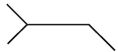
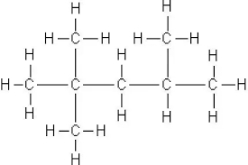
The reference compound `iso-octane' which is used in determining the octane number of gasoline has the structure
- A
$C{H_3} - CH(C{H_3}) - CH(C{H_3}) - CH(C{H_3}) - C{H_3}$
- ✓
$C{H_3} - C{(C{H_3})_2} - C{H_2} - CH(C{H_3}) - C{H_3}$
- C
$C{H_3} - C{(C{H_3})_2} - CH(C{H_3}) - C{H_2} - C{H_3}$
- D
$C{H_3} - C{(C{H_3})_2} - C{(C{H_3})_2} - C{H_3}$
AnswerCorrect option: B. $C{H_3} - C{(C{H_3})_2} - C{H_2} - CH(C{H_3}) - C{H_3}$
b
The octane number of gasoline is a way of knocking down its resistance. The characteristics of octane number one gasoline are compared by isoacetane ($2,2,4$-trimethylparnane) and heptane. Isooctane is assigned an octane number of $100$ . It is a highly branching compound that burns easily, with little knock.
View full question & answer→MCQ 1171 Mark
The order of appearance of the following with rising temperature during the refining of crude oil is
- A
Kerosene oil, gasoline, diesel
- B
Diesel, gasoline, kerosene oil
- C
Gasoline, diesel, kerosene oil
- ✓
Gasoline, kerosene oil, diesel
AnswerCorrect option: D. Gasoline, kerosene oil, diesel
d
(d) Gasoline, kerosene oil, diesel
View full question & answer→MCQ 1181 Mark
When sodium propionate is heated with soda lime, the main product is
Answera
(a) $C{H_3} - C{H_2} - COONa \xrightarrow[\Delta]{Soda lime} \mathop {}\limits C{H_3} - C{H_3}$
View full question & answer→MCQ 1191 Mark
Gasoline is a mixture of alkanes with the number of carbon atoms
- A
${C_3} - {C_5}$
- B
${C_5} - {C_6}$
- C
${C_6} - {C_8}$
- ✓
${C_7} - {C_9}$
AnswerCorrect option: D. ${C_7} - {C_9}$
d
(d) Gasoline or petrol composition ${C_7} - {C_{12}}$.
View full question & answer→MCQ 1201 Mark
The final product of complete oxidation of hydrocarbons is
AnswerCorrect option: C. ${H_2}O + C{O_2}$
c
(c) $\mathop {C{H_4}}\limits_{{\rm{Methane}}} + 2{O_2} \to C{O_2} + 2{H_2}O$
$\mathop {{C_2}{H_4}}\limits_{{\rm{Ethene}}} + 3{O_2} \to 2C{O_2} + 2{H_2}O$
All hydrocarbons saturated or unsaturated on complete combustion always produce $C{O_2}$ and ${H_2}O$.
View full question & answer→MCQ 1211 Mark
Which of the following represents the most oxidized form of hydrocarbon
- ✓
$C{O_2}$
- B
$RCHO$
- C
$RCOOH$
- D
$RCOOOH$
AnswerCorrect option: A. $C{O_2}$
a
(a) Hydrocarbons on complete oxidation produce $C{O_2}$ and water
$C{H_3} - C{H_3} + 3\frac{1}{2}{O_2} \to 2\,C{O_2} + 3{H_2}O$
View full question & answer→MCQ 1221 Mark
Name the reaction
${C_{10}}{H_{22}} \xrightarrow{900\,K} {C_4}{H_8} + {C_6}{H_{14}}$
Answerb
(b) $\mathop {{C_{10}}{H_{22}}}\limits_{{\rm{Decane}}} \mathop {}\limits_{{\rm{}}} \xrightarrow[Cracking]{900\,K} \mathop {{C_4}{H_8}}\limits_{{\rm{Butane}}} + \mathop {{C_6}{H_{14}}}\limits_{{\rm{Hexane}}} $
View full question & answer→MCQ 1231 Mark
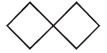
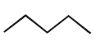
How many types of carbon atoms are present in $ 2, 2, 3-$ trimethylpentane
View full question & answer→MCQ 1241 Mark
At room temperature solid paraffin is
- A
${C_3}{H_8}$
- B
${C_8}{H_{18}}$
- C
${C_4}{H_{10}}$
- ✓
${C_{20}}{H_{42}}$
AnswerCorrect option: D. ${C_{20}}{H_{42}}$
d
$n$-Icosane (the straight-chain structural isomer of icosane) $\left( C _{20} H _{42}\right)$ is the shortest compound found in paraffin waxes used to form candles.
View full question & answer→MCQ 1251 Mark
Which one of the following compounds does not give addition reactions
- A
- ✓
- C
- D
Alkynes(e)Ketones(f)All of these
Answerb
(b) Alkanes do not give addition reactions because multiple bond is absent.
View full question & answer→MCQ 1261 Mark
The inorganic origin of petroleum is indicated by the fact that
- A
Its constituents can be separated by fractional distillation
- ✓
Carbon and hydrocarbon can combine by absorption of solar energy to give hydrocarbons
- C
Petroleum contains traces of chlorophyll
- D
Oil fields are located with the help of seismograph
AnswerCorrect option: B. Carbon and hydrocarbon can combine by absorption of solar energy to give hydrocarbons
b
Abiogenesis-inorganic origin of petroleum is the oldest theory which suggests that petroleum comes from the underneath part of the mantle very long time ago before the existence of life on earth. Carbon and hydrocarbon can combine by absorption of solar energy to give hydrocarbons.
View full question & answer→MCQ 1271 Mark
Which of the following is a gemdihalide
AnswerCorrect option: D. $C{H_3}CHB{r_2}$
d
(d) In gemdihalide both the halogen atoms are present on the same carbon atom while in vicdihalide both the halogen atoms are present on adjacent carbon atoms.
$\mathop {C{H_3} - CHB{r_2}}\limits_{{\rm{Gemdihalide}}} $ $\mathop {\mathop {C{H_2}}\limits_{\mathop {|\,\,\,\,\,\,\,}\limits_{Br\,\,\,} } - \mathop {C{H_2}}\limits_{\mathop {|\,\,\,\,\,\,\,\,}\limits_{Br\,\,\,\,} } }\limits_{vic{\rm{ - }}{\rm{dihalide}}} $
View full question & answer→MCQ 1281 Mark
Which one of the following contain isopropyl group
AnswerCorrect option: B. $2-$methylpentane
b
(b) $\mathop {\begin{array}{*{20}{c}}
{\,\,\,\,\,\,\,\,\,\,\,\,\,\,\,\,\,\,\,\,\,\,\,C{H_3}\,\,C{H_3}} \\
{\,\,\,\,\,\,\,\,\,\,\,\,\,\,\,\,\,\,\,|\,\,\,\,\,\,\,\,\,\,\,\,|} \\
{{H_3}C - {H_2}C - C - C - C{H_3}} \\
{\,\,\,\,\,\,\,\,\,\,\,\,\,\,\,\,\,\,\,\,\,\,|\,\,\,\,\,\,\,\,\,\,\,|\,\,\,\,} \\
{\,\,\,\,\,\,\,\,\,\,\,\,\,\,\,\,\,\,\,\,\,\,\,C{H_3}\,\,\,C{H_3}}
\end{array}}\limits_{2,3,3,3 - tetramethylpen\tan e} $
$\mathop {{H_3}C - {H_2}C - \mathop {\mathop {{H_2}C - HC - C{H_3}}\limits^{\,\,\,\,|} }\limits^{\,\,\,\,\,\,\,\,\,C{H_3}} }\limits_{{\rm{isopropyl group 2 - methylpentane}}} $
$\mathop {\begin{array}{*{20}{c}}
{\,\,\,\,\,\,\,\,\,\,\,\,\,\,\,\,\,\,\,\,\,\,\,\,\,\,C{H_3}\,\,\,C{H_{3\,}}} \\
{\,\,\,\,\,\,\,\,\,\,\,\,\,\,\,\,\,\,\,\,\,\,\,|\,\,\,\,\,\,\,\,\,\,\,\,|} \\
{{H_3}C - {H_2}C - HC - C - C{H_3}} \\
{\,\,\,\,\,\,\,\,\,\,\,\,\,\,\,\,\,\,\,\,\,\,\,\,\,\,\,\,\,\,\,\,\,\,\,\,|} \\
{\,\,\,\,\,\,\,\,\,\,\,\,\,\,\,\,\,\,\,\,\,\,\,\,\,\,\,\,\,\,\,\,\,\,\,\,\,\,C{H_3}}
\end{array}}\limits_{2,2,3 - trimethylpen\tan e} $
$\mathop {\mathop {\mathop {\mathop {\mathop {{H_3}C - {H_2}C - C - C{H_2} - C{H_3}}\limits^{\,\,|} }\limits^{\,\,\,\,\,\,\,\,C{H_3}} }\limits_{\,|} }\limits_{\,\,\,\,\,\,C{H_3}} }\limits_{{\rm{3, 3 - dimethylpentane}}} $
View full question & answer→MCQ 1291 Mark
Natural gas is a mixture of
AnswerCorrect option: D. $C{H_4} + {C_2}{H_6} + {C_3}{H_8}$
View full question & answer→MCQ 1301 Mark
By Wurtz reaction, a mixture of methyliodide and ethyliodide gives
- A
- B
- C
- ✓
A mixture of the above three
AnswerCorrect option: D. A mixture of the above three
d
(d) All-butane, Ethane and Propane are possible in this reaction.
View full question & answer→MCQ 1311 Mark
Isomerism in saturated hydrocarbons is due to
AnswerCorrect option: C. Formation of branches in the chain of $C$ atoms
c
(c) Formation of branches in the chain of $C$ atoms
$\mathop {C - C - C - C}\limits_{{\rm{straight chain}}} $ $\mathop {C - \mathop C\limits_{\mathop |\limits_C } - C}\limits_{{\rm{Branched chain}}} $
View full question & answer→MCQ 1321 Mark
Photochemical chlorination of alkane is initiated by a process of
Answerc
(c) Chlorination of alkane in photochemical reaction which takes place by free radical mechanism. Free radicals are formed by homolytic bond fission or homolysis.
View full question & answer→MCQ 1331 Mark
Which of the following is not linked with methane
Answerc
(c) Marsh gas, Natural gas and coal gas contains $C{H_4}$ but producer gas is a mixture of $CO$ and ${N_2}$
$ \underset {Coke \,Red \,hot} {2C} \, + \underbrace {O_2 \, + 4N_2}_\text {Air} \, \longrightarrow \, \underbrace {2CO \, + \,4N_2}_\text {Producer $\,$gas} $
View full question & answer→MCQ 1341 Mark
Which of the following has highest octane number
Answerc
An aromatic compound has the highest octane number. The octane number of aromatic hydrocarbons are exceptionally high.
View full question & answer→MCQ 1351 Mark
Most of the hydrocarbons from petroleum are obtained by
- ✓
- B
Fractional crystallization
- C
- D
Answera
(a) Fractional distillation is based on the difference in the boiling point of different components.
View full question & answer→MCQ 1361 Mark
In the dichlorination reaction of propane, mixture of products are obtained. How many isomers, the mixture contains
Answerc
The mixture will contains $4$ isomers.
View full question & answer→MCQ 1371 Mark
Grignard reagent is not prepared in aqueous medium but prepared; in ether medium because the reagent
- ✓
- B
- C
Is highly reactive in ether
- D
Becomes inactive in water
Answera
Grignard reagent is not prepared in aqueous medium. It is prepared in ether medium because the reagent reacts with water. Slight traces of moisture will prevent the reaction.
View full question & answer→MCQ 1381 Mark
A sample of petrol is a mixture of $30\%$ $n-$heptane and $70\%$ iso-octane. The sample has octane number
Answerb
(b) Petrol sample $30\%$ $n-$heptane + $70\%$ iso-octane since iso-octane is $70\%$. Hence, octane no. is $70$.
View full question & answer→MCQ 1391 Mark
For the reduction of ketones to hydrocarbon, the appropriate agent is
- A
$HI$
- ✓
$Zn - Hg/HCl$
- C
- D
${H_2}S{O_4}$
AnswerCorrect option: B. $Zn - Hg/HCl$
b
Clemmensen reduction aldehydes and ketones are reduced to the corresponding alkanes by means of amalgamated $Zn - Hg$ and $HCl$.
View full question & answer→MCQ 1401 Mark
Heating of alkanes with fuming sulphuric acid or oleum at high temperature, which forms sulphonic acid, is called
Answerc
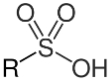
Heating of alkanes with fuming sulphuric acid or oleum at high temperature, which form sulphonic acid, is called Sulphonation.
$H _2 S _2 O _7 \text { (Oleum) } \rightarrow H _2 SO _4+ SO _3$
$R - H + SO _3 \rightarrow R - SO _2 OH$
View full question & answer→MCQ 1411 Mark
Daily use candles (paraffin wax) contain
- ✓
Higher saturated hydrocarbon
- B
Lower saturated hydrocarbon
- C
Higher unsaturated hydrocarbon
- D
Lower unsaturated hydrocarbon
AnswerCorrect option: A. Higher saturated hydrocarbon
a
Candles consist of paraffin wax which generally contains saturated hydrocarbons of length more than $C _{24}$.
View full question & answer→MCQ 1421 Mark
Normal butane convert into isobutane by
- A
$LiAl{H_4}$
- ✓
$AlC{l_3}$
- C
$NaB{H_4}$
- D
$Zn / HCl$
AnswerCorrect option: B. $AlC{l_3}$
b
(b) $\mathop {C{H_3}C{H_2}C{H_2}C{H_3}}\limits_{n - {\rm{butane}}} \xrightarrow[\Delta]{Anhyd AlCl_3} \mathop {C{H_3} - \mathop {CH}\limits_{\mathop {|\,\,\,\,\,}\limits_{\,\,C{H_3}} } - C{H_3}}\limits_{{\rm{iso}}\,{\rm{butane}}} $
View full question & answer→MCQ 1431 Mark
Aluminium carbide on reacting with water gives
Answera
(a) $A{l_4}{C_3} + 6{H_2}O \to \mathop {3C{H_4}}\limits_{{\rm{Methane}}} + 2A{l_2}{O_3}$
View full question & answer→MCQ 1441 Mark
The marsh gas detector used by minerals works on the principle of
- ✓
Difference in the rates of diffusion of gases
- B
- C
Gay-Lussac's law of gaseous volumes
- D
AnswerCorrect option: A. Difference in the rates of diffusion of gases
a
The marsh gas detector used by miners works on the principle of Difference in the rates of diffusion of gases.
A marsh gas detector is a device that detects the presence of gases in an area, often as part of a safety system. This type of equipment is used to detect a gas leak or other emissions and can interface with a control system so a process can be automatically shut down. This type of device is important because there are many gases that can be harmful to organic life, such as humans or animals.
View full question & answer→MCQ 1451 Mark
Methane can be prepared by
Answerb
(b)$C{H_3}COONa + NaOH \xrightarrow{CaO} C{H_4} + N{a_2}C{O_3}$
View full question & answer→MCQ 1461 Mark
Which does not react with chlorine in dark
- A
${C_2}{H_4}$
- B
${C_2}{H_2}$
- ✓
$C{H_4}$
- D
$C{H_3}CHO$
AnswerCorrect option: C. $C{H_4}$
c
$Cl _2$ fissure into the atoms of of Chlorine. Chlorine atoms contact to Methane and they led to the formation of $HCl$ and the radicals of Methane. So, methane does not react with Chlorine in dark.
View full question & answer→MCQ 1471 Mark
Which of the following method can be used for the preparation of methane
- A
- B
- ✓
Reduction of alkyl halide
- D
AnswerCorrect option: C. Reduction of alkyl halide
c
(c) $C{H_3} - Cl + 2H \xrightarrow{Zn/HCl} C{H_4} + HCl$
View full question & answer→MCQ 1481 Mark
Which hydrocarbon will be most stable
Answerd
Longer chain alkanes are typically more stable (relatively, based on the number of carbons) compared with a shorter chain alkane. More branched compounds are typically more stable than straight chain alkanes with the same number of atoms.
View full question & answer→MCQ 1491 Mark
When sodium reacts with ethyl iodide, which of the following hydrocarbons is produced
Answerc
(c) Wurtz reaction
${C_2}{H_5} - I + 2Na + I - {C_2}{H_5} \xrightarrow[Ether]{Dry} \mathop {}\limits_{{\rm{Ether}}} \mathop {{C_2}{H_5} - {C_2}{H_5} + 2NaI}\limits_{{\rm{Butane}}} $
View full question & answer→MCQ 1501 Mark
$C{H_3}MgI$ will give methane with
AnswerCorrect option: D. Both $(a)$ and $(b)$
d
(d) $C{H_3}MgI + C{H_3} - C{H_2} - N{H_2} \to \,\,C{H_4} + C{H_3}C{H_2}NHMgI$
$C{H_3}MgI + {C_2}{H_5}OH \to C{H_4} + {C_2}{H_5}OMgI$
Alkyl group of Grignard’s reagent is involved in the formation of alkane.
View full question & answer→MCQ 1511 Mark
Propane$-1-$ol can be prepared from propene by its reaction with
AnswerCorrect option: C. ${B_2}{H_6}/NaOH,{H_2}{O_2}$
View full question & answer→MCQ 1521 Mark
Successive alkanes differ by
- ✓
$>C{H_2}$
- B
$>CH$
- C
$ - \,\,C{H_3}$
- D
${C_2}{H_4}$
AnswerCorrect option: A. $>C{H_2}$
a
successive members differ in mass by an extra methylene bridge $\left(- CH _2-\right.$ unit) inserted in the chain.
View full question & answer→MCQ 1531 Mark
Methane and ethane both can be prepared in one step by which of the following compound
- A
${C_2}{H_4}$
- B
$C{H_3}O$
- ✓
$C{H_3}Br$
- D
$C{H_3}C{H_2}OH$
AnswerCorrect option: C. $C{H_3}Br$
c
(c) $C{H_3}Br + {H_2}\,\, \xrightarrow{LiAlH4} CH_4 $ (methane) $ \xrightarrow{Na} \,\,C{H_3} - C{H_3}$ (Ethane)
View full question & answer→MCQ 1541 Mark
Photochemical chlorination of alkane is initiated by a process of
Answerd
(d) Photochemical chlorination of alkane take place by free radical mechanism which are possible by Homolysis of $C -C$ bond
$C{l_2} \xrightarrow{hv} C{l^ \bullet } + C{l^ \bullet }$
$C{H_3} - C{H_3} + C{l^ \bullet } \to C{H_3}C{l^ \bullet } + \dot C{H_3}$
View full question & answer→MCQ 1551 Mark
A petroleum fraction having boiling range $70-200\,^oC$ and containing $6-10$ carbon atoms per molecule is called
View full question & answer→MCQ 1561 Mark
Producer gas is a mixture of
- ✓
$CO$ and ${N_2}$
- B
$C{O_2}$ and ${H_2}$
- C
${N_2}$ and ${O_2}$
- D
$C{H_4}$ and ${N_2}$
AnswerCorrect option: A. $CO$ and ${N_2}$
a
(a) Producer gas -$ CO\,{\rm{and \,}}{N_2}$
View full question & answer→MCQ 1571 Mark
The highest boiling point is expected for
AnswerCorrect option: C. $n - $octane
c
(c) Among alkanes, boiling point increase with increasing molecular weight. For isomeric alkanes straight chain alkanes have higher boiling point than the branched alkanes.
View full question & answer→MCQ 1581 Mark
Which of the following is a good conductor of heat of electricity
Answerb
(b) Graphite is a good conductor of heat of electricity.
View full question & answer→MCQ 1591 Mark
Which one of the following has the minimum boiling point
- A
$1-$Butene
- B
$1-$Butyne
- C
$n-$Butane
- ✓
Answerd
(d)Among the isomeric alkanes, the normal isomer has a higher boiling point than the branched chain isomer. The greater the branching of the chain, the lower is the boiling point. The $n-$alkane have larger surface area in comparison to branched chain isomer (as the shape approaches that of a sphere in the branched chain isomers). Thus, intermolecular forces are weaker in branched chain isomers, there fore they have lower point in comparision to straight chain isomers.
View full question & answer→MCQ 1601 Mark
Octane number can be changed by
Answerd
(d) The octane numbers of Fuel can be improved by increasing the percentage of branched chain alkanes, alkenes and aromatic hydrocarbon. Thus octane number can be changed by isomerisation (reforming), alkylation and aromatisation (cyclisation) etc.
View full question & answer→MCQ 1611 Mark
- A
${C_8} - {C_{12}}$
- B
${C_2} - {C_5}$
- ✓
${C_6} - {C_{11}}$
- D
AnswerCorrect option: C. ${C_6} - {C_{11}}$
c
(c) The approximate composition of gasoline is ${C_6} - {C_{11}}$ at boiling point $70-200\,^oC$ and is used in motor fuel, dry cleaning, petrol gas etc.
View full question & answer→MCQ 1621 Mark
The complete combustion of $C{H_4}$ gives
- A
$CO + {H_2}$
- B
$CO + {N_2}$
- ✓
$C{O_2} + {H_2}O$
- D
$CO + {N_2}O$
AnswerCorrect option: C. $C{O_2} + {H_2}O$
c
(c) $C{H_4} + {O_2} \to C{O_2} + 2{H_2}O$
View full question & answer→MCQ 1631 Mark
Which one of the following compounds gives methane on treatment with water
- ✓
$A{l_4}{C_3}$
- B
$Ca{C_2}$
- C
$VC$
- D
$SiC$(e)${B_4}C$
AnswerCorrect option: A. $A{l_4}{C_3}$
a
(a) $A{l_4}{C_3} + 12{H_2}O \to 3C{H_4} + 4Al{(OH)_3}$
$Ca{C_2} + 2{H_2}O \to {C_2}{H_2} + Ca{(OH)_2}$
View full question & answer→MCQ 1641 Mark
Pick out the alkane which differs from the other members of the group.
- A
$2,2-$dimethyl propane
- B
- C
$2-$methyl butane
- ✓
$2,2-$dimethyl butane
AnswerCorrect option: D. $2,2-$dimethyl butane
d
(d) Except $2,2$ dimethyl butane rest compound contain $5$ carbon i.e., pantane while $2,2 $ dimethyl butane contain $6$ carbon i.e., Hexane
$\begin{array}{*{20}{c}}
{\,\,\,\,\,\,\,\,\,\,\,\,\,\,\,\,\,\,\,\,\,\,\,\,C{H_3}} \\
{\,\,\,\,\,\,\,\,\,\,\,\,\,\,\,\,\,\,|} \\
{C{H_3} - C{H_2} - C - C{H_3}} \\
{\,\,\,\,\,\,\,\,\,\,\,\,\,\,\,\,\,|} \\
{\,\,\,\,\,\,\,\,\,\,\,\,\,\,\,\,\,\,\,\,\,\,C{H_3}}
\end{array}$
View full question & answer→MCQ 1651 Mark
The product obtained on reaction of ${C_2}{H_5}Cl$ with hydrogen over palladium carbon is
- A
${C_3}{H_8}$
- B
${C_4}{H_{10}}$
- ✓
${C_2}{H_6}$
- D
${C_2}{H_4}$
AnswerCorrect option: C. ${C_2}{H_6}$
c
(c) ${C_2}{H_5}Cl + {H_2} \xrightarrow{Pd/c} {C_2}{H_6} + HCl$
This reaction is used for the preparation of pure alkanes.
View full question & answer→MCQ 1661 Mark
When ethylene bromide is treated with $Zn,$ we get
Answerb
(b) $\begin{array}{*{20}{c}}
{C{H_2} - C{H_2}} \\
{|\,\,\,\,\,\,\,\,\,\,\,\,\,\,|\,\,\,\,\,\,\,\,} \\
{\,Br\,\,\,\,\,\,\,\,Br\,\,\,\,\,\,\,\,\,}
\end{array} + Zn \to \mathop {C{H_2} = C{H_2}}\limits_{Alkene} + B{r_2}$
View full question & answer→MCQ 1671 Mark
Which of the following hydrocarbons cannot be obtained by Sabatier and Senderen's reaction
- ✓
$C{H_4}$
- B
${C_2}{H_6}$
- C
${C_3}{H_8}$
- D
AnswerCorrect option: A. $C{H_4}$
a
(a)Methane can not be obtained by Sabatier and Sendern’s reaction because in this the product obtained contain minimum two carbon atoms.
$C{H_2} = C{H_2} + {H_2} \xrightarrow{Ni}C{H_3} - C{H_3}$
$CH \equiv CH + 2{H_2} \xrightarrow{Ni} C{H_3} - C{H_3}$
View full question & answer→MCQ 1681 Mark
Which of the following has highest knocking property
Answerd
(d) Octane number increases in the order
Straight chain alkanes < Branched chain alkanes < Olefins < Cyclo alkanes < Aromatic compounds
Since, straight chain alkane has minimum octane number. Hence, it produces maximum knocking.
View full question & answer→MCQ 1691 Mark
Which of the following yield both alkane and alkene
Answera
(a) Kolbe’s methods -Electrolysis of a concentrated aqueous solution of either sodium or potassium salts of saturated mono carboxylic acids yields higher alkanes at anode.
$C{H_3}COONa$ $ \rightleftharpoons $ $C{H_3}CO{O^ - } + Na + $
Anode :$2C{H_3}CO{O^ - }\xrightarrow{{ - 2{e^ - }}}C{H_3} - C{H_3} + 2C{O_2}$
Cathode : $2N{a^ + } + 2{e^ - } \to 2Na$
$2Na + 2{H_2}O \to 2NaOH + {H_2}$
View full question & answer→MCQ 1701 Mark
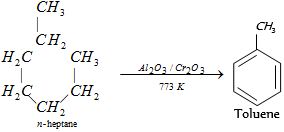
Aromatisation of $ n-$ heptane by passing over $(A{l_2}{O_3} + C{r_2}{O_3})$ catalyst at $773 \,K$ gives
Answerb
(b)
View full question & answer→MCQ 1711 Mark
How many primary, secondary, tertiary and quaternary carbons are present in the following hydrocarbon
$C{H_3} - CH(C{H_3}) - C{(C{H_3})_2} - C{H_2} - CH(C{H_3}) - C{H_2} - C{H_3}$
|
|
Primary
|
Secondary
|
Tertiary
|
Quaternary
|
|
$(a)$
|
$6$
|
$2$
|
$2$
|
$1$
|
|
$(b)$
|
$2$
|
$6$
|
$3$
|
$0$
|
|
$(c)$
|
$2$
|
$4$
|
$3$
|
$2$
|
|
$(d)$
|
$2$
|
$2$
|
$4$
|
$3$
|
- ✓
$I > II > III > IV$
- B
$I > III > II > I$
- C
$II > III > IV > I$
- D
$III > I > II > IV$
AnswerCorrect option: A. $I > II > III > IV$
a
(a) $\mathop {C{H_3}}\limits^{{1^{o\,\,\,\,\,\,\,\,\,}}} - \mathop {\mathop {CH}\limits^{{3^{o\,\,\,\,}}} }\limits_{\mathop {|\,\,\,\,\,\,}\limits_{\,\mathop {\,C{H_3}}\limits_{{1^{o\,\,\,\,\,}}} } } - \mathop {{C^{{4^o}}} - }\limits_{\mathop {|\,\,\,\,\,\,\,\,\,\,}\limits_{\mathop {C{H_3}}\limits_{{1^o}\,\,\,\,} } }^{\mathop {|\,\,\,\,\,\,\,\,\,\,}\limits^{\mathop {C{H_3}\,\,\,}\limits^{{1^{o\,\,\,\,\,\,\,\,}}} } } \mathop {C{H_2}}\limits^{{2^o}\,\,\,\,\,\,} - \mathop {\mathop {CH}\limits^{{3^o}\,\,\,} }\limits_{\mathop {|\,\,\,\,\,}\limits_{\,\,\mathop {C{H_3}}\limits_{\,\,\,{1^o}} } } - \mathop {C{H_2}}\limits^{{2^{o\,\,\,\,\,\,}}} - \mathop {C{H_3}}\limits^{\,\,\,{1^o}} $
${1^o}\, \Rightarrow {\rm{ Primary \,6, }}\,\,{{\rm{2}}^{\rm{o}}} \Rightarrow {\rm{Secondary\, 2}}$
${3^o}\, \Rightarrow {\rm{ Tertiary \,2, }}\,\,{{\rm{4}}^{\rm{o}}} \Rightarrow {\rm{Quanternary}}\,1$
View full question & answer→MCQ 1721 Mark
The octane number of a sample of petrol is $40$. It means that its knocking property is equal to the mixture of
- A
$40\%$ $n-$ heptane + $60\%$ iso-octane
- B
$40\%$ petrol + $60\%$ iso-octane
- ✓
$60\%$ $n-$ heptane + $40\%$ iso-octane
- D
$60\%$ petrol + $40\%$ iso-octane
AnswerCorrect option: C. $60\%$ $n-$ heptane + $40\%$ iso-octane
c
(c) Octane number of fuel is the percentage of iso- octane in mixture.
View full question & answer→MCQ 1731 Mark
When ethyl alcohol is heated with red phosphorus and $HI$, then which of the following is formed
- ✓
${C_2}{H_6}$
- B
$C{H_4}$
- C
${C_3}{H_8}$
- D
${C_2}{H_4}$
AnswerCorrect option: A. ${C_2}{H_6}$
a
(a) $\mathop {C{H_3}C{H_2} - OH}\limits_{{\text{Ethyl}}\,{\text{alcohol}}} + 2HI\xrightarrow{{Red\,P}}\mathop {C{H_3} - C{H_3}}\limits_{{\text{Ethane}}} + {H_2}O + {I_2}$
View full question & answer→MCQ 1741 Mark
In the Fischer-Tropsch synthesis of petrol..... and ..... are used as the raw materials
- ✓
${H_2};CO$
- B
$C{H_4};{H_2}$
- C
$C{H_4};C{H_3}OH$
- D
$C{H_3}OH;CO$
AnswerCorrect option: A. ${H_2};CO$
a
(a) Fischer-Tropsch process -
$\underbrace {CO + {H_2}}_{{\text{Water}}\,{\text{gas}}} + \mathop {{H_2}}\limits_{{\text{Excess}}} \mathop {\xrightarrow{{{\text{CO}}\,\,{\text{or}}\,{\text{Ni}}}}}\limits_{{\text{heat}}} \mathop {Mixure\,of\,hydrocarbons\,}\limits_{(Petrol)} + {H_2}O$
View full question & answer→MCQ 1751 Mark
On cracking petrol, we get
AnswerCorrect option: C. Both $(a)$ and $(b)$
c
(c) On cracking petrol gives smaller hydrocarbons like $CH_4$, $C_3H_6$.
View full question & answer→MCQ 1761 Mark
Cetane is a compound which has very good ignition property. Chemically it is
AnswerCorrect option: A. $C{H_3}{(C{H_2})_{14}}C{H_3}$
a
(a) Cetane is chemically hexadecane i.e,
$C{H_3}{(C{H_2})_{14}}C{H_3}$.
View full question & answer→MCQ 1771 Mark
The number of secondary hydrogens in $2, 2-$ dimethyl butane is
Answerd
(d) $\mathop {\begin{array}{*{20}{c}}
{\,\,\,\,\,\,\,H\,\,\,\,\,\,\,C{H_{3\,}}} \\
{|\,\,\,\,\,\,\,\,\,\,\,|} \\
{{H_3}C - C - C - C{H_3}} \\
{|\,\,\,\,\,\,\,\,\,\,\,|} \\
{\,\,\,\,\,\,H\,\,\,\,\,\,\,C{H_3}}
\end{array}}\limits_{2,2\,\dim ethyl\,bu\tan e} $
View full question & answer→MCQ 1781 Mark
An alkane (molecular weight $72$) forms only one monochlorinated product. Its formula is
AnswerCorrect option: A. ${(C{H_3})_4}C$
a
(a) The alkane forms only one mono substituted product, it must have only one type of hydrogen atoms. there fore the alkane is $2, 2-$ dimethyl propane.
View full question & answer→MCQ 1791 Mark
The poisonous gas that comes out with petrol burning in a car is
- A
$C{H_4}$
- B
${C_2}{H_6}$
- C
$C{O_2}$
- ✓
$CO$
Answerd
(d) On petrol burning $CO$ comes out which is so much poisonous gas.
View full question & answer→MCQ 1801 Mark
$\mathop {{C_6}{H_{14}}}\limits_{n - hexane} \xrightarrow{{A{l_2}{O_3}/\Delta }}(A)\xrightarrow{{(CO + HCl)/AlC{l_3}}}(B)$
Select the incorrect statement among following
- A
Compound $'B'$ form silver mirror on reaction with $[Ag(NH_3)_2]OH$
- ✓
Molecularity of reaction during conversion from $'A'$ to $'B'$ is $'3'$
- C
Compound $'A'$ can also be synthesised by reaction of benzene diazonium chloride with $H_3PO_2$
- D
Compound $'B'$ give grey colour with aq. $HgCl_2$ solution
AnswerCorrect option: B. Molecularity of reaction during conversion from $'A'$ to $'B'$ is $'3'$
View full question & answer→MCQ 1811 Mark
Which has maximum $B.P.$ ?
View full question & answer→MCQ 1821 Mark
The order of reactivity of following compounds :
$(I)$ $\phi -CH_3$
$(II)$ $\phi -CH_2-CH_3$
$(III)$ $\phi -CH(CH_3)_2$
$(IV)$ $\phi-C(CH_3)_3$
towards electrophilic substitution will be - [where $\phi =C_6H_5$]
- ✓
$I > II > III > IV$
- B
$IV > III > II > I$
- C
$II > I > III > IV$
- D
$III > II > I > IV$
AnswerCorrect option: A. $I > II > III > IV$
View full question & answer→MCQ 1831 Mark
Which of the following compounds can be best prepared by Wurtz reaction?
- A
- ✓
$n-$ butane
- C
$n-$ pentane
- D
$Iso-$ pentane
AnswerCorrect option: B. $n-$ butane
b
Symmetrical alkane with single free radical intermediate
View full question & answer→MCQ 1841 Mark
Which of the following gas is evolved at anode during electrolysis of sodium acetate ?
AnswerCorrect option: A. $CO_2$
View full question & answer→MCQ 1851 Mark
Which of the following compounds will react with $Na$ to form $4,5-$ diethyloctane ?
- A
$CH_3CH_2CH_2CH_2Br$
- B
$\begin{array}{*{20}{c}}
{C{H_3}C{H_2}C{H_2} - CH - C{H_2}C{H_2}Br}\\
|\\
{\,\,\,\,\,\,\,C{H_3}}
\end{array}$
- C
$\begin{array}{*{20}{c}}
{C{H_3}C{H_2}C{H_2}C{H_2} - CH - C{H_3}}\\
{\,\,\,\,\,\,\,\,\,\,\,\,\,\,\,\,\,\,\,\,\,\,\,\,\,\,\,\,\,\,\,\,\,\,\,\,\,\,\,\,\,\,\,|\,\,\,\,\,\,\,\,\,\,\,\,\,\,\,\,}\\
{\,\,\,\,\,\,\,\,\,\,\,\,\,\,\,\,\,\,\,\,\,\,\,\,\,\,\,\,\,\,\,\,\,\,\,\,\,\,\,\,\,\,\,\,\,\,\,\,\,\,Br\,\,\,\,\,\,\,\,\,\,\,\,\,\,\,\,\,\,\,\,\,}
\end{array}\,\,\,$
- ✓
$\begin{array}{*{20}{c}}
{C{H_3}C{H_2}C{H_2} - CH - C{H_2}C{H_3}}\\
{\,\,\,\,\,\,\,\,\,\,\,\,\,\,\,\,\,\,\,\,\,\,|\,\,\,\,\,\,\,\,\,\,\,\,\,\,\,\,}\\
{\,\,\,\,\,\,\,\,\,\,\,\,\,\,\,\,\,\,\,\,\,\,\,\,\,\,\,\,\,Br\,\,\,\,\,\,\,\,\,\,\,\,\,\,\,\,\,\,\,\,\,}
\end{array}$
AnswerCorrect option: D. $\begin{array}{*{20}{c}}
{C{H_3}C{H_2}C{H_2} - CH - C{H_2}C{H_3}}\\
{\,\,\,\,\,\,\,\,\,\,\,\,\,\,\,\,\,\,\,\,\,\,|\,\,\,\,\,\,\,\,\,\,\,\,\,\,\,\,}\\
{\,\,\,\,\,\,\,\,\,\,\,\,\,\,\,\,\,\,\,\,\,\,\,\,\,\,\,\,\,Br\,\,\,\,\,\,\,\,\,\,\,\,\,\,\,\,\,\,\,\,\,}
\end{array}$
d
$\,\begin{array}{*{20}{c}}
{C{H_3} - C{H_2} - C{H_2} - CH - \boxed{Br + 2Na + Br} - CH - C{H_2} - C{H_2} + C{H_3}} \\
{|\,\,\,\,\,\,\,\,\,\,\,\,\,\,\,\,\,\,\,\,\,\,\,\,\,\,\,\,\,\,\,\,\,\,\,\,\,\,\,\,\,\,\,\,\,\,\,\,\,\,\,\,\,\,\,\,\,\,\,\,\,\,\,\,|} \\
{\,\,\,\,\,\,\,\,\,\,\,C{H_2}C{H_3}\,\,\,\,\,\,\,\,\,\,\,\,\,\,\,\,\,\,\,\,\,\,\,\,\,\,\,\,\,\,\,\,\,\,\,\,\,\,\,\,\,\,C{H_2}C{H_3}\,\,\,\,\,}
\end{array}$ $\xrightarrow[{DE}]{{Na}}$ $\begin{array}{*{20}{c}}
{C{H_3} - C{H_2} - C{H_2} - CH - CH - C{H_2}C{H_2}C{H_3}} \\
{\,\,\,\,\,\,\,|\,\,\,\,\,\,\,\,\,\,\,\,\,|} \\
{\,\,\,\,\,\,\,\,\,\,C{H_2}\,\,\,\,\,C{H_2}} \\
{\,\,\,\,\,\,\,\,\,\,|\,\,\,\,\,\,\,\,\,\,\,\,\,|\,\,\,\,\,} \\
{\,\,\,\,\,\,\,\,\,C{H_3}\,\,\,\,\,\,C{H_3}\,}
\end{array}$
View full question & answer→MCQ 1861 Mark
Which of the following products is formed when $n-$ heptane is passed over $(Al_2O_3 + Cr_2O_3)$ catalyst at $773\,K$ ?
Answerb
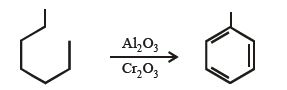
View full question & answer→MCQ 1871 Mark
What happen when methane react with conc.$HNO_3$ at high temperature ?
Answera
When methane reacts with nitric acid, it underogoes nitration to form nitromethane.
$CH _4+ HNO _3 \underset{400^{\circ} C }{\stackrel{\Delta}{\longrightarrow}} \underset{\text { (Nitromethane) }}{ CH _3 NO _2}+ H _2 O$
View full question & answer→MCQ 1881 Mark
Which of the following alkenes is the most stable ?
Answerd
$(d)$ Stability of Alkene $\propto$ No; of $'\propto' \,H$ -atoms or more hyper conjugation
View full question & answer→MCQ 1891 Mark
On halogenation, an alkane gives only one monohalogenated product. The alkane may be
- A
$2$ -methyl butane
- B
$2, 2$ -dimethyl propane
- C
- ✓
both $(b)$ and $(c)$
AnswerCorrect option: D. both $(b)$ and $(c)$
d
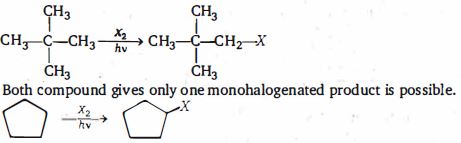
View full question & answer→MCQ 1901 Mark
Which of the following compounds can be best prepared by Wurtz-reaction ?
- A
- ✓
$n$ -butane
- C
$n$ -pentane
- D
AnswerCorrect option: B. $n$ -butane
b
$2C{H_3} - C{H_2} - Cl\xrightarrow[{Dry\,ether}]{{Na}}C{H_3} - C{H_2} - C{H_2} - C{H_3}$
Open chain alkane product having even number of carbons and symmetrical can be achieved by Wurtz reaction.
View full question & answer→MCQ 1911 Mark
A hydrocarbon $A (V.D. = 36)$ forms only one monochloro substitution product. $A$ will be
Answerb
$Mol. \,wt. = 2 \times V. D = 72$
$\therefore$ Mol. formula $= C_5H_{12}$, Structure $\begin{array}{*{20}{c}}
{\,\,\,\,\,\,C{H_3}} \\
| \\
{C{H_3} - C - C{H_3}} \\
| \\
{\,\,\,\,\,\,\,C{H_3}}
\end{array}$ neo-pentane
View full question & answer→MCQ 1921 Mark
Ethyl iodide and $n-$ propyl iodide are allowed to undergo Wurtz reaction. The alkane which will not be obtained in this reaction is
Answerb
$Et - I + C{H_3} - C{H_2} - C{H_2} - I\xrightarrow[{DE}]{{Na}}Et - Et + C{H_3} - C{H_2} - C{H_2} - Et$ $+$ $hexane$
View full question & answer→MCQ 1931 Mark
$\begin{array}{*{20}{c}}
{C{H_3} - CH - C{H_2} - C{H_3}\xrightarrow[{hv}]{{C{l_2}}}} \\
{|\,\,\,\,\,\,\,\,\,\,\,\,\,\,\,\,\,\,\,\,\,\,\,\,\,\,\,\,\,\,\,\,\,\,} \\
{C{H_3}\,\,\,\,\,\,\,\,\,\,\,\,\,\,\,\,\,\,\,\,\,\,\,\,\,\,\,\,\,}
\end{array}$
Number of chiral centers generated during monochlorination in the above reaction
Answerb
$\begin{array}{*{20}{c}}
{Cl - C{H_2} - \mathop C\limits^* H - C{H_2} - C{H_3},} \\
{|\,\,\,\,\,\,\,\,\,\,\,} \\
{C{H_3}\,\,\,\,\,\,}
\end{array}\begin{array}{*{20}{c}}
{\,\,\,\,\,\,\,\,\,Cl} \\
{\,\,\,\,\,\,\,|} \\
{C{H_3} - CH - \mathop C\limits_* H - C{H_3}} \\
{|\,\,\,\,\,\,\,\,\,\,\,\,\,\,\,\,\,} \\
{C{H_3}\,\,\,\,\,\,\,\,\,\,\,}
\end{array}$
View full question & answer→MCQ 1941 Mark
$CH_3Cl \to CH_4$
Above conversion can be achieved by
Answerd
$C{H_3}Cl\xrightarrow[{\operatorname{Re} d.}]{{Zn/{H^ \oplus }}}C{H_4}$
$C{H_3}Cl\xrightarrow[{\operatorname{Re} d.}]{{LiAl{H_4}}}C{H_4}$
$C{H_3}Cl\xrightarrow[\begin{subarray}{l}
Dry \\
ether
\end{subarray} ]{{Mg}}\mathop {\mathop C\limits^{.\,.} }\limits^\Theta {H_3}\mathop {Mg}\limits^ \oplus Cl\xrightarrow{{\mathop H\limits^ \oplus OR}}C{H_4}$
View full question & answer→MCQ 1951 Mark
$n - Butane \xrightarrow{{C{l_2}/hv}}$
Give the total number of monochloro products(including stereo isomers), which are possible in the above reaction.
Answerb
$CH_3 -CH_2 -CH_2 -CH_2 -Cl$ and $\begin{array}{*{20}{c}}
{C{H_3} - \mathop C\limits^* H - CH - C{H_3}} \\
{|\,\,\,\,\,\,\,\,\,\,\,\,\,\,\,\,\,\,\,\,\,\,\,\,\,} \\
{Cl\,\,\,\,\,\,\,\,\,\,\,\,\,\,\,\,\,\,\,\,\,\,}
\end{array}$ and mirror image
View full question & answer→MCQ 1961 Mark
$C{H_4} + C{l_2}\xrightarrow{{hv}}C{H_3}Cl + HCl$
To obtain high yields of $CH_3Cl$, the ratio of $CH_4$ to $Cl_2$ must be
Answera
$(a)$ In order to maximize the amount of monohalogenated product obtained,a radical substitution reaction should be carried out in the presence of excess of alkane. The presence of excess alkane in the reaction mixture ensures that there is a greater probability of the halogen radical colliding with a molecule of alkane than with a molecule of alkyl halide. This is true even toward . the end of the reaction, by which time a considerable amount of alkyl halide will have been formed. If the halogen radical abstracts a hydrogen from a molecule of alkyl halide rather than from a molecule of alkane, a dihalogenated product will be obtained
$C{l^ \bullet } + C{H_3}Cl \to {\,^ \bullet }C{H_2}Cl + HCl$
$^ \bullet C{H_2}Cl + C^{12} \to C{H_2}C{l_2} + C{l^ \bullet }$
Bromination of alkanes follows the same mechanism as chlorination. The only difference is that chlorination produces alkyl chlorides, whereas bromination forms alkyl bromides
View full question & answer→MCQ 1971 Mark
$\begin{array}{*{20}{c}}
{C{H_3} - CH - C{H_2} - C{H_3}\xrightarrow[{hv}]{{C{l_2}}}(x)} \\
{|\,\,\,\,\,\,\,\,\,\,\,\,\,\,\,\,\,\,\,\,\,\,\,\,\,\,\,\,\,\,\,\,\,\,\,\,\,\,\,\,\,} \\
{C{H_3}\,\,\,\,\,\,\,\,\,\,\,\,\,\,\,\,\,\,\,\,\,\,\,\,\,\,\,\,\,\,\,\,\,\,\,\,}
\end{array} =$ Number of monochloro product including stereoisomers.
Answerc
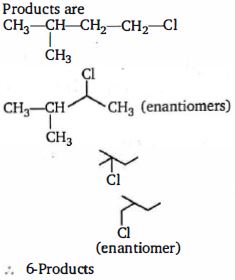
View full question & answer→MCQ 1981 Mark
Arrange the following alkanes in decreasing order of their heats of combustion
$(i)\,\mathop {\begin{array}{*{20}{c}}
{\,\,\,\,\,C{H_3}} \\
| \\
{C{H_3} - C - C{H_3}} \\
| \\
{\,\,\,\,\,C{H_3}}
\end{array}}\limits_{(Neo - pen\tan e)\,(i)} $
$(ii\mathop {)\,\begin{array}{*{20}{c}}
{C{H_3} - CH - C{H_2} - C{H_3}} \\
{|\,\,\,\,\,\,\,\,\,\,\,\,\,\,\,\,\,\,} \\
{\,\,\,\,\,C{H_{3\,\,\,\,\,\,\,\,\,\,\,\,\,\,\,\,\,\,\,\,\,\,\,\,}}}
\end{array}}\limits_{(Iso - pen\tan e)\,\,(ii)} $
$(iii)\,\mathop {C{H_3} - C{H_2} - C{H_2} - C{H_2} - C{H_3}}\limits_{(n - pen\tan e)} $
- A
$(i) > (ii) > (iii)$
- B
$(iii) > (i) > (ii)$
- ✓
$(iii) > (ii) > (i)$
- D
$(i) > (iii) > (ii)$
AnswerCorrect option: C. $(iii) > (ii) > (i)$
c
$(c) \,(iii)$ is most stable because of less steric repulsion $\therefore$ least heat of combustion.
View full question & answer→MCQ 1991 Mark
Ethane is subjected to combustion process. During the combustion the hybrid state of carbon changes from
- A
$sp^2$ થી $sp^3$
- ✓
$sp^3$ થી $sp$
- C
$sp$ થી $sp^3$
- D
$sp^2$ થી $sp^2$
AnswerCorrect option: B. $sp^3$ થી $sp$
b
$C{H_3} - \mathop {\mathop {C{H_3}}\limits_ \uparrow }\limits_{s{p^3}} + \frac{7}{2}{O_2}\xrightarrow{\Delta }\mathop {\mathop {2C{O_2}}\limits_ \uparrow }\limits_{sp} + 3{H_2}O$
View full question & answer→MCQ 2001 Mark
${C{H_3} - C{H_2} - C{H_2} - C{H_3}\xrightarrow[\Delta ]{{AlC{l_3}}}}$ $\begin{array}{*{20}{c}}
{C{H_3} - CH - C{H_3}} \\
{|\,\,\,\,} \\
{\,\,C{H_3}}
\end{array}$
Above reaction is an example of
Answera
Above reaction is the example of isomerization
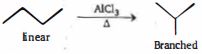
View full question & answer→MCQ 2011 Mark
Pure methane can be prepared by
- A
- B
Kolbe electrolysis method
- ✓
soda-lime de-carboxylation
- D
reduction with $H_2$
AnswerCorrect option: C. soda-lime de-carboxylation
c
$C{H_3} - C{O_2}H\xrightarrow[\Delta ]{{NaOH,CaO}}C{H_4} + C{O_2}$
View full question & answer→MCQ 2021 Mark
Arrange the compounds $I, II$ and $III$ in decreasing order of their heats of combustion

- A
$II > I > III$
- B
$I > II > III$
- ✓
$III > II > I$
- D
$III > I > II$
AnswerCorrect option: C. $III > II > I$
c
$(c)$ More the carbon in alkane. More will heat of combustion.
View full question & answer→MCQ 2031 Mark
An alkane $(mol.\, wt. = 86)$ on bromination gives only two monobromo derivatives (excluding stereoisomers). The alkane is
- A
$\begin{array}{*{20}{c}}
{C{H_3} - CH - C{H_2} - C{H_2} - C{H_3}}\\
{|\,\,\,\,\,\,\,\,\,\,\,\,\,\,\,\,\,\,\,\,\,\,\,\,\,\,\,\,\,\,\,\,\,\,\,\,\,\,\,\,\,\,\,}\\
{C{H_3}\,\,\,\,\,\,\,\,\,\,\,\,\,\,\,\,\,\,\,\,\,\,\,\,\,\,\,\,\,\,\,\,\,\,\,\,\,}
\end{array}$
- B
$\begin{array}{*{20}{c}}
{C{H_{3\,\,\,\,\,\,\,\,\,\,\,\,\,}}}\\
{|\,\,\,\,\,\,\,\,\,\,\,\,\,\,\,}\\
{C{H_3} - C - C{H_2} - C{H_3}}\\
{|\,\,\,\,\,\,\,\,\,\,\,\,\,\,\,}\\
{C{H_3}\,\,\,\,\,\,\,\,}
\end{array}$
- ✓
$\begin{array}{*{20}{c}}
{C{H_3} - CH - CH - C{H_3}}\\
{|\,\,\,\,\,\,\,\,\,\,\,\,\,|\,\,\,\,\,}\\
{C{H_3}\,\,\,\,C{H_3}}
\end{array}$
- D
$\begin{array}{*{20}{c}}
{\,\,\,\,\,\,\,C{H_{3\,}}}\\
|\\
{C{H_3} - C - C{H_3}}\\
|\\
{\,\,\,\,\,\,C{H_3}}
\end{array}$
AnswerCorrect option: C. $\begin{array}{*{20}{c}}
{C{H_3} - CH - CH - C{H_3}}\\
{|\,\,\,\,\,\,\,\,\,\,\,\,\,|\,\,\,\,\,}\\
{C{H_3}\,\,\,\,C{H_3}}
\end{array}$
c
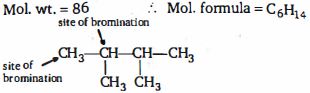
View full question & answer→MCQ 2041 Mark
The correct order of reactivity of $I, II$ & $III$ towards addition reactions is
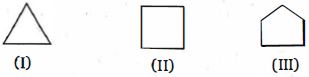
- A
$I > III > II$
- ✓
$I > II > III$
- C
$III > II > I$
- D
$III > I > II$
AnswerCorrect option: B. $I > II > III$
b
$(b)$ Cyclopropane is most unstable therefore more reactive toward addition reaction. Cyclopentene is most stable $\therefore$ less reactive .
View full question & answer→MCQ 2051 Mark
Which of the following reactants is suitable for preparation of methane and ethane by using one step only ?
- A
$H_2C = CH_2$
- B
$CH_3OH$
- ✓
$CH_3 - Br$
- D
$CH_3 - CH_2 - OH$
AnswerCorrect option: C. $CH_3 - Br$
c
$C{H_3} - Br\xrightarrow{{reduction}}C{H_4}$
$C{H_3} - Br\xrightarrow{{Wurtz}}C{H_3} - C{H_3}$
View full question & answer→MCQ 2061 Mark
How many carbon atoms does an alkane (not a cycloalkane) need before it is capable to exist in enantiomeric form ?
Answerd

View full question & answer→MCQ 2071 Mark
Among the following free radical bromination reactions, select those in which $2^o$ halide is the major product
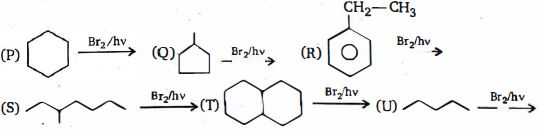
- A
$P, Q, R, S$
- ✓
$P, R, U$
- C
$P, R, S, T$
- D
$P, Q, R, S, T$
AnswerCorrect option: B. $P, R, U$
b
$(b)$ Bromine is more selective $\therefore$ it will form $3^o$ halide if there is presence of $3^o$ hydrogen. $\therefore\, Q, S, T,$ form $3^o$ halide as major and $P, R, U$ form $2^o$ halide as major.
View full question & answer→MCQ 2081 Mark
$(A) + C{l_2}\xrightarrow{{hv}}$ monochloro product
To maximise the yield of monochloro product in the above reaction ?
- A
$Cl_2$ must be added in excess
- ✓
Reactant $(A)$ must be added in excess
- C
Reaction must be carried out in dark
- D
Reaction must be carried out with equimolar mixture of $Cl_2$ and $A$
AnswerCorrect option: B. Reactant $(A)$ must be added in excess
b
$(b)$ If reactant $(A)$ is added in excess then maximum collission between $(A)$ and $C{l^ \bullet }$ in the rate determining step.
View full question & answer→MCQ 2091 Mark
$C{H_3} - C{H_2} - C{H_2} - C{H_3}\xrightarrow{{B{r_2}/hv}}$
Major product in the above reaction is
Answera
$(a)$ $2^o$ halide is major, due to formation of $sp^2$ -hybridized free radical racemization take place.
View full question & answer→MCQ 2101 Mark
The number of possible monobromo products is (excluding stereoisomers)
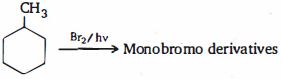
Answerb
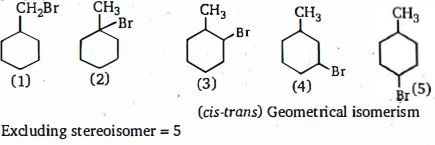
View full question & answer→MCQ 2111 Mark
$Br^\bullet $ will abstract which of the hydrogen most readily ?
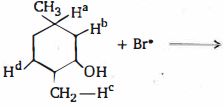
Answera
$(a)$ Bromine is more selective
$\therefore$ abstract that hydrogen which forms stable free-radical
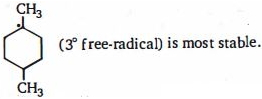
View full question & answer→MCQ 2121 Mark
Arrange the following compounds in decreasing order of their heats of combustion
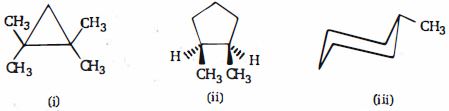
- A
$(iii) > (ii) > (i)$
- B
$(ii) > (i) > (iii)$
- C
$(iii) > (i) > (ii)$
- ✓
$(i) > (ii) > (iii)$
AnswerCorrect option: D. $(i) > (ii) > (iii)$
d
$(d)$ Stability of cyclic system $6 > 5 > 3$ $\therefore$ Heat of combustion $i > ii > iii$
View full question & answer→MCQ 2131 Mark
$\mathop {C{H_3} - }\limits_a \mathop {C{H_2} - }\limits_b \mathop {C{H_2} - }\limits_c \mathop {C{H_2} - }\limits_d F$
Arrange the hydrogens $a, b, c, d$ in decreasing order of their reactivities towards chlorination
- A
$a > b > c > d$
- B
$b > c > d > a$
- ✓
$b > c > a > d$
- D
$c > b > a > d$
AnswerCorrect option: C. $b > c > a > d$
c
$(c)$ Selectivity of $Cl \to 3^o > 2^o > 1^o$ hydrogen.
as well as $-I$ of $F$ -atom.
View full question & answer→MCQ 2141 Mark
How many dichloro products are formed in the above reaction (including stereoisomers)?
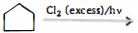
Answerc
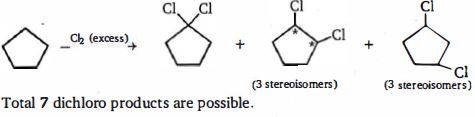
View full question & answer→MCQ 2151 Mark
$\begin{array}{*{20}{c}}
{Ph - C{H_2} - CH - C{H_3}\xrightarrow{{B{r_2}/hv}}} \\
{|\,\,\,\,\,\,\,\,\,\,} \\
{D\,\,\,\,\,\,\,\,\,\,}
\end{array}$
Product of the above reaction will be
Answera
$\begin{array}{*{20}{c}}
{Ph - C{H_2} - CH - C{H_3}\xrightarrow{{B{r_2}/hv}}} \\
{|\,\,\,\,\,\,\,\,\,\,} \\
{D\,\,\,\,\,\,\,\,\,\,}
\end{array}$
$\begin{array}{*{20}{c}}
{Ph - \mathop {{\text{ }}C}\limits^* H - \mathop {{\text{ }}C}\limits^* H - C{H_3}} \\
{|{\mkern 1mu} {\mkern 1mu} {\mkern 1mu} {\mkern 1mu} {\mkern 1mu} {\mkern 1mu} \,\,\,\,\,\,\,\,\,\,\,\,{\mkern 1mu} {\mkern 1mu} {\mkern 1mu} {\mkern 1mu} {\mkern 1mu} {\mkern 1mu} {\mkern 1mu} {\mkern 1mu} {\mkern 1mu} |{\mkern 1mu} {\mkern 1mu} {\mkern 1mu} {\mkern 1mu} {\mkern 1mu} \,\,\,\,{\mkern 1mu} {\mkern 1mu} {\mkern 1mu} } \\
{Br{\mkern 1mu} {\mkern 1mu} {\mkern 1mu} \,\,\,\,\,\,{\mkern 1mu} {\mkern 1mu} \,\,\,\,{\mkern 1mu} {\mkern 1mu} {\mkern 1mu} {\mkern 1mu} {\mkern 1mu} D\,\,\,\,{\mkern 1mu} {\mkern 1mu} {\mkern 1mu} {\mkern 1mu} {\mkern 1mu} {\mkern 1mu} {\mkern 1mu} }
\end{array}$
View full question & answer→MCQ 2161 Mark
Which of the following does not represent major product of that reaction ?
Answerd

View full question & answer→MCQ 2171 Mark
Conversion of cyclohexene to cyclohexanol can be conveniently achieved by
- A
$NaOH + H_2O$
- B
$Br_2 - H_2O$
- ✓
- D
Answerc
$(c)$ Hydroboration - oxidation reaction
View full question & answer→MCQ 2181 Mark
$cis-3$ -hexene $\xrightarrow{(a)}$ meso $3,4-$ hexanediol
$trans-3$ -hexene $\xrightarrow{(b)}$ meso $3,4-$ hexanediol
Choose pair of reagent $(a, b)$ for above conversions
- A
Cold $KMnO_4,OsO_4$
- ✓
Cold $KMnO_4,RCO_3H / H_3O^{\oplus}$
- C
$RCO_3H / H_3O^{\oplus}$, cold $KMnO_4$
- D
AnswerCorrect option: B. Cold $KMnO_4,RCO_3H / H_3O^{\oplus}$
b
$(b)\, a =$ Cold $KMnO_4$ (syn-addition)
$b = RCO_3H / H_3O^{\oplus}$ (anti-addition)
View full question & answer→MCQ 2191 Mark
Which of the following alkane is synthesized from single alkyl halide by wurtz reaction ?
Answerd
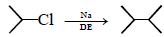
View full question & answer→MCQ 2201 Mark
Which of the following will not gives one monochloro product
Answerd
$\begin{array}{*{20}{c}}
{C{H_3} - CH - C{H_3}} \\
{|\,\,\,\,\,} \\
{\,C{H_3}}
\end{array}$ $\xrightarrow[{hv}]{{C{l_2}}}\begin{array}{*{20}{c}}
{\,\,Cl} \\
| \\
{C{H_3} - C - C{H_3}} \\
| \\
{\,\,\,\,C{H_3}}
\end{array}$ $+$ $\begin{array}{*{20}{c}}
{C{H_3} - CH - C{H_2} - Cl} \\
{|\,\,\,\,\,\,\,\,\,\,\,\,\,\,} \\
{C{H_{3\,\,\,\,\,\,\,\,\,\,\,\,\,\,\,\,}}}
\end{array}$
View full question & answer→MCQ 2211 Mark
Product $(A)$ is
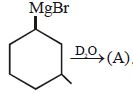
View full question & answer→MCQ 2221 Mark
View full question & answer→MCQ 2231 Mark
The reaction conditions leading to the best yields of $C_2H_5Cl$ are
- ✓
${C_2}{H_6}(excess)\, + \,C{l_2}\,\xrightarrow{{UV}}$
- B
${C_2}{H_6}\, + \,C{l_2}\,\xrightarrow[{room\,\,\,temp.}]{{dark}}$
- C
${C_2}{H_6}\, + \,C{l_2}(excess)\,\xrightarrow{{UV}}$
- D
${C_2}{H_6}\, + \,C{l_2}\,\xrightarrow{{UV}}$
AnswerCorrect option: A. ${C_2}{H_6}(excess)\, + \,C{l_2}\,\xrightarrow{{UV}}$
a
There can be polyhalogenation in this reaction but if excess of ethane is taken, then $C_5H_5Cl$ is obtained is major amount
View full question & answer→MCQ 2241 Mark
$(CH_3)_2CHBr$ $\xrightarrow[{(2)\,CuI}]{{(1)\,Li}}\left( A \right)\xrightarrow{{{{\left( {C{H_3}} \right)}_2}CHC{H_2}Br}}B$
$'B'$ is
AnswerCorrect option: C. $(CH_3)_2CHCH_2CH(CH_3)_2$
c
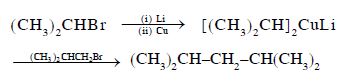
View full question & answer→MCQ 2251 Mark
$n-$ heptane $\xrightarrow[{600\,{}^oC}]{{C{r_2}{O_3}/{V_2}{O_3}}}$ ?
Answerb
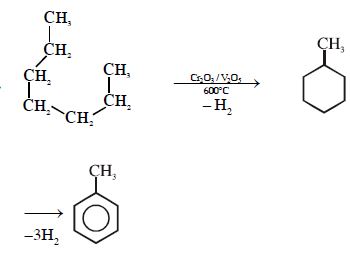
View full question & answer→MCQ 2261 Mark
Which of the following can't be prepared using wurtz method ?
MCQ 2271 Mark
Which of the following compound has highest boiling point
- A
$n-$ hexane
- B
- ✓
$n-$ octane
- D
$2,3-$ Dimethyl butane
AnswerCorrect option: C. $n-$ octane
c
Boiling point $\alpha $ molecular weight $n-$ octane has highest molecular weight among all
View full question & answer→MCQ 2281 Mark
$\,$
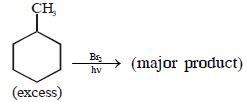
Answerb
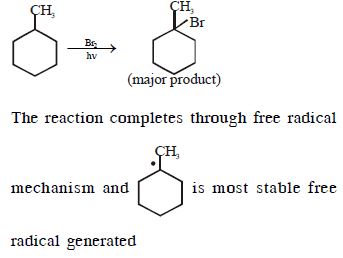
View full question & answer→MCQ 2291 Mark
$n-$ butane on heating with catalytic mixture of $AlCl_3$ and $HCl$ gives
Answerc

View full question & answer→MCQ 2301 Mark
The reaction conditions leading to the best yield of $C_2H_5Cl$ are
- A
$\mathop {{C_2}{H_6}}\limits_{\left( {excess} \right)} + \mathop {C{l_2}}\limits_{\left( {excess} \right)} \xrightarrow{\Delta }$
- B
$\mathop {{C_2}{H_6}}\limits_{\left( {less} \right)} + \mathop {C{l_2}}\limits_{\left( {less} \right)} \xrightarrow{\Delta }$
- ✓
$\mathop {{C_2}{H_6}}\limits_{\left( {excess} \right)} + \mathop {C{l_2}}\limits_{\left( {less} \right)} \xrightarrow{\Delta }$
- D
$\mathop {{C_2}{H_6}}\limits_{\left( {less} \right)} + \mathop {C{l_2}}\limits_{\left( {excess} \right)} \xrightarrow{\Delta }$
AnswerCorrect option: C. $\mathop {{C_2}{H_6}}\limits_{\left( {excess} \right)} + \mathop {C{l_2}}\limits_{\left( {less} \right)} \xrightarrow{\Delta }$
c
$\mathop {{C_2}{H_6}}\limits_{\left( {excess} \right)} + \mathop {C{l_2}}\limits_{\left( {less} \right)} \to {C_2}{H_5} - Cl$
View full question & answer→MCQ 2311 Mark
Compound $(P)$ is
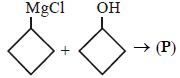
Answerd
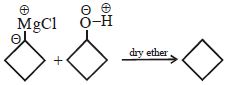
View full question & answer→MCQ 2321 Mark
What are the products form at anode during Kolbe synthesis
Answerc
The Kolbe electrolysis or Kolbe reaction is an organic reaction named after Hermann Kolbe. The
Kolbe reaction is formally a decarboxylative dimerisation of two carboxylic acids (or carboxylate ions) The overall general reaction is as shown in an image.
After electrolysis alkane is formed at anode along with the release of carbon-dioxide. When potassium acetate $\left(\mathrm{CH}_{3} \mathrm{COO}^{-} \mathrm{K}^{+}\right)$ is used in electrolysis, carbon dioxide is released
along with ethane $\left(\mathrm{H}_{3} \mathrm{C}-\mathrm{CH}_{3}\right)$
$\mathrm{CH}_{3} \mathrm{COO}^{-} \longrightarrow \mathrm{CH}_{3}($ radical $)+\mathrm{CO}_{2}$
$\mathrm{CH}_{3}($ radical $)+\mathrm{CH}_{3}($ radical $) \longrightarrow \mathrm{C}_{2} \mathrm{H}_{6}($ ethane $)$ is release at anode.
Option C is the correct answer.
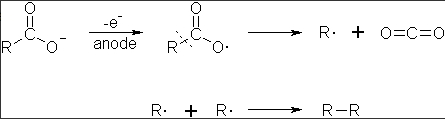
View full question & answer→MCQ 2331 Mark
Match list $I$ with list $II$ and then select the correct answer from the codes given below the lists
| list $I$ |
list $II$ |
| $(A)$ Butane $\to$ Isobutane |
$(a)$ Cracking |
| $(B)$ Butane $\to$ Lower hydrocarbons |
$(b)$ Isomerisation |
| $(C)$ $n-$ Heptane $\to $ Toluene |
$(c)$ Reed reaction |
| $(D)$ Propane $\to$ $CH_3CH_2CH_2SO_2Cl$ |
$(d)$ Aromatizatio |
- ✓
$A-b,\,\,B-a,\,\,C-d,\,\,D-c$
- B
$A-b,\,\,B-d,\,\,C-a,\,\,D-c$
- C
$A-b,\,\,B-c,\,\,C-d,\,\,D-a$
- D
$A-b,\,\,B-d,\,\,C-c,\,\,D-a$
AnswerCorrect option: A. $A-b,\,\,B-a,\,\,C-d,\,\,D-c$
View full question & answer→MCQ 2341 Mark
Which of the following has the highest boiling point
- ✓
$n-$ octane
- B
- C
- D
$2, 2-$ Dimethyl pentane
AnswerCorrect option: A. $n-$ octane
View full question & answer→MCQ 2351 Mark
Match list $I$ with list $II$ and then select the correct answer from the codes given below the lists
| |
list $I$ |
|
list $II$ |
| $A.$ |
Butane $\to $ Isobutane |
$(a)$ |
Cracking |
| $B.$ |
Butane $\to $ Lower hydrocarbons |
$(b)$ |
Isomerisation |
| $C.$ |
$n-$ Heptane $\to $ Toluene |
$(c)$ |
Reed reaction |
| $D.$ |
Propane $\to CH_3CH_2CH_2SO_2Cl$ |
$(d)$ |
Aromatization |
- ✓
$A-b,\,\,\,B-a,\,\,\,C-d,\,\,\,D-c$
- B
$A-b,\,\,\,B-d,\,\,\,C-a,\,\,\,D-c$
- C
$A-b,\,\,\,B-c,\,\,\,C-d,\,\,\,D-a$
- D
$A-b,\,\,\,B-d,\,\,\,C-c,\,\,\,D-a$
AnswerCorrect option: A. $A-b,\,\,\,B-a,\,\,\,C-d,\,\,\,D-c$
View full question & answer→MCQ 2361 Mark
Arrange following alkanes in order of their boiling points
$(A)$ Pentane
$(B)\,2-$ Methyl butane
$(C)\,2,2-$ Dimethyl propane
- ✓
$A > B > C$
- B
$A > C > B$
- C
$C > B > A$
- D
$C > A > B$
AnswerCorrect option: A. $A > B > C$
View full question & answer→MCQ 2371 Mark
Choose the chain terminating step
(1)${H_2} \to {H^ \bullet } + {H^ \bullet }$
(2)$B{r_2} \to B{r^ \bullet } + B{r^ \bullet }$
(3)$B{r^ \bullet } + HBr \to {H^ \bullet } + B{r_2}$
(4)${H^ \bullet } + B{r_2} \to HBr + B{r^ \bullet }$
(5)$B{r^ \bullet } + B{r^ \bullet } \to B{r_2}$
Answerd
Step $5$ is chain termination step since no more radical formation is taking place.
View full question & answer→MCQ 2381 Mark
Ethylene reacts with bromine to form
- A
$Br - C{H_2} - C{H_3}$
- B
$C{H_3} - CB{r_3}$
- ✓
$Br - C{H_2} - C{H_2}Br$
- D
$CHB{r_3}$
AnswerCorrect option: C. $Br - C{H_2} - C{H_2}Br$
c
Alkenes react in the cold with pure liquid bromine, or with a solution of bromine in an organic solvent like tetrachloromethane. The double bond breaks, and a bromine atom becomes attached to each carbon.... In the case of the reaction with ethene, $1,2$-dibromoethane is formed.
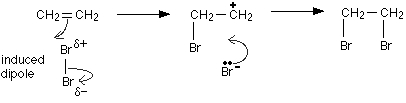
View full question & answer→MCQ 2391 Mark
Sodium ethoxide is a specific reagent for
Answerc
(c) $C{H_3} - C{H_2} - C{H_2} - Br\mathop {}\limits_{{\rm{}}} $ $ \xrightarrow[C_2H_5ONa]{Dehydro halogenati on } $ $C{H_3} - CH = C{H_2} + HBr$
View full question & answer→MCQ 2401 Mark
Which of the following has highest knocking
Answerc
(c) Straight chain olefins has highest knocking.
View full question & answer→MCQ 2411 Mark
Addition of bromine to $1, 3-$butadiene gives
- A
$1, 2 $ addition product only
- B
$1, 4$ addition product only
- ✓
Both $1, 2$ and $1, 4$ addition products
- D
AnswerCorrect option: C. Both $1, 2$ and $1, 4$ addition products
c
$1,3$-butadiene accompanies the bromine molecule to form two products.
They are $1,2$-add products and $1,4$-surplus products.
At low temperatures, the $1,2$-pair is predominant but at higher temperatures, the $1,4$-pair is predominant. Products $A$ and $B$ will be on this basis.
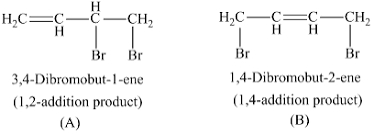
View full question & answer→MCQ 2421 Mark
Ethene when treated with $B{r_2}$ in the presence of $CC{l_4}$ which compound is formed
AnswerCorrect option: A. $1, 2-$dibromoethane
a
(a) $C{{H}_{2}}=C{{H}_{2}}+B{{r}_{2}}\xrightarrow{CC{{l}_{4}}}\underset{\begin{smallmatrix}
\text{1, 2-dibromo } \\
\text{ethane}
\end{smallmatrix}}{\mathop{\underset{Br\,\,\,\,\,}{\mathop{\underset{|\,\,\,\,\,\,\,}{\mathop{C{{H}_{2}}}}\,}}\,-\underset{\underset{Br\,\,\,\,}{\mathop{|\,\,\,\,\,\,\,}}\,}{\mathop{C{{H}_{2}}}}\,}}\,$
View full question & answer→MCQ 2431 Mark
Ethylene may be obtained by dehydration of which of the following with concentrated ${H_2}S{O_4}$ at $160 - {170\,^o}C$
- ✓
${C_2}{H_5}OH$
- B
$C{H_3}OH$
- C
$C{H_3}C{H_2}C{H_2}OH$
- D
${(C{H_3})_2}CHC{H_2}OH$
AnswerCorrect option: A. ${C_2}{H_5}OH$
a
(a) $C{H_3} - C{H_2} - OH \xrightarrow[160-170\,^oC]{Conc. H_2SO_4} \mathop {}\limits_{} C{H_{_2}} = C{H_2} + {H_2}O$
View full question & answer→MCQ 2441 Mark
$X$ in the above reaction is
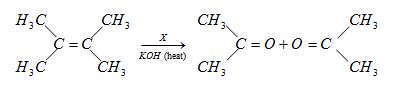
- A
$HN{O_3}$
- B
${O_2}$
- C
${O_3}$
- ✓
$KMn{O_4}$
AnswerCorrect option: D. $KMn{O_4}$
d
(d)

View full question & answer→MCQ 2451 Mark
A gas formed by the action of alcoholic $KOH$ on ethyl iodide, decolourises alkaline$KMn{O_4}$. The gas is
- A
${C_2}{H_6}$
- B
$C{H_4}$
- C
${C_2}{H_2}$
- ✓
${C_2}{H_4}$
AnswerCorrect option: D. ${C_2}{H_4}$
d
(d) ${C_2}{H_5}I + alc.KOH \to {C_2}{H_4} + KI + {H_2}O$
View full question & answer→MCQ 2461 Mark
$C{H_3} - C{H_2} - Cl $ $ \xrightarrow{alcKOH} $ $A$, the product is
AnswerCorrect option: D. $C{H_2} = C{H_2}$
d
$CH _3- CH _2- Cl \stackrel{ alc\,\,KOH }{\longrightarrow} CH _2= CH _2+ KBr + H _2 O$
Haloalkanes in the presence of alcoholic $KOH$ undergoes elimination reaction or dehydrohalogenation reaction..
View full question & answer→MCQ 2471 Mark
The final product formed when ethyl bromide is treated with excess of alcoholic $KOH$ is
Answera
(a)$C{H_3} - C{H_2} - Br + KOH \to C{H_2} = C{H_2} + KBr + {H_2}O$
View full question & answer→MCQ 2481 Mark
$C{H_2} = C{H_2} \xrightarrow[KOH / H_2o ]{KMnO_4} \mathop {}\limits_{} X$ . Product ‘$X$’ in above reaction is
Answera
$CH _2= CH _2 \underset{ KOH / H _2 O }{\stackrel{ KMnO _4}{\longrightarrow}} HO - CH _2- CH _2- OH + MnO _2$
Ethenes react with acidified potassium permanganate. Potassium
Permanganate is a strong oxidant, and will initially convert the double bond to two alcohol ( $OH )$ groups.
Ethene $+$ Acidified Potassium Permanganate $\rightarrow$ Ethan - $1,2$ - diol(Ethylene -
glycol)The purple colour of permanganate will fade as the reaction proceeds.
View full question & answer→MCQ 2491 Mark
Which of the following compounds represents acrylonitrile
Answerd
Acrylonitrile is an organic compound with the formula $CH _2 CHCN$. It is a colorless volatile liquid although commercial samples can be yellow due to impurities. It has a pungent odor of garlic or onions. In terms of its molecular structure, it consists of a vinyl group linked to a nitrile. It is an important monomer for the manufacture of useful plastics such as polyacrylonitrile. It is reactive and toxic at low doses. Acrylonitrile was first synthesized by the French chemist Charles Moureu $(1863-1929)$ in $1893$.
View full question & answer→MCQ 2501 Mark
Ozonolysis of which one of the following will give two molecules of acetaldehyde
- A
$1-$butene
- ✓
$2-$butene
- C
$1-$pentene
- D
$2-$pentene
AnswerCorrect option: B. $2-$butene
b
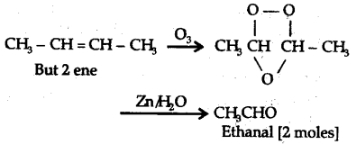
View full question & answer→MCQ 2511 Mark
Dilute aqueous $KMn{O_4}$, at room temperature reacts with ${\rm{ }}R - CH = CH - R$ to give
- A
$R -CHO$
- B
$R -COOH$
- ✓
$RCHOH -CHOHR$
- D
$C{O_2} + {H_2}O$
AnswerCorrect option: C. $RCHOH -CHOHR$
c
(c) $R-CH=CH-R\underset{\text{room temp}\text{.}}{\mathop{\xrightarrow{\text{dil}\text{. aqueous }KMn{{O}_{4}}}}}\,\underset{(\text{Alcohol)}}{\mathop{R-\underset{\begin{smallmatrix}
| \\
OH
\end{smallmatrix}}{\mathop{CH}}\,-\underset{\begin{smallmatrix}
| \\
OH
\end{smallmatrix}}{\mathop{CH}}\,\,-R}}\,$
$R-CH=CH-R\underset{\text{heat}}{\mathop{\xrightarrow{\text{Conc}\text{. }KMn{{O}_{4}}}}}\,R-COOH+R-COOH$
View full question & answer→MCQ 2521 Mark
Aqueous sulphuric acid reacts with $2-$methyl$-1-$butene to give predominantly
- A
Isobutyl hydrogen sulphate
- ✓
$2-$methyl$-2-$butanol
- C
$2-$methyl$-1-$butanol
- D
Secondary butyl hydrogen sulphate
AnswerCorrect option: B. $2-$methyl$-2-$butanol
b
(b) $\mathop {\begin{array}{*{20}{c}}
{C{H_3}\,\,\,\,\,\,\,\,} \\
{|\,\,\,\,\,\,\,\,\,\,\,\,\,\,\,} \\
{C{H_2} = C - C{H_2} - C{H_3}}
\end{array}}\limits_{2 - methyl - 1 - bu\tan e} + {H_2}O$ $\xrightarrow[{Markownikoffs\,rule}]{{{H_2}S{O_4}}}\begin{array}{*{20}{c}}
{\,\,\,\,\,\,C{H_3}\,\,\,\,\,\,\,\,\,\,\,\,\,\,\,} \\
{|\,\,\,\,\,\,\,\,\,\,\,\,\,\,\,} \\
{C{H_3} - C - C{H_2} - C{H_3}} \\
{|\,\,\,\,\,\,\,\,\,\,\,\,\,\,\,} \\
{\,\,\,\,OH\,\,\,\,\,\,\,\,\,\,\,\,\,\,\,}
\end{array}$
View full question & answer→MCQ 2531 Mark
How can ethene be produced from ethanol
AnswerCorrect option: C. By dehydration with conc. ${H_2}S{O_4}$ at ${170\,^o}C$
c
When ethanol is heated in presence of conc. $H _2 SO _4$, dehydration takes place to give ethylene.
The reaction of ethene with steam to form ethanol can be reversed. This allows ethanol to be converted into ethene. This is called a dehydration reaction.
$\underset{Ethanol}{C _2 H _5 OH} \xrightarrow[160^{\circ}-170^{\circ} C]{Conc. H _2 SO _4} \underset{Ethene}{CH _2= CH _2}+ \underset{Water}{H _2 O}$
View full question & answer→MCQ 2541 Mark
Isopropyl alcohol is obtained by reacting which of the following alkenes with conc. ${H_2}S{O_4}$ and ${H_2}O$
Answerb
(b) $\mathop {C{H_3} - CH = C{H_2}}\limits_{} + {H_2}O \xrightarrow[Markownikoff's \,rule]{Conc.H_2 SO_4} \mathop {}\limits_{{\rm{}}} \mathop {C{H_3} - \mathop {CH}\limits_{\mathop {|\,\,\,\,\,}\limits_{OH} } - C{H_3}}\limits_{{\rm{Isopropyl}}\,{\rm{\,alcohol}}} $
View full question & answer→MCQ 2551 Mark
When 2-bromobutane reacts with alcoholic $KOH$, the reaction is called
Answerd
(d) $C{H_3} - \mathop {CH}\limits_{\mathop {|\,\,\,\,}\limits_{Br\,} } - C{H_2} - C{H_3} \xrightarrow{alc.KOH} \mathop {C{H_3}CH = CHC{H_3}}\limits_{{\rm{2 - butene}}} $
The reaction is dehydrohalogenation.
View full question & answer→MCQ 2561 Mark
$1, 3-$butadiene reacts with ethylene to form
- A
- B
- ✓
- D
$2, 3$ dimethyl butane
Answerc
the addition of ethene to $1,3$-butadiene to give cyclohexene.
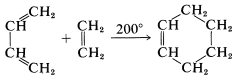
View full question & answer→MCQ 2571 Mark
Ethylene reacts with ozone gas to form the compound
- ✓
$HCHO$
- B
${C_2}{H_5}OH$
- C
- D
$C{H_3}CHO$
AnswerCorrect option: A. $HCHO$
a
(a)
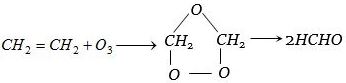
View full question & answer→MCQ 2581 Mark
Oils are converted into fats by
- A
- B
- ✓
- D
Dehydrogenation(e)Hydrogenolysis
Answerc
(c) Oil are unsaturated esters which are converted into fats by saturating it by catalytic hydrogenation.
View full question & answer→MCQ 2591 Mark
Which process converts olefins into parafins
Answerc
(c)

View full question & answer→MCQ 2601 Mark
Of the following the formula which represents a saturated cyclic compound is
- ✓
${C_3}{H_6}$
- B
${C_3}{H_8}$
- C
${C_8}{H_{10}}$
- D
${C_8}{H_{12}}$
AnswerCorrect option: A. ${C_3}{H_6}$
a
(a)

View full question & answer→MCQ 2611 Mark
In a reaction, if half of the double bond is broken and two new bonds are formed, this is a case of
Answerb
(b) e.g. $C{H_2} = C{H_2} + B{r_2} \to \begin{array}{*{20}{c}}
{C{H_2} - C{H_2}} \\
{\,|\,\,\,\,\,\,\,\,\,\,\,\,\,\,\,|\,\,\,\,\,\,\,} \\
{Br\,\,\,\,\,\,\,\,Br\,\,\,\,\,}
\end{array}$
Half of the double bond is broken. It means $\pi $ bond is broken while sigma bond is retained also two new $C - Br$ bonds are formed.
View full question & answer→MCQ 2621 Mark
Which of the following are formed on addition reaction of $DCl$ with $3-$methyl$-1-$butene
- A
$C{H_2}DCHClCH{(C{H_3})_2}$
- B
$C{H_2}DC{H_2}CCl{(C{H_3})_2}$
- C
$C{H_3}CDClCH{(C{H_3})_2}$
- ✓
Both $(a)$ and $(c)$
AnswerCorrect option: D. Both $(a)$ and $(c)$
View full question & answer→MCQ 2631 Mark
Major product of the following reaction is $C{H_3}\mathop {\mathop {\mathop {\mathop { - C - }\limits^| }\limits^{Br} }\limits_| }\limits_H C{H_2} - C{H_3} + alco.\,KOH \to $
- A
Butene$-1$
- ✓
Butene$-2$
- C
- D
Butyne$-1$
AnswerCorrect option: B. Butene$-2$
b
(b) $C{H_3} - \mathop {CH}\limits^{\mathop {|\,\,\,\,\,}\limits^{Br\,\,} } - C{H_2} - C{H_3} + \mathop {KOH}\limits_{\left( {{\rm{alc}}} \right)} \to $
$\mathop {C{H_3} - CH = CH - C{H_3}}\limits_{{\rm{Butene - 2}}} + KBr + {H_2}O$
View full question & answer→MCQ 2641 Mark
Cyclopentene on treatment with alkaline $KMn{O_4}$ gives
- A
- B
trans $1, 2-$cyclopentanediol
- ✓
cis $1, 2-$cyclopentanediol
- D
$1 : 1$ mixture of cis and trans $1, 2-$cyclopentanediol
AnswerCorrect option: C. cis $1, 2-$cyclopentanediol
c
(c)
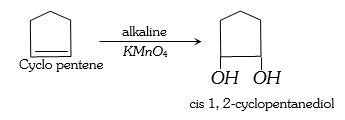
View full question & answer→MCQ 2651 Mark
Ethene gives with acidic $KMn{O_4}$ solution
Answerc
(c) $C{H_2} = C{H_2} + 2[O] \xrightarrow{KMnO_4} \mathop {HCHO + HCHO}\limits_{{\rm{Formaldehyde}}} $
View full question & answer→MCQ 2661 Mark
In paraffins, with the increasing molecular weight, it is found that
- A
- B
- ✓
- D
Vapour pressure decreases
Answerc
(c) Paraffins are non-polar compounds. The intermolecular forces are weak Vander Waal’s forces. As the molecular mass increases Vander Waal’s forces increases. Hence boiling point increases.
View full question & answer→MCQ 2671 Mark
When alcoholic solution of ethylene dibromide is heated with granulated zinc, the compound formed is
Answera
(a) $\begin{array}{*{20}{c}}
{C{H_2} - C{H_2}} \\
{\,|\,\,\,\,\,\,\,\,\,\,\,\,\,\,\,|\,\,\,\,\,\,\,} \\
{Br\,\,\,\,\,\,\,\,Br\,\,\,\,\,}
\end{array}$ $ + Zn \to ZnB{r_2} + C{H_2} = C{H_2}$
View full question & answer→MCQ 2681 Mark
Markownikoff's rule provides guidance of addition of $HBr$ on
AnswerCorrect option: D. $C{H_2} = CHBr$
d
(d) According to Markownikoff’s rule $H$ atom or positive part goes to that carbon atom which is more hydrogenated.

View full question & answer→MCQ 2691 Mark
Ethyl bromide gives ethylene when reacted with
- A
- B
Dilute ${H_2}S{O_4}$
- C
Aqueous $KOH$
- ✓
Alcoholic $KOH$
AnswerCorrect option: D. Alcoholic $KOH$
d
(d) $C{H_3} - C{H_2} - Br + \mathop {KOH}\limits_{{\rm{(alc)}}} \to \mathop {C{H_2} = C{H_2}}\limits_{{\rm{Ethene}}} + KBr + {H_2}O$
View full question & answer→MCQ 2701 Mark
Ethylene is prepared by the dehydration of
Answera
(a) $C{{H}_{3}}-C{{H}_{2}}-OH\underset{\text{Dehydration}}{\mathop{\xrightarrow{\text{Conc}\text{. }{{H}_{2}}S{{O}_{4}}}}}\,C{{H}_{2}}=C{{H}_{2}}+{{H}_{2}}O$
View full question & answer→MCQ 2711 Mark
Which reactions are most common in alkenes
- A
Electrophilic substitution reactions
- B
Nucleophilic substitution reactions
- ✓
Electrophilic addition reactions
- D
Nucleophilic addition reactions
AnswerCorrect option: C. Electrophilic addition reactions
c
(c) Electrophillic addition reactions are shown by alkenes or alkynes in these reactions attacking species is electrophiles
$C{H_3} - CH = C{H_2} + {H^ + } \xrightarrow{Slow} \mathop {C{H_3} - \mathop C\limits^ + H - C{H_3}}\limits_{{2^o}{\rm{ carbonium ion}}} $
$C{H_3} - \mathop {{\text{ }}C}\limits^ + H - C{H_3} + B{r^ - }\xrightarrow{{Fast}}$ $\mathop {\begin{array}{*{20}{c}}
{C{H_3} - CH - C{H_3}} \\
{|\,\,\,\,} \\
{\,Br\,\,\,}
\end{array}}\limits_{2 - Bromopropane} $
View full question & answer→MCQ 2721 Mark
A mixture of $1-$chloropropane and $2-$chloropropane when treated with alcoholic $KOH$ gives
- ✓
$1-$propene
- B
$2-$propene
- C
- D
AnswerCorrect option: A. $1-$propene
a
(a) $C{H_3}C{H_2}C{H_2}Cl + KOH \to $$C{H_3} - CH = C{H_2} + KCl + {H_2}O$
$\begin{array}{*{20}{c}}
{C{H_3} - CH - C{H_3}} \\
{|\,\,\,\,\,} \\
{\,Cl\,\,\,\,}
\end{array}$ ${ + KOH \to C{H_3} - CH = C{H_2} + KCl + {H_2}O}$
View full question & answer→MCQ 2731 Mark
The compound formed by passing ethylene gas into cold alkaline solution of $KMn{O_4}$ is
Answerd
(d) $\mathop {C{H_2} = C{H_2}}\limits_{{\rm{Ethene}}} \xrightarrow{Cold.\,alk \,KMnO_4} \mathop {\mathop {\mathop {C{H_2}}\limits_{|\,\,\,\,\,\,} }\limits_{OH} - \mathop {\mathop {C{H_2}}\limits_{|\,\,\,\,\,\,\,} }\limits_{OH\,} }\limits_{{\rm{Ethylene}}\,{\rm{glycol}}} $
View full question & answer→MCQ 2741 Mark
When ethene is heated at ${400\,^o}C$ under high pressure, the product is/are
- A
Carbon and ${H_2}$
- ✓
- C
Acetylene and ${H_2}$
- D
Answerb
(b) $\mathop {n\,(C{H_2} = C{H_2})}\limits_{{\rm{(ethylene)}}} \xrightarrow[highpressure]{400\,^oC} \mathop {}\limits_{{\rm{}}} \,\,\mathop {{{( - C{H_2} - C{H_2} - )}_n}}\limits_{{\rm{(polyethylene)}}} $
View full question & answer→MCQ 2751 Mark
Which decolorize aqueous bromine and gives white fumes of $HCl$ on reaction with $PC{l_5}$
- A
$C{H_3}COC{H_2}CH = C{H_2}$
- B
$C{H_3}C{H_2}C{H_2}C{H_2}C{H_3}$
- ✓
$C{H_3}CH = CHC{H_2}C{H_2}OH$
- D
$C{H_3}OC{H_2}C{H_2}C{H_2}C{H_2}OH$
AnswerCorrect option: C. $C{H_3}CH = CHC{H_2}C{H_2}OH$
c
$CH _3- CH = CH - CH _2- CH _2- OH + PCl _5 \rightarrow K _3 C - CH = CH - CH _2-CH _2- Cl + MCl + POCl _3$
$\downarrow Br _2 \mid H _2 O$
Colour decolorises due to the presence of double bond.
View full question & answer→MCQ 2761 Mark
What product is formed when $1-$chlorobutane react with alcoholic $KOH$
- ✓
$1-$butene
- B
$2-$butene
- C
$1-$butanol
- D
$2-$butanol
AnswerCorrect option: A. $1-$butene
a
(a) $ClC{H_2} - C{H_2} - C{H_2} - C{H_3}$ $\xrightarrow{alc.KOH}$ $\mathop {C{H_2} = CH - C{H_2} - C{H_3}}\limits_{{\rm{1}} - {\rm{butene}}} $
View full question & answer→MCQ 2771 Mark
The olefin which on ozonolysis gives $C{H_3}C{H_2}CHO$ and $C{H_3}CHO$ is
- A
$1-$butene
- B
$2-$butene
- C
$1-$pentene
- ✓
$2-$pentene
AnswerCorrect option: D. $2-$pentene
d
(d) $C{H_3}C{H_2}CH = CHC{H_3} \xrightarrow[Zn/H_2O]{O_3} \mathop {}\limits_{} \mathop {C{H_3}C{H_2}CHO}\limits_{{\rm{Propanal}}} + \mathop {CHOC{H_3}}\limits_{{\rm{Ethanal}}} $
View full question & answer→MCQ 2781 Mark
Bond length between carbon-carbon in ethylene molecule is......$ \mathop A\limits^o $
- A
$1.54$
- ✓
$1.35$
- C
$1.19$
- D
$2.4$
AnswerCorrect option: B. $1.35$
b
A typical carbon-carbon single bond has a length of $154\, pm$, while a typical double bond and triple bond are $134\, pm$ and $120\, pm$, respectively.
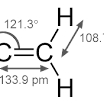
View full question & answer→MCQ 2791 Mark
When ethene reacts with bromine, it forms
- A
- ✓
- C
$1 $ bromopropane
- D
$1,2-$dichloroethene
Answerb
The bromine loses its original red-brown colour to give a colourless liquid. In the case of the reaction with ethene,
$1,2$-dibromoethane is formed,also know as ethylene dibromide. This decolourisation of bromine is often used as a test for a carbon-carbon double bond.
View full question & answer→MCQ 2801 Mark
Answerb
(b)Paraffins or alkanes are non-polar compounds. Hence soluble in benzene.
View full question & answer→MCQ 2811 Mark
Addition of $HCl$ to propene in presence of peroxides gives
- A
$1-$Chloropropane
- ✓
$2-$Chloropropane
- C
$3-$Chloropropane
- D
AnswerCorrect option: B. $2-$Chloropropane
b
(b) $C{H_3} - CH = C{H_2} + HCl \xrightarrow{peroxide} \begin{array}{*{20}{c}}
{C{H_3} - CH - C{H_3}} \\
| \\
{\,\,\,Cl}
\end{array}$
Peroxide rule is applicable only to $HBr$.
View full question & answer→MCQ 2821 Mark
The name of the product obtained by the addition of $HI$ to propene in presence of peroxide catalyst is
- A
- B
$2-$Iodopropane
- C
$3-$Iodopropane
- ✓
$1-$Iodopropane
AnswerCorrect option: D. $1-$Iodopropane
d
$C H_{3}-C H=C H_{2}+H I \stackrel{\text { Peroxide }}{\longrightarrow} C H_{3}-C H_{2}-C H_{2} I$
View full question & answer→MCQ 2831 Mark
In the reaction ${C_2}{H_5}CH = C{H_2} + H - X \to $ Product. What is the product
- A
${C_2}{H_5} - C{H_3}$
- B
${C_2}{H_5}C{H_2} - C{H_2}X$
- ✓
${C_2}{H_5} - CHX - C{H_3}$
- D
$C{H_3} - C{H_2}X - CH = C{H_2}$
AnswerCorrect option: C. ${C_2}{H_5} - CHX - C{H_3}$
c
$C _2 H _5 CH = CH _2+ H - X \rightarrow C _2 H _5- CHX - CH _3$
When halide react with $1$ butene then tere will be a two product is possible.
$1.$ $C _2 H _5- CHX - CH _3$
$2.$ $C _2 H _5- CH _2- CHX_3$
But $90\, \%$ of the product is $C _2 H _5- CHX - CH _3$
And $10\, \%$ is $C _2 H _5- CH _2- CHX_3$.
Therefore our answer is Option $C$.
View full question & answer→MCQ 2841 Mark
Alkene can be prepared from alkyl halide by the following reagent $R - X + N{u^ - } \to {\rm{Alkene}} + NuH$
- ✓
Alc. $KOH$ + heat
- B
Aq. $KOH $ + cold water
- C
$NaOH$
- D
$LiOH$
AnswerCorrect option: A. Alc. $KOH$ + heat
a
When heated with strong bases, alkyl halides typically undergo a $1,2$-elimination reactions to generate alkenes. Typical bases are $KOH$ in the alcohol as solvent.
View full question & answer→MCQ 2851 Mark
$2-$chlorobutane is heated with alcoholic $NaOH$, the product formed in larger amount is
- A
$1-$Butene
- B
$1-$Butyne
- ✓
$2-$Butene
- D
AnswerCorrect option: C. $2-$Butene
c
(c) $C{H_3} - \mathop {CH}\limits_{\mathop {|\,\,\,\,\,}\limits_{H\,\,\,} } - \mathop {CH}\limits_{\mathop {|\,\,\,\,}\limits_{Cl\,\,} } - \mathop {C{H_2}}\limits_{\mathop {|\,\,\,\,\,\,\,\,}\limits_{H\,\,\,\,\,} } \mathop {} $ $\xrightarrow[alc.NaOH] {-HCL} $ $C{H_3}CH = CH - C{H_3}$
View full question & answer→MCQ 2861 Mark
Ethylene has high b.p. and high vapour pressure at ${100\,^o}C$ and does not dissolve in water. Hence ethylene is separated by this method
Answerc
Steam Distillation also know as vapour Distillation:- This technique is used for separating substances which are immiscible with water, volatile in steam and having high vapour pressure at the boiling temperature of water. It is also used for purifying liquids which decompose at their normal boiling points.
Therefore, Ethylene has high $b.p.$ and high vapour pressure at $100^{\circ} C$ and does not dissolve in water. Hence, ethylene is separated by thi vapour distillation method.
View full question & answer→MCQ 2871 Mark
The compound most likely to decolourize a solution of potassium permanganate is
- A
$C{H_3}C{H_3}$
- B
- ✓
$C{H_3}CH = CHC{H_2}C{H_3}$
- D
$\mathop {\mathop {\mathop {\mathop {C{H_3} - C - C{H_3}}\limits^| }\limits^{\,\,\,\,\,\,C{H_3}} }\limits_| }\limits_{\,\,\,\,\,C{H_3}} $
AnswerCorrect option: C. $C{H_3}CH = CHC{H_2}C{H_3}$
c
(c)$C{H_3} - CH = CH - C{H_2} - C{H_3}$ it decolourizes $KMn{O_4}$ solution because double bond is present.
View full question & answer→MCQ 2881 Mark
Ethylene is converted to $X$ on passing through a mixture of an acidified aqueous solution of palladium chloride and cupric chloride. Which of the following reagents readily take part in addition reaction with $X$
- A
$B{r_2}$
- B
$HBr$
- C
$HCl$
- ✓
$HCN$
View full question & answer→MCQ 2891 Mark
Addition of $HCl$ does not obey antimarkownikoff’s rule because
Answerc
Antimarkownikoff's addition takes place in the presence of $H _2 O _2$ and the formation of free radicals take place. But in case of $HCl$, the $H - Cl$ bond has very high energy and large amount of energy is required for the formation of $H$ and $Cl$ free radicals, hence the reaction is endothermic. Such large amount of energy is not available and formation of free radicals does not take place.
View full question & answer→MCQ 2901 Mark
Correct statement about $1, 3-$dibutene
- A
Conjugated double bonds are present
- B
Reacts with $HBr$
- C
- ✓
Answerd
The statements that are true for $1,3$ - dibutane are as follows: Conjugated double bonds are present.
Reacts with $HBr$.
Foms polymer.
It is a colorless gas with a mild gasoline-like odor.
About $75\, \%$ of the $1,3$ -butadiene manufactured is used to make synthetic rubber.
View full question & answer→MCQ 2911 Mark
The compounds that will give an isomer of $2; 2-$ dimethyl propane on catalytic hydrogenation are
$(1)$ $\begin{array}{*{20}{c}}
{C{H_3}CH = C - C{H_3}} \\
{\,\,\,\,\,\,\,\,\,\,|} \\
{\,\,\,\,\,\,\,\,\,\,\,\,\,\,\,\,C{H_3}}
\end{array}$
$(2)$ $C{H_3}CH = CHC{H_3}$
$(3)$ $\mathop {C{H_3}C}\limits^{\begin{subarray}{l}
\,\,\,\,\,\,\,\,{\begin{array}{*{20}{c}}
{}&H
\end{array}} \\
\,\,\,\,\,\,\,\,\,\,\,\,\,\,|
\end{subarray} } = CHC{H_2}C{H_3}$
$(4)$ $\begin{array}{*{20}{c}}
{C{H_3}C = C - C{H_3}} \\
{\,\,\,\,\,\,\,|\,\,\,\,\,\,\,\,\,\,\,\,|\,\,\,\,\,\,\,\,\,\,\,\,\,} \\
{\,\,\,\,\,\,\,\,\,\,\,\,\,C{H_{3\,\,}}\,\,C{H_3}\,\,\,\,\,\,\,\,\,\,\,\,\,\,\,\,}
\end{array}$
- A
$1$ and $4$
- B
$2$ and $4$
- ✓
$1$ and $3$
- D
$1$ and $2$
AnswerCorrect option: C. $1$ and $3$
c
Compounds that give an two isomer of $2$-dimethyl propane on catalystic hydrogenation are as follows:-
$\begin{array}{*{20}{c}}
{C{H_3}CH = C - C{H_3}} \\
{\,\,\,\,\,\,\,\,\,\,|} \\
{\,\,\,\,\,\,\,\,\,\,\,\,\,\,\,\,C{H_3}}
\end{array}$
and
$\mathop {C{H_3}C}\limits^{\begin{subarray}{l}
\,\,\,\,\,\,\,\,{\begin{array}{*{20}{c}}
{}&H
\end{array}} \\
\,\,\,\,\,\,\,\,\,\,\,\,\,\,|
\end{subarray} } = CHC{H_2}C{H_3}$
View full question & answer→MCQ 2921 Mark
Bayer’s reagent is used for detection of
Answerc
Baeyer's reagent is an alkaline solution of cold $KMnO _4$, and is used for detection of unsaturation in a molecule.
View full question & answer→MCQ 2931 Mark
Structural formula for lewisite is
- A
$\begin{array}{l}CHCl\\{\rm{||}}\\CHAsC{l_3}\end{array}$
- B
$\begin{array}{l}CHC{l_2}\\{\rm{|}}\\CHAsC{l_3}\end{array}$
- ✓
$\begin{array}{l}CHCl\\||\\CHAsC{l_2}\end{array}$
- D
AnswerCorrect option: C. $\begin{array}{l}CHCl\\||\\CHAsC{l_2}\end{array}$
c
(c)Lewisite is more poisonous than mustard gas and was used in world war $-II$.
$\begin{array}{*{20}{c}}
{CH} \\
{|||\,\,\,\,} \\
{CH}
\end{array} + \mathop {\begin{array}{*{20}{c}}
{Cl\,\,\,\,} \\
{|\,\,\,\,\,\,\,} \\
{AsC{l_2}}
\end{array}}\limits_{{\text{Arsenic}}{\mkern 1mu} {\mkern 1mu} {\text{trichloride}}} \xrightarrow{{Anhydrous\,AlC{l_3}}}\mathop {\begin{array}{*{20}{c}}
{\,\,\,\,CHCl\,\,\,\,\,\,\,\,\,\,\,\,\,\,} \\
{||\,\,\,\,\,\,\,\,\,\,\,\,\,\,\,\,\,\,\,} \\
{CH\,\,AsC{l_2}}
\end{array}}\limits_{{\text{Lewisite }}\left( {\beta {\text{ - Chlorovinyl }}{\mkern 1mu} {\mkern 1mu} {\text{dichloroarsine}}} \right)} $
View full question & answer→MCQ 2941 Mark
Propene when heated with chlorine at about ${500\,^o}C$ forms
- ✓
$C{H_2}Cl.CH = C{H_2}$
- B
$C{H_3}.CHCl.C{H_2}Cl$
- C
$C{H_2}Cl.CHCl.C{H_2}Cl$
- D
AnswerCorrect option: A. $C{H_2}Cl.CH = C{H_2}$
a
(a) $C{H_3} - CH = C{H_2} + C{l_2}\xrightarrow{{500{\,^o}C}}$ $\begin{array}{*{20}{c}}
{C{H_2} - CH = C{H_2}} \\
{|\,\,\,\,\,\,\,\,\,\,\,\,\,\,\,\,\,\,\,\,\,\,\,\,\,\,\,\,\,\,\,\,\,\,} \\
{Cl\,\,\,\,\,\,\,\,\,\,\,\,\,\,\,\,\,\,\,\,\,\,\,\,\,\,\,\,\,\,\,\,}
\end{array} + HCl$
This reaction is called allylic halogenation reaction because halogenation occurs at the allylic position of an alkene
View full question & answer→MCQ 2951 Mark
$PVC$ is obtained from vinyl chloride by a reaction called
Answerc
(c) $_n(C{H_2} = CH - Cl) \xrightarrow{Polymeriza tion} \mathop {{{( - \,C{H_2} - \mathop {CH}\limits_{\mathop {|\,\,\,\,\,}\limits_{Cl\,} \,} - )_n}}}\limits_{({\rm{PVC}})} $
View full question & answer→MCQ 2961 Mark
Reaction of $B{r_2}$ on ethylene in presence of $NaCl$ gives
- A
$BrC{H_2} - C{H_2}Br$
- B
$ClC{H_2} - C{H_2}Br$
- ✓
Both $(a)$ and $(b)$
- D
AnswerCorrect option: C. Both $(a)$ and $(b)$
c
(c) $C{H_2} = C{H_2}\, + B{r_2} \xrightarrow{NaCl} \mathop {\mathop {C{H_2}}\limits_{\mathop {|\,\,\,\,\,\,\,}\limits_{Br\,\,\,} } - \mathop {C{H_2}}\limits_{\mathop {|\,\,\,\,\,\,\,\,}\limits_{Br\,\,\,} } }\limits_{{\rm{1,2}} - {\rm{dibromo}}\,{\rm{ethane}}} $ $\mathop { + \mathop {C{H_2}}\limits_{\mathop {\,\,|\,\,\,\,\,\,\,\,\,}\limits_{Cl\,\,\,} }^{2\,\,\,\,\,\,} - \mathop {C{H_2}}\limits_{\mathop {|\,\,\,\,\,\,}\limits_{Br\,\,} }^{1\,\,\,\,\,\,\,} }\limits_{{\rm{1}} - {\rm{bromo}} - {\rm{2}} - {\rm{chloro}}\,{\rm{ethane}}} $
View full question & answer→MCQ 2971 Mark
The product of reaction between propene and $HBr$ in the presence of a peroxide is
AnswerCorrect option: A. $C{H_3} - C{H_2} - C{H_2}Br$
a
(a) $C{H_3} - CH = C{H_2} + \mathop {HBr}\limits^{\,\,\,} \xrightarrow{peroxide} C{H_3} - C{H_2} - C{H_2} - Br$
View full question & answer→MCQ 2981 Mark
Ozonolysis of $2-$ methyl butene $-2$ yields
Answerc
(c) $C{H_3} - \mathop {C = }\limits_{\mathop {|\,\,\,\,\,\,}\limits_{\,C{H_3}} } CH - C{H_3} \mathop {}\limits_{} $ $ \xrightarrow[(2)Zn/H_2O]{(1)O_2}\,\mathop {C{H_3}COC{H_3}}\limits_{{\rm{Ketone}}} + \mathop {CHOC{H_3}}\limits_{{\rm{Aldehyde}}} $
View full question & answer→MCQ 2991 Mark
The final product formed by the ozonolysis of compound $RCH = C{R_2}$ is
- A
$RCHO$
- B
${R_2}CO$
- ✓
Both $(a)$ and $(b)$
- D
AnswerCorrect option: C. Both $(a)$ and $(b)$
c
(c) $\begin{array}{*{20}{c}}
{R - CH = C - R} \\
{\,\,\,\,\,\,\,\,\,\,\,\,\,\,\,\,\,|} \\
{\,\,\,\,\,\,\,\,\,\,\,\,\,\,\,\,R}
\end{array}$ $\xrightarrow[{(2)Zn/{H_2}O}]{{(1){O_3}}}{\mkern 1mu} \mathop {R{\text{ }} - {\text{ }}CHO}\limits_{{\text{Aldehyde}}} {\mkern 1mu} + \mathop {{R_2}CO}\limits_{{\text{Ketone}}} $
View full question & answer→MCQ 3001 Mark
Which one is an unsaturated compound
- A
${C_6}{H_{14}}$
- ✓
${C_4}{H_8}$
- C
${C_3}{H_7}OH$
- D
$C{H_3}OH$
AnswerCorrect option: B. ${C_4}{H_8}$
b
$C _4 H _8$ is an alkene with the general formula; $C _{ n } H _{2 n }$ and thus an unsaturated compound.
View full question & answer→MCQ 3011 Mark
Ethyl alcohol on heating with conc. ${H_2}S{O_4}$ gives
- A
$C{H_3}COO{C_2}{H_5}$
- B
${C_2}{H_6}$
- ✓
${C_2}{H_4}$
- D
${C_2}{H_2}$
AnswerCorrect option: C. ${C_2}{H_4}$
c
(c) $C{H_3} - C{H_2} - OH \xrightarrow[H_2SO_4]{Conc.}\mathop {}\limits_{} C{H_2} = C{H_2} + {H_2}O$
View full question & answer→MCQ 3021 Mark
Monohalides on reacting with alcoholic $KOH$ give
Answerb
(b) $\mathop {C{H_3} - C{H_2} - Cl}\limits_{{\rm{Ethyl }}\,{\rm{Chloride}}} \xrightarrow{alc.KoH} \mathop {\,C{H_2} = C{H_2}}\limits_{{\rm{Alkene}}} + KCl + {H_2}O$
View full question & answer→MCQ 3031 Mark
Ethylene is a member of..... series
Answerb
(b)Olefin because double bond is present.
View full question & answer→MCQ 3041 Mark
In a double bond between two carbon atoms of ethene, there are
AnswerCorrect option: B. One sigma and one pi bond
b
(b) In $C{H_2}\mathop = \limits_\sigma ^\pi C{H_2}$ double bond consist of one $\sigma $ and one $\pi $ bond
View full question & answer→MCQ 3051 Mark
The formation of alkene from alkyl halide is an example of
Answerb
(b) $\mathop {R - C{H_2} - C{H_2} - X}\limits_{\text{Alkyl halide}} \mathop {\xrightarrow{\text{Elimination}}} \limits_{{\text{alc}}{\text{. }}KOH} \,\mathop {R - CH = C{H_2}}\limits_{\text{Alkene}} \,\, + \mathop {HX}\limits_{\begin{subarray}{l} {\text{Halogen }} \\ {\text{acid}} \end{subarray}} $
View full question & answer→MCQ 3061 Mark
The compound $B$ formed in the following sequences of reactions is
$C{H_3}C{H_2}C{H_2}OH \xrightarrow{PCl_3}A\xrightarrow{Alco.KOH}B$
Answerb
(b) $C{H_3} - C{H_2} - C{H_2} - OH \xrightarrow{PCl_3}$
$\mathop {\mathop {C{H_3} - C{H_2} - C{H_2} - Cl}\limits_{{\rm{(a)}}} }\limits_{{\rm{propylchloride}}} \xrightarrow{PCl_3} \mathop {\mathop {C{H_3} - CH = C{H_2}}\limits_{{\rm{(b)}}} }\limits_{\Pr opene} $
View full question & answer→MCQ 3071 Mark
Shape of ethylene molecule is
Answerc
(c) Ethylene $s{p^2}$- hybridization; Shape = Planar.
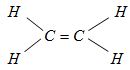
View full question & answer→MCQ 3081 Mark
Electrophilic addition on a carbon-carbon double bond involves the intermediate formation of a more stable carbocation. This statement is called
Answerc
According to Saytzeff rule "In dehydrohalogenation reactions, the preferred product is that alkene which has the greater number of alkyl groups attached to the doubly bonded carbon atoms." For example: The dehydrohalogenation of $2$-bromobutane yields two products $1$-butene and $2$-butene.
The Markownikoff's rule states that with the addition of a protic acid $HX$ to an asymmetric alkene, the acid hydrogen $( H )$ gets attached to the carbon with more hydrogen substituents, and the halide $( X )$ group gets attached to the carbon with more alkyl substituents.
View full question & answer→MCQ 3091 Mark
$C{H_2} = CHCl$ reacts with $HCl$ to form
- A
$C{H_2}Cl - C{H_2}Cl$
- ✓
$C{H_3} - CHC{l_2}$
- C
$C{H_2} = CHCl.HCl$
- D
AnswerCorrect option: B. $C{H_3} - CHC{l_2}$
b
(b) According to Markownikoff’s rule $H$ atom of the reagent goes to that carbon atom which is more hydrogenated.

View full question & answer→MCQ 3101 Mark
Deviation from Markownikoff's rule occurs in presence of
Answerb
(b) $C{H_3} - CH = C{H_2} + HBr \xrightarrow{Markownikoff\,rule} \mathop {C{H_3} - \mathop {CH}\limits_{\mathop {|\,\,\,\,\,\,}\limits_{Br\,\,} } - C{H_3}}\limits_{2 - {\rm{Bromopropane}}} + HBr$
$\xrightarrow{presence \,of\, peroxide} \mathop {C{H_3} - C{H_2} - C{H_2} - Br}\limits_{{\rm{1 - Bromopropane }}} $
View full question & answer→MCQ 3111 Mark
Presence of peroxides affects the addition of
Answera
(a) Peroxide rule is applicable only to $HBr$ and not for $HCl,\,HF$ and $HI$.
View full question & answer→MCQ 3121 Mark
Chloroprene is used in making
Answera
(a) $\mathop {n\,\left( {C{H_2} = \mathop C\limits_{\mathop {|\,\,}\limits_{Cl} } - CH = C{H_2}} \right)}\limits_{{\rm{Chloroproene}}} $ $ \xrightarrow{Polymerization} \mathop {{{\left( { - C{H_2} - \mathop C\limits_{\mathop |\limits_{Cl} } = CH - C{H_2} - } \right)}_n}}\limits_{{\rm{Neoprene}}} $
View full question & answer→MCQ 3131 Mark
Which of the following occurs easily in ethylene
Answera
(a)In case of ethene double bond is present. Hence, addition reactions occur easily.
View full question & answer→MCQ 3141 Mark
How many gm of bromine will react with $21\, gm$ ${C_3}{H_6}$
Answera
(a) $\mathop {\mathop {\mathop {C{H_3} - CH}\limits_{{\rm{Propane}}} }\limits_{{\rm{1 \,mole}}} }\limits_{{\rm{42 }}\,gms} = \,\,C{H_2}\,\, + \mathop {B{r_2}}\limits_{\mathop {1\,{\rm{mole}}}\limits_{42\,{\rm{ }}gms} } \to C{H_3} - \mathop {\mathop {\mathop {C{H_2}}\limits_{|\,\,\,\,\,\,\,\,} }\limits_{Br\,\,\,\,} - \mathop {\mathop {C{H_2}}\limits_{|\,\,\,\,\,\,\,\,} }\limits_{Br\,\,\,\,} }\limits_{{\rm{1, 2 - dibromo propane}}} $
$42\, gm$ of propene reacts with $160\, gms$ of bromine.
$\therefore $ $21\,gms$ of propene $\frac{{160}}{{42}} \times \,21 = 80\,gms$.
View full question & answer→MCQ 3151 Mark
Conjugate double bond is present in
Answerb
(b) Butadiene $C{H_2} = CH - CH = C{H_2}$
A single bond separated by two double bonds is known as conjugated double bond.
View full question & answer→MCQ 3161 Mark
On passing vapours of an organic liquid over finely divided $Cu$ at $573\,K$ the product was an alkene. This reaction is
- A
Catalytic oxidation of primary alcohol
- B
Catalytic dehydrogenation of secondary alcohol
- C
Catalytic dehydrogenation of tertiary alcohol
- ✓
Catalytic dehydration of tertiary alcohol
AnswerCorrect option: D. Catalytic dehydration of tertiary alcohol
d
(d) $\begin{array}{*{20}{c}}
{\,\,\,\,\,\,\,\,\,\,C{H_3}} \\
{\,\,\,|} \\
{C{H_3} - C - OH} \\
{\,\,\,|} \\
{\,\,\,\,\,\,\,\,\,C{H_3}}
\end{array}\xrightarrow{{300{\,^o}C}}$ $\mathop {\begin{array}{*{20}{c}}
{\,\,\,\,\,\,\,\,\,\,\,\,\,\,\,\,\,\,\,C{H_3}} \\
{\,\,\,\,\,\,\,\,\,\,\,\,\,\,\,\,\,\,|} \\
{C{H_3} - C} \\
{\,\,\,\,\,\,\,\,\,\,\,\,\,\,\,\,\,||} \\
{\,\,\,\,\,\,\,\,\,\,\,\,\,\,\,\,\,\,\,C{H_2}}
\end{array}}\limits_{\,\,\,\,\,\,\,\,\,\,\,\,\,\,\,\,\,\,\,\,\,\,\,\,\,\,\,\,\,\,\,\,\,Isobutene} + {H_2}O$
View full question & answer→MCQ 3171 Mark
The total number of sigma $(\sigma) $ and pi $(\pi )$ bonds in an ethylene molecule are
- A
$4\sigma ,2\pi $
- B
$4\sigma ,1\pi $
- C
$5\sigma ,2\pi $
- ✓
$5\sigma ,1\pi $
AnswerCorrect option: D. $5\sigma ,1\pi $
d
The sigma bond is formed by the head-on overlap of two $sp$ orbitals. The $pi$ bonds are formed by the side-on overlap of $2 p$ orbitals.
where, $X$ $=$ number of carbon atoms; $Y =$ number of hydrogen atoms and $P$ $=$ number of $\pi$ bonds/double bonds.
Therefore, ethylene having $5$ sigma an $1$ pi bond.
View full question & answer→MCQ 3181 Mark
General formula of alkenes is
- ✓
${C_n}{H_{2n}}$
- B
${C_n}{H_{2n - 2}}$
- C
${C_n}{H_{2n + 2}}$
- D
${C_n}{H_{2n - 1}}$
AnswerCorrect option: A. ${C_n}{H_{2n}}$
a
$C _{ n } H _{2 n }$ is the general formula of alkenes.
View full question & answer→MCQ 3191 Mark
Which one of the following organic compounds decolourizes an alkaline $KMn{O_4}$ solution
- A
$C{S_2}$
- ✓
${C_3}{H_6}$
- C
${C_3}{H_8}$
- D
$C{H_3}OH$
AnswerCorrect option: B. ${C_3}{H_6}$
b
(b)${C_3}{H_6}$ is an alkene therefore decolourizes alkaline $KMn{O_4}$ solution.
View full question & answer→MCQ 3201 Mark
Decolourization of alkaline $KMn{O_4}$ is used as a test for
Answerb
Decolourization of pink colour of $KMnO_4$ indicates unsaturation.
olefinic hydrocarbon. The group of hydrocarbon compounds that has one or more double or triple bonds between carbon atoms in the linear chain. Ethylene, $C _2 H_4$, is the smallest olefin.
View full question & answer→MCQ 3211 Mark
The alkene which on ozonolysis yields acetone is
AnswerCorrect option: C. ${(C{H_3})_2}C = C{(C{H_3})_2}$
c
(c) $\begin{array}{*{20}{c}}
{C{H_3} - C = C - C{H_3}} \\
{|\,\,\,\,\,\,\,\,\,\,\,|} \\
{\,\,\,\,\,C{H_3}\,\,\,C{H_3}}
\end{array}\xrightarrow[{(2)\,Zn/{H_2}O}]{{(1)\,{O_3}}}$ $\mathop {\begin{array}{*{20}{c}}
{C{H_3} - CO - OC - C{H_3}} \\
{|\,\,\,\,\,\,\,\,\,\,\,\,\,\,\,|} \\
{\,\,\,C{H_3}\,\,\,\,\,C{H_3}}
\end{array}}\limits_{Acetone} $
View full question & answer→MCQ 3221 Mark
$C{H_3}CH = CHCHO$ is oxidized to $C{H_3}CH = CHCOOH$ using
- A
Alkaline potassium permanganate
- ✓
Acidified potassium permanganate
- C
- D
AnswerCorrect option: B. Acidified potassium permanganate
b
(b) $C{H_3} - CH = CH - CHO\mathop {}\limits_{} \xrightarrow[KMnO_4]{Acidic} C{H_3} - CH = CH - COOH$
View full question & answer→MCQ 3231 Mark
The order of increasing reactivity towards $HCl$ of the following compounds will be
$(1)$ $C{H_2} = C{H_2}$
$(2)$ ${(C{H_3})_2}C = C{H_2}$
$(3)$ $C{H_3}CH = CHC{H_3}$
- A
$1 < 2 < 3$
- B
$1 < 3 < 2$
- ✓
$3 < 2 < 1$
- D
$2 < 1 < 3$
AnswerCorrect option: C. $3 < 2 < 1$
c
The correct order of increasing reactivity towards $HCl$ is
$CH _3 CH = CHCH _3\,<\,\left( CH _3\right)_2 C = CH _2\,<\, CH _2= CH _2 \text {. }$
As the number of alkyl groups attached to the carbon atoms increases, the $+ I$ effect of the alkyl groups increases and the alkene becomes electron rich.
Hence, the reactivity towards $HCl$ increases as $pi$ electrons of the double bond are donated to proton.
Also as the stability of alkene decreases (cis isomer is less stable than trans isomer), the reactivity towards acid catalyzed hydration increases.
View full question & answer→MCQ 3241 Mark
Which one of the following reactions would be the best for the formation of $2-$ bromobutane
$(1)$ $C{H_3}CH = CHC{H_2}C{H_3}$ $ \xrightarrow{HBr} $
$(2)$ $C{H_3}C{H_2}CH = C{H_2}$ $ \xrightarrow{HBr} $
$(3)$ $C{H_3}CH = CHC{H_3}$ $ \xrightarrow{Br_2} $
$(4)$ $C{H_3}C{H_2}CH = C{H_2}\mathop {}\limits_{{\rm{}}} $ $ \xrightarrow[Proxide]{HBr} $
Answerb
(b) $C{H_3} - C{H_2} - CH = C{H_2}$ $ \xrightarrow{HBr} $ $\mathop {C{H_3} - C{H_2} - \mathop {CH}\limits_{\mathop {|\,\,\,\,}\limits_{Br\,} } - C{H_3}}\limits_{\,\,\,\,\,\,\,\,\,\,\,\,\,\,\,\,{\rm{2}} - {\rm{Bromo}}\,{\rm{butane}}} $
View full question & answer→MCQ 3251 Mark
Position of double bond in an organic compound is determined by
Answera
(a) Ozonolysis is useful in locating the position of a double bond in an alkene. The double bond is obtained by joining the carbon atoms of the two carbonyl compounds. For example
Let the product of ozonolysis be two molecules of ethanal.
$\mathop {C{H_3} - \mathop C\limits^{\mathop |\limits^H } = O}\limits_{} + O = \mathop C\limits^{\mathop |\limits^H } - C{H_3} \to $$\mathop {C{H_3} - CH = CH - C{H_3}}\limits_{{\rm{2}} - {\rm{Butene}}} $
View full question & answer→MCQ 3261 Mark
A gas decolourises Bayer's reagent but does not react with Tollen's reagent, this gas is
Answera
The correct answer is - Ethene $\left( C _2 H _4\right)$ gas. Also, But-$1$-yne and But-$2$-yne are known for the same reactions.
Ammonical silver nitrate solution is also known as Tollen's reagent in chemical reaction studies.
These gases are known to decolourize aqueous bromine water. They also form a white precipitate when they react with aqueous ammoniacal silver nitrate solution.
View full question & answer→MCQ 3271 Mark
Formation of $2-$butene from $2-$bromobutane is according to
Answerc
(c) $\mathop {C{H_3} - \mathop {CH}\limits_{\mathop {|\,\,\,\,}\limits_{Br\,} } - C{H_2} - C{H_3}}\limits_{{\rm{2}} - {\rm{Bromo}}\,{\rm{butane}}\,\,\,\,\,\,\,\,\,\,\,\,\,} \to C{H_3} - CH = CH - C{H_3} + HBr$
View full question & answer→MCQ 3281 Mark
An alkene on ozonolysis gave acetaldehyde the alkene is
- A
- B
- C
$2-$butene
- ✓
Both $(b)$ and $(c)$
AnswerCorrect option: D. Both $(b)$ and $(c)$
d
Propene is that alkene which gives the mixture of acetaldehyde and formaldehyde on ozonolysis.
The ozonolysis of $2$-butene leads to a primary ozonide. This primary ozonide decomposes into acetaldehyde and syn and anti acetaldehyde oxide.
View full question & answer→MCQ 3291 Mark
The reaction $\mathop {\mathop {\mathop {\mathop {C{H_3} - C - C{H_3}}\limits^{\,|} }\limits^{\,\,\,\,\,\,\,C{H_3}} }\limits_{|\,} }\limits_{OH} \xrightarrow{H_2SO_4} \mathop {\mathop {C{H_3} - C = C{H_2}}\limits^{\,|} }\limits^{\,\,\,\,\,\,\,C{H_3}} $ is the example of
Answerb
(b)$\mathop {\begin{array}{*{20}{c}}
{\,\,\,\,\,\,C{H_3}} \\
| \\
{C{H_3} - C - C{H_3}} \\
| \\
{\,\,\,\,\,OH}
\end{array}}\limits_{2 - Methyl - 2 - hydroxypropane} \xrightarrow[{Dehydration}]{{{H_2}S{O_4}}}$ $\begin{array}{*{20}{c}}
{\,\,\,\,C{H_3}} \\
{|\,\,} \\
{C{H_3} - C = C{H_2}}
\end{array} + {H_2}O$
View full question & answer→MCQ 3301 Mark
Electrolysis of cold concentrated aqueous solution of potassium succinate yields
Answerc
(c)$\begin{array}{*{20}{l}}
{\mathop C\limits_| {H_2}COOK}\\
{C{H_2}COOK}
\end{array} + 2{H_2}O$ $ \xrightarrow{Electrolysis} \mathop {\mathop {\mathop {C{H_2}}\limits_{||\,\,\,\,\,\,\,\,} }\limits_{\,C{H_2}\,\,\,} }\limits_{{\rm{Anode}}} \, + 2C{O_2} + 2KOH\,\,\,\, + \mathop {{H_2}}\limits_{\begin{array}{*{20}{c}}
{}\\
{{\rm{Cathode}}}
\end{array}} $
View full question & answer→MCQ 3311 Mark
What is the product of the reaction of $1, 3-$butadiene with $Br_2$
- ✓
$1,4 -$dibromobutene
- B
$1,2 -$dibromobutene
- C
$3,4-$dibromobutene
- D
$2,3-$dibromo$-2-$butene
AnswerCorrect option: A. $1,4 -$dibromobutene
a
(a) $\mathop {C{H_2} = CH - CH = C{H_2}}\limits_{{\rm{1,3}}\,{\rm{butadiene}}} \xrightarrow{Br_2} \mathop {\mathop {C{H_2}}\limits_{\mathop {|\,\,\,\,\,\,\,}\limits_{Br\,\,\,\,} } - CH = CH - \mathop {C{H_2}}\limits_{\mathop {|\,\,\,\,\,\,\,}\limits_{Br\,\,\,\,} } }\limits_{{\rm{1,4}} - {\rm{di}}\,\,{\rm{bromo}} - {\rm{2}} - {\rm{butene}}} $
View full question & answer→MCQ 3321 Mark
An alkene given two moles of $HCHO$, one mole of $C{O_2}$ and one mole of $C{H_3}COCHO$on ozonolysis. What is its structure
- A
$C{H_2} = C = CH - C{H_2} - C{H_3}$
- B
$\begin{array}{*{20}{c}}
{\,\,\,C{H_3}} \\
{|\,\,\,} \\
{C{H_2} = CH - CH - CH = C{H_2}}
\end{array}$
- C
$\begin{array}{*{20}{c}}
{C{H_2} = C = C - C{H_3}} \\
{\,\,\,\,\,\,\,\,\,\,\,|} \\
{\,\,\,\,\,\,\,\,\,\,\,\,\,\,\,C{H_3}}
\end{array}$
- ✓
$\begin{array}{*{20}{c}}
{\,\,\,C{H_3}} \\
{|\,\,\,} \\
{C{H_2} = C = C - CH = C{H_2}}
\end{array}$
AnswerCorrect option: D. $\begin{array}{*{20}{c}}
{\,\,\,C{H_3}} \\
{|\,\,\,} \\
{C{H_2} = C = C - CH = C{H_2}}
\end{array}$
d
$\begin{array}{*{20}{c}} {\,\,\,C{H_3}} \\ {|\,\,\,} \\ {C{H_2} = C = C - CH = C{H_2}} \end{array} \rightarrow CO _2+ CH _3 COCHO +2 HC ( H ) O$
When,$3$ - methypenta -$1,2,4$- triene on Ozonolysies will give $1$ mole of carbon dioxide, $2$ moles of formaldehyde and $1$ mole of $CH _3 COCHO$.
View full question & answer→MCQ 3331 Mark
Which of the following alkenes gives only acetic acid and on oxidation with potassium permanganate solution
MCQ 3341 Mark
Ethylene reacts with ozone to give
Answera
(a) $C{H_2} = C{H_2}\mathop {\xrightarrow{{1\,)\,{O_3}}}}\limits_{2\,)\,Zn/{H_2}O} \mathop {HCHO + HCHO}\limits_{{\text{Formaldehyde}}} $
View full question & answer→MCQ 3351 Mark
Which of the following aliphatic compounds will discharge red colour of bromine
- A
${C_2}{H_4}$
- B
${C_3}{H_6}$
- C
${C_4}{H_8}$
- ✓
Answerd
(d) ${C_2}{H_4},{C_3}{H_6}$ and ${C_4}{H_8}$ all an alkene. Therefore they discharge the red colour of bromine.
View full question & answer→MCQ 3361 Mark
Chlorination can be done on
- A
$C{H_3} - CH = C{h_2}$
- B
$C{H_2} = C{H_2}$
- C
$CH \equiv CH$
- ✓
Answerd
The unsaturated hydrocarbon undergoes additional reactions with halogen: the halogen atom $( X )$ is added to the double $( C = C )$ or triple $( C \equiv C )$ bond
View full question & answer→MCQ 3371 Mark
When butene$-1$ is mixed with excess of bromine, the expected reaction product is
- ✓
$1, 2-$dibromobutane
- B
$1, 1-$dibromobutane
- C
$2, 2-$dibromobutane
- D
AnswerCorrect option: A. $1, 2-$dibromobutane
a
(a) $C{H_3} - C{H_2} - CH = C{H_2} + B{r_2} \to \mathop {C{H_3} - C{H_2} - \mathop {CH}\limits_{\mathop {|\,\,\,\,\,}\limits_{Br\,\,} } - \mathop {C{H_2}}\limits_{\mathop {|\,\,\,\,\,\,}\limits_{Br\,\,} } }\limits_{1,2{\rm{ - dibromo butane}}} $
View full question & answer→MCQ 3381 Mark
For the reaction $C{H_3} - CH = C{H_2} + HOCl \to A$ the product $A$ is
- A
$C{H_3} - CHCl - C{H_2}OH$
- ✓
$C{H_3} - \mathop {\mathop {CH}\limits_{\,|\,\,\,\,\,\,} }\limits_{OH} - C{H_2} - Cl$
- C
$C{H_3} - C{H_2} - C{H_2} - COCl$
- D
$C{H_3} - \mathop {\mathop {\mathop {\mathop C\limits^| \,\, - }\limits^{\,\,Cl\,\,\,\,} }\limits_{|\,\,\,\,\,\,\,\,} }\limits_{\,OH\,} C{H_3}$
AnswerCorrect option: B. $C{H_3} - \mathop {\mathop {CH}\limits_{\,|\,\,\,\,\,\,} }\limits_{OH} - C{H_2} - Cl$
b
$CH _3- CH = CH _2+ HOCl \rightarrow CH _3- CH ( OH )- CH _2- Cl$
condition:(in the presence of $H _2 SO _4$
Mechanism:-
According to markovnikov's rule, if we add any polar compound to asymmetric alkene the negative part of additive reagent (in this case we have $OH$ as negative part and $Cl$ as positive part and $HOCl$ as additive reagent) goes to the carbon having less number of hydrogen (in this case the second $C$ in $CH _3-$ $\left.CH = CH _2\right)$
therefore, Option $B$ is a correct answer.
View full question & answer→MCQ 3391 Mark
${(C{H_3})_2}C = \mathop {CH}\limits_{\mathop {|\,\,\,\,\,\,\,}\limits_{C{H_3}} } \mathop {\xrightarrow{{{\text{Catalyst}}}}}\limits_{{H_2}} $ Optical isomers
Answerc
(c) ${(C{H_3})_2}C = \mathop {\mathop {CH}\limits_{|\,\,\,\,\,\,\,\,} }\limits_{C{H_3}} \mathop {\xrightarrow{{{\text{Catalytic}}}}}\limits_{{\text{hydro}}\,{\text{genation}}} {(C{H_3})_2}CH - \mathop {\mathop {C{H_2}}\limits_{|\,\,\,\,\,\,\,\,\,\,} }\limits_{C{H_3}} $
View full question & answer→MCQ 3401 Mark
Isobutene $ + HBr\,\,\xrightarrow[{{\text{Peroxide}}}]{}$ product is
Answerb
(b) $\begin{array}{*{20}{c}}
{C{H_3} - C = C{H_2}} \\
{|\,\,} \\
{\,\,\,\,\,C{H_3}}
\end{array} + HBr\xrightarrow[{Peroxide}]{}$ $\begin{array}{*{20}{c}}
{H\,\,\,\,\,\,\,\,\,\,\,\,} \\
{|\,\,\,\,\,\,\,\,\,\,\,\,\,} \\
{C{H_3} - C - C{H_2} - Br} \\
{|\,\,\,\,\,\,\,\,\,\,\,\,} \\
{C{H_{3\,\,\,\,\,\,\,\,\,\,}}}
\end{array}$
View full question & answer→MCQ 3411 Mark
The product obtained, heating ethanol with conc. ${H_2}S{O_4}$ at ${165^o} - {170^o}$, is
- A
${({C_2}{H_5})_2}S{O_4}$
- ✓
$C{H_2} = C{H_2}$
- C
$C{H_3}COOH$
- D
${C_2}{H_5}HS{O_4}$
AnswerCorrect option: B. $C{H_2} = C{H_2}$
b
(b) Reaction is of dehydration
${C_2}{H_5}OH\xrightarrow{{{\text{Conc}}{\text{.}}\,{H_2}S{O_4}}}C{H_2} = C{H_2}$
View full question & answer→MCQ 3421 Mark
Which of the following is the most stable
- A
$1-$butene
- B
$2-$butene
- C
$1-$pentene
- ✓
$2-$pentene
AnswerCorrect option: D. $2-$pentene
d
(d) $C{H_3} - CH = CH - C{H_2} - C{H_3}$ will be the most stable because greater the number of alkyl groups attached to double bonded carbon atoms, more stable is the alkene.
View full question & answer→MCQ 3431 Mark
Which doesn’t follow Markownikoff’s rule
- A
$C{H_3} - CH = C{H_2}$
- ✓
$C{H_3}CH = CHC{H_3}$
- C
$C{H_3} - \mathop {\mathop {CH - }\limits_{|\,\,\,\,\,\,\,\,} }\limits_{C{H_3}\,\,} CH = C{H_2}$
- D
$C{H_3} - C{H_2} - CH = C{H_2}$
AnswerCorrect option: B. $C{H_3}CH = CHC{H_3}$
b
(b)Markownikoff’s rule can not be applied for symmetrical alkene.
View full question & answer→MCQ 3441 Mark
A reagent used to test for unsaturation of allkene is
AnswerCorrect option: D. Solution of $B{r_2}$ in $CC{l_4}$
d
(d)Solution of bromine in carbon tetrachloride is used to test for unsaturation of alkene. Red colour of bromine disappears due to the formation of colourless dibromo ethane $({C_2}{H_4}B{r_2})$.
View full question & answer→MCQ 3451 Mark
Propylene on hydrolysis with sulphuric acid forms
Answerb
(b) $\mathop {C{H_2} = CH - C{H_3} + {H_2}O}\limits_{{\text{Propylene}}} \xrightarrow{{{H_2}S{O_4}}}$ $\mathop {C{H_3} - \mathop {\mathop C\limits^| H}\limits^{OH} - C{H_3}}\limits_{{\text{Isopropyl alcohol}}} $
Thus in this reaction isopropyl alcohol is formed.
View full question & answer→MCQ 3461 Mark
An alkene, on ozonolysis gives formaldehyde and acetaldehyde. The alkene is :
Answerb
(b) Propene gives formaldehyde and acetaldehyde on ozonolysis
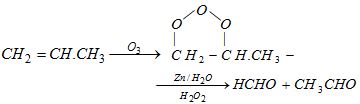
View full question & answer→MCQ 3471 Mark
In the reaction, ${H_2}C = C{H_2}\xrightarrow{\begin{subarray}{l}
{\text{cold alkaline}} \\
{\text{KMn}}{{\text{O}}_{\text{4}}}
\end{subarray} }(A)$ Product $A$ is :
Answera
(a) When ethylene is treated with cold alkaline $KMnO_4$, ethylene glycol is formed.
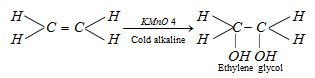
View full question & answer→MCQ 3481 Mark
Which of the following react with $KMn{O_4}$ but does not react with $AgN{O_3}$?
- A
${C_2}{H_6}$
- B
$C{H_4}$
- ✓
${C_2}{H_4}$
- D
${C_2}{H_2}$
AnswerCorrect option: C. ${C_2}{H_4}$
c
(c) $C{H_2} = C{H_2}\xrightarrow{{KMn{O_4}}}\begin{array}{*{20}{c}}
{C{H_2} - C{H_2}} \\
{|\,\,\,\,\,\,\,\,\,\,\,\,\,\,\,\,|\,\,\,\,} \\
{OH\,\,\,\,\,\,\,\,\,OH}
\end{array}$
$C{H_2} = C{H_2}\xrightarrow{{AgN{O_3}}}No\,reaction$
View full question & answer→MCQ 3491 Mark
The only alcohol that can be prepared by the indirect hydration of alkene is
Answera
(a) $\mathop {||}\limits_{C{H_2}}^{C{H_2}} + {H_2}S{O_4} \to \mathop {|\,\,\,\,\,\,\,\,\,\,\,\,\,\,\,\,\,\,\,}\limits_{C{H_2}HS{O_4}}^{C{H_3}\,\,\,\,\,\,\,\,\,\,\,\,\,\,\,\,} \xrightarrow{{{H_2}O}}$ $\mathop {|\,\,\,\,\,\,\,\,\,\,\,\,\,\,}\limits_{C{H_2}OH}^{C{H_3}\,\,\,\,\,\,\,\,\,\,} + {H_2}S{O_4}$
Except ethyl alcohol, no other primary alcohol can be prepared by this method as the addition of ${H_2}S{O_4}$ follows Markownikoff’s rule. Generally secondary and tertiary alcohols are obtained.
View full question & answer→MCQ 3501 Mark
The reaction of $HBr$ with $\begin{array}{*{20}{c}}
{\,\,\,\,\,C{H_3}} \\
| \\
{C{H_3} - C = C{H_2}}
\end{array}$ in the presence of peroxide will give
- A
$\begin{array}{*{20}{c}}
{C{H_3}CBrC{H_3}} \\
{\,\,\,|\,\,\,\,\,\,\,\,\,\,\,\,} \\
{\,\,C{H_3}\,\,\,}
\end{array}$
- B
$CH_3$ $CH_2$ $CH_2$ $CH_2$ $Br$
- ✓
$\begin{array}{*{20}{c}}
{\,\,C{H_{3\,\,\,\,\,\,\,}}} \\
{|\,\,\,\,\,\,\,\,\,\,\,} \\
{C{H_3}CHC{H_2}Br}
\end{array}$
- D
$\begin{array}{*{20}{c}}
{\,\,\,\,\,\,\,\,\,\,\,C{H_3}} \\
{\,\,\,\,\,|} \\
{C{H_3}C{H_2}CHC{H_3}}
\end{array}$
AnswerCorrect option: C. $\begin{array}{*{20}{c}}
{\,\,C{H_{3\,\,\,\,\,\,\,}}} \\
{|\,\,\,\,\,\,\,\,\,\,\,} \\
{C{H_3}CHC{H_2}Br}
\end{array}$
c
$\begin{array}{*{20}{c}}
{C{H_3} - C = C{H_2}} \\
{|\,\,\,} \\
{\,\,C{H_3}}
\end{array}$ $\mathop {\xrightarrow{{HBr/peroxide}}}\limits_{anti.\,Markownkoffs\,addtion} $ $\begin{array}{*{20}{c}}
{C{H_3} - CHC{H_2} - Br} \\
{|\,\,\,\,\,\,\,\,\,\,\,} \\
{\,\,C{H_3}\,\,\,\,\,\,\,}
\end{array}\,$
View full question & answer→MCQ 3511 Mark
A gas decolourised by $KMn{O_4}$ solution but gives no precipitate with ammoniacal cuprous chloride is
Answerc
(c)
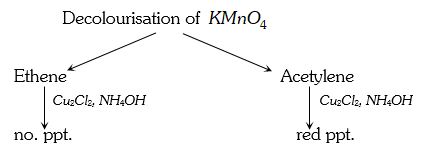
View full question & answer→MCQ 3521 Mark
The shapes of methane, ethene and ethyne molecules are, respectively
- ✓
Tetrahedral, planar and linear
- B
Tetrahedral, linear and planar
- C
Pyramidal, planar and linear
- D
Tetrahedral, pyramidal and planar
AnswerCorrect option: A. Tetrahedral, planar and linear
a
The shapes of methane, ethene and ethyne are tetrahedral, planer and Linear respectively. The $C$ atom in methane, ethene and ethyne is $sp , sp ^2$ and $sp 3$ hybridized respectively
View full question & answer→MCQ 3531 Mark
The alkene ${C_6}{H_{10}}$ producing $OHC - {(C{H_2})_4} - CHO$ on ozonolysis is
Answerc
This reaction is known as the ozonolysis reaction. The starting product is cyclohexene which undergoes ozonolysis reaction to form hexane $1,6$ -dial.
View full question & answer→MCQ 3541 Mark
Formation of $ 2-$ butene as major product by dehydration of $2-$ butanol is according to
Answerb
(b) $\mathop {C{H_3}\mathop { - \mathop C\limits_| H - }\limits_{OH\,} C{H_2} - C{H_3}}\limits_{2 - {\rm{Butanol}}} \to $$\mathop {C{H_3} - CH = CH - C{H_3}}\limits_{2 - {\rm{Butene}}} + {H_2}O$
According to this rule $H$ atom goes from that $\beta$ -carbon which is less hydrogenated.
View full question & answer→MCQ 3551 Mark
Propane cannot be prepared from which reaction
- ✓
$C{H_3} - CH = C{H_2}\mathop {\xrightarrow{{{B_2}{H_6}}}}\limits_{O{H^ - }} $
- B
$C{H_3}C{H_2}C{H_2}I\mathop {\xrightarrow{{HI}}}\limits_P $
- C
$C{H_3}C{H_2}C{H_2}Cl\xrightarrow{{Na}}$
- D
AnswerCorrect option: A. $C{H_3} - CH = C{H_2}\mathop {\xrightarrow{{{B_2}{H_6}}}}\limits_{O{H^ - }} $
a
(a) Hydroboration of alkenes followed by hydrolysis in basic medium yield alcohols and not the alkanes.
$R - CH = C{H_2}\xrightarrow{{{B_2}{H_6}}}{(R - C{H_2} - C{H_2})_3} - B$ $\xrightarrow{{O{H^ - }}}R - C{H_2} - C{H_2}OH$
View full question & answer→MCQ 3561 Mark
The reaction $C{H_3}CH = C{H_2}\mathop {\xrightarrow{{(CO + {H_2})}}}\limits_{{H^{^ + }}} C{H_3} - \mathop {\mathop {CH - C{H_3}}\limits_{|\,\,\,\,\,\,\,\,\,\,\,\,\,\,\,\,\,\,\,\,\,} \,\,\,\,\,}\limits_{COOH\,\,\,\,\,\,\,\,\,\,\,\,\,\,\,} \,\,$is known as
Answerb
(b) Koch reaction : (Carboxylation of Alkene)
$C{H_3} - CH = C{H_2}\mathop {\xrightarrow{{{\text{Water gas (}}CO + {H_2})}}}\limits_{{{400}\,^o}C,{\kern 1pt} {H_3}P{O_4}} $ $\mathop {\begin{array}{*{20}{c}}
{\,\,\,\,\,\,\,COOH} \\
{|\,\,\,\,} \\
{C{H_3} - CH - C{H_3}}
\end{array}}\limits_{Isobutyric\,acid} $
View full question & answer→MCQ 3571 Mark
Write the products of the addition reaction $\,\,\,\,\,>C = C<\,\, + XY \to $
- ✓
$\,\,\,\,\,>\mathop {\mathop C\limits_| }\limits_X - \mathop {\mathop C\limits_{|\,\,\,\,\,} }\limits_{\,Y\,\,\,\,} <$
- B
$X - \mathop C\limits_| = \mathop C\limits_| - Y$
- C
$\mathop C\limits_|^| = \mathop {\mathop C\limits_| }\limits_Y - $
- D
$X - C - C - X$
AnswerCorrect option: A. $\,\,\,\,\,>\mathop {\mathop C\limits_| }\limits_X - \mathop {\mathop C\limits_{|\,\,\,\,\,} }\limits_{\,Y\,\,\,\,} <$
a
(a) Addition reaction means addition on double bond.
View full question & answer→MCQ 3581 Mark
The addition of $HBr$ is easiest with
- A
$ClC{H_2} = CHCl$
- B
$ClCH = CHCl$
- C
$C{H_3} - CH = C{H_2}$
- ✓
${(C{H_3})_2}C = C{H_2}$
AnswerCorrect option: D. ${(C{H_3})_2}C = C{H_2}$
d
(d) It is a unsymmetrical olefin. In such cases addition of $H - X$ is governed by 'Markownikoff's rule'
View full question & answer→MCQ 3591 Mark
Identify the species $X$ in the reaction :${\rm{Propene }} + O\,{\rm{ (conc}}{\rm{. acidic\, }}KMn{O_4}) \to X + {\rm{Formic\, acid}}$
Answerd
(d) $C{H_3} - CH = C{H_2}\mathop {\xrightarrow{{{\text{Conc}}{\text{.}}}}}\limits_{{\text{Acidic}}\,KMn{O_4}} C{H_3}COOH + HCOOH$
View full question & answer→MCQ 3601 Mark
Which kind of isomerism will butene$-2$ show
Answera
(a) $2-$ butene shows geometrical isomerism.
$\mathop {\begin{array}{*{20}{c}}{H - C - C{H_3}}\\{|\,|\,\,\,\,\,}\\{H - C - C{H_3}}\end{array}}\limits_{{\rm{cis - Butene - 2}}} $ $\mathop {\begin{array}{*{20}{c}}{\,\,\,\,\,H - C - C{H_3}}\\{|\,|}\\{C{H_3} - C - H\,\,\,\,\,\,}\end{array}}\limits_{{\rm{trans - Butene - 2}}} $
View full question & answer→MCQ 3611 Mark
Compound ${C_6}{H_{12}}$ is an
- A
Aliphatic saturated compound
- ✓
- C
- D
Answerb
(b) Cyclohexane $({C_6}{H_{12}})$ is alicyclic compound.
View full question & answer→MCQ 3621 Mark
$n-$pentane and iso pentane can be distinguished by
- A
$B{r_2}$
- B
${O_3}$
- C
conc. ${H_2}S{O_4}$
- ✓
$KMn{O_4}$
AnswerCorrect option: D. $KMn{O_4}$
d
(d) On oxidation, with $KMn{O_4}$, they give different alcohols
$\mathop {C{H_3}C{H_2}C{H_2}C{H_2}C{H_3}}\limits_{n{\text{ }}penten} \mathop {\xrightarrow{{KMn{O_4}}}}\limits_{[O]} $ $\mathop {C{H_3}C{H_2}C{H_2}C{H_2}CHO{H_2}}\limits_{{\text{1}}^\circ {\text{ }}alcohol} $
$C{H_3}C{H_2} - \mathop {\mathop {{\text{ }}C}\limits_| H}\limits_{C{H_3}} - C{H_3}\mathop {\xrightarrow{{KMn{O_4}}}}\limits_{[O]} $ $\mathop {\begin{array}{*{20}{c}}
{\,\,\,\,\,\,\,\,\,\,\,\,\,OH} \\
{\,\,\,\,\,\,\,\,|} \\
{C{H_3}C{H_2} - C - C{H_3}} \\
{\,\,\,\,\,\,\,\,\,|} \\
{\,\,\,\,\,\,\,\,\,\,\,\,\,\,\,\,C{H_3}}
\end{array}}\limits_{{3^o}\,alcohol} $
View full question & answer→MCQ 3631 Mark
The reaction, ${H_2}C\mathop { = C{H_2}}\limits_{{\text{Ethylene}}} + \mathop {{H_2}O}\limits_{{\text{water}}} \mathop {\xrightarrow{{{H_3}P{O_4}}}}\limits_{300\,^o C/60\,atm..} \mathop {{C_2}{H_5}OH}\limits_{{\text{Ethyl alcohol}}} $ is called :
Answera
(a) Alkenes react with water in the presence of acid and form alcohols. This reaction is called as hydration.
$\mathop {H - \mathop {\mathop C\limits_| }\limits_H = \mathop {\mathop C\limits_| }\limits_H - H + {H_2}O}\limits_{{\text{Ethylene}}} \mathop {\xrightarrow{{{H_3}P{O_4}}}}\limits_{300\,^o C/60\,atm} \mathop {H - \mathop {\mathop C\limits_|^| }\limits_H^H - \mathop {\mathop C\limits_|^| }\limits_H^H - H}\limits_{{\text{Ethyl alcohol}}} $
View full question & answer→MCQ 3641 Mark
The reagent $X$ in the reactions ${(C{H_3})_3}CCH = C{H_2}\mathop {\xrightarrow{X}}\limits_{THF} Y\mathop {\xrightarrow{{NaB{H_4}}}}\limits_{NaOH} $$\mathop {\mathop {{{(C{H_3})}_3} - C - CH - C{H_3}}\limits_{|\,\,\,\,\,\,\,\,\,\,\,\,\,} }\limits_{OH\,\,\,\,\,\,} $
- A
${H_3}{O^ + }$
- ✓
$Hg{(C{H_3}COO)_2}$
- C
$O{H^ - }$
- D
$HCOOH$
AnswerCorrect option: B. $Hg{(C{H_3}COO)_2}$
b
(b) Oxy mercuration-demercuration : with mercuricacetate (in $THF$) followed by reduction with $NaB{H_4}/NaOH$ is an example of hydration of alkene according to markownikoff’s rule.
${(C{H_3})_3}C - CH = C{H_2}\mathop {\xrightarrow{{{{(C{H_3}COO)}_2}Hg}}}\limits_{THF} {(C{H_3})_3}\mathop {\mathop {C - CH - C{H_2} - }\limits_{|\,\,\,\,\,\,\,\,\,\,\,\,\,\,\,\,\,\,\,\,\,} }\limits_{OOCC{H_3}\,\,\,\,\,\,\,\,\,\,\,\,} HgOOCC{H_3}$
$\mathop {{{(C{H_3})}_3}C - \mathop {\mathop {CH - }\limits_{|\,\,\,\,\,\,\,\,\,\,\,} }\limits_{OH\,\,\,} C{H_3}\,\,\,\,\,\,\,\,\,\,\,}\limits_{{\text{3, 3 - Dimethyl - 2 - butanol}}} \begin{array}{*{20}{c}} {\,\,NaB{H_4}/NaOH} \\ {} \\ {} \end{array}$
View full question & answer→MCQ 3651 Mark
$C{H_2} = C{H_2}\xrightarrow{{B{r_2}/{H_2}O}}A,$ In the above reaction the compound $A$ is
- ✓
- B
$1, 2-$ dibromo ethane
- C
- D
Answera
(a) $C{H_2} = C{H_2}\xrightarrow{{B{r_2},{H_2}O}}\mathop {\mathop {\mathop C\limits_| {H_2}}\limits_{Br\,\,\,\,} - \mathop {\mathop C\limits_| {H_2}}\limits_{OH\,\,\,\,} }\limits_{{\text{Ethylene bromohydrin}}} $
Hence compound $A$ is Ethylene bromohydrin.
View full question & answer→MCQ 3661 Mark
A hydrocarbon $C_5H_{12}$ does not react with chlorine in dark but gives six monochloro compound in bright sunlight. Then hydrocarbon is
View full question & answer→MCQ 3671 Mark
Propanal and pentan $-3-$ one are ozonolysis product of $-$
- ✓
$\begin{array}{*{20}{c}}
{C{H_3} - C{H_2} - CH = C - C{H_2} - C{H_3}} \\
{\,\,\,\,\,\,\,\,\,\,\,\,\,\,\,\,\,|} \\
{\,\,\,\,\,\,\,\,\,\,\,\,\,\,\,\,\,\,\,\,\,\,\,\,\,\,\,\,\,\,\,\,\,\,\,\,\,\,C{H_2} - C{H_3}}
\end{array}$
- B
$\begin{array}{*{20}{c}}
{C{H_3} - CH = C - C{H_2} - C{H_3}} \\
{\,|\,\,\,\,\,\,} \\
{\,\,\,\,\,\,\,\,\,\,\,\,\,\,\,\,\,\,\,\,\,\,\,C{H_2} - C{H_3}}
\end{array}$
- C
$\begin{array}{*{20}{c}}
{C{H_3} - C{H_2} - C - C{H_2} - C{H_3}} \\
{\,||} \\
{C{H_3} - C - C{H_3}}
\end{array}$
- D
$\begin{array}{*{20}{c}}
{C{H_3} - CH = CH - CH - C{H_2} - C{H_2} - C{H_3}} \\
{\,\,|\,\,\,\,\,\,\,\,\,\,\,\,} \\
{C{H_3\,\,\,}}
\end{array}$
AnswerCorrect option: A. $\begin{array}{*{20}{c}}
{C{H_3} - C{H_2} - CH = C - C{H_2} - C{H_3}} \\
{\,\,\,\,\,\,\,\,\,\,\,\,\,\,\,\,\,|} \\
{\,\,\,\,\,\,\,\,\,\,\,\,\,\,\,\,\,\,\,\,\,\,\,\,\,\,\,\,\,\,\,\,\,\,\,\,\,\,C{H_2} - C{H_3}}
\end{array}$
View full question & answer→MCQ 3681 Mark
Which of the following is the most stable alkene
- ✓
${R_2}C = C{R_2}$
- B
$RCH = CHR$
- C
${R_2}C = CHR$
- D
$C{H_2} = C{H_2}$
AnswerCorrect option: A. ${R_2}C = C{R_2}$
a
We know that greater the number of alkyl groups attached to double bonded carbon atoms, more stable is the alkene. Therefore most stable is $R_{2} C=C R_{2}$

View full question & answer→MCQ 3691 Mark
The compound $\begin{matrix}
C{{H}_{3\,\,\,\,\,\,\,\,\,\,\,\,\,\,\,\,}} \\
|\,\,\,\,\,\,\,\,\,\,\,\,\,\,\,\, \\
C{{H}_{3}}-C=CH-C{{H}_{3}} \\
\end{matrix}$ on reaction with $NaIO_4$ in the presence of $KMnO_4$ gives :-
- A
$CH_3CHO+CO_2$
- B
$CH_3COCH_3$
- ✓
$CH_3COCH_3 + CH_3COOH$
- D
$CH_3COCH_3 + CH_3CHO$
AnswerCorrect option: C. $CH_3COCH_3 + CH_3COOH$
c
always acid products are preferred on strong oxidation
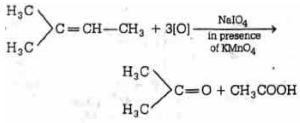
View full question & answer→MCQ 3701 Mark
Which of following does not represent correct major product
- A
$Me_3C-Cl \xrightarrow[{Dry - ether}]{{Na}}$ $ \begin{array}{*{20}{c}}
{C{H_2} = C - C{H_3}} \\
| \\
{\,\,\,\,\,\,C{H_3}}
\end{array} + \begin{array}{*{20}{c}}
{C{H_3} - CH - C{H_3}} \\
{|\,\,\,\,\,} \\
{C{H_3}}
\end{array}$
- B
$M{e}COONa(aq.)\,\xrightarrow{{Electrolysis}}\,C{H_3} - C{H_3}$
- ✓
$M{e_3}COONa(aq.)\,\xrightarrow{{Electrolysis}}\,\begin{array}{*{20}{c}}
{C{H_2} = C - C{H_3}} \\
| \\
{\,\,\,\,\,C{H_3}}
\end{array} + \,C{H_4}$
- D
$Me - Cl\,\xrightarrow[{Dry - ether}]{{Na}}\,C{H_3} - C{H_3}$
AnswerCorrect option: C. $M{e_3}COONa(aq.)\,\xrightarrow{{Electrolysis}}\,\begin{array}{*{20}{c}}
{C{H_2} = C - C{H_3}} \\
| \\
{\,\,\,\,\,C{H_3}}
\end{array} + \,C{H_4}$
View full question & answer→MCQ 3711 Mark
The molecular formula of the first member of the family of alkenynes and its name is given by the set
- A
$C_3H_2,$ alkene
- B
$C_5H_6,\, 1-$ penten$-3-$yne
- C
$C_6H_8, \,1-$hexen$-5-$yne
- ✓
$C_4H_4,$ butenyne
AnswerCorrect option: D. $C_4H_4,$ butenyne
d
Alkenynes contain a double bond and a triple bond. So, they must have at least four carbon atoms.
The first member of the family of alkenynes is butenyne. Its molecular formula is $C _4 H _4$.
View full question & answer→MCQ 3721 Mark
Major product of above reaction is
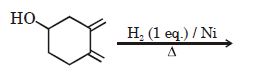
MCQ 3731 Mark
Which of the following acyclic compound will react fastest with $Br_2$ gas ?
- A
$C_2H_6$
- ✓
$C_3H_6$
- C
$C_2H_4$
- D
$C_2H_2$
AnswerCorrect option: B. $C_3H_6$
b
The compound that will react most readily with gaseous bromine has the formula $\mathrm{C}_{3} \mathrm{H}_{6}$.
Unsymmetrical alkenes generally are more reactive than the symmetrical alkenes, alkynes and alkanes. That is why, propene is more reactive than the other given compounds.
View full question & answer→MCQ 3741 Mark
$\begin{array}{*{20}{c}}
{C{H_2} - COOK} \\
{|\,\,\,\,\,\,\,\,\,\,\,\,\,\,\,\,\,\,\,\,\,\,\,\,\,\,\,} \\
{C{H_2} - COOK}
\end{array}\xrightarrow{{elerctrolysis}}\mathop {\left( A \right)}\limits_{\left( {major} \right)} $
Product $A$ is
- A
$CH_3-CH_3$
- ✓
$CH_2=CH_2$
- C
$CH_3-CH=CH_2$
- D
AnswerCorrect option: B. $CH_2=CH_2$
View full question & answer→MCQ 3751 Mark
Which of the following is most stable alkene
- A
But $-1-$ ene
- B
But $-2-$ ene
- ✓
- D
View full question & answer→MCQ 3761 Mark
Which of the following reaction has addition is according to Markonikoff's rule ?
- A
$CH_3-CH=CH_2+HBr \xrightarrow{{{R_2}{O_2}}}$
- B
$Cl_3C-CH=CH_2+HCl \rightarrow$
- C
$\begin{array}{*{20}{c}}
{C{H_3} - C = CH - Ph + HBr\xrightarrow{{}}} \\
{|\,\,\,\,\,\,\,\,\,\,\,\,\,\,\,\,\,\,\,\,\,\,\,\,\,\,\,\,\,\,\,\,\,\,\,\,\,\,\,} \\
{C{H_3}\,\,\,\,\,\,\,\,\,\,\,\,\,\,\,\,\,\,\,\,\,\,\,\,\,\,\,\,\,\,\,\,\,\,}
\end{array}$
- ✓
$\begin{array}{*{20}{c}}
{{H_3}C\,\,\,\,\,\,\,\,\,\,\,\,\,\,\,\,\,\,\,\,\,\,\,\,\,\,\,\,\,\,\,\,\,} \\
{|\,\,\,\,\,\,\,\,\,\,\,\,\,\,\,\,\,\,\,\,\,\,\,\,\,\,\,\,} \\
{C{H_3} - C = C{H_2} + {H^ \oplus }\xrightarrow{{{H_2}O}}}
\end{array}$
AnswerCorrect option: D. $\begin{array}{*{20}{c}}
{{H_3}C\,\,\,\,\,\,\,\,\,\,\,\,\,\,\,\,\,\,\,\,\,\,\,\,\,\,\,\,\,\,\,\,\,} \\
{|\,\,\,\,\,\,\,\,\,\,\,\,\,\,\,\,\,\,\,\,\,\,\,\,\,\,\,\,} \\
{C{H_3} - C = C{H_2} + {H^ \oplus }\xrightarrow{{{H_2}O}}}
\end{array}$
View full question & answer→MCQ 3771 Mark
Which of the following is Baeyer's reagent :
- A
${H^ \oplus } + KMnO_4$
- B
$\mathop O\limits^ \ominus H + K_2Cr_2O_7$
- ✓
$\mathop O\limits^ \ominus H + KMnO_4$
- D
${H^ \oplus } + K_2Cr_2O_7$
AnswerCorrect option: C. $\mathop O\limits^ \ominus H + KMnO_4$
View full question & answer→MCQ 3781 Mark
${\text{Isobutylene}}\xrightarrow[{{\text{(2) }}{{\text{H}}_2}{\text{O }}}]{{{\text{(1) }}{{\text{O}}_3}}}{\text{Product}}$
- ✓
Acetone and $CO_2$
- B
Acetone $+ CO$
- C
Acetic acid $+ CO_2$
- D
AnswerCorrect option: A. Acetone and $CO_2$
a
Oxidation of isobutylene with acid potassium permanganate gives Acetone, water and carbondioxide.
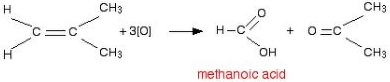
View full question & answer→MCQ 3791 Mark
$C{H_3} - CH = CH - C{H_3}\xrightarrow[{(ii){H_2}O,Zn}]{{(i){O_3}}}{\text{Product}}$
- A
$CH_3-CH_2-CHO$
- ✓
$CH_3-CHO$
- C
$CH_3-COOH$
- D
$\begin{array}{*{20}{c}}
{C{H_3} - C = O} \\
{\,\,\,\,|} \\
{\,\,\,\,\,\,\,\,\,C{H_3}}
\end{array}$
AnswerCorrect option: B. $CH_3-CHO$
b
Hence option $C$ is correct.
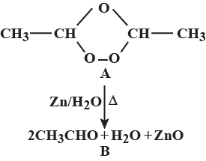
View full question & answer→MCQ 3801 Mark
Find the major product of following reaction $\begin{array}{*{20}{c}}
{C{H_3}\,\,\,\,\,\,} \\
{|\,\,\,\,\,\,\,\,\,\,\,\,\,} \\
{C{H_3} - C - CH = C{H_2}} \\
{|\,\,\,\,\,\,\,\,\,\,\,\,\,} \\
{C{H_3}\,\,\,\,\,\,\,}
\end{array}\xrightarrow{{HCl}}?$
- A
$\begin{array}{*{20}{c}}
{\begin{array}{*{20}{c}}
{C{H_3}\,\,\,\,\,\,\,}\\
{|\,\,\,\,\,\,\,\,\,\,\,\,}
\end{array}}\\
{C{H_3} - C - CH - C{H_3}}\\
{|\,\,\,\,\,\,\,\,\,|\,\,\,}\\
{C{H_3}\,\,\,\,Cl\,\,}
\end{array}$
- B
$\begin{array}{*{20}{c}}
{C{H_3}\,\,\,\,\,\,\,\,\,\,\,\,\,\,\,\,\,\,\,\,\,\,\,\,} \\
{|\,\,\,\,\,\,\,\,\,\,\,\,\,\,\,\,\,\,\,\,\,\,\,\,\,\,\,\,\,\,\,\,} \\
{C{H_3} - C - C{H_2} - C{H_2} - Cl} \\
{|\,\,\,\,\,\,\,\,\,\,\,\,\,\,\,\,\,\,\,\,\,\,\,\,\,\,\,\,\,\,\,} \\
{C{H_{3\,\,}}\,\,\,\,\,\,\,\,\,\,\,\,\,\,\,\,\,\,\,\,\,\,\,}
\end{array}$
- ✓
$\begin{array}{*{20}{c}}
{\begin{array}{*{20}{c}}
{Cl\,\,\,\,\,\,\,\,\,\,}\\
{|\,\,\,\,\,\,\,\,\,\,\,\,}
\end{array}}\\
{C{H_3} - C - CH - C{H_3}}\\
{|\,\,\,\,\,\,\,\,\,|\,\,\,}\\
{C{H_3}\,\,\,\,C{H_3}\,\,}
\end{array}$
- D
$\begin{matrix}
C{{H}_{3\,\,\,\,\,\,\,\,\,\,\,\,\,\,\,\,}} \\
\,\,\,\,\,|\,\,\,\,\,\,\,\,\,\,\,\,\,\,\,\,\,\,\,\,\, \\
C{{H}_{2}}-C-C{{H}_{2}}-C{{H}_{3}} \\
\,|\,\,\,\,\,\,\,\,\,\,\,\,\,\,\,|\,\,\,\,\,\,\,\,\,\,\,\,\,\,\,\,\,\,\,\,\,\,\,\,\,\,\,\,\,\,\,\,\,\, \\
Cl\,\,\,\,\,\,\,C{{H}_{3}}\,\,\,\,\,\,\,\,\,\,\,\,\,\,\,\,\,\,\,\,\,\,\,\,\,\,\,\,\,\, \\
\end{matrix}$
AnswerCorrect option: C. $\begin{array}{*{20}{c}}
{\begin{array}{*{20}{c}}
{Cl\,\,\,\,\,\,\,\,\,\,}\\
{|\,\,\,\,\,\,\,\,\,\,\,\,}
\end{array}}\\
{C{H_3} - C - CH - C{H_3}}\\
{|\,\,\,\,\,\,\,\,\,|\,\,\,}\\
{C{H_3}\,\,\,\,C{H_3}\,\,}
\end{array}$
c
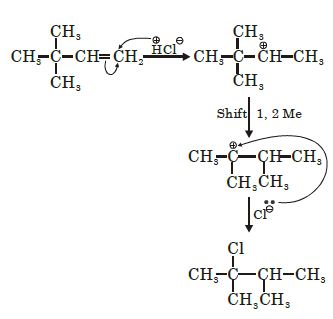
View full question & answer→MCQ 3811 Mark
Which of the following product is not formed during this reaction
$\,\begin{array}{*{20}{c}}
{\,C{H_3} - \,CH - \,CH = C{H_2}\,\xrightarrow{{B{r_2}/aq.NaCl}}} \\
{|\,\,\,\,\,\,\,\,\,\,\,\,\,\,\,\,\,\,\,\,\,\,\,\,\,\,\,\,\,\,\,\,\,\,\,\,\,\,\,\,\,\,\,\,} \\
{C{H_3}\,\,\,\,\,\,\,\,\,\,\,\,\,\,\,\,\,\,\,\,\,\,\,\,\,\,\,\,\,\,\,\,\,\,\,\,\,\,\,}
\end{array}$
- A
$\begin{array}{*{20}{c}}
{\begin{array}{*{20}{c}}
{\,\,\,Br} \\
|
\end{array}\,\,\,\,} \\
{C{H_3} - CH - CH - C{H_2} - Br} \\
{|\,\,\,\,\,\,\,\,\,\,\,\,\,\,\,\,\,\,\,\,\,\,\,\,\,\,\,\,} \\
{C{H_3}\,\,\,\,\,\,\,\,\,\,\,\,\,\,\,\,\,\,\,\,\,\,}
\end{array}\,\,\,\,\,$
- B
$\begin{array}{*{20}{c}}
{\,\,\,\,\,\,\,\,\,\,\,\,\,\,\,\,\,\,\,OH} \\
{\,\,\,\,\,\,\,\,\,\,\,\,\,\,\,|} \\
{C{H_3} - CH - CH - C{H_2}} \\
{\,\,\,\,\,\,\,\,\,\,\,|\,\,\,\,\,\,\,\,\,\,\,\,\,\,\,\,\,\,\,\,\,\,\,\,\,\,\,\,\,|} \\
{\,\,\,\,\,\,\,\,\,\,\,\,\,\,C{H_3}\,\,\,\,\,\,\,\,\,\,\,\,\,\,\,\,\,\,\,\,\,Br}
\end{array}$
- C
$\begin{array}{*{20}{c}}
{\,\,\,\,\,\,\,\,\,\,\,\,\,\,\,\,\,\,\,Cl} \\
{\,\,\,\,\,\,\,\,\,\,\,\,\,\,\,|} \\
{C{H_3} - CH - CH - C{H_2}} \\
{\,\,\,\,\,\,\,\,\,\,\,\,|\,\,\,\,\,\,\,\,\,\,\,\,\,\,\,\,\,\,\,\,\,\,\,\,\,\,\,\,\,\,\,|} \\
{\,\,\,\,\,\,\,\,\,\,\,\,\,\,\,C{H_3}\,\,\,\,\,\,\,\,\,\,\,\,\,\,\,\,\,\,\,\,\,\,\,Br}
\end{array}$
- ✓
$\begin{array}{*{20}{c}}
{\,\,\,\,\,\,\,\,\,\,\,\,\,\,\,\,\,\,\,Cl} \\
{\,\,\,\,\,\,\,\,\,\,\,\,\,\,\,|} \\
{C{H_3} - CH - CH - C{H_2}} \\
{\,\,\,\,\,\,\,\,\,\,\,\,|\,\,\,\,\,\,\,\,\,\,\,\,\,\,\,\,\,\,\,\,\,\,\,\,\,\,\,\,\,\,\,|} \\
{\,\,\,\,\,\,\,\,\,\,\,\,\,\,\,C{H_3}\,\,\,\,\,\,\,\,\,\,\,\,\,\,\,\,\,\,\,\,\,\,Cl}
\end{array}$
AnswerCorrect option: D. $\begin{array}{*{20}{c}}
{\,\,\,\,\,\,\,\,\,\,\,\,\,\,\,\,\,\,\,Cl} \\
{\,\,\,\,\,\,\,\,\,\,\,\,\,\,\,|} \\
{C{H_3} - CH - CH - C{H_2}} \\
{\,\,\,\,\,\,\,\,\,\,\,\,|\,\,\,\,\,\,\,\,\,\,\,\,\,\,\,\,\,\,\,\,\,\,\,\,\,\,\,\,\,\,\,|} \\
{\,\,\,\,\,\,\,\,\,\,\,\,\,\,\,C{H_3}\,\,\,\,\,\,\,\,\,\,\,\,\,\,\,\,\,\,\,\,\,\,Cl}
\end{array}$
View full question & answer→MCQ 3821 Mark
Number of products
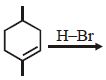
MCQ 3831 Mark
Most reactive towards $EAR$
Answerc
$EDG$ will increase the reactivity of alkene towards $EAR$
View full question & answer→MCQ 3841 Mark
$\begin{array}{*{20}{c}}
{C{H_3} - CH - CH = C{H_2} + HBr \to X(product)} \\
{|\,\,\,\,\,\,\,\,\,\,\,\,\,\,\,\,\,\,\,\,\,\,\,\,\,\,\,\,\,\,\,\,\,\,\,\,\,\,\,\,\,\,\,\,\,\,\,\,\,\,\,\,\,\,\,\,\,\,\,\,\,\,\,\,\,\,\,\,\,\,\,\,\,\,\,\,} \\
{C{H_{3\,\,\,\,\,\,\,\,\,\,\,}}\,\,\,\,\,\,\,\,\,\,\,\,\,\,\,\,\,\,\,\,\,\,\,\,\,\,\,\,\,\,\,\,\,\,\,\,\,\,\,\,\,\,\,\,\,\,\,\,\,\,\,\,\,\,\,\,\,\,\,\,\,\,\,}
\end{array}$
What is the major product i.e. $X$ in the reaction?
- A
$\begin{array}{*{20}{c}}
{C{H_3} - CH - C{H_2}C{H_2}Br}\\
{|\,\,\,\,\,\,\,\,\,\,\,\,\,\,\,\,\,\,\,\,}\\
{C{H_3}\,\,\,\,\,\,\,\,\,\,\,\,\,\,\,}
\end{array}$
- ✓
$\begin{array}{*{20}{c}}
{\begin{array}{*{20}{c}}
{Br}\\
|
\end{array}\,\,\,\,\,\,\,\,\,\,\,\,\,\,}\\
{C{H_3} - C - C{H_2} - C{H_3}}\\
{|\,\,\,\,\,\,\,\,\,\,\,\,\,\,}\\
{C{H_3}\,\,\,\,\,\,\,\,\,}
\end{array}$
- C
$\begin{array}{*{20}{c}}
{C{H_3} - CH - CH - C{H_3}}\\
{|\,\,\,\,\,\,\,\,\,\,\,\,\,|\,\,\,\,}\\
{C{H_3}\,\,\,\,\,Br\,\,}
\end{array}$
- D
$\begin{array}{*{20}{c}}
{C{H_2} - CH - C{H_2} - C{H_3}}\\
{|\,\,\,\,\,\,\,\,\,\,\,\,\,\,\,|\,\,\,\,\,\,\,\,\,\,\,\,\,\,\,\,\,\,\,\,\,\,\,\,\,\,\,\,\,\,\,\,\,}\\
{Br\,\,\,\,\,\,\,\,\,\,C{H_3}\,\,\,\,\,\,\,\,\,\,\,\,\,\,\,\,\,\,\,\,\,\,\,\,\,\,\,\,}
\end{array}$
AnswerCorrect option: B. $\begin{array}{*{20}{c}}
{\begin{array}{*{20}{c}}
{Br}\\
|
\end{array}\,\,\,\,\,\,\,\,\,\,\,\,\,\,}\\
{C{H_3} - C - C{H_2} - C{H_3}}\\
{|\,\,\,\,\,\,\,\,\,\,\,\,\,\,}\\
{C{H_3}\,\,\,\,\,\,\,\,\,}
\end{array}$
b
$\begin{array}{*{20}{c}}
{C{H_3} - CH - CH = C{H_2}} \\
{|\,\,\,\,\,\,\,\,\,\,\,\,\,\,\,\,\,} \\
{\,\,\,\,\,C{H_3}\,\,\,\,\,\,\,\,\,\,\,\,\,\,\,\,\,}
\end{array}$ $\xrightarrow{{{H^ + }}}$ $\begin{array}{*{20}{c}}
{C{H_3} - CH - \mathop C\limits^ + H - C{H_3}} \\
{|\,\,\,\,\,\,\,\,\,\,\,\,\,\,\,\,\,} \\
{\,\,\,\,\,C{H_3}\,\,\,\,\,\,\,\,\,\,\,\,\,\,\,\,\,}
\end{array}$ $\xrightarrow{{{H^ + }\,shift}}$ $\begin{array}{*{20}{c}}
{C{H_3} - \mathop C\limits^ + - C{H_2} - C{H_3}} \\
{|\,\,\,\,\,\,\,\,\,\,\,\,\,\,\,\,\,} \\
{\,\,\,\,\,C{H_3}\,\,\,\,\,\,\,\,\,\,\,\,\,\,\,\,\,}
\end{array}$ $\xrightarrow{{B{r^ - }}}$ $\begin{array}{*{20}{c}}
{\,Br\,\,\,\,\,\,\,\,\,\,\,\,\,} \\
{|\,\,\,\,\,\,\,\,\,\,\,\,\,\,\,\,} \\
{C{H_3} - C - C{H_2} - C{H_3}} \\
{|\,\,\,\,\,\,\,\,\,\,\,\,\,\,\,\,\,} \\
{\,C{H_3}\,\,\,\,\,\,\,\,\,\,\,\,\,}
\end{array}$
View full question & answer→MCQ 3851 Mark
$1, 2\,-\,$ Dibromopropane on treatement with $X$ moles of $NaNH_2$ followed by reaction with ethyl bromide give a $2 - $ pentyne the value of $X$ is
View full question & answer→MCQ 3861 Mark
Which of the following undergoes reduction (By $H_2|Ni$ ) at fastest rate
View full question & answer→MCQ 3871 Mark
The product $(A)$ of given oxymercuration demercuration is
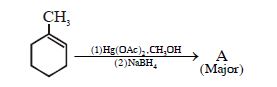
Answerb
Alkoxymercuration demecuration is a reaction in which as alkene and alcohol reacts to form an alkoxy mercury intermediate in presence of mercuric acetate leagent to yield ether on geather reduction with $NaBH _4$.
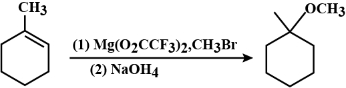
View full question & answer→MCQ 3881 Mark
The major product for in the reaction
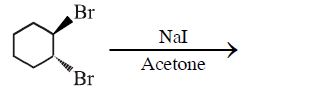
MCQ 3891 Mark
$CH_3-CH=CH_2+NOCl \to $ Product (Major) Identify the product
Answera
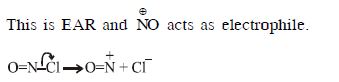
View full question & answer→MCQ 3901 Mark
$\begin{array}{*{20}{c}}
{C{H_3} - CH - C - O - C{H_3} + 2C{H_3}MgBr\, \to \,A} \\
{||\,\,\,\,\,\,\,\,\,\,\,\,\,\,\,\,\,\,\,\,\,\,\,\,\,\,\,\,\,\,\,\,\,\,\,\,\,\,\,\,\,\,\,\,\,\,\,} \\
{O\,\,\,\,\,\,\,\,\,\,\,\,\,\,\,\,\,\,\,\,\,\,\,\,\,\,\,\,\,\,\,\,\,\,\,\,\,\,\,\,\,\,\,\,\,\,\,\,}
\end{array}$
$\xrightarrow[\Delta ]{{{H^ \oplus }}}\,B$
The product $"B"$ is
- ✓
$\begin{array}{*{20}{c}}
{C{H_3} - C = CH - C{H_3}}\\
{|\,\,\,\,\,\,\,\,\,\,\,\,\,\,\,\,\,\,\,}\\
{C{H_3}\,\,\,\,\,\,\,\,\,\,\,\,\,\,}
\end{array}$
- B
$\begin{array}{*{20}{c}}
{C{H_3} - CH - CH = C{H_2}}\\
{|\,\,\,\,\,\,\,\,\,\,\,\,\,\,\,\,\,\,}\\
{C{H_3}\,\,\,\,\,\,\,\,\,\,\,\,\,}
\end{array}$
- C
$\begin{array}{*{20}{c}}
{OH\,\,\,\,\,\,\,\,\,\,\,\,\,} \\
{|\,\,\,\,\,\,\,\,\,\,\,\,\,\,\,\,} \\
{C{H_3} - C - C{H_2} - C{H_3}} \\
{|\,\,\,\,\,\,\,\,\,\,\,\,\,\,\,\,\,} \\
{\,C{H_3}\,\,\,\,\,\,\,\,\,\,\,\,\,}
\end{array}$
- D
$\begin{array}{*{20}{c}}
{\begin{array}{*{20}{c}}
{\,\,\,\,\,\,\,\,\,C{H_3}}\\
|
\end{array}\,\,\,\,\,\,\,\,\,\,\,\,\,\,\,\,\,\,\,}\\
{C{H_3} - C - C{H_2} - OH}\\
{|\,\,\,\,\,\,\,\,\,\,\,\,\,\,\,\,\,}\\
{C{H_3}\,\,\,\,\,\,\,\,\,\,\,\,}
\end{array}$
AnswerCorrect option: A. $\begin{array}{*{20}{c}}
{C{H_3} - C = CH - C{H_3}}\\
{|\,\,\,\,\,\,\,\,\,\,\,\,\,\,\,\,\,\,\,}\\
{C{H_3}\,\,\,\,\,\,\,\,\,\,\,\,\,\,}
\end{array}$
View full question & answer→MCQ 3911 Mark
$\xrightarrow[{hv}]{{NBS}}$ Product ;
Which product will not likely to form
Answerb
In presence of $NBS$ , Allylic/Benzylic substitution take place
View full question & answer→MCQ 3921 Mark
(image) $\xrightarrow[CC{{l}_{4}}]{HCl}X\xrightarrow{Aq.NaOH}Y\xrightarrow[\Delta ]{Conc.{{H}_{3}}P{{O}_{4}}}Z$ Major product is
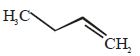
- A
$CH_3 -CH_2 -CH=CH_2$
- ✓
$CH_3 -CH=CH-CH_3$
- C
$\begin{array}{*{20}{c}}
{C{H_3} - CH - CH = C{H_2}}\\
{|\,\,\,\,\,\,\,\,\,\,\,\,\,\,\,\,\,\,\,\,}\\
{OH\,\,\,\,\,\,\,\,\,\,\,\,\,\,\,\,\,\,}
\end{array}$
- D
$CH_2 =CH-CH=CH_2$
AnswerCorrect option: B. $CH_3 -CH=CH-CH_3$
b
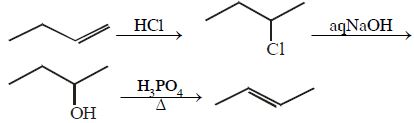
View full question & answer→MCQ 3931 Mark
$A$ and $B$ are
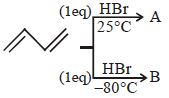
View full question & answer→MCQ 3941 Mark
What is major product of following reaction?
$\xrightarrow[{{H_2}O}]{{B{r_2}}}$

Answerb
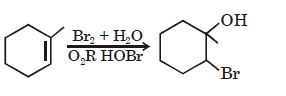
View full question & answer→MCQ 3951 Mark
$2-$ Bromobutane on heating with alcoholic $KOH$ forms
- A
$\alpha-$ Butylene only
- B
$\beta-$ Butylene only
- C
$20\%$ of $\beta-$ Butylene $+\, 80\%$ of $\alpha-$ Butylene
- ✓
$80\% \,\beta-$ Butylene $+ 20\%\, \alpha-$ Butylene
AnswerCorrect option: D. $80\% \,\beta-$ Butylene $+ 20\%\, \alpha-$ Butylene
View full question & answer→MCQ 3961 Mark
${C_2}{H_5}Br\xrightarrow{{KCN}}A\xrightarrow{{Hydrolysis}}B$
The compound $A$ is a above reaction is
View full question & answer→MCQ 3971 Mark
Identify $Z$ in the series
$C{H_2} = C{H_2}\xrightarrow{{HBr}}X\xrightarrow[{{I_2}(excess)}]{\begin{subarray}{l}
Hydrolisis \\
N{a_2}C{O_3}
\end{subarray} }Z$
- A
$Et-I$
- B
$EtOH$
- ✓
$CHI_3$
- D
$MeCHO$
AnswerCorrect option: C. $CHI_3$
c
Option $C$ is correct.
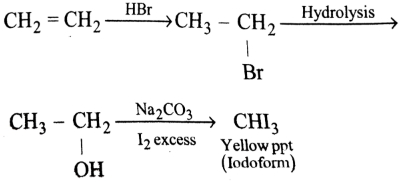
View full question & answer→MCQ 3981 Mark
$2 - Hexyne$ can be converted into trans- $2 - hexene$ by the action of
- A
$H_2-Pd/BaSO_4$
- ✓
$Na+Liq.NH_3$
- C
$NaBH_4$
- D
AnswerCorrect option: B. $Na+Liq.NH_3$
View full question & answer→MCQ 3991 Mark
Product $B$ is
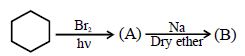
View full question & answer→MCQ 4001 Mark
(image) $\xrightarrow[{CC{l_4}}]{{{\text{B}}{{\text{r}}_2}}}\,(X){\kern 1pt}$ products. Value of $X$ is
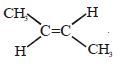
View full question & answer→MCQ 4011 Mark
Major products of the reaction is (are)
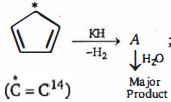
AnswerCorrect option: D. both $(b)$ and $(c)$
d
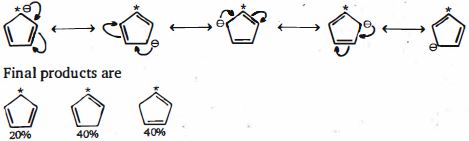
View full question & answer→MCQ 4021 Mark
Double bond equivalent of cubane is

Answerb
$(b)$ Cubane has molecular formula $(C_8H_8)$ from the given structure.
View full question & answer→MCQ 4031 Mark
$(A)$ ના દ્વિબંધ સમકક્ષ કેટલા છે ?
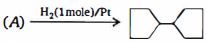
Answerc

View full question & answer→MCQ 4041 Mark
On catalytic reduction $(H_2 /Pt)$ how many alkenes will give $n$ -butane ?
Answerc
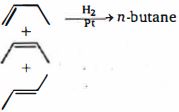
View full question & answer→MCQ 4051 Mark
On catalytic reduction $(H_2/Pt)$ how many alkenes will give $2$ -methylbutane ?
Answerc
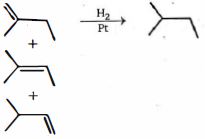
View full question & answer→MCQ 4061 Mark
Product of the above reaction will be
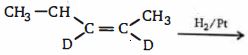
Answera
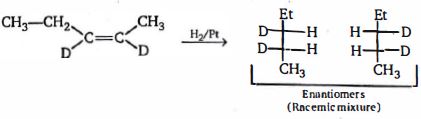
View full question & answer→MCQ 4071 Mark
$(R)-3$ -bromocyclopentene (shown below) reacts with $Br_2/CCl_4$ to form two products, $Y$ and $Z, Y$ is not optically active (does not rotate plane- polarized light). What is the structure of $Y$ ?
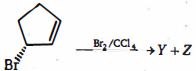
Answerc
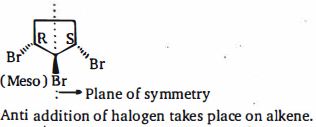
View full question & answer→MCQ 4081 Mark
Reactant $(A)$ can be
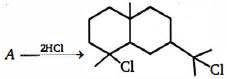
Answerd
Source of this carbocation can be $(a), (b)$ and $(c).$
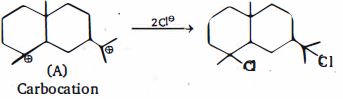
View full question & answer→MCQ 4091 Mark
Major product of the reaction is
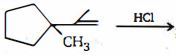
Answerc
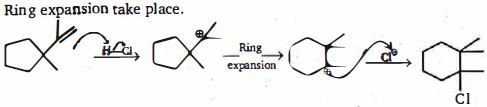
View full question & answer→MCQ 4101 Mark
$\begin{array}{*{20}{c}}
{C{H_2} - C{O_2}K} \\
{|\,\,\,\,\,\,\,\,\,\,\,\,\,\,\,\,\,\,\,\,\,\,\,\,\,\,} \\
{C{H_2} - C{O_2}K}
\end{array}\xrightarrow{{electrolysis}}\mathop {(A)}\limits_{\left( {major} \right)} $ (Kolbe electrolysis method)
Product $(A)$ of the reaction is
- A
$CH_3 - CH_3$
- ✓
$CH_2 = CH_2$
- C
$CH_3 -CH = CH_2$
- D
AnswerCorrect option: B. $CH_2 = CH_2$
b
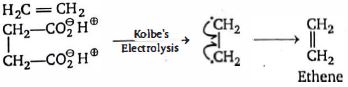
View full question & answer→MCQ 4111 Mark
Product $(C)$ of the reaction is
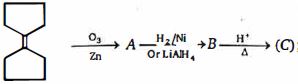
Answerc

View full question & answer→MCQ 4121 Mark
Product $W$ is

Answerc

View full question & answer→MCQ 4131 Mark
The reaction of propene with $H_3O^+$ will proceed with which of the following intermediates ?
- A
$\begin{array}{*{20}{c}}
{\,\,\,\,\,\,\,\,\,\,\,\,\,\,\,\,\,\,\,\,\,\,\,\,\,\,\,\,\,\,\,\,\,\,{\,^ \oplus }O{H_2}} \\
{\,\,\,\,\,\,\,\,\,\,\,\,\,\,\,\,\,\,\,\,\,\,\,\,\,\,\,\,\,\,\,\,\,|} \\
{C{H_3} - C{H_2} - C{H_2}}
\end{array}$
- B
$\begin{array}{*{20}{c}}
{\,\,\,\,\,\,\,\,\,\,\,\,\,\,\,\,\,\,\,\,\,\,\,\,\,\,\,\,\,\,\,\,\,\,\,\,\,\,O{H}} \\
{\,\,\,\,\,\,\,\,\,\,\,\,\,\,\,\,\,\,\,\,\,\,\,\,\,\,\,\,\,\,\,|} \\
{C{H_3} - \mathop C\limits^ \oplus H - C{H_2}}
\end{array}$
- ✓
$\begin{array}{*{20}{c}}
{{\mkern 1mu} {\mkern 1mu} {\mkern 1mu} {\mkern 1mu} {\mkern 1mu} {\mkern 1mu} {\mkern 1mu} {\mkern 1mu} {\mkern 1mu} {\mkern 1mu} {\mkern 1mu} {\mkern 1mu} {\mkern 1mu} {\mkern 1mu} {\mkern 1mu} {\mkern 1mu} {\mkern 1mu} {\mkern 1mu} {\mkern 1mu} {\mkern 1mu} {\mkern 1mu} {\mkern 1mu} {\mkern 1mu} {\mkern 1mu} {\mkern 1mu} {\mkern 1mu} {\mkern 1mu} {\mkern 1mu} {\mkern 1mu} {\mkern 1mu} {\mkern 1mu} {\mkern 1mu} {\mkern 1mu} {\mkern 1mu} {{\mkern 1mu} ^ \oplus }O{H_2}\,\,\,\,\,\,\,\,\,\,\,\,\,\,\,} \\
{{\mkern 1mu} {\mkern 1mu} {\mkern 1mu} {\mkern 1mu} {\mkern 1mu} {\mkern 1mu} {\mkern 1mu} {\mkern 1mu} {\mkern 1mu} {\mkern 1mu} {\mkern 1mu} {\mkern 1mu} {\mkern 1mu} {\mkern 1mu} {\mkern 1mu} {\mkern 1mu} {\mkern 1mu} {\mkern 1mu} {\mkern 1mu} {\mkern 1mu} {\mkern 1mu} {\mkern 1mu} {\mkern 1mu} {\mkern 1mu} {\mkern 1mu} {\mkern 1mu} {\mkern 1mu} {\mkern 1mu} {\mkern 1mu} {\mkern 1mu} {\mkern 1mu} {\mkern 1mu} |\,\,\,\,\,\,\,\,\,\,\,\,\,\,\,\,\,\,} \\
{C{H_3} - CH - C{H_3}}
\end{array}$
- D
$\begin{array}{*{20}{c}}
{\,\,\,OH} \\
{|\,\,} \\
{C{H_3} - CH - C{H_3}}
\end{array}$
AnswerCorrect option: C. $\begin{array}{*{20}{c}}
{{\mkern 1mu} {\mkern 1mu} {\mkern 1mu} {\mkern 1mu} {\mkern 1mu} {\mkern 1mu} {\mkern 1mu} {\mkern 1mu} {\mkern 1mu} {\mkern 1mu} {\mkern 1mu} {\mkern 1mu} {\mkern 1mu} {\mkern 1mu} {\mkern 1mu} {\mkern 1mu} {\mkern 1mu} {\mkern 1mu} {\mkern 1mu} {\mkern 1mu} {\mkern 1mu} {\mkern 1mu} {\mkern 1mu} {\mkern 1mu} {\mkern 1mu} {\mkern 1mu} {\mkern 1mu} {\mkern 1mu} {\mkern 1mu} {\mkern 1mu} {\mkern 1mu} {\mkern 1mu} {\mkern 1mu} {\mkern 1mu} {{\mkern 1mu} ^ \oplus }O{H_2}\,\,\,\,\,\,\,\,\,\,\,\,\,\,\,} \\
{{\mkern 1mu} {\mkern 1mu} {\mkern 1mu} {\mkern 1mu} {\mkern 1mu} {\mkern 1mu} {\mkern 1mu} {\mkern 1mu} {\mkern 1mu} {\mkern 1mu} {\mkern 1mu} {\mkern 1mu} {\mkern 1mu} {\mkern 1mu} {\mkern 1mu} {\mkern 1mu} {\mkern 1mu} {\mkern 1mu} {\mkern 1mu} {\mkern 1mu} {\mkern 1mu} {\mkern 1mu} {\mkern 1mu} {\mkern 1mu} {\mkern 1mu} {\mkern 1mu} {\mkern 1mu} {\mkern 1mu} {\mkern 1mu} {\mkern 1mu} {\mkern 1mu} {\mkern 1mu} |\,\,\,\,\,\,\,\,\,\,\,\,\,\,\,\,\,\,} \\
{C{H_3} - CH - C{H_3}}
\end{array}$
c

View full question & answer→MCQ 4141 Mark
Which of the following bromides is the major product of the reaction shown below, assuming that there are no carbocation rearrangement ?
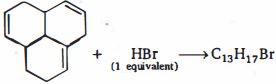
Answerd
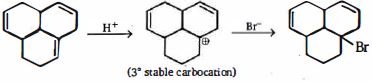
View full question & answer→MCQ 4151 Mark
Which of the following reactions results in the formation of a pair of diastereomers ?
Answerb

View full question & answer→MCQ 4161 Mark
What is a likely product of the reaction shown ?
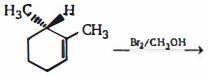
Answerd
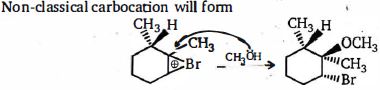
View full question & answer→MCQ 4171 Mark
Which of the following, when undergoing addition of $HBr$, will form $ONLY$ a pair of diastereomers ?
Answerc
$(c)$ Because of formation of new chiral center.
View full question & answer→MCQ 4181 Mark
How many transition states and intermediates will be formed during the course of following reaction ?
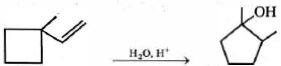
- A
$3$ transition states and $3$ intermediates
- ✓
$4$ transition states and $3$ intermediates
- C
$3$ transition states and $2$ intermediates
- D
$5$ transition states and $4$ intermediates
AnswerCorrect option: B. $4$ transition states and $3$ intermediates
b
$(b)$ Transition state = Intermediate $+ 1$
View full question & answer→MCQ 4191 Mark
Product of which of the following reactions, is racemic mixture ?
Answerb
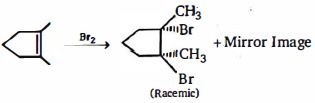
View full question & answer→MCQ 4201 Mark
Taking into account the stability of various carbocations and, as well as the rules governing mechanisms of carbocation rearrangements, which reaction is most likely to occur during the given reaction ?

Answerd
This carbocatioon rearrangement is not favourable.
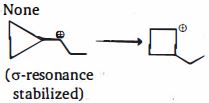
View full question & answer→MCQ 4211 Mark
Consider the following reaction in which the intermediate carbocation loses $H^+$ to give the final product ?
Which of the following energy profiles best represents the overall reaction ?

Answerd
$(d)$ Reaction is exothermic because of formation of stable alkene.
View full question & answer→MCQ 4221 Mark
Methyl vinyl ether, $H_2C = CH -OCH_3$, reacts with $Br_2 /CH_3OH$. If methanol is reacting as water would, and if this reaction follows a typical mechanism of electrophilic addition, what would be the expected product ?
Answerb

View full question & answer→MCQ 4231 Mark
$2, 4$ -hexadiyne $(C_6H_6)$ is allowed to react with $Li $ in $NH_3 (liq)$. The product obtained is treated with $1$ equivalent of $Cl_2$ in $CCl_4$. Which of the following constitutional isomers are possible products ?

- A
$I$ and $II$
- B
$II$ and $III$
- C
$I$ and $V$
- ✓
$I$ and $III$
AnswerCorrect option: D. $I$ and $III$
d
$(d) \,1,2$ and $1,4-$ addition take place.
View full question & answer→MCQ 4241 Mark
Which of the following is the best stereochemical representation when reaction between $1$ -methylcyclohexene and $NBS$ react in aqueous dimethyl sulfoxide ?
Answerb
$(b)$ $NBS + aq. DMSO$ is used for preparation of halohydrin
View full question & answer→MCQ 4251 Mark
Which of the following is among the major products of the reaction of $(E)-3$ - methyl- $2$ -pentene with $BH_3$ in $THF$ followed by the addition of $H_2O_2 /HO^-$ ?
Answera
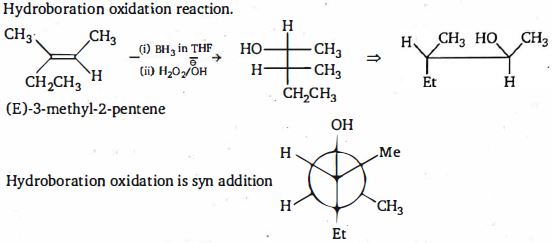
View full question & answer→MCQ 4261 Mark
Compare rate of dehydration of $(i), (ii)$ and $(iii)$ by conc. $H_2SO_4$

- A
$(i) > (iii) > (ii)$
- ✓
$(i) > (ii) > (iii)$
- C
$(ii) > (i) > (iii)$
- D
$(ii) > (iii) > (i)$
AnswerCorrect option: B. $(i) > (ii) > (iii)$
b
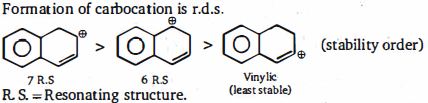
View full question & answer→MCQ 4271 Mark
How many products will be formed in this reaction ?
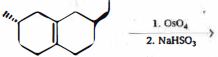
Answerb
$(b)$ Two products will be obtained by addition reaction above and below the plane of ring. It is the example of syn hydroxylation
View full question & answer→MCQ 4281 Mark
Product $(A)$ of the reaction is

Answerb
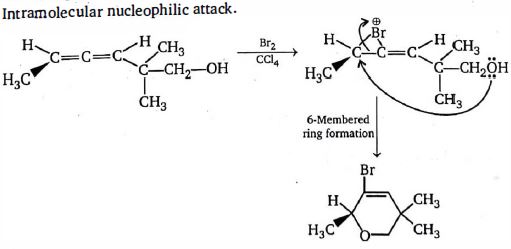
View full question & answer→MCQ 4291 Mark
$\begin{array}{*{20}{c}}
{C{H_3}\,\,\,\,\,\,\,\,\,\,\,\,\,\,\,\,\,\,\,\,\,} \\
{|\,\,\,\,\,\,\,\,\,\,\,\,\,\,\,\,\,\,\,\,\,\,\,\,\,} \\
{C{H_3} - CH + {H_2}C = C{H_2}} \\
{|\,\,\,\,\,\,\,\,\,\,\,\,\,\,\,\,\,\,\,\,\,\,\,\,\,} \\
{C{H_3}\,\,\,\,\,\,\,\,\,\,\,\,\,\,\,\,\,\,\,\,}
\end{array}\xrightarrow[{{{2.5}\,^o}C}]{{HF}}(A) ; (A)$ is
- A
- ✓
- C
- D
$\begin{array}{*{20}{c}}
{C{H_3} - CH + C{H_2} - CH = C{H_2}} \\
{|\,\,\,\,\,\,\,\,\,\,\,\,\,\,\,\,\,\,\,\,\,\,\,\,\,\,\,\,\,\,\,\,\,\,\,\,\,\,\,\,} \\
{C{H_3}\,\,\,\,\,\,\,\,\,\,\,\,\,\,\,\,\,\,\,\,\,\,\,\,\,\,\,\,\,\,\,\,\,\,\,}
\end{array}$
Answerb
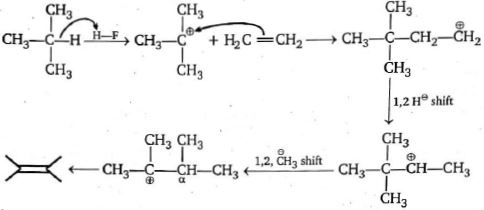
View full question & answer→MCQ 4301 Mark
Predict the product $(A)$ of the following reaction
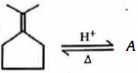
Answerd

View full question & answer→MCQ 4311 Mark
Major-product $(A)$ is:
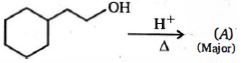
Answerb
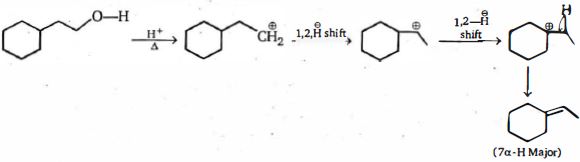
View full question & answer→MCQ 4321 Mark
Di-imide $(N_2H_4)$ is used to reduce doubble bond of
AnswerCorrect option: D. $-CH =CH-$
d
$(d)$ Di-imide is used to reduce pi-bond formed between like atom.
For example $\to -CH = CH-, - N = N -$
It can not be reduced following gps.
$\begin{array}{*{20}{c}}
{O\,\,\,\,\,\,\,\,N\,\,\,\,\,\,\,\,\,\,\,\,\,\,\,\,\,\,\,\,\,\,\,\,\,\,\,\,\,\,\,\,\,\,\,\,\,\,\,\,\,\,\,\,\,\,\,\,\,\,\,\,\,\,\,\,\,\,} \\
{||\,\,\,\,\,\,\,\,\,\,\,||\,\,\,\,\,\,\,\,\,\,\,\,\,\,\,\,\,\,\,\,\,\,\,\,\,\,\,\,\,\,\,\,\,\,\,\,\,\,\,\,\,\,\,\,\,\,\,\,\,\,\,\,\,\,\,\,\,\,\,\,} \\
{ \to - C - , - C - , - N = O, - C \equiv N - NC,}
\end{array}$
View full question & answer→MCQ 4331 Mark
End product of the reaction is

Answerb

View full question & answer→MCQ 4341 Mark
Product $(A)$ is
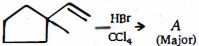
Answerc

View full question & answer→MCQ 4351 Mark
Compound $(A)$ is
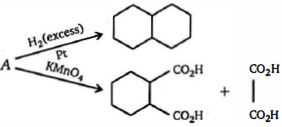
Answerb
$(b)$ Conjugated Dienes on $KMnO_4 / \Delta$ give oxalic acid
View full question & answer→MCQ 4361 Mark
Product $(X)$ will be
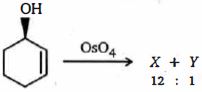
Answera
Because of less steric hinderance $(a)$ is major
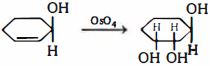
View full question & answer→MCQ 4371 Mark
Product $(P)$ is
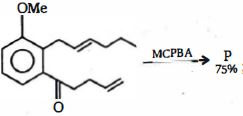
Answerb
$(b)$ More substituted alkene will undergo epoxide formation.
View full question & answer→MCQ 4381 Mark
metachloroperbenzoic acid
Product $(A)$ of the above reaction is

Answerb
$(b)$ More nucleophilic alkene will react.
View full question & answer→MCQ 4391 Mark
The major product of the following reaction sequence is
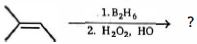
Answerb
$(b)$ Hydroboration oxidation reaction.
View full question & answer→MCQ 4401 Mark
Which one of the following compounds gives acetone $(CH_3)_2 C = O$ as one of the product of its ozonolysis ?
Answerd
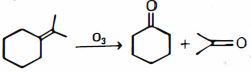
View full question & answer→MCQ 4411 Mark
Addition of $HCl$ to $3, 3$ -dimethyl- $1$ -butene yields two products, one of which has a rearranged carbon skeleton. Among the following carbocations, select the possible intermediates in that reaction ?
$\mathop {{{(C{H_3})}_3}C\mathop C\limits^ + HC{H_2}Cl}\limits_1 $ $\mathop {{{(C{H_3})}_3}C\mathop C\limits^ + HC{H_3}}\limits_2 $ $\mathop {\begin{array}{*{20}{c}}
{{{(C{H_3})}_2}C\mathop C\limits^ + {{(C{H_3})}_2}} \\
{|\,\,\,\,} \\
{Cl\,\,\,}
\end{array}}\limits_3 $ $\mathop {{{(C{H_3})}_2}\mathop C\limits^ + CH{{(C{H_3})}_2}}\limits_4 $
- A
$1 , 2$
- B
$1, 3$
- C
$1, 4$
- ✓
$2, 3$
AnswerCorrect option: D. $2, 3$
d
$\begin{matrix}
C{{H}_{3\,\,\,\,\,\,\,\,\,\,\,\,\,\,\,}} \\
|\,\,\,\,\,\,\,\,\,\,\,\,\,\,\,\, \\
C{{H}_{3}}-C-CH=C{{H}_{2}} \\
|\,\,\,\,\,\,\,\,\,\,\,\,\,\,\,\,\, \\
C{{H}_{3\,\,\,\,\,\,\,\,\,\,\,\,\,\,\,\,}} \\
\end{matrix}\xrightarrow{HCl}$ $\underset{\begin{smallmatrix}
{{2}^{o}}\,Carbocation \\
(less\,stable)
\end{smallmatrix}}{\mathop{\begin{matrix}
\,C{{H}_{3\,\,\,\,\,\,\,\,\,\,\,\,\,\,\,}} \\
|\,\,\,\,\,\,\,\,\,\,\,\,\,\,\,\,\, \\
C{{H}_{3}}-C-\overset{\oplus }{\mathop{C}}\,H-C{{H}_{3}} \\
|\,\,\,\,\,\,\,\,\,\,\,\,\,\,\,\,\, \\
\,\,\,C{{H}_{3\,\,\,}}\,\,\,\,\,\,\,\,\,\, \\
\end{matrix}}}\,$ $\xrightarrow{1,2\,\overset{\Theta }{\mathop{C}}\,{{H}_{3}}}\underset{\begin{smallmatrix}
{{3}^{o}}\,Carbocation \\
(more\,stable)
\end{smallmatrix}}{\mathop{\begin{matrix}
\,\,\,C{{H}_{3}}\,C{{H}_{3}}\,\, \\
|\,\,\,\,\,\,\,\,\,\,|\,\,\, \\
C{{H}_{3}}-\underset{\oplus }{\mathop{C}}\,-CH-C{{H}_{3}} \\
\end{matrix}}}\,$ $\xrightarrow{C{{l}^{\Theta }}}\begin{matrix}
\,\,\,\,C{{H}_{3}}\,\,\,C{{H}_{3\,\,\,\,\,\,\,}} \\
|\,\,\,\,\,\,\,\,\,\,\,|\,\,\,\, \\
C{{H}_{3}}-C-CH-C{{H}_{3}} \\
|\,\,\,\,\,\,\,\,\,\,\,\,\,\,\,\, \\
Cl\,\,\,\,\,\,\,\,\,\,\,\,\,\,\, \\
\end{matrix}$
View full question & answer→MCQ 4421 Mark
Trans-cyclohexane- $1,2$ -diol can be obtained by the reaction of cyclohexene with
AnswerCorrect option: C. peroxy formic acid / $H_3O^+$
c

View full question & answer→MCQ 4431 Mark
The major product formed during the reaction of $1$ -methyl cyclopentene with $CH_3CO_3H$ is
Answerc
$(c)$ Epoxide will form.
View full question & answer→MCQ 4441 Mark
.

Answerb

View full question & answer→MCQ 4451 Mark
Product $(P)$ is
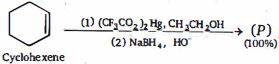
Answerb
$(b)$ Alkoxymercuration-De-mercuration reaction
View full question & answer→MCQ 4461 Mark
What is the major product expected from the following reaction ?
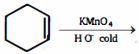
Answerb
$(b)$ cis-diol will form (syn addition takes place)
View full question & answer→MCQ 4471 Mark
$C{H_3} - CH = C{H_2}\xrightarrow[{(low\,\,conc.)}]{{B{r_2}/hv}}(A)$ ; Product $(A)$ of the reaction is
- A
$\begin{array}{*{20}{c}}
{C{H_3} - CH - C{H_2} - Br}\\
{|\,\,\,\,\,\,\,\,\,\,\,\,\,\,\,\,\,\,\,\,\,\,}\\
{Br\,\,\,\,\,\,\,\,\,\,\,\,\,\,\,\,\,\,\,\,}
\end{array}$
- ✓
$H_2C = CH - CH_2 -Br$
- C
$\begin{array}{*{20}{c}}
{C{H_3} - C = C{H_2}}\\
|\\
{\,\,\,Br}
\end{array}$
- D
$Br - CH_2 - CH_2 - CH_2 -Br$
AnswerCorrect option: B. $H_2C = CH - CH_2 -Br$
b
$(b)\, Br_2/hv$ (low cone.) (or) $N.B.S,$ Allylic free radical substitution reaction.
View full question & answer→MCQ 4481 Mark
Reagent $(A)$ in the reaction is
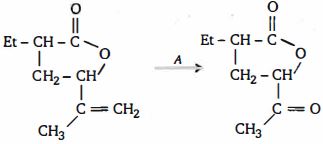
- ✓
$O_3 /Zn(H_2O)$
- B
$HIO_4$
- C
$CrO_3$
- D
Cold dil. $KMnO_4$
AnswerCorrect option: A. $O_3 /Zn(H_2O)$
a
$(a)$ Alkene will be cleaved by ozonolysis.
View full question & answer→MCQ 4491 Mark
Product of the reaction is
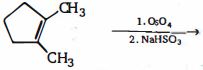
Answerb
$(b)$ cis-diol will form
View full question & answer→MCQ 4501 Mark
Which compound is a possible product from addition of $Br_2$ to $1$ -butene ?
Answerd
$(d)$ Anti-addition take place.
View full question & answer→MCQ 4511 Mark
Addition of $Br_2$ to cis- $2$ -butene would give a product which is
Answerb
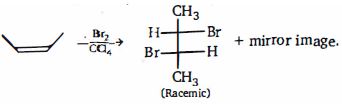
View full question & answer→MCQ 4521 Mark
Addition of $Br_2$ to trans- $2$ -butene would give a product which is
Answerc
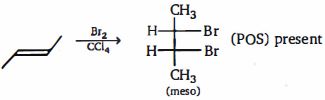
View full question & answer→MCQ 4531 Mark
Addition of $OsO_4$ to cyclopentene would give a product which is
Answerc
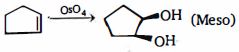
View full question & answer→MCQ 4541 Mark
Addition of $BH_3$ followed by $H_2O_2$ to trans- $2$ -butene would give a product which is
Answerb
$(b)$ Hydroboration - oxidation reaction is a syn-addition.
View full question & answer→MCQ 4551 Mark
Reagent $A$ may be
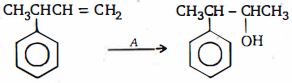
AnswerCorrect option: C. $Hg(OCOCH_3)_2.H_2O/NaBH_4 .NaOH$
c
$(c)$ Oxymercuration - Demercuration reaction addition of $H_2O$ molecule is according to Markovnikoff's rule
View full question & answer→MCQ 4561 Mark
The major product of the following reaction is
$C{H_3} - CH = C{H_2} + HBr\xrightarrow{{{{({C_6}{H_5}CO)}_2}{O_2}}}$
- ✓
$CH_3 -CH_2 -CH_2 -Br$
- B
$CH_3CH (Br)-CH_3$
- C
$BrCH_2 - CH = CH_2$
- D
AnswerCorrect option: A. $CH_3 -CH_2 -CH_2 -Br$
a
$(a)$ Anti-Markovnikoffs addition take place (Peroxide effect operates).
View full question & answer→MCQ 4571 Mark
Identify $(B)$
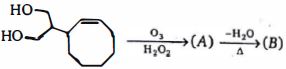
Answerb
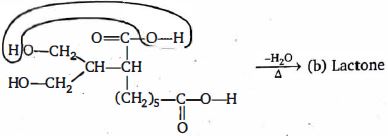
View full question & answer→MCQ 4581 Mark
Which of the following is a major product of the reaction shown below?
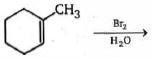
Answerd
$(d)$ Halohydrin formation take place (anti-addition).
View full question & answer→MCQ 4591 Mark
In methyl alcohol solution, bromine reacts with ethylene (ethene) to yield $BrCH_2CH_2OCH_3$ in addition to $1, 2$ -dibromoethane because
AnswerCorrect option: A. the methyl alcohol solvates the bromine
a
Solvation take place and $CH_3 \mathop O\limits^{} H$ act as nucleophile.
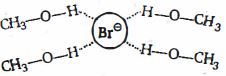
View full question & answer→MCQ 4601 Mark
Which of the following compound was the starting material for the oxidation shown below ?
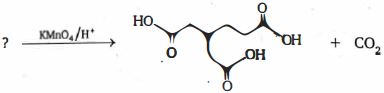
Answerb
$(b)$ Hot $KMnO_4$ is similar to oxidative ozonolysis.
View full question & answer→MCQ 4611 Mark
Which series of reactions will achieve the following transformation ?
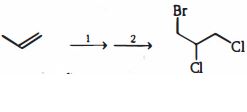
- A
$1 = Cl_2/CCl_4$ $2 = Br_2$
- B
$1 = HBr$ $2 = Cl_2/CCl_4$
- C
$1 = Cl_2/CCl_4$ $2 = NBS / hv$
- ✓
$1 = NBS / hv$ $2 = Cl_2/CCl_4$
AnswerCorrect option: D. $1 = NBS / hv$ $2 = Cl_2/CCl_4$
d
$C{H_3} - CH = C{H_2}\xrightarrow{{NBS}}$ $Br - C{H_2} - CH = C{H_2}\xrightarrow{{C{l_2}}}$ $\begin{array}{*{20}{c}}
{{\mkern 1mu} {\mkern 1mu} {\mkern 1mu} {\mkern 1mu} {\mkern 1mu} {\mkern 1mu} {\mkern 1mu} {\mkern 1mu} {\mkern 1mu} {\mkern 1mu} {\mkern 1mu} {\mkern 1mu} {\mkern 1mu} {\mkern 1mu} {\mkern 1mu} {\mkern 1mu} {\mkern 1mu} {\mkern 1mu} {\mkern 1mu} {\mkern 1mu} {\mkern 1mu} {\mkern 1mu} {\mkern 1mu} {\mkern 1mu} {\mkern 1mu} {\mkern 1mu} {\mkern 1mu} {\mkern 1mu} {\mkern 1mu} {\mkern 1mu} {\mkern 1mu} {\mkern 1mu} {\mkern 1mu} \,\,\,\,\,\,\,\,\,\,\,\,\,\,\,\,\,\,{\mkern 1mu} \,\,\,\,\,\,\,\,\,\,\,\,\,\,Cl} \\
{{\mkern 1mu} {\mkern 1mu} {\mkern 1mu} {\mkern 1mu} {\mkern 1mu} {\mkern 1mu} {\mkern 1mu} {\mkern 1mu} {\mkern 1mu} {\mkern 1mu} {\mkern 1mu} {\mkern 1mu} {\mkern 1mu} {\mkern 1mu} {\mkern 1mu} {\mkern 1mu} {\mkern 1mu} {\mkern 1mu} {\mkern 1mu} {\mkern 1mu} {\mkern 1mu} {\mkern 1mu} {\mkern 1mu} {\mkern 1mu} {\mkern 1mu} {\mkern 1mu} {\mkern 1mu} {\mkern 1mu} {\mkern 1mu} {\mkern 1mu} {\mkern 1mu} {\mkern 1mu} \,\,\,\,\,\,\,\,\,\,\,\,\,\,\,\,\,\,\,\,\,\,\,\,\,\,\,\,\,\,\,{\mkern 1mu} |} \\
{Br - C{H_2} - CH - C{H_2}} \\
{{\mkern 1mu} {\mkern 1mu} {\mkern 1mu} {\mkern 1mu} {\mkern 1mu} {\mkern 1mu} {\mkern 1mu} {\mkern 1mu} |} \\
{{\mkern 1mu} {\mkern 1mu} {\mkern 1mu} {\mkern 1mu} {\mkern 1mu} {\mkern 1mu} {\mkern 1mu} {\mkern 1mu} {\mkern 1mu} {\mkern 1mu} {\mkern 1mu} Cl}
\end{array}$
View full question & answer→MCQ 4621 Mark
Taking into account the stability of various cycloalkanes and carbocations, as well as the rules governing mechanisms of carbocation rearrangements, what is the most likely product of this reaction ?
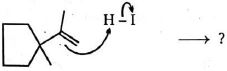
Answerb
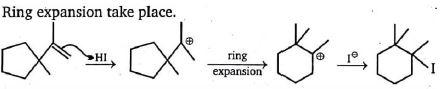
View full question & answer→MCQ 4631 Mark
A triene is treated with ozone followed by zinc in acetic acid to give the following three products. What is the structure of the triene ?

Answerd
$(d)$ Reductive ozonolysis
View full question & answer→MCQ 4641 Mark
Which of the following compound would yield trialkylborane shown below when treated with $BH_3/THF$?
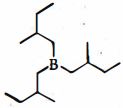
- ✓
$2$ -methylbut- $1$ -ene
- B
$2$ -methylbut- $2$ -ene
- C
$3$ -methylbut- $1$ -ene
- D
$3$ -methylbut- $1$ -yne
AnswerCorrect option: A. $2$ -methylbut- $1$ -ene
a
$\begin{array}{*{20}{c}}
{C{H_3}\,\,\,\,\,\,\,\,\,\,\,} \\
{|\,\,\,\,\,\,\,\,\,\,\,\,\,\,\,\,\,} \\
{{H_2}C = C - C{H_2} - C{H_3}}
\end{array}$
View full question & answer→MCQ 4651 Mark
Which is the most precise designation of stereochemistry for the products formed in the electrophilic addition of $DBr$ to $1$ -methylcyclohexene? ($D = {}^2H$, an isotope of hydrogen)
AnswerCorrect option: D. both $(a)$ and $(b)$
d
$(d)$ Markovnikoff's addition take place.
View full question & answer→MCQ 4661 Mark
Consider the addition of $HBr$ to $3,3$ -Dimethyl- $1$ -butene shown below. What is the best mechanistic explanation for the formation of the observed product ?
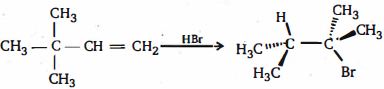
- A
Protonation of the alkene followed by a hydride shift -and addition of bromide to the carbocation
- B
Double bond shift in the alkene following by the protonation and addition of bromide to the carbocation
- C
Addition of bromide to the alkene followed by a double bond shift and protonation
- ✓
Protonation of the alkene followed by a methyl shift and addition of bromide to the carbocation
AnswerCorrect option: D. Protonation of the alkene followed by a methyl shift and addition of bromide to the carbocation
d
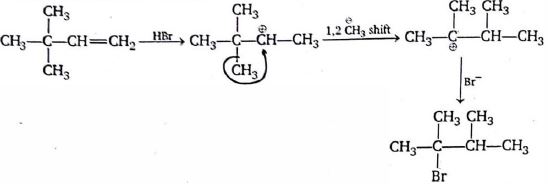
View full question & answer→MCQ 4671 Mark
Propene $CH_3CH = CH_2$ can be converted into $1$ -propanol by oxidation. Indicate which sets of reagents amongst the following is ideal to effect the above conversion ?
AnswerCorrect option: C. $B_2H_6$ and alk. $H_2O_2$
c
$(c)$ Hydroboration-oxidation reaction.
View full question & answer→MCQ 4681 Mark
The principal organic product formed in the reaction given below is
$C{H_2} = CH{(C{H_2})_8}COOH + HBr\xrightarrow{{peroxide}}....$
AnswerCorrect option: C. $CH_2BrCH_2 (CH_2)_8COOH$
c
$(c)$ Anti-Markovnikoffs addition take place.
View full question & answer→MCQ 4691 Mark
Which of the following alkene on catalytic hydrogenation given cis and trans- isomer?
Answerd
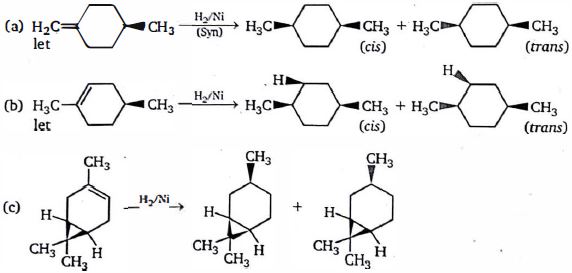
View full question & answer→MCQ 4701 Mark
In the reaction of hydrogen bromide with an alkene (in the absence of peroxides), the first step of the reaction is the ................. to the alkene
- A
fast addition of an electrophilic
- ✓
slow addition of an electrophile
- C
fast addition of a nucleophilic
- D
slow addition of a nucleophile
AnswerCorrect option: B. slow addition of an electrophile
b
$(b)$ Formation of carbocation is the rate determining step.
View full question & answer→MCQ 4711 Mark
Which of the following alcohols cannot be prepared from hydration of an alkene?
Answerd
$(d)$ Corresponding alkene is not possible.
View full question & answer→MCQ 4721 Mark
Which of the species shown below is the most stable form of the intermediate in the electrophilic addition of $Cl_2$ in water to cyclohexene to form a halohydrin ?
Answerd
$(d)$ Non-classical carbocation will form.
View full question & answer→MCQ 4731 Mark
The reaction, $(CH_3)_2C = CH_2 + B{{r}^{\centerdot }} \to (CH_3)_2 \overset{\centerdot }{\mathop{C}}\,- CH_2Br$
is an example of a/an ................ step in a radical chain reaction.
Answerc
$(c)$ Attack of free radical on alkene is an propagation step.
View full question & answer→MCQ 4741 Mark
Which of the following most accurately describes the first step in the reaction of hydrogen chloride with $1-$ butene ?
Answerb
$(b)$ Attack of alkene take place of $H - Cl$
View full question & answer→MCQ 4751 Mark
Which of the following best describes the flow of electrons in the acid-catalyzed dimerization of $(CH_3)_2C = CH_2$ ?
Answera
$(a)$ Carbocation formed will attacked by alkene.
View full question & answer→MCQ 4761 Mark
Hydroboration of $1$- methylcyclopentene using $B_2D_6$ , followed by treatment with alkaline hydrogen peroxide, gives
Answera
$(a)$ Hydroboration-oxidation take place (syn addition).
View full question & answer→MCQ 4771 Mark
Product $(B)$ of the reaction is

Answerb
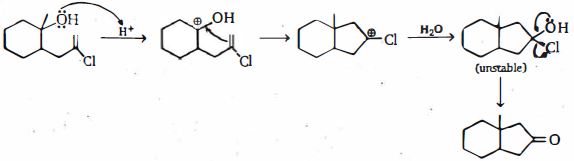
View full question & answer→MCQ 4781 Mark
Product $(C)$ is
(figure) $\xrightarrow[CC{{l}_{4}}]{B{{r}_{2}}}(A)\xrightarrow[(ii)\,NaN{{H}_{2}}]{(i)\,alc.\,KOH}(B)\xrightarrow[(ii)\,C{{H}_{3}}-Cl]{(i)\,NaN{{H}_{2}}}(C)$
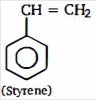
- A
$Ph - C \equiv CNa$
- B
$Ph - CH_2 -C \equiv CH$
- ✓
$Ph -C \equiv C - CH_3$
- D
$Ph - CH = C =CH_2$
AnswerCorrect option: C. $Ph -C \equiv C - CH_3$
c
$\begin{array}{*{20}{c}}
{(A)\,Ph - CH - C{H_2} - Br}\\
{|\,\,\,\,\,\,\,\,\,\,}\\
{Br\,\,\,\,\,\,\,\,\,}
\end{array}\,\,\,\,\,\,(B)\,Ph - C \equiv C - H\,\,\,\,(C)\,\,Ph - C \equiv C - C{H_3}$
View full question & answer→MCQ 4791 Mark
Which of the following will give a mixture of cis and trans- $1,4$ -dimethyl cyclohexane, when undergo catalytic hydrogenation ?
AnswerCorrect option: D. both $(a)$ & $(b)$
d
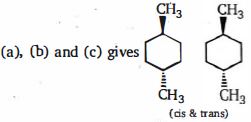
View full question & answer→MCQ 4801 Mark
An optically active compound $A$ with molecular formula $C_8H_{14}$ undergoes catalytic hydrogenation to give mesa compound, the structure of $(A)$ is
Answerb
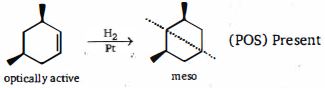
View full question & answer→MCQ 4811 Mark
How many products will be formed in above reaction ?

Answerb
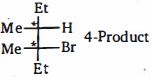
View full question & answer→MCQ 4821 Mark
Product of the reacion is
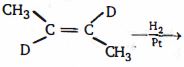
Answera
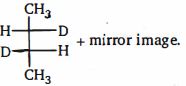
View full question & answer→MCQ 4831 Mark
cis- $2$ -butene $\xrightarrow[{Peroxide}]{{HBr}}$ product ; Product of the reaction is
Answera
$\begin{array}{*{20}{c}}
{C{H_3} - C{H_2} - \mathop C\limits^* H - C{H_3}} \\
{\,\,\,\,\,\,\,\,\,\,\,\,\,\,\,|} \\
{\,\,\,\,\,\,\,\,\,\,\,\,\,\,\,\,\,Br}
\end{array}$ (racemic mixture)
View full question & answer→MCQ 4841 Mark
Rate of reaction towards reduction using $(H_2 /Pt)$
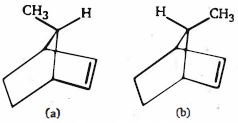
- ✓
$a > b$
- B
$a = b$
- C
$b > a$
- D
Reduction of given molecule is not possible
AnswerCorrect option: A. $a > b$
a
$(a)$ Less steric hinderance site will be attacked. Approach of $H_2$ is more hindered in $(b)$.
View full question & answer→MCQ 4851 Mark
Product is
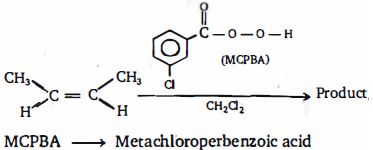
Answerb
$(b)$ Oxidation take place i.e., epoxidation
View full question & answer→MCQ 4861 Mark
Product of the reaction is
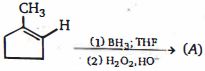
Answera
$(a)$ Hydroboration-oxidation take place.
View full question & answer→MCQ 4871 Mark
$C{H_3} - CH = C{H_2}\xrightarrow[{(2)C{H_3}C{O_2}T}]{{(1)THF\,:\,B{D_3}}}(A)$ ; Product $(A)$ of the above reaction is
- A
$CH_3 - CHD - CH_2D$
- B
$CH_3 -CHT - CH_2T$
- ✓
$CH_3 - CHD - CH_2T$
- D
$CH_3 - CHT -CH_2D$
AnswerCorrect option: C. $CH_3 - CHD - CH_2T$
c
$(c)$ Hydroboration-reduction take place
$C{{H}_{3}}-CH=C{{H}_{2}}\xrightarrow{THF.\,B{{D}_{3}}}$ ${{\left( \begin{matrix}
D\,\,\, \\
|\,\,\,\, \\
C{{H}_{3}}-CH-C{{H}_{3}}- \\
\end{matrix} \right)}_{3}}B\xrightarrow{C{{H}_{3}}-C{{O}_{2}}T}$ $\begin{matrix}
D\,\,\,\,\,\,\, \\
|\,\,\,\,\,\,\,\, \\
C{{H}_{3}}-CH-C{{H}_{2}}T \\
\end{matrix}$
View full question & answer→MCQ 4881 Mark
Optically active isomer $(A)$ of $(C_5H_9Cl)$ on treatment with one mole of $H_2$ gives an optically inactive compound $(B)$ compound $(A)$ will be
- A
$\begin{array}{*{20}{c}}
{C{H_3} - CH - CH = C{H_2}} \\
{|\,\,\,\,\,\,\,\,\,\,\,\,\,\,\,\,\,\,\,\,\,\,\,\,\,\,\,} \\
{C{H_2}Cl\,\,\,\,\,\,\,\,\,\,\,\,\,\,\,\,}
\end{array}$
- B
$\begin{array}{*{20}{c}}
{Cl - CH - CH = CH - C{H_3}} \\
{|\,\,\,\,\,\,\,\,\,\,\,\,\,\,\,\,\,\,\,\,\,\,\,\,\,\,\,\,\,\,\,\,\,\,\,\,\,\,\,\,\,\,\,} \\
{C{H_3}\,\,\,\,\,\,\,\,\,\,\,\,\,\,\,\,\,\,\,\,\,\,\,\,\,\,\,\,\,\,\,\,\,\,\,\,\,\,}
\end{array}$
- C
$\begin{array}{*{20}{c}}
{C{H_3} - CH - C{H_2} - CH = C{H_2}} \\
{|\,\,\,\,\,\,\,\,\,\,\,\,\,\,\,\,\,\,\,\,\,\,\,\,\,\,\,\,\,\,\,\,\,\,\,\,\,\,\,\,\,} \\
{Cl\,\,\,\,\,\,\,\,\,\,\,\,\,\,\,\,\,\,\,\,\,\,\,\,\,\,\,\,\,\,\,\,\,\,\,\,\,\,\,\,}
\end{array}$
- ✓
$\begin{matrix}
C{{H}_{3}}-C{{H}_{2}}-CH-CH=C{{H}_{2}} \\
| \\
Cl \\
\end{matrix}$
AnswerCorrect option: D. $\begin{matrix}
C{{H}_{3}}-C{{H}_{2}}-CH-CH=C{{H}_{2}} \\
| \\
Cl \\
\end{matrix}$
d
$\begin{matrix}
C{{H}_{3}}-C{{H}_{2}}-CH-CH=C{{H}_{2}}\xrightarrow[Pt]{{{H}_{2}}} \\
\,|\,\,\,\,\,\,\,\,\,\, \\
Cl\,\,\,\,\,\,\,\,\,\,\, \\
\end{matrix}\begin{matrix}
Et-CH-Et \\
| \\
Cl \\
\end{matrix}$ optically inactive
View full question & answer→MCQ 4891 Mark
An organiccompound $C_4H_6$ on ozonolysis give $HCHO,CO_2, CH_3CHO$. Compound will be
AnswerCorrect option: B. $CH_3 - CH = C = CH_2$
b
$(b)$ Cumulative dienes.
View full question & answer→MCQ 4901 Mark
major product of this reaction is
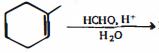
Answerb

View full question & answer→MCQ 4911 Mark
$\begin{matrix}
\,\,\,C{{H}_{3}} \\
\,\,\,|\,\,\, \\
C{{H}_{3}}-CH\xrightarrow{KMn{{O}_{4}}} \\
\,\,\,|\,\,\, \\
\,\,\,C{{H}_{3}} \\
\end{matrix}(A)\xrightarrow[\Delta ]{{{H}^{+}}}(B)\xrightarrow[ROOR]{HBr}(C)$
Product $(C)$ in the above reactions is
- A
$\begin{array}{*{20}{c}}
{\,\,\,\,\,H}\\
{\,\,\,\,|}\\
{C{H_3} - C - Br}\\
{\,\,\,|}\\
{\,\,\,\,\,\,\,\,\,\,C{H_3}}
\end{array}$
- B
$\begin{array}{*{20}{c}}
{\,\,\,\,\,\,\,\,\,\,\,C{H_3}}\\
{\,\,\,\,|}\\
{C{H_3} - C - Br}\\
{\,\,\,|}\\
{\,\,\,\,\,\,\,\,\,\,C{H_3}}
\end{array}$
- C
$\begin{array}{*{20}{c}}
{C{H_3} - CH - H}\\
|\\
{\,\,\,\,\,\,\,\,\,\,\,\,\,\,\,\,C{H_2} - Br}
\end{array}$
- ✓
$\begin{array}{*{20}{c}}
{\,\,\,\,\,\,\,\,\,\,\,\,\,\,\,\,\,\,C{H_3}}\\
{\,\,\,\,\,\,\,\,\,\,\,|}\\
{C{H_3} - CH}\\
{\,\,\,\,\,\,\,\,\,\,|}\\
{\,\,\,\,\,\,\,\,\,\,\,\,\,\,\,\,\,\,\,\,\,\,\,\,\,\,C{H_3} - Br}
\end{array}$
AnswerCorrect option: D. $\begin{array}{*{20}{c}}
{\,\,\,\,\,\,\,\,\,\,\,\,\,\,\,\,\,\,C{H_3}}\\
{\,\,\,\,\,\,\,\,\,\,\,|}\\
{C{H_3} - CH}\\
{\,\,\,\,\,\,\,\,\,\,|}\\
{\,\,\,\,\,\,\,\,\,\,\,\,\,\,\,\,\,\,\,\,\,\,\,\,\,\,C{H_3} - Br}
\end{array}$
d
$(A)\,\begin{array}{*{20}{c}}
{\,\,\,\,\,\,\,\,\,\,\,C{H_3}}\\
{\,\,\,\,|}\\
{C{H_3} - C - OH}\\
{\,\,\,|}\\
{\,\,\,\,\,\,\,\,\,\,C{H_3}}
\end{array}\,\,\,\,\,\,\,\,\,\,\,\,\,\,\,\,(B)\begin{array}{*{20}{c}}
{\,\,\,\,\,C{H_3}}\\
|\\
{C{H_3} - C = C{H_2}}
\end{array}\,\,\,\,\,\,\,\,\,\,\,\,(C)\begin{array}{*{20}{c}}
{C{H_3}\,\,\,\,\,\,\,\,\,\,\,\,\,\,\,\,\,\,\,\,\,\,\,\,\,\,\,\,\,\,\,\,\,\,\,\,\,\,\,\,\,\,\,\,\,\,\,\,\,\,\,\,\,\,\,\,}\\
{|\,\,\,\,\,\,\,\,\,\,\,\,\,\,\,\,\,\,\,\,\,\,\,\,\,\,\,\,\,\,\,\,\,\,\,\,\,\,\,\,\,\,\,\,\,\,\,\,\,\,\,\,\,\,\,\,\,\,\,\,\,\,}\\
\begin{array}{l}
C{H_3} - CH - C{H_2} - Br\\
\,(Anti - markovnikoff's\,addition{\rm{ }}\,take{\rm{ }}\,place)
\end{array}
\end{array}$
View full question & answer→MCQ 4921 Mark
$\begin{array}{*{20}{c}}
{C{H_3}\,\,\,\,\,\,\,\,\,\,\,\,\,\,\,\,\,\,\,\,\,\,\,\,\,\,\,\,\,\,\,\,\,\,\,\,\,\,\,\,\,\,\,\,\,\,\,\,\,\,\,\,\,\,\,\,\,\,\,\,\,\,\,\,\,\,\,\,\,\,\,\,\,\,\,\,\,\,\,\,\,\,\,} \\
{|\,\,\,\,\,\,\,\,\,\,\,\,\,\,\,\,\,\,\,\,\,\,\,\,\,\,\,\,\,\,\,\,\,\,\,\,\,\,\,\,\,\,\,\,\,\,\,\,\,\,\,\,\,\,\,\,\,\,\,\,\,\,\,\,\,\,\,\,\,\,\,\,\,\,\,\,\,\,\,\,\,\,\,\,\,\,\,\,\,} \\
{C{H_3} - C = C{H_2} + {{(C{H_3})}_2}CHC{H_3}\xrightarrow[{273\,K}]{{HF}}{C_8}{H_{18}}(A)}
\end{array}$ Unknown $(A)$ in the above reaction is
- A
$2, 2, 3$ -trimethyl pentane
- ✓
$2, 2, 4$ -trirnethyl pentane
- C
$2, 2$ -dirnethyl hexane
- D
$n$ -octane
AnswerCorrect option: B. $2, 2, 4$ -trirnethyl pentane
b
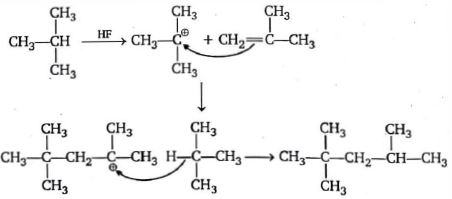
View full question & answer→MCQ 4931 Mark
Product $(Q)$ is
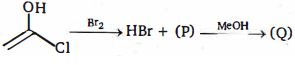
Answerb
$\begin{matrix}
\,\,\,\,\,\,\,\,\,\,\,\,\,\,\,\,\,\,\,\,\,\,\,O\,\, \\
\,\,\,\,\,\,\,\,\,\,\,\,\,\,\,\,\,\,\,\,|| \\
Br-C{{H}_{2}}-C-Cl \\
\end{matrix}\xrightarrow{C{{H}_{3}}OH}$ $\begin{matrix}
\,\,\,O \\
\,\,\,|| \\
Br-C{{H}_{2}}-C-O-C{{H}_{3}} \\
\end{matrix}$
View full question & answer→MCQ 4941 Mark
What is the major product expected from the following reaction ?
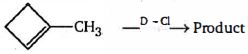
Answerb
$(b)$ Markovnikoffs addition .
View full question & answer→MCQ 4951 Mark
Choose the correct product of this reaction
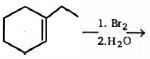
Answerb
$(b)$ Halohydrin will form (anti-addition).
View full question & answer→MCQ 4961 Mark
Product $A$ is
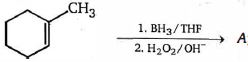
Answerd
$(d)$ Hydroboration $ - $ oxidation talce place.
View full question & answer→MCQ 4971 Mark
Product; Product is
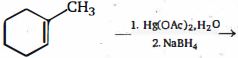
Answerd
$(d)$ Oxymercuration-Demercuration take place.
(Addition of $-OH$ takes place according to Markovnikoff's Rule)
View full question & answer→MCQ 4981 Mark
Choose the correct product of the following reactions
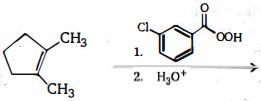
Answerc
$(c)$ Anti-addition take place. (i.e. , anti-hydroxylation)
View full question & answer→MCQ 4991 Mark
How many stereoisomeric tetrabromides will be formed in the following reaction ?
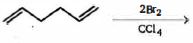
Answerb
As refer to the above image it has $2$ chiral carbons which can result in $4$ stereoisomers, but $1$ is a meso compound. So, $3$ stereoisomeric tetrabromides are formed.
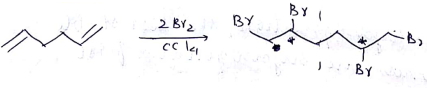
View full question & answer→MCQ 5001 Mark
How many stereoisomeric pentabrornides will be formed in the following reaction ?