MCQ
Acetylene is obtained by the electrolysis of
- ASodium succinate
- ✓Potassium fumarate
- CBoth $(a)$ and $(b)$
- DNone of these
$\begin{array}{*{20}{c}}
{C{H_2} - COONa} \\
{|\,\,\,\,\,\,\,\,\,\,\,\,\,\,\,\,\,\,\,\,\,\,\,\,\,\,\,\,\,\,} \\
{C{H_2}COONa\,\,\,\,\,}
\end{array} + 2{H_2}O\xrightarrow{{Electrolysis}}$ $\begin{array}{*{20}{c}}
{C{H_2}} \\
{||\,\,\,\,\,\,} \\
{C{H_2}}
\end{array} + 2C{O_2} + 2NaOH + {H_2}$
Generate a complete, print-ready paper with questions like this in minutes — across 16+ boards, with answer keys.
$[{N_2}{O_4}\,(g)\, \rightleftharpoons \,2N{o_2}(g)]$
At $300\,K$ and $1\,atm$ pressure, the degree of dissociation of $N_2O_4$ is $0.2.$ If one mole of $N_2O_4$ gas is contained in a vessel, then the density of the equilibrium mixture is.......$g/L$
$R - H + {X_2}\xrightarrow{{hv}}R - X + H - X$
Statement $I : C _{2} H _{5} OH$ and $AgCN$ both can generate nucleophile.
Statement $II : KCN$ and $AgCN$ both will generate nitrile nucleophile with all reaction conditions.
Choose the most appropriate option :
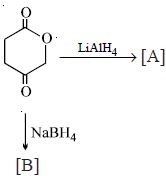
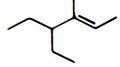
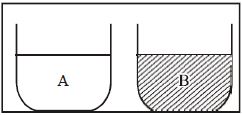
$'X'$ and $'Y'$ are