MCQ
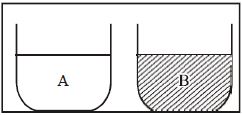
Two beakers $A$ and $B$ containing pure water and aqueous solution are shown. What  will be observed gradually with passage of time ?
  • A
    Level of water in beaker $A$ becomes lower than level of solution in beaker $B$
  • B
    Level of water in beaker $A$ and level of solution in beaker $B$ remains constant
  • Level of water in beaker $A$ increases and that of solution in beaker $B$ decreases
  • D
    Level of both the beakers increases

Answer

Correct option: C.
Level of water in beaker $A$ increases and that of solution in beaker $B$ decreases
c
$\mathrm{P}_{\mathrm{s}}=150-60 \mathrm{X}_{\mathrm{B}}$

For pure  $\mathrm{B}, \mathrm{X}_{\mathrm{B}}=1$,     $\mathrm{P}_{\mathrm{s}}=\mathrm{p}_{\mathrm{B}}^{o}=90$

For pure  $\mathrm{A}, \mathrm{X}_{\mathrm{B}}=0$,     $\mathrm{P}_{\mathrm{s}}=\mathrm{p}_{\mathrm{A}}^{o}=150$

Need a full question paper?

Generate a complete, print-ready paper with questions like this in minutes — across 16+ boards, with answer keys.

Start Generating Free

Similar questions

Which of the following has highest $pK_a$ value
Consider the following reaction The mechanism of reaction will be
The element $Z = 117$ should
The energies of activation for forward and reverse reactions for ${A_2} + {B_2} \rightleftharpoons 2AB$ are $180\, kJ\, mol^{-1}$ and $200\, kJ\, mol^{-1}$ respectively. The presence of a catalyst lowers the activation energy of both (forward and reverse) reactions by $100\, kJ\, mol^{-1}$. The enthalpy change of the reaction $(A_2 + B_2 \to  2AB)$ in the presence of catalyst will be (in $kJ\, mol^{-1}$)
Ferrous ammonium sulphate aqueous solution consist of
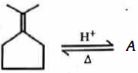
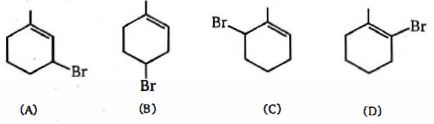
Predict the product $(A)$ of the following reaction
Which one of the following conditions will favour maximum formation of the product in the reaction

$\mathrm{A}_{2}(\mathrm{g})+\mathrm{B}_{2}(\mathrm{g}) \rightleftharpoons \mathrm{X}_{2}(\mathrm{g}) \Delta_{r} \mathrm{H}=-\mathrm{X} \mathrm{kJ} ?$

Among the given compound choose the two that yield same carbocation on ionization.
The major product obtained on interaction of phenol with sodium hydroxide and carbon dioxide is
$p$-Amino- $N, N$-dimethylaniline is added to a strongly acidic solution of ${X}$. The resulting solution is treated with a few drops of aqueous solution of ${Y}$ to yield blue coloration due to the formation of methylene blue. Treatment of the aqueous solution of ${Y}$ with the reagent potassium hexacyanoferrate$(II)$ leads to the formation of an intense blue precipitate. The precipitate dissolves on excess addition of the reagent. Similarly, treatment of the solution of ${Y}$ with the solution of potassium hexacyanoferrate$(III)$ leads to a brown coloration due to the formation of ${Z}$.

$1.$ The compound ${X}$ is

$(A)$ $\mathrm{NaNO}_3$ $(B)$ $\mathrm{NaCl}$ $(C)$ $\mathrm{Na}_2 \mathrm{SO}_4$ $(D)$ $\mathrm{Na}_2 \mathrm{~S}$

$2.$ The compound ${Y}$ is

$(A)$ $\mathrm{MgCl}_2$ $(B)$ $\mathrm{FeCl}_2$ $(C)$ $\mathrm{FeCl}_3$ $(D)$ $\mathrm{ZnCl}_2$

$3.$ The compound ${Z}$ is

$(A)$ $\left.\mathrm{Mg}_2 \mid \mathrm{Fe}(\mathrm{CN})_6\right]$ $(B)$ $\operatorname{Fe}\left[\mathrm{Fe}(\mathrm{CN})_6\right]$

$(C)$ $\mathrm{Fe}_4\left[\mathrm{Fe}(\mathrm{CN})_6\right]_3$ $(D)$ $\mathrm{K}_2 \mathrm{Zn}_3\left[\mathrm{Fe}(\mathrm{CN})_6\right]_2$

Give the answer question $1,2$ and $3.$