Question
Action and reaction:
  1. Act on two different objects.
  2. Have equal magnitude.
  3. Have opposite directions.
  4. Have resultant zero.

Answer

  1. Act on two different objects.
  2. Have equal magnitude.
  3. Have opposite directions.
  4. Have resultant zero.
Explanation:
The two forces $\overrightarrow{\text{F}}$ and $-\overrightarrow{\text{F}}$ connected by Newton's third law are known as action-reaction pair.
For example, when a man jumps out from a ferry, he applied some force on the ferry. So, the action force in this case is the force applied by the man and the reaction is the force exerted by the ferry on the man. Both the forces act upon different objects (the man and the ferry) but have equal magnitudes and opposite directions. As a result, their resultant is zero.

Need a full question paper?

Generate a complete, print-ready paper with questions like this in minutes — across 16+ boards, with answer keys.
Start Generating Free

Similar questions

The potential at a point due to an electric dipole will be maximum and minimum when  the angles between the axis of the dipole and the line joining the point to the dipole are respectively(a) 90° and 180 °  (b) 0°  and 90°(c) 90 ° and 0°(d) 0° and 180°
       
If a source is transmitting electromagnetic wave of frequency $8.2 \times 10^6\ Hz,$ then wavelength of the electromagnetic waves transmitted from the source will be
According to Bohr's model, the radius of the second orbit of helium atom is(a) 0.53 Å(b) 1.06 Å(c) 2.12 Å                                           (d) 0.265 Å
       
The focal length of a concave mirror is 10 cm. On placing an object at 10 cm in front of the mirror, its image will be formed:
One can define ...A... of a place as the vertical plane which passes through the imaginary line joining the magnetic North and the South–poles.Here, A refers to.
Light of wavelength 1824 Å, incident on the surface of a metal, produces photo-electrons with maximum energy 5.3 eV. When light of wavelength 1216 Å is used, the maximum energy of photoelectrons is 8.7 eV. The work function of the metal surface is(a) 3.5 eV(b) 13.6 eV(c) 6.8 eV  (d) 1.5 eV
       
In a situation the contact force by a rough horizontal surface on a body placed on it has constant magnitude. If the angle between this force and the vertical is decreased, the frictional force between the surface and the body will:
  1. Increase.
  2. Decrease.
  3. Remain the saint.
  4. May increase or decrease.
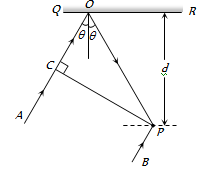
In the adjacent diagram, $CP$ represents a wavefront and $AO\ \&\ BP,$ the corresponding two rays. Find the condition on $q$  for constructive interference at $P$ between the ray $BP$ and reflected ray $OP$
In a semiconductor diode, the depletion region is removed when:
$\lambda$ ray of light passes through a prism of refractive index $\sqrt{2}$ in such a way that its angle of incidence is twice of the angle of refraction and there is minimum deviation in the ray. The angle of the prism will be :