Acylindrical vessel open at the top is $20$ $cm$ high and $10$ $cm$ in diameter.Acircular hole whose cross-sectional area $1$ $cm^2$ is cut at the centre of the bottom of the vessel. Water flows from a tube above it into the vessel at the rate $100$ $cm^3s^{^{-1}}$. The height of water in the vessel under steady state is ....... $cm$ (Take $g=1000 $ $ cms^{^{-2}})$
Medium


Download our appand get started for free
Experience the future of education. Simply download our apps or reach out to us for more information. Let's shape the future of learning together!No signup needed.*
Similar Questions
- 1View SolutionCorrect Bernoulli's equation is (symbols have their usual meaning) :
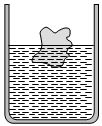
- 2View SolutionA body floats in a liquid contained in a beaker. If the whole system as shown in figure falls freely under gravity, then the upthrust on the body due to liquid is
- 3A tank is filled with water of density $1\,g$ per $cm^3$ and oil of density $0.9\,g$ per $cm^3$ . The height of water layer is $100\,cm$ and of the oil layer is $400\,cm.$ If $g = 980\,cm/sec^2,$ then the velocity of efflux from an opening in the bottom of the tank isView Solution
- 4A flat plate of area $0.1 \,m ^2$ is placed on a flat surface and is separated from it by a film of oil $10^{-5} \,m$ thick whose coefficient of viscosity is $1.5 N \,sm s ^{-2}$. The force required to cause the plate to slide on the surface at constant speed of $1 \,mm s ^{-1}$ is ............ $N$View Solution
- 5A cylinder containing water, stands on a table of height $H$. A small hole is punched in the side of cylinder at its base. The stream of water strikes the ground at a horizontal distance $R$ from the table. Then the depth of water in the cylinder is ............View Solution
- 6An air bubble of $1\, cm$ radius is rising at a steady rate of $2.00\, mm/sec$ through a liquid of density $1.5\, gm$ per $cm^3$. Neglect density of air. If $g$ is $1000\, cm/sec^2$, then the coefficient of viscosity of the liquid isView Solution
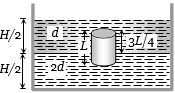
- 7A homogeneous solid cylinder of length $L$$(L < H/2)$. Cross-sectional area $A/5$ is immersed such that it floats with its axis vertical at the liquid-liquid interface with length $L/4$ in the denser liquid as shown in the fig. The lower density liquid is open to atmosphere having pressure ${P_0}$. Then density $D$ of solid is given byView Solution
- 8Two uniform solid balls of same density and of radii $r$ and $2r$ are dropped in air and fall vertically downwards. The terminal velocity of the ball with radius $r$ is $1\,cm\,s^{-1}$ , then find the terminal velocity of the ball of radius $2r$ (neglect bouyant force on the balls.) ........... $cm\,s^{-1}$View Solution
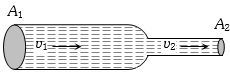
- 9A liquid flows in a tube from left to right as shown in figure. ${A_1}$ and ${A_2}$ are the cross-sections of the portions of the tube as shown. Then the ratio of speeds ${v_1}/{v_2}$ will beView Solution
- 10A beaker containing a liquid of density $\rho $ moves up with an acceleration $a$ ; the pressure due to the liquid at a depth $h$ below the free surface of the liquid isView Solution