Question
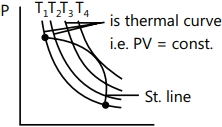
Agas expands such that its initial and final temperature are equal. Also, the process followed by the gas traces a straight line on the $P-V$ diagram :

Answer

The slope of straight line can't be tve. since, $\mathrm{T} \propto \mathrm{PV}$ and if slope is $+ve$, then both $\mathrm{P}$ and $\mathrm{V}$ are increasing. Therefore, temperature will always increase.

$\mathrm{T}_{1}<\mathrm{T}_{2}<\mathrm{T}_{3}<\mathrm{T}_{4}$

Thus, from graph it can be seen, that temperature first increases and then decrease.
Need a full question paper?

Generate a complete, print-ready paper with questions like this in minutes — across 16+ boards, with answer keys.
Start Generating Free

Similar questions

If $V_m$ is the velocity of sound in moist air, $V_d$ is the velocity of sound in dry air, under identical conditions of pressure and temperature
A magnet is suspended in such a way that it oscillates in the horizontal plane. It makes $20$  oscillations per minute at a place where dip angle is $30°$ and $15$ oscillations per minute at a place where dip angle is $60°$. The ratio of total earth's magnetic field at the two places is
A parallel plate capacitor is charged fully by using a battery. Then, without disconnecting the battery, the plates are moved further apart. Then,
The range of wavelength of the visible light is
In adiabatic expansion
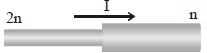
Two cylindrical rods of uniform crosssection area $A$ and $2A$, having free electrons per unit volume $2n$ and $n$ respectively are joined in series. A current $I$ flows through them in steady state. Then the ratio of drift velocity of free electron in left rod to drift velocity of electron in the right rod is $\left( {\frac{{{v_L}}}{{{v_R}}}} \right)$
Two resistances are connected in two gaps of a meter bridge. The balance point is $20\, cm$ from the zero end. A resistance of $15\, ohms$ is connected in series with the smaller of the two. The null point shifts to $40\, cm$. The value of the smaller resistance in $ohms$ is
A person blows into open-end of a long pipe. As a result, a high-pressure pulse of air travels down the pipe. When this pulse reaches the other end of the pipe then which of the following statements are true ?

$(I)$ a high-pressure pulse starts travelling up the pipe, if the other end of the pipe is open

$(II)$ a low -pressure pulse starts travelling up the pipe, if the other end of the pipe is open

$(III)$ a low pressure pulse starts travelling up the pipe, if the other end of the pipe is closed

$(IV)$ a high-pressure pulse starts travelling up the pipe, if the other end of the pipe is closed
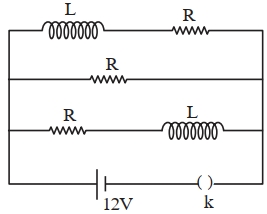
Three identical resistors with resistance $R =12\,\Omega$ and two identical inductors with sell inductance $L =5\,mH$ are connected to an ideal battery with emf of $12\,V$ as shown in figure. The current through the battery long after the switch has been closed will be $......A$.
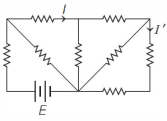
Consider the following circuit shown below. All the resistors are identical. The ratio of $I / I^{\prime}$ is