Answer the following by appropriately matching the lists based on the information given in the paragraph.

In a thermodynamics process on an ideal monatomic gas, the infinitesimal heat absorbed by the gas is given by $T \Delta X$, where $T$ is temperature of the system and $\Delta X$ is the infinitesimal change in a thermodynamic quantity $X$ of the system. For a mole of monatomic ideal gas

$X=\frac{3}{2} R \ln \left(\frac{T}{T_A}\right)+R \ln \left(\frac{V}{V_A}\right)$. Here, $R$ is gas constant, $V$ is volume of gas, $T_A$ and $V_A$ are constants.

The $List-I$ below gives some quantities involved in a process and $List-II$ gives some possible values of these quantities.

List-$I$ List-$II$
$(I)$ Work done by the system in process $1 \rightarrow 2 \rightarrow 3$ $(P)$ $\frac{1}{3} R T_0 \ln 2$
$(II)$ Change in internal energy in process $1 \rightarrow 2 \rightarrow 3$ $(Q)$ $\frac{1}{3} RT _0$
$(III)$ Heat absorbed by the system in process $1 \rightarrow 2 \rightarrow 3$ $(R)$ $R T _0$
$(IV)$ Heat absorbed by the system in process $1 \rightarrow 2$ $(S)$ $\frac{4}{3} RT _0$
  $(T)$ $\frac{1}{3} RT _0(3+\ln 2)$
  $(U)$ $\frac{5}{6} RT _0$

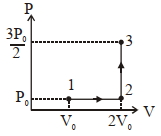
If the process carried out on one mole of monatomic ideal gas is as shown in figure in the PV-diagram with $P _0 V _0=\frac{1}{3} RT _0$, the correct match is,

$(1)$$I \rightarrow Q, II \rightarrow R , III \rightarrow P , IV \rightarrow U$

$(2)$ $I \rightarrow S , II \rightarrow R , III \rightarrow Q , IV \rightarrow T$

$(3)$ $I \rightarrow Q , II \rightarrow R , III \rightarrow S , IV \rightarrow U$

$(4)$ $I \rightarrow Q , II \rightarrow S , III \rightarrow R , IV \rightarrow U$

($2$) If the process on one mole of monatomic ideal gas is an shown is as shown in the $TV$-diagram with $P _0 V _0=\frac{1}{3} RT _0$, the correct match is

$(1)$ $I \rightarrow S, II \rightarrow T, III \rightarrow Q , IV \rightarrow U$

$(2)$ $I \rightarrow P , II \rightarrow R, III \rightarrow T , IV \rightarrow S$

$(3)$ $I \rightarrow P, II \rightarrow, III \rightarrow Q, IV \rightarrow T$

$(4)$ $I \rightarrow P, II \rightarrow R, III \rightarrow T, IV \rightarrow P$

Give the answer or quetion $(1)$ and $(2)$
IIT 2019, Advanced
Download our app for free and get startedPlay store
$(I)$ Degree of freedom $f=3$

Work done in any proces $5$ Area under P-V graph $\Rightarrow$ Work dooe in $1 \rightarrow 2 \rightarrow 3= P _1 V$,

$=\frac{ RI _0}{3} \Rightarrow(Q)$

$(II)$ Change in intemal energy $1 \rightarrow 2 \rightarrow 3$

$\Delta U =\Delta C \Delta T$

$=\frac{f}{2} n R A T$

$=\frac{f}{2}\left(P_t V_t-P_2 V_i\right)$

$=\frac{3}{2}\left(\frac{3 P_0}{2} 2 V _4- P _0 V _0\right)$

$=3 P _0 V _0$

$\Delta U = RT _{ b } \Rightarrow( R )$

$(III)$ Heat absorbed in $1 \rightarrow 2 \rightarrow 3$

for any process, $I^4$ law of thermodymmics

$\Delta Q =\Delta W +\infty$

$\Delta Q = RT _4+\frac{R T_3}{3}$

$\Delta Q =\frac{4 RT }{3} \Rightarrow( s )$

$(IV)$ Heat absorbed in process $1 \rightarrow 2$

$\Delta Q=\Delta U+W$

$=\frac{f}{2}\left(P_t V_f-P_V V_0\right)+W$

$=\frac{3}{2}\left(P_a 2 V_0-P_0 V_0\right)+P_a V_0$

$=\frac{5}{2} P_0 V_a$

$=\frac{5}{2}\left(\frac{R I_0}{3}\right)$

$\Delta Q-\frac{5 R I_0}{6} \Rightarrow(U)$

($2$) Process $1 \rightarrow 2$ is isothermal (temmerature constaut)

Process $2 \rightarrow 3$ is isochoric (volme constant)

$(I)$ Work done in $1 \rightarrow 2 \rightarrow 3$

$W = W _{1 \rightarrow 2}+ W _{2 \rightarrow 1}$

$=n R T \ln \left(\frac{V_t}{V_i}\right)+ W _{2 \rightarrow 1}$

$=\frac{R I_0}{3} \ln \left(\frac{2 V_4}{V_0}\right)+0$

$W =\frac{R T_1}{3} \ln 2 \Rightarrow \text { (P) }$

$\text { (II) } \Delta U \text { in } 1 \rightarrow 2 \rightarrow 3$

$\Delta U=\frac{f}{2} n R\left(T_4-T_i\right)$

$=\frac{3}{2} R\left( T _0-\frac{T_4}{5}\right)$

$=\frac{3}{2} R\left(\frac{2 T_0}{3}\right)$

$\Delta U=R_0 \quad(R)$

$(III)$ For any system first law of thermodynamics for $1 \rightarrow 2 \rightarrow 3$

$\Delta Q=\Delta U+W$

$\Delta Q=R T_0+\frac{R T_1}{3} \ln 2$

$\Delta Q=\frac{R I_0}{3}(3+\ln 2) \Rightarrow \text { (T) }$

$(IV)$ For process $1 \rightarrow 2$ (isothermal)

$\Delta Q =\Delta U + W$

$=\frac{ f }{2} RR \left( I _e- T _{ i }\right)+ RRT \ln \left( V _e / V _{ i }\right)$

$=0+ R \left(\frac{ T _{ e }}{3}\right) \ln \left(\frac{2 v _{ e }}{ V _{ a }}\right)$

$\Delta Q =\frac{R T_4}{3} \ln 2 \Rightarrow( P )$

art

Download our app
and get started for free

Experience the future of education. Simply download our apps or reach out to us for more information. Let's shape the future of learning together!No signup needed.*

Similar Questions

  • 1
    One mole of an ideal gas at initial temperature $T$, undergoes a quasi-static process during which the volume $V$ is doubled. During the process, the internal energy $U$ obeys the equation $U=a V^3$, where $a$ is a constant. The work done during this process is
    View Solution
  • 2
    The efficiency of a Carnot engine depends upon
    View Solution
  • 3
    An ideal gas heat engine operates in a Carnot cycle between $227^o C$ and $127^o C$. It absorbs $6\,kcal$ at the higher temperature. The amount of heat (in $kcal$) converted into work is equal to
    View Solution
  • 4
    When the amount of work done is $333\, cal$ and change in internal energy is $167\, cal$, then the heat supplied is ....... $cal$
    View Solution
  • 5
    An ideal gas expands in such a way that $PV^2 =$ constant throughout the process.
    View Solution
  • 6
    $5.6$ $liter$ of helium gas at $STP$ is adiabatically compressed to $0.7$ $liter$. Taking the initial temperature to be $T_1$, the work done in the process is
    View Solution
  • 7
    A heat engine operates with the cold reservoir at temperature $324 K$. The minimum temperature of the hot reservoir, if the heat engine takes $300 \; J$ heat from the hot reservoir and delivers $180 \; J$ heat to the cold reservoir per cycle, is $\dots \; K .$
    View Solution
  • 8
    Find the change in the entropy in the following process $100 \,gm$ of ice at $0°C$ melts when dropped in a bucket of water at $50°C$ (Assume temperature of water does not change) ..... $ cal/K$
    View Solution
  • 9
    Consider the given series combination of carnot cycles. If $W_1 = W_2$ then the value of $T$ is ...... $K$ (all temperatures are maintained at their respective values)
    View Solution
  • 10
    A carnot engine has the same efficiency between $800 K$ to $500 K$ and $x\, K$ to $600 K.$ The value of $x$ is ...... $K$
    View Solution