MCQ
Age of a tree is determined using radio-isotope of
  • Carbon
  • B
    Cobalt
  • C
    Iodine
  • D
    Phosphorus

Answer

Correct option: A.
Carbon
a
(a) Carbon dating

Need a full question paper?

Generate a complete, print-ready paper with questions like this in minutes — across 16+ boards, with answer keys.

Start Generating Free

Similar questions

At what distance above and below the surface of the earth a body will have same weight, (take radius of earth as $R$.)
When a mass $m$ is hung from the lower end of a spring of neglibgible mass, an extension $x$ is produced in the spring. The time period of oscillation is
A uniform circular disc of radius $50\, cm$ at rest is free to turn about an axis which is perpendicular to its plane and passes through its centre. It is subjected to a torque which produces a constant angular acceleration of $2.0\, rad \,s^{-2}$. Its net acceleration in $ms^{-2}$ at the end of $2.0\,s$  is approximately
A particle of mass $200 \,MeV / c ^{2}$ collides with a hydrogen atom at rest. Soon after the collision the particle comes to rest, and the atom recoils and goes to its first excited state. The initial kinetic energy of the particle (in $eV$ ) is $\frac{ N }{4} .$ The value of $N$ is :

(Given the mass of the hydrogen atom to be $\left.1\, GeV / c ^{2}\right)$
A piece of iron is heated in a flame. It first becomes dull red then becomes reddish yellow and finally turns to white hot. The correct explanation for the above observation is possible by using
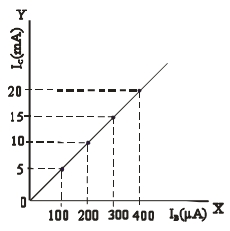
The typical transfer characteristic of a transistor in $CE$ configuration is shown in figure. A load resistor of $2\,k\Omega$ is connected in the collector branch of the circuit used. The input resistance of the transistor is $0.50\,k \Omega$. The voltage gain of the transistor is.
A man of mass $m$ starts falling towards a planet of mass $M$ and radius $R.$ As he reaches near to the surface, he realizes that he will pass through a small hole in the planet. As he enters the hole, he sees that the planet is really made of two pieces a spherical shell of negligible thickness of mass $\frac{2M}{3}$ and a point  mass $\frac{M}{3}$ at the centre. Change in the force of gravity experienced by the man is
We have three identical metallic spheres $A, B$ and $C$. $A$ is given a charge $Q$, and $B$ and $C$ are uncharged. The following processes of touching of two spheres are carried out in succession. Each process is carried out with sufficient time.
$(i)$ $A$ and $B$      $(ii)$ $B$ and $C$
$(iii)$ $C$ and $A$      $(iv)$ $A$ and $B$
$(v)$ $B$ and $C$
The final charges on the spheres are
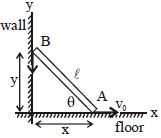
A rigid rod is sliding. At some instant position of the rod is as shown in the figure. End $A$ has constant velocity $v_0$. At $t = 0, y = l$ . 
For harder $X-$ rays