MCQ
$AgN{O_3}$ does not give precipitate with $CHC{l_3}$ because
- ✓$CHC{l_3}$ does not ionise in water
- B$AgN{O_3}$ does not reacts with $CHC{l_3}$
- C$CHC{l_3}$ is chemically inert
- DNone of these
$CHC{l_3}$ is a covalent compound. It does not ionize in water.
Generate a complete, print-ready paper with questions like this in minutes — across 16+ boards, with answer keys.
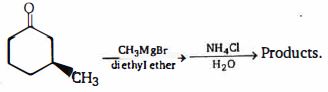
$\begin{array}{l}
C{H_3} - C{H_2} - N{H_2}\\
\,\,\,\,\,\,\,\,\,\,\,\,\,\,\,\,\,\,\,\,{\rm{(I)}}
\end{array}$
$\begin{array}{l}
Ph - C{H_2} - N{H_2}\\
\,\,\,\,\,\,\,\,\,\,\,\,\,\,\,\,\,\,\,\,{\rm{(II)}}
\end{array}$
$\begin{array}{l}
Ph - N{H_2}\\
\,\,\,\,\,\,\,\,\,{\rm{(III)}}
\end{array}$
Correct order of their basic strength is
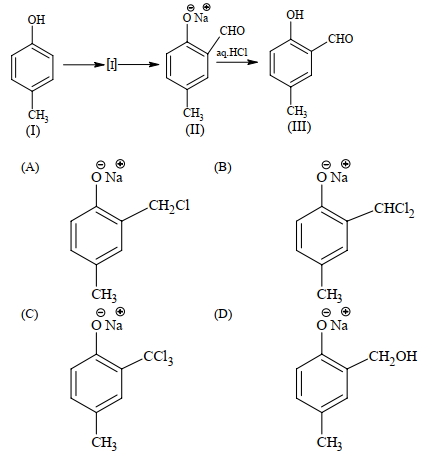
$Image$
$1.$ Which one of the following reagents is used in the above reaction?
$(A)$ aq. $\mathrm{NaOH}+\mathrm{CH}_3 \mathrm{Cl}$
$(B)$ aq. $\mathrm{NaOH}+\mathrm{CH}_2 \mathrm{Cl}_2$
$(C)$ aq. $\mathrm{NaOH}+\mathrm{CHCl}_3$
$(D)$ aq. $\mathrm{NaOH}+\mathrm{CCl}_4$
$2.$ The electrophile in this reaction is
$(A)$ : $\mathrm{CHCl}$ $(B)$ ${ }^{+} \mathrm{CHCl}_2$
$(C)$ $\mathrm{CCl}_2$ $(D)$. $\mathrm{CCl}_3$
$3.$ The structure of the intermediate $I$ is
$Image$
Give the answer question $1, 2$ and $3.$