Air is blown through a hole on a closed pipe containing liquid. Then the pressure will
Easy
Download our app for free and get started
(c) From Pascal's principie which was stated in $1652$ by Biaise Pascal, according to which a change in pressure applied to an enclosed incompressible fluid is transmitted undiminshed to every portion of the fluid and uo the walls of its container. This pressure change is independent of height. Hence, on biowing air through a closed pipe containing liquid, pressure will increase in all directions.

Download our appand get started for free
Experience the future of education. Simply download our apps or reach out to us for more information. Let's shape the future of learning together!No signup needed.*
Similar Questions
- 1A vertical U-tube of uniform cross-section contains water in both the arms. A $10 \,cm$ glycerine column ($R.D$. $=1.2$ ) is added to one of the limbs. The level difference between the two free surfaces in the two limbs will be ...... $cm$View Solution
- 2A ball of density $'\rho '$ is released from deep inside of a viscous liquid of density $'2\rho '$ . It will move upView Solution
- 3Water is flowing continuously from a tap having an internal diameter $8 \times 10^{-3}\ m $ The water velocity as it leaves the tap is $0.4$ $ms^{-1}$ છે. The diameter of the water stream at a distance $2 \times 10^{-1}$ $m$ below the tap is close to .......$\times 10^{-3}\;m$View Solution
- 4An object with uniform density $\rho$ is attached to a spring that is known to stretch linearly with applied force as shown below.When the spring object system is immersed in a liquid of density $\rho_1$ as shown in the above figure, the spring stretches by an amount $x_1\left(\rho > \rho_1\right)$. When the experiment is repeated in a liquid of density $\left(\rho_2 < \rho_1\right)$, the spring stretches by an amount $x_2$. Neglecting any buoyant force on the spring, the density of the object isView Solution
- 5A hosepipe directs a horizontal jet of water moving with velocity of $20\, m/s$ on a vertical wall. The cross-sectional area of jet is $10^{-3}\,m^2$. If density of water is $1000\, kg/m^3$, then force acting on wall is ........... $N$ [Assuming water comes to rest after striking wall]View Solution
- 6A sudden drop in the mercury level by $10 \,mm$ or more is a sign of ..........View Solution
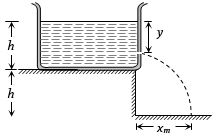
- 7A tank is filled upto a height $h$ with a liquid and is placed on a platform of height h from the ground. To get maximum range ${x_m}$ a small hole is punched at a distance of $y$ from the free surface of the liquid. ThenView Solution
- 8Two water pipes of diameters $ 2 cm $ and $4 cm $ are connected with the main supply line. The velocity of flow of water in the pipe of $ 2 cm$ diameter isView Solution
- 9A spherical ball of radius $1 \times 10^{-4} \mathrm{~m}$ and density $10^5$ $\mathrm{kg} / \mathrm{m}^3$ falls freely under gravity through a distance $h$ before entering a tank of water, If after entering in water the velocity of the ball does not change, then the value of $h$ is approximately:View Solution
(The coefficient of viscosity of water is $9.8 \times 10^{-6}$ $\left.\mathrm{N} \mathrm{s} / \mathrm{m}^2\right)$
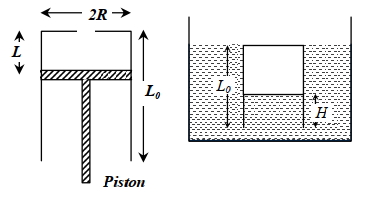
- 10A fixed thermally conducting cylinder has a radius $\mathrm{R}$ and height $\mathrm{L}_0$. The cylinder is open at its bottom and has a small hole at its top. A piston of mass $M$ is held at a distance $L$ from the top surface, as shown in the figure. The atmospheric pressure is $\mathrm{P}_0$.View Solution
$1.$ The piston is now pulled out slowly and held at a distance $2 \mathrm{~L}$ from the top. The pressure in the cylinder between its top and the piston will then be
$(A)$ $\mathrm{P}_0$ $(B)$ $\frac{\mathrm{P}_0}{2}$ $(C)$ $\frac{P_0}{2}+\frac{M g}{\pi R^2}$ $(D)$ $\frac{\mathrm{P}_0}{2}-\frac{\mathrm{Mg}}{\pi \mathrm{R}^2}$
$2.$ While the piston is at a distance $2 \mathrm{~L}$ from the top, the hole at the top is sealed. The piston is then released, to a position where it can stay in equilibrium. In this condition, the distance of the piston from the top is
$(A)$ $\left(\frac{2 \mathrm{P}_0 \pi \mathrm{R}^2}{\pi \mathrm{R}^2 \mathrm{P}_0+\mathrm{Mg}}\right)(2 \mathrm{~L})$ $(B)$ $\left(\frac{\mathrm{P}_0 \pi R^2-\mathrm{Mg}}{\pi R^2 \mathrm{P}_0}\right)(2 \mathrm{~L})$
$(C)$ $\left(\frac{\mathrm{P}_0 \pi \mathrm{R}^2+\mathrm{Mg}}{\pi \mathrm{R}^2 \mathrm{P}_0}\right)(2 \mathrm{~L})$ $(D)$ $\left(\frac{\mathrm{P}_0 \pi \mathrm{R}^2}{\pi \mathrm{R}^2 \mathrm{P}_0-\mathrm{Mg}}\right)(2 \mathrm{~L})$
$3.$ The piston is taken completely out of the cylinder. The hole at the top is sealed. A water tank is brought below the cylinder and put in a position so that the water surface in the tank is at the same level as the top of the cylinder as shown in the figure. The density of the water is $\rho$. In equilibrium, the height $\mathrm{H}$ of the water column in the cylinder satisfies
$(A)$ $\rho g\left(\mathrm{~L}_0-\mathrm{H}\right)^2+\mathrm{P}_0\left(\mathrm{~L}_0-\mathrm{H}\right)+\mathrm{L}_0 \mathrm{P}_0=0$
$(B)$ $\rho \mathrm{g}\left(\mathrm{L}_0-\mathrm{H}\right)^2-\mathrm{P}_0\left(\mathrm{~L}_0-\mathrm{H}\right)-\mathrm{L}_0 \mathrm{P}_0=0$
$(C)$ $\rho g\left(\mathrm{~L}_0-\mathrm{H}\right)^2+\mathrm{P}_0\left(\mathrm{~L}_0-\mathrm{H}\right)-\mathrm{L}_0 \mathrm{P}_0=0$
$(D)$ $\rho \mathrm{g}\left(\mathrm{L}_0-\mathrm{H}\right)^2-\mathrm{P}_0\left(\mathrm{~L}_0-\mathrm{H}\right)+\mathrm{L}_0 \mathrm{P}_0=0$
Give the answer question $1,2$ and $3.$