A fixed thermally conducting cylinder has a radius $\mathrm{R}$ and height $\mathrm{L}_0$. The cylinder is open at its bottom and has a small hole at its top. A piston of mass $M$ is held at a distance $L$ from the top surface, as shown in the figure. The atmospheric pressure is $\mathrm{P}_0$.
$1.$ The piston is now pulled out slowly and held at a distance $2 \mathrm{~L}$ from the top. The pressure in the cylinder between its top and the piston will then be
$(A)$ $\mathrm{P}_0$ $(B)$ $\frac{\mathrm{P}_0}{2}$ $(C)$ $\frac{P_0}{2}+\frac{M g}{\pi R^2}$ $(D)$ $\frac{\mathrm{P}_0}{2}-\frac{\mathrm{Mg}}{\pi \mathrm{R}^2}$
$2.$ While the piston is at a distance $2 \mathrm{~L}$ from the top, the hole at the top is sealed. The piston is then released, to a position where it can stay in equilibrium. In this condition, the distance of the piston from the top is
$(A)$ $\left(\frac{2 \mathrm{P}_0 \pi \mathrm{R}^2}{\pi \mathrm{R}^2 \mathrm{P}_0+\mathrm{Mg}}\right)(2 \mathrm{~L})$ $(B)$ $\left(\frac{\mathrm{P}_0 \pi R^2-\mathrm{Mg}}{\pi R^2 \mathrm{P}_0}\right)(2 \mathrm{~L})$
$(C)$ $\left(\frac{\mathrm{P}_0 \pi \mathrm{R}^2+\mathrm{Mg}}{\pi \mathrm{R}^2 \mathrm{P}_0}\right)(2 \mathrm{~L})$ $(D)$ $\left(\frac{\mathrm{P}_0 \pi \mathrm{R}^2}{\pi \mathrm{R}^2 \mathrm{P}_0-\mathrm{Mg}}\right)(2 \mathrm{~L})$
$3.$ The piston is taken completely out of the cylinder. The hole at the top is sealed. A water tank is brought below the cylinder and put in a position so that the water surface in the tank is at the same level as the top of the cylinder as shown in the figure. The density of the water is $\rho$. In equilibrium, the height $\mathrm{H}$ of the water column in the cylinder satisfies
$(A)$ $\rho g\left(\mathrm{~L}_0-\mathrm{H}\right)^2+\mathrm{P}_0\left(\mathrm{~L}_0-\mathrm{H}\right)+\mathrm{L}_0 \mathrm{P}_0=0$
$(B)$ $\rho \mathrm{g}\left(\mathrm{L}_0-\mathrm{H}\right)^2-\mathrm{P}_0\left(\mathrm{~L}_0-\mathrm{H}\right)-\mathrm{L}_0 \mathrm{P}_0=0$
$(C)$ $\rho g\left(\mathrm{~L}_0-\mathrm{H}\right)^2+\mathrm{P}_0\left(\mathrm{~L}_0-\mathrm{H}\right)-\mathrm{L}_0 \mathrm{P}_0=0$
$(D)$ $\rho \mathrm{g}\left(\mathrm{L}_0-\mathrm{H}\right)^2-\mathrm{P}_0\left(\mathrm{~L}_0-\mathrm{H}\right)+\mathrm{L}_0 \mathrm{P}_0=0$
Give the answer question $1,2$ and $3.$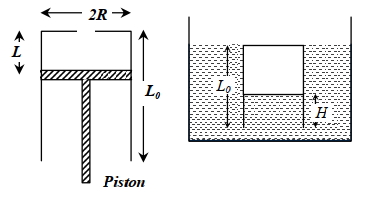
IIT 2007, Advanced
Download our app for free and get started
$2.$ $ \mathrm{Mg}+\mathrm{P}\left(\pi R^2\right)=\mathrm{P}_0 \pi R^2 $
$ \mathrm{P}_0\left(2 \mathrm{~L} \pi R^2\right)=\mathrm{P}\left(\mathrm{x} \pi R^2\right) $
$ \mathrm{x}=\left(\frac{\mathrm{P}_0 \pi R^2}{\pi R^2 P_0-\mathrm{Mg}}\right)(2 L) \quad\left(\mathrm{P}_1 \cdot V_1=\mathrm{P}_2 V_2 \text { for isothermal process }\right)$
( $\mathrm{P}_1 \cdot \mathrm{V}_1=\mathrm{P}_2 \mathrm{~V}_2$ for isothermal process)
$3.$ $ \pi \mathrm{R}^2 \mathrm{P}_0 \mathrm{~L}_0=\mathrm{P}\left(\mathrm{L}_0-\mathrm{H}\right) \pi \mathrm{R}^2 $ ............$(i)$
$ \mathrm{P}=\mathrm{P}_0+\rho \mathrm{g}\left(\mathrm{L}_0-\mathrm{H}\right)$ ................$(ii)$
Solving $(i)$ and $(ii)$, we get the answer.

Download our appand get started for free
Experience the future of education. Simply download our apps or reach out to us for more information. Let's shape the future of learning together!No signup needed.*
Similar Questions
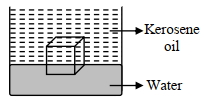
- 1A cube of ice floats partly in water and partly in kerosene oil. The radio of volume of ice immersed in water to that in kerosene oil (specific gravity of Kerosene oil $=0.8$, specific gravity of ice $=0.9$ )View Solution
- 2At what speed the velocity head of a stream of water be equal to $40 cm $ of $Hg$ ........ $cm/sec$View Solution
- 3A tank $5 \,m$ high is half filled with water and then is filled to the top with oil of density $0.85 \,g/cm^3$. The pressure at the bottom of the tank, due to these liquids is ........ $g/cm^2$View Solution
- 4A fully loaded boeing aircraft has a mass of $5.4 \times 10^5\,kg$. Its total wing area is $500\,m ^2$. It is in level flight with a speed of $1080\,km / h$. If the density of air $\rho$ is $1.2\,kg\,m ^{-3}$, the fractional increase in the speed of the air on the upper surface of the wing relative to the lower surface in percentage will be $\left( g =10\,m / s ^2\right)$View Solution
- 5Small water droplets of radius $0.01 \mathrm{~mm}$ are formed in the upper atmosphere and falling with a terminal velocity of $10 \mathrm{~cm} / \mathrm{s}$. Due to condensation, if $8 \mathrm{such}$ droplets are coalesced and formed a larger drop, the new terminal velocity will be ........... $\mathrm{cm} / \mathrm{s}$.View Solution
- 6A load of mass $M\,kg$ is suspended from a steel wire of length $2\,m$ and radius $1.0\,mm$ in Searle’s apparatus experiment. The increase in length produced in the wire is $4.0\,mm.$ Now the load is fully immersed in a liquid of relative density $2$. The relative density of the material of load is $8$. The new value of increase in length of the steel wire is ........ $mm$View Solution
- 7Suppose you have taken a dilute solution of oleic acid in such a way that its concentration becomes $0.01 \,cm ^{3}$ of oleic acid per $cm ^{3}$ of the solution. Then you make a thin film of this solution (monomolecular thickness) of area $4\, cm ^{2}$ by considering $100$ spherical drops of radius $\left(\frac{3}{40 \pi}\right)^{\frac{1}{3}} \times 10^{-3}\, cm .$ Then the thickness of oleic acid layer will be $x \times 10^{-14} \,m$. Where $x$ is ...... .View Solution
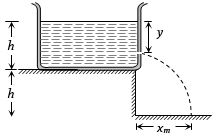
- 8A tank is filled upto a height $h$ with a liquid and is placed on a platform of height h from the ground. To get maximum range ${x_m}$ a small hole is punched at a distance of $y$ from the free surface of the liquid. ThenView Solution
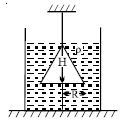
- 9A cone of radius $R$ and height $H$, is hanging inside a liquid of density $\rho$ by means of a string as shown in the figure. The force, due to the liquid acting on the slant surface of the cone isView Solution
- 10Which of the following is the incorrect graph for a sphere falling in a viscous liquid? (Given at $t = 0$, velocity $v = 0$ and displacement $x = 0$.)View Solution