MCQ
Albert Einstein got a nobel prize in physics for his work on:
- ASpecial theory of relativity
- BGeneral theory of relativity
- CPhotoelectric effect
- DTheory of specific heats
Explanation:
In 1905, Albert Einstein extended Planck's hypothesis to explain the photoelectric effect, which is the emission of electrons by a metal surface when it is irradiated by light or more-energetic photons.
Generate a complete, print-ready paper with questions like this in minutes — across 16+ boards, with answer keys.
Electric lines of force about negative point charge are
|
(a) Circular, anticlockwise |
(b) Circular, clockwise |
|
(c) Radial, inward |
(d) Radial, outward |
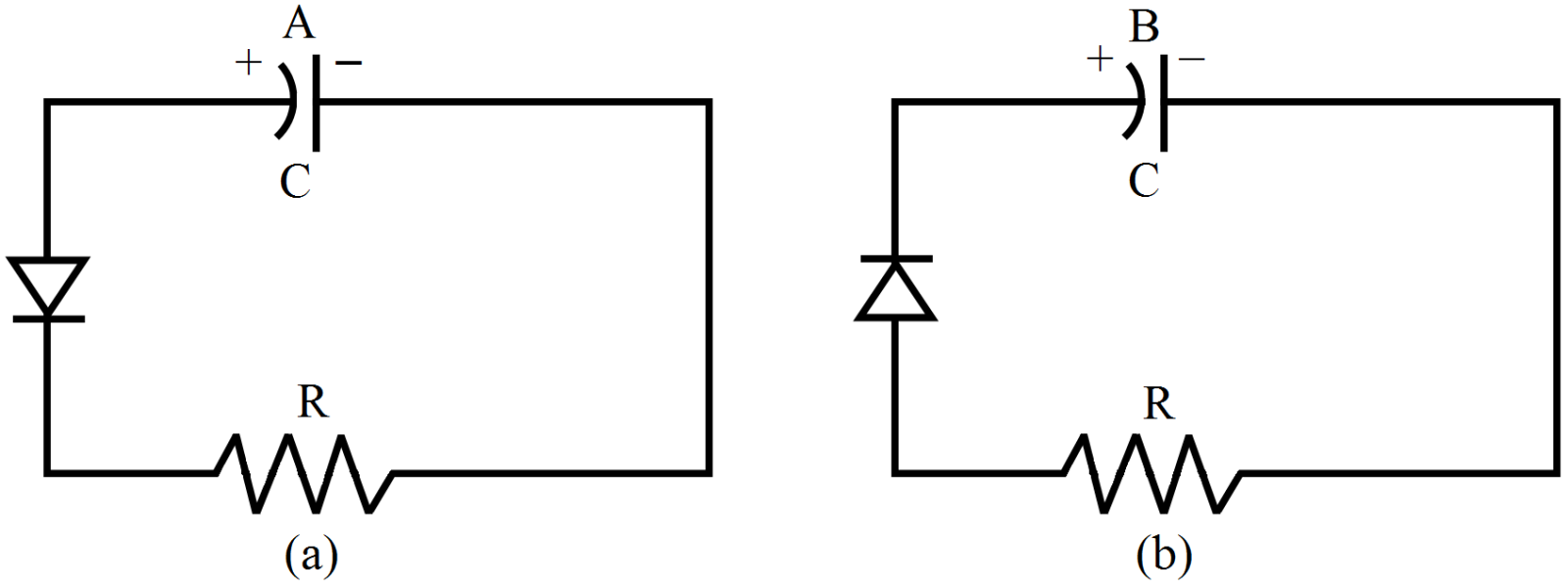
Barrier potential of a P-N junction diode does not depend on
|
(a) Temperature |
(b) Forward bias |
(c) Doping density |
(d) Diode design |
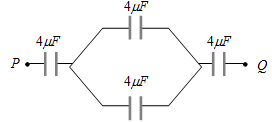
Four condensers each of capacity 4μF are connected as shown in figure.  The energy stored in the system is
|
(a) 2400 ergs |
(b) 1800 ergs |
(c) 3600 ergs |
(d) 5400 ergs |
Light waves producing interference have their amplitudes in the ratio 3 : 2. The intensity ratio of maximum and minimum of interference fringes is
|
(a) 36 : 1 |
(b) 9 : 4 |
(c) 25 : 1 |
(d) 6 : 4 |
Electric potential at an equatorial point of a small dipole with dipole moment P (r, distance from the dipole) is
|
(a) Zero |
(b) |
(c) |
(d) |
A person wears glasses of power – 2.0 D. The defect of the eye and the far point of the person without the glasses will be
|
(a) Nearsighted, 50 cm |
(b) Farsighted, 50 cm |
(c) Nearsighted, 250 cm |
(d) Astigmatism, 50 cm |


