Question
Aldehydes are more reactive toward nucleophilic addition reactions than ketones. Explain.
(1) Influence of electronic effects: A ketone has two electron-donating aJ.kyl groups ( + I effect) bonded to carbonyl carbon which are responsible for decreasing its positive polarity and electrophilicity. In contrast. aldehydes have only electron-donating group bonded to carbonyl carbon. This shows aldehydes are more electrophilic than ketones.
(2) Steric effects : Two bulky alkyl groups in ketone come in the way of the incoming nucleophile. This is called steric hindrance to nucleophilic attack.
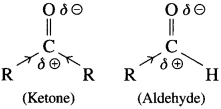
On the other hand. nucleophile can easily attack the carbonyl carbon in aldehyde because has one alkyl group and is less crowded or sterically less hindered.
Hence aldehydes are more reactive and can easily be attacked by nucleophiles.
Generate a complete, print-ready paper with questions like this in minutes — across 16+ boards, with answer keys.