MCQ
Aldol condensation will not be observed in
  • chloral
  • B
    phenylacetaldehyde
  • C
    hexanal
  • D
    nitromethane

Answer

Correct option: A.
chloral
a
only those compounds which have $\alpha -H$ give aldol condensation

  $(a)$ $\underset{(no\,\,\alpha -H)}{\mathop{\begin{matrix}
   \,\,\,\,\,\,\,\,\,\,\,O  \\
   \,\,\,\,\,\,\,\,\,\,\,||  \\
   C{{l}_{3}}\overset{\alpha }{\mathop{C}}\,CH  \\
\end{matrix}}}\,$     $(b)$ $\underset{(\alpha -H)}{\mathop{{{C}_{6}}{{H}_{5}}\overset{\alpha }{\mathop{C}}\,{{H}_{2}}CHO}}\,$

$(c)$ $\underset{(\alpha -H)}{\mathop{{{C}_{4}}{{H}_{9}}\overset{\alpha }{\mathop{C}}\,{{H}_{2}}CHO}}\,$       $(d)$  $CH_3NO_2$

Need a full question paper?

Generate a complete, print-ready paper with questions like this in minutes — across 16+ boards, with answer keys.
Start Generating Free

Similar questions

An object $2.4\ m$ in front of a lens forms a sharp image on a film $12\ cm$ behind the lens. A glass plate $1\ cm$ thick, of refractive index $1.50$ is interposed between lens and film with its plane faces parallel to film. At what distance ( from lens) should object shifted to be in sharp focus of film?......$m$
A black body radiates at the rate of $W$ watts at a temperature $T$ . If the temperature of the body is reduced to $T/3$ , it will radiate at the rate of (in Watts)
A real image of an object is formed at a distance of $20\, cm$ from lens. On putting another identical lens in contact with it, the image is shifted $10\, cm$ towards the combination, the power of the lens is
An observer moves with a constant speed along the line joining two stationary objects. He will observe that the two objects
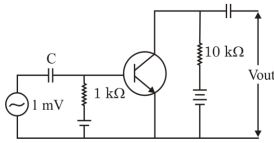
An $n.p.n$ transistor with current gain $\beta=100$ in common emitter configuration is shown in figure. The output voltage of the amplifier will be$.....V$
On a frictionless horizontal plane, a bob of mass $m=0.1 kg$ is attached to a spring with natural length $l_0=0.1 m$. The spring constant is $k_1=0.009 Nm ^{-1}$ when the length of the spring $I > l_0$ and is $k_2=0.016 Nm ^{-1}$ when $ I < l_0$. Initially the bob is released from $l=0.15 m$. Assume that Hooke's law remains valid throughout the motion. If the time period of the full oscillation is $T=(n \pi) s$, then the integer closest to $n$ is. . . . .
A $0.5\ kg$ mass of lead is submerged in a container filled to the brim with water and a block of wood floats on top. The lead mass is slowly lifted from the container by a thin wire and as it emerges into air the level of the water in the container drops a bit. The lead mass is now placed on the block of wood. As the lead is placed on the wood.
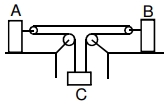
If acceleration of $A$ is $2\,m / s ^2$ to left and acceleration of $B$ is $1\,m / s ^2$ to left, then acceleration of $C$ is -
A stone ties to the end of a string $1\,m$ long is whirled in a horizontal circle with a constant speed. If the stone makes $22$ revolution in $44$ seconds, what is the magnitude and direction of acceleration of the stone
A particle of charge $q$ and mass $m$ enters a region of a transverse electric field of $E_{0} \hat{ j }$ with initial velocity $v_{0} \hat{ i }$. The time taken for the change in the de-Broglie wavelength of the charge from the initial value of $\lambda_{0}$ to $\lambda_{0} / 3$ is proportional to