A black body radiates at the rate of $W$ watts at a temperature $T$ . If the temperature of the body is reduced to $T/3$ , it will radiate at the rate of (in Watts)
Medium


Download our appand get started for free
Experience the future of education. Simply download our apps or reach out to us for more information. Let's shape the future of learning together!No signup needed.*
Similar Questions
- 1Consider two rods of same length and different specific heats $\left(S_{1}, S_{2}\right)$, conductivities $\left(K_{1}, K_{2}\right)$ and area of cross-sections $\left(A_{1}, A_{2}\right)$ and both having temperatures $T_{1}$ and $T_{2}$ at their ends. If rate of loss of heat due to conduction is equal, thenView Solution
- 2A cylindrical metallic rod in thermal contact with two reservoirs of heat at its two ends conducts an amount of heat $Q$ in time $t$. The metallic rod is melted and the material is formed into a rod of half the radius of the original rod. What is the amount of heat conducted by the new rod, when placed in thermal contact with the two reservoirs in time $t$ ?View Solution
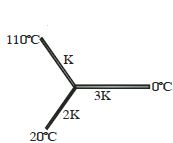
- 3Three rods of equal length and cross sectional area and coefficient of thermal conductivities $K, 2K$ and $3K$ are joined as shown in figure temperature of their ends are $110\ ^oC, 20\ ^oC$ and $0\ ^oC$ respectively then temperature of junction will be ......... $^oC$View Solution
- 4$A$ wall has two layers $A$ and $B$ made of different materials. The thickness of both the layers is the same. The thermal conductivity of $A$ and $B$ are $K_A$ and $K_B$ such that $K_A = 3K_B$. The temperature across the wall is $20°C$ . In thermal equilibriumView Solution
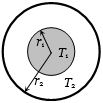
- 5The figure shows a system of two concentric spheres of radii $r_1$ and $r_2$ and kept at temperatures $T_1$ and $T_2$, respectively. The radial rate of flow of heat in a substance between the two concentric spheres is proportional toView Solution
- 6At $127^o C$ radiates energy is $2.7 \times 10^{-3} J/s$. At ....... $K$ temperature radiated energy is $4.32 \times 10^6 J/s$View Solution
- 7If two metallic plates of equal thicknesses and thermal conductivities ${K_1}$ and ${K_2}$ are put together face to face and a common plate is constructed, then the equivalent thermal conductivity of this plate will beView Solution

- 8In a certain planetary system, it is observed that one of the celestial bodies having a surface temperature of $200 \;K$, emits radiation of maximum intensity near the wavelength $12\; \mu m$. The surface temperature (in $K$) of a nearby star which emits light of maximum intensity at a wavelength $\lambda= 4800\;\mathring A$ isView Solution
- 9One end of a metal rod of length $1.0 m$ and area of cross section $100c{m^2}$ is maintained at ${100^o}C.$If the other end of the rod is maintained at ${0^o}C$, the quantity of heat transmitted through the rod per minute is (Coefficient of thermal conductivity of material of rod =$100W/m-K$)View Solution
- 10Two identical objects $A$ and $B$ are at temperatures $T_A$ and $T_B$ respectively. Both objects are placed in a room with perfectly absorbing walls maintained at temperatures T $({T_A} > T > {T_B}).$ The objects A and B attain temperature $T $ eventually which one of the following is correct statementView Solution