MCQ
$\ce{AlH_3}$​ is an example for:
  • A
    interstitial hydride
  • B
    electron rich hydride
  • C
    ionic hydride
  • electron deficient hydride

Answer

Correct option: D.
electron deficient hydride
According to the Bohr's octet rule, each element tends to completely fill its outermost orbit with $8$ electrons in it. Electronic configuration of aluminium is $2, 8, 3$ that means it still needs $5$ more electrons to complete its octet. That's why aluminium is electron deficient.

Need a full question paper?

Generate a complete, print-ready paper with questions like this in minutes — across 16+ boards, with answer keys.

Start Generating Free

Similar questions

Two moles of $N{H_3}$ when put into a previously evacuated vessel (one litre), partially dissociate into ${N_2}$ and ${H_2}$. If at equilibrium one mole of $NH_3$ is present, the equilibrium constant is
Going from $K-$shell to $N-$shell in case of $H-$atom :
The enthalpies of combustion of $S(s)$ and $H_2(g)$ are $ -300$ and $-290\,\, kcal\,\, mol^{-1.}$ 

Given $SO_3(g) + H_2O(l) \rightarrow H_2SO_4(l)$
$\Delta H = -130\,\, kcal\, mol^{-1}$
$SO_2(g) + 1/2O_2(g) \rightarrow SO_3(g)$
$\Delta H = -100 \,\,kcal\,\, mol^{-1}$
the enthalpy of formation of $H_2SO_4(l)$ would be ......$kcal\, mol^{-1}$

The most abundant elements by mass in the body of a healthy human adult are :

Oxygen $(61.4\%);$ Carbon $(22.9\%),$ Hydrogen $(10.0\%);$ and Nitrogen $(2.6\%).$ The weight which a $75\, kg$ person would gain if all $^1H$ atoms are replaced by $^2H$ atoms is ....... $kg$

Assign $A, B, C, D$ from given type of reaction. $3PbS + 8HNO_3\, (Dil.) \longrightarrow 3Pb(NO_3)_2 + 3S  \downarrow  + 2NO + 4H_2O$
The major product formed in the following reaction is
Assertion : Nitrating mixture used for carrying out nitration of benzene consists of conc. $HNO_3+$ conc. $H_2SO_4$.

Reason : In presence of $H_2SO_4$, $HNO_3$ acts as a base and produces $NO_2^+$ ions.
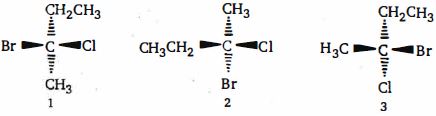
Which of the following depict the same ?
What is the ratio of time periods in $3^{rd}$ orbit of $H-$ atom to the $2^{nd}$ orbit of $He^+$ ion 
What is the effect of halving the pressure by doubling the volume on the following system at $500\,^oC$

${H_{2(g)}} + {I_{2(g)}}$ $\rightleftharpoons$ $2H{I_{(g)}}$