MCQ 11 Mark
In the structure of diborane.
- A
All hydrogen atoms lie in one plane and boron atoms lie in a plane perpendicular to this plane.
- ✓
$2$ boron atoms and $4$ terminal hydrogen atoms lie in the same plane and $2$ bridging hydrogen atoms lie in the perpendicular plane.
- C
$4$ bridging hydrogen atoms and boron atoms lie in one plane and two terminal hydrogen atoms lie in a plane perpendicular to this plane.
- D
All the atoms are in the same plane.
AnswerCorrect option: B. $2$ boron atoms and $4$ terminal hydrogen atoms lie in the same plane and $2$ bridging hydrogen atoms lie in the perpendicular plane.
The four terminal hydrogen atoms and the two boron atoms lie in one plane.
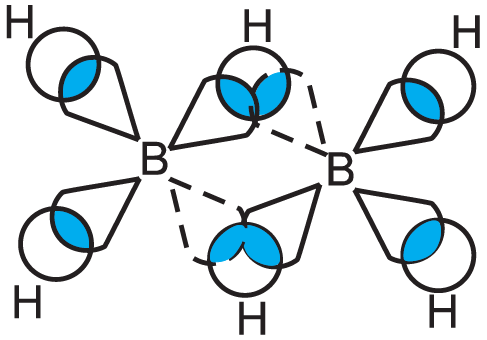
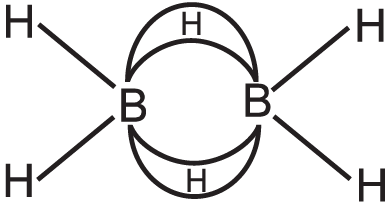
Above and below this plane, there are two bridging hydrogen atoms. The four terminal $\ce{B-H}$ bonds are regular two$-$center$-$two$-$electron bonds while the two bridge $\text{(B-H-B)}$ bonds are different and can be described in terms of three$-$centre$-$two$-$electrone bonds as shown in figure: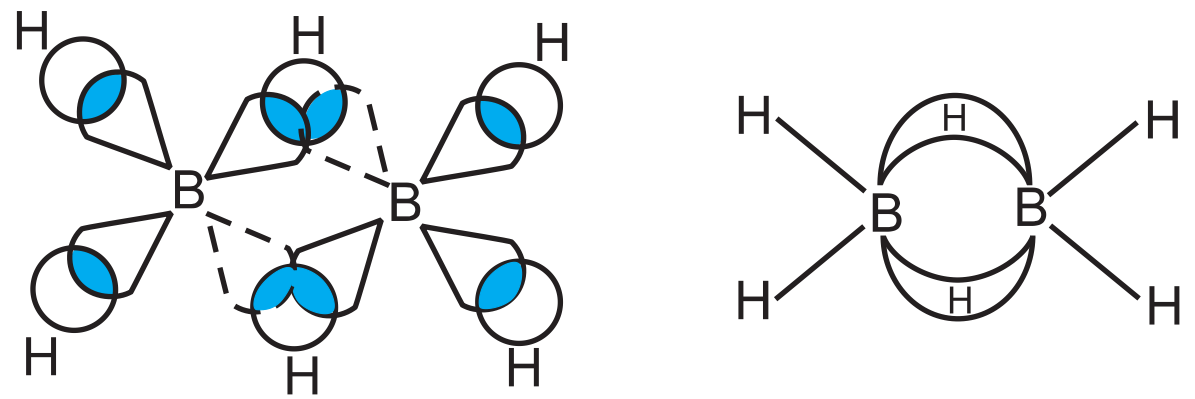
View full question & answer→MCQ 21 Mark
$\ce{B_2H_6}$ on heating with $\ce{NH_3}$ gases gives:
- ✓
$ \mathrm{B}_3 \mathrm{~N}_3 \mathrm{H}_6$
- B
$ \mathrm{~B}_2 \mathrm{H}_6 \cdot \mathrm{NH}_3 $
- C
$\mathrm{H}_6 \cdot 3 \mathrm{NH}_3 $
- D
$\mathrm{~B}_2 \mathrm{~N}_4 \mathrm{H}_{10} $
AnswerCorrect option: A. $ \mathrm{B}_3 \mathrm{~N}_3 \mathrm{H}_6$
$3\text{B}_2\text{H}_6+6\text{NH}_3\rightarrow2\text{B}_3\text{N}_3\text{H}_6+12\text{H}_2\\\ \ \ \ \ \ \ \ \ \ \ \ \ \ \ \ \ \ \ \ \ \ \ \ \ \ \ \ \ \ \ \ \ \ ^\text{(Inorganic benzene)}$
View full question & answer→MCQ 31 Mark
Catenation i.e., linking of similar atoms depends on size and electronic configuration of atoms. The tendency of catenation in Group $14$ elements follows the order:
- A
$\text{C > Si > Ge > Sn.}$
- ✓
$\text{C >> Si > Ge ≈ Sn.}$
- C
$\text{Si > C > Sn > Ge.}$
- D
$\text{Ge > Sn > Si > C.}$
AnswerCorrect option: B. $\text{C >> Si > Ge ≈ Sn.}$
The decrease in catenation property is linked with $M – M$ bond energy which decreases from carbon to tin.
$\text{C}-\text{C}\ \ \ \ \ \ \ \ \text{Si}-\text{S}\ \ \ \ \ \ \ \ \text{Ge}-\text{Ge}\ \ \ \ \ \ \ \ \text{Sn}-\text{Sn}\\^{83\text{kcal/ mol}}\ \ \ \ ^{54\text{kcal/ mol}}\ \ \ \ ^{40\text{kcal/ mol}}\ \ \ \ \ \ \ \ ^{37\text{kcal/ mol}}$
Thus, two options $(a)$ and $(b)$ are correct in this question but $(b)$ is more approprite.
$\text{C}>>\text{Si}\ \ \ \ \ \ > \ \ \ \ \ \text{Ge}\approx\text{Sn}\\ ^{\text{large difference}\\ \ \ \ \text{in energy}}\ \ \ \ \ \ \ \ \ \ ^{\text{Small difference}\\ \ \ \ \text{in energy}}$
View full question & answer→MCQ 41 Mark
AnswerKeisulguhr is a naturally occurring soft silicons sedimentary rock that is easily crumbled into fine white$-$to$-$off$-$white powder. It contains $80−90\%$ silica, with $2−4\%$ alumina. So it has silicon.
View full question & answer→MCQ 51 Mark
Which of the following figures show$(s)$ the bonding in diborane?
AnswerCorrect option: C. Both $(A)$ and $(b)$
In the structure of diborane, each $B$ atom uses $sp^3$-hybridised orbital for bonding. Out of the four $sp^3 -$hybridised orbitals on each $B$ atom, one is without an electron shown by dotted lines. The terminal $B-H$ bonds are normal $2$ centre$-2$ electron bonds but the two bridge bonds are $3$ centre$-2$ electron bonds. The $3$ centre$-2$ electron bridge bonds are also refered as banana bonds.
View full question & answer→MCQ 61 Mark
In representative elements the ionization energy values generally decrease smoothly down the group. But in boron group the values show an erratic trend. This is mainly due to:
AnswerCorrect option: C. $d-$block contraction and lanthanide contraction affecting the values of later elements due to poor shielding by $d$ and $f$ electrons
Poor shielding of nuclear charge in $Ga$ by $3d$ electrons results in smaller atomic size and higher $I.P$ for the atom. Similarly, in $TI$ the poor shielding by the $4f$ electrons leads to higher $I.P$ or the atom. Hence, first $I.P$ values for the $3^{rd}$ group elements show erratic trend.
View full question & answer→MCQ 71 Mark
Which of the following statements about anhydrous aluminium chloride is correct?
AnswerCorrect option: A. It exists as $\ce{AlCl_3}$ molecule in vapour.
It exists as dimer in vapour.
It is a strong Lewis acid due to incomplete octet and because of that it can be easily hydrolyzed.
View full question & answer→MCQ 81 Mark
The coloured bead produced when borax is heated with $Cu$ in an oxidizing flame is:
AnswerCorrect option: B. Green when hot $\&$ blue when cold
The coloured metaborate $\mathrm{Cu}\left(\mathrm{BO}_2\right)_2$ formed when borax is heated with $Cu$ is green when hot and blue when cold.
View full question & answer→MCQ 91 Mark
The element which exists in liquid state for a wide range of temperature and can be used for measuring high temperature is :
AnswerThe melting point of gallium is $30^{\circ} C$ and boiling point is $2240^{\circ} C$. Thus, the element exists in liquid state for a wide range of temperature.
View full question & answer→MCQ 101 Mark
Boric acid is an acid because its molecule.
AnswerCorrect option: C. Accepts $OH^-$ from water releasing proton.
Because of the small size of boron atom and presence of only six electrons in its valence shell, $\ce{B(OH)_3}$ accepts a pair of electrons from $\ce{OH^-}$ ion of $\ce{H_2O}$, releasing a proton.

View full question & answer→MCQ 111 Mark
Which of the following has trigonal planar geometry?
- ✓
$\ce{BF_3}$
- B
$\ce{NH_3}$
- C
$\ce{PCI_3}$
- D
$\ce{IF_3}$
AnswerCorrect option: A. $\ce{BF_3}$
$\ce{BF_3 , p^2}$ hybridised, trigonal planar, bond angle $120^{\circ}$
View full question & answer→MCQ 121 Mark
Element showing the phenomenon of allotropy is:
AnswerAmong the given elements tin $(Sn)$ shows the allotropy.
$\beta$-$tin ($the metallic form, or white tin$)$, which is stable at and above room temperature, is malleable. In contrast, $\alpha - tin ($nonmetallic form, or gray tin$)$, which is stable below $13.2^{\circ}C (55.8^{\circ}F),$ is brittle.
View full question & answer→MCQ 131 Mark
Which of the following is not isostructural with $\ce{SicI_4}$?
- A
$\text{SO}^{2-}_4$
- B
$\text{PO}^{3-}_4$
- C
$\text{NH}^{+}_4$
- ✓
$\text{Scl}_4$
AnswerCorrect option: D. $\text{Scl}_4$
$\ce{Scl_4}$ is not isostructural, it has sea$-$saw shope, others are tetrahedral.
View full question & answer→MCQ 141 Mark
Which of the following is a Lewis acid?
- ✓
$\ce{AlCl_3}$.
- B
$\ce{MgCl_2}$.
- C
$\ce{CaCl_2}$.
- D
$\ce{BaCl_2}$.
AnswerCorrect option: A. $\ce{AlCl_3}$.
Lewis acids are the species in which octate is not complete and ready to accept electrons. In $\ce{AlCl_3},Al$ is surrounded by $6$ electrons and all three $Cl$ atoms are surrounded by $8$ electrons, therefore, $\ce{AlCl_3}$ is electron accepter. It is a covalent compound.
View full question & answer→MCQ 151 Mark
Indite is a mineral for the production of $.........$
AnswerIndite is an extremely rare indium$-$iron sulfide mineral, found in Siberia.
Its chemical formula is $\ce{FeIn_2S_4}$.
View full question & answer→MCQ 161 Mark
AnswerCorrect option: C. Partially soluble in cold water $\&$ fairly soluble in hot water.
Borax slightly soluble in cold water, very soluble in hot water and insoluble in acids.
View full question & answer→MCQ 171 Mark
How many electrons can fit in the orbital for which n = 3 and l = 1?
AnswerExplanation: d. 6
n = 3 and l = 1
⇒ 3p orbital so 3p orbital can accommodate 6 electrons.
View full question & answer→MCQ 181 Mark
Total number of sigma bonds formed by all the boron atoms in borax is:
MCQ 191 Mark
Which of the following is a white crystalline solid, with soapy touch?
MCQ 201 Mark
Vapour pressure of a solvent containing nonvolatile solute is $.........$
- A
more than the vapour pressure of a solvent
- ✓
less than the vapour pressure of solvent
- C
equal to the vapour pressure of solvent
- D
AnswerCorrect option: B. less than the vapour pressure of solvent
At any given temperature, the vapor pressure of a solution containing a nonvolatile solute is less than that of the pure solvent. This effect is called vapor pressure lowering. The solid line in Figure is a plot of the vapor pressure of pure water versus temperature. The break in the curve at $0^{\circ} C$ is the intersection of the curve of the vapor pressure of the solid with the curve of the vapor pressure of the liquid. The dashed line in is a plot of the vapor pressure of an aqueous solution of sugar versus temperature. Notice that the vapor pressure of the solution is always less than that of the pure solvent.
The vapor pressure of pure water is shown as a solid line; the vapor pressure of an aqueous solution is shown as a dashed line. Note the differences between the solution and the pure substance in melting point and boiling point.
View full question & answer→MCQ 211 Mark
Cement, the important building material is a mixture of oxides of several elements. Besides calcium, iron and sulphur, oxides of elements of which of the group $(s)$ are present in the mixture?
- A
Group $2$
- ✓
Groups $2, 13$ and $14$
- C
Groups $2$ and $13$
- D
Groups $2$ and $14$
AnswerCorrect option: B. Groups $2, 13$ and $14$
groups $2(\mathrm{MgO})$, Group $13\left(\mathrm{Al}_2 \mathrm{O}_3\right)$, Group $14\left(\mathrm{SiO}_2\right)$.
View full question & answer→MCQ 221 Mark
Borax contains the tetranuclear units. Thus, its formula can be written as:
- A
$[\text{Na}_2\text{B}_4\text{O}_5(\text{OH})_4].8\text{H}_2\text{O}$
- ✓
$\text{Na}_2[\text{B}_4\text{O}_5(\text{OH)}_4].8\text{H}_2\text{O}$
- C
$[\text{Na}_2\text{B}_4\text{O}_5(\text{OH})_6].6\text{H}_2\text{O}$
- D
AnswerCorrect option: B. $\text{Na}_2[\text{B}_4\text{O}_5(\text{OH)}_4].8\text{H}_2\text{O}$
View full question & answer→MCQ 231 Mark
Which of the following is a water$-$borne disease:
AnswerWater borne diseases are caused by micro organisma in untreated contaminated water.
ex. Cholera,Dysentery.
View full question & answer→MCQ 241 Mark
Most stable oxidation state of gold is:
MCQ 251 Mark
Which of the following elements can present both in cation and anion of its salts?
AnswerBoron can only form cation of its salts.
$Al$ can form both cation and anion of its salts.
Example: $\mathrm{Al}^3+ ($cation$) \mathrm{AlO}_3{ }^{3-} ($Anion$)$
$Ga$ and $Tl$ can only form cation of their salts.
View full question & answer→MCQ 261 Mark
Silicon is an important constituent of:
AnswerSilicon is an important constituent of rock in form of silica $\ce{SiO_2}$.
Amalgams contains $Hg$.
Haemoglobin contains iron.
Chlorophyll contains $Mg$.
View full question & answer→MCQ 271 Mark
AnswerApatite is $\mathrm{CaF}_2 \cdot 3 \mathrm{Ca}_3\left(\mathrm{PO}_4\right)_2$
$\therefore$ It is an ore of fluorine with calcium.
View full question & answer→MCQ 281 Mark
Which of the following does not exhibit inert pair effect?
AnswerOnly high atomic weight elements in $p$ block show inert pair effect. Here $B$ is the first member of boron family and it does not have high atomic weight so it does not show inert pair effect.
View full question & answer→MCQ 291 Mark
The type of hybridisation of boron in diborane is:
- A
$sp.$
- B
$\ce{sp^2}$
- ✓
$\ce{sp^3}$
- D
$\mathrm{dsp}{ }^2$
AnswerCorrect option: C. $\ce{sp^3}$
Boron in diborane is $\ce{sp^3}$ hybridized.
View full question & answer→MCQ 301 Mark
Silica is heated with carbon in electric furnace to form :
- A
- ✓
Silicon carbide or carborundum
- C
- D
AnswerCorrect option: B. Silicon carbide or carborundum
View full question & answer→MCQ 311 Mark
Carbon has a unique ability to form pit$-$pt :
View full question & answer→MCQ 321 Mark
Which of the following has highest dipole moment?
- ✓
$\mathrm{NH}_3$
- B
$\mathrm{NCI}_3$
- C
$\mathrm{NF}_3$
- D
$\mathrm{CO}_2$
AnswerCorrect option: A. $\mathrm{NH}_3$
$\mathrm{NH}_3$ has hightest dipole moment due to more polarity.
View full question & answer→MCQ 331 Mark
AnswerAll clear colourless quartzs are known as rock crystal and they are used as ornamental stone.
View full question & answer→MCQ 341 Mark
Carbon dioxide can be obtained as a solid in the form of:
MCQ 351 Mark
The important mineral$(s)$ of $Al$ is$/$are:
AnswerCorrect option: C. Both $(a)$ and $(b)$
View full question & answer→MCQ 361 Mark
When aluminium is heated in the atmosphere of nitrogen it forms a nitride of formula :
AnswerCorrect option: A. $\text{AlN}$
When aluminium is heated in atmosphere of nitrogen it forms aluminum nitride and the reaction involve is.
$\text{2Al + N}_2\xrightarrow{\Delta}\text{2AlN}$
View full question & answer→MCQ 371 Mark
When Borax is heated with solid salt metal metaborate is produced. Which of the following reaction actually involve the metal metaborate formation?
- ✓
Acid base reaction between metal oxide and $\mathrm{B}_2 \mathrm{O}_3$
- B
Oxidation reduction reaction between metal oxide and $\mathrm{B}_2 \mathrm{O}_3$
- C
Substitution reaction between $\mathrm{NaBO}_2\ \&$ metal oxide
- D
Complex formation reaction between metal oxide and $\mathrm{B}_2 \mathrm{O}_3$
AnswerCorrect option: A. Acid base reaction between metal oxide and $\mathrm{B}_2 \mathrm{O}_3$
View full question & answer→MCQ 381 Mark
The compounds of boron are :
Answer$IE$ and electron affinity values of boron are too high to form ionic compounds.
View full question & answer→MCQ 391 Mark
Which element does not show allotropy?
Answer$Pb$ orbitals are too diffused to form strong single $Pb-Pb$ bonds.
View full question & answer→MCQ 401 Mark
The tendency of $Ge, Sn$ and $Pb$ to show $+2$ oxidation state increases in the sequence:
- A
$\text{Ge=Sn < Pb}$
- ✓
$\text{Ge < Sn < Pb}$
- C
$\text{Ge > Sn > Pb}$
- D
$\text{Ge > Sn = Pb}$
AnswerCorrect option: B. $\text{Ge < Sn < Pb}$
The tendency of $\text{Ge, Sn, Pb}$ to show $+2$ oxidation state increases on moving from $Ge$ to $Pb.$ Thus, the correct sequence is $\text{Ge < Sn < Pb}.$
View full question & answer→MCQ 411 Mark
Boron possesses a high melting point among the elements of group$-13$ due to:
AnswerCorrect option: D. Strong bonding between individual atoms in the solid state.
View full question & answer→MCQ 421 Mark
The blue coloured mineral 'Lapis Lazuli' which is used as a semi$-$precious stone is a mineral of the following class:
AnswerLapis Lazuli, a semi$-$precious stone is a "Sodium Alumino Silicate" class of mineral.
View full question & answer→MCQ 431 Mark
The strongest oxiding agent among the following is:
- A
$\mathrm{GeO}_2$
- ✓
$\mathrm{PbO}_2$
- C
$\mathrm{SrO}_2$
- D
$\mathrm{SiO}_2$
AnswerCorrect option: B. $\mathrm{PbO}_2$
$\text{PbO}_2\because \text{Pb}^{4+}+2\text{e}^-\rightarrow\text{Pb}^{2+}$ Which is more stable due to inert pair effect.
View full question & answer→MCQ 441 Mark
Which of the following element does not show inert pair effect?
AnswerThe inert pair effect is the tendency of the electrons in the outermost atomic $s$ orbital to remain unionized or unshared in compounds of post$-$transition metals. The term inert pair effect is often used in relation to the increasing stability of oxidation states that are two less than the group valency for the heavier elements of groups $13, 14, 15$ and $16$. The inert pair effect is shown by $Tl, Pb$ and $Bi$ due to which, the lower oxidation state is more stable than the higher oxidation state. But $C$, being higher up in the periodic table, does not show inert pair effect.
View full question & answer→MCQ 451 Mark
Elements of group $14$ :
- A
Exhibit oxidation state of $+4$ only.
- ✓
Exhibit oxidation state of $+2$ and $+4.$
- C
Form $\mathrm{M}^{2-}$ and $\mathrm{M}^{4+}$ ions.
- D
Form $\mathrm{M}^{2+}$ and $\mathrm{M}^{4+}$ ions.
AnswerCorrect option: B. Exhibit oxidation state of $+2$ and $+4.$
Due to inert pair effect, elements of group $14$ exhibit oxidation states of $+2$ and $+4$. Thus, option $(b)$ is correct.
View full question & answer→MCQ 461 Mark
$\mathrm{H}_3 \mathrm{PO}_2$ is:
Answer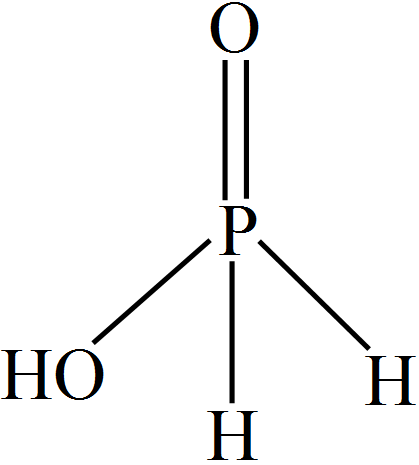
It is monobasic acid because it has one replacable hydrogen.
View full question & answer→MCQ 471 Mark
Super conductors are derived from compounds of:
AnswerCorrect option: A. $p-$block elements
View full question & answer→MCQ 481 Mark
The exhibition of highest co$-$ordination number depends on the availability of vacant orbitals in the central atom. Which of the following elements is not likely to act as central atom in $\text{MF}^{3-}_6$?
AnswerBoron does not have $d-$orbittal. the element $M$ in the complex ion $\text{MF}^{3-}_6$has cordination number $6$. Boron can have maximum cordination number $4$. Thus, $B$ cannot from this complex.
View full question & answer→MCQ 491 Mark
The most abundant metal among the following is :
AnswerIn the Earth's crust, aluminium is the most abundant $(8.3\%$ by weight$)$ metallic element and the third most abundant of all elements $($after oxygen and silicon$)$.
View full question & answer→MCQ 501 Mark
The geometry of a complex species can be understood from the knowledge of type of hybridisation of orbitals of central atom. The hybridisation of orbitals of central atom in $\ce{[Be(OH)^4]^-}$ and the geometry of the complex are respectively.
- ✓
$\mathrm{sp}^3$, tetrahedral.
- B
$\mathrm{sp}^3$, square planar.
- C
$\mathrm{sp}^3 \mathrm{~d}^2$, octahedral.
- D
$\ce{dsp^2}$, square planar.
AnswerCorrect option: A. $\mathrm{sp}^3$, tetrahedral.
Boron has die electronic configuration:
$1\text{s}^22\text{s}^22\text{p}^1_\text{x}2\text{p}^0_\text{y}2\text{p}^0_\text{z}$
In the excited state, $2s-$orbital electrons are impaired and one electron is shifted to a $p-$orbital. Now, hybridisation occurs between one $s-$and three $p-$orbitals to give $sp^3$ hybridisation and tetrahedral geometry.
$1\text{s}^2\underbrace{2\text{s}^12\text{p}^1_\text{x}2\text{p}^1_\text{y}2\text{p}^0_\text{z}}\\ \ \ \ \text{sp}^3\text{-hybridisation}$
View full question & answer→MCQ 511 Mark
Which of the following forms $\ce{M_2O}$ type of oxide?
Answer$Tl^+ ($due to inert pair effect$)$ is stable and forms compounds like $\ce{Tl_2O}$.
View full question & answer→MCQ 521 Mark
What is the hybridisation of $C-$atom in $\ce{CO_2}$ molecule?
Answer${ \ \ \ \ \sigma\ \ \ \ \ \ \ \sigma}\\\text{O}=\text{C}=\text{O}: sp -$ hybridisation. $(\because2\sigma$ bonds$)$
View full question & answer→MCQ 531 Mark
Which one of the following is paramagnetic in nature?
AnswerWhenever two electrons are paired together in an orbital, or their total spin is $0$, they are diamagnetic electrons. Atoms with all diamagnetic electrons are called diamagnetic atoms.
A paramagnetic electron is an unpaired electron. $NO$ has one unpaired electron. Hence, it is paramagnetic in nature.
View full question & answer→MCQ 541 Mark
Which of the following compounds have zero dipole moment ?
AnswerCorrect option: A. $\mathrm{BF}_3$
View full question & answer→MCQ 551 Mark
Which among the following substances is not a component of the mixture used for glazing pottery?
AnswerCeramic glaze is an impervious layer or coating of a vitreous substance which has been fused to a ceramic body through firing. Glaze can serve to colour, decorate or waterproof an item.
Pottery glaze is made up of five basic components. These components are silica, alumina, flux, colourants and modifiers.
View full question & answer→MCQ 561 Mark
An aqueous solution of borax is:
AnswerBorax is a salt of a strong base $\ce{(NaOH)}$ and a weak acid $(\mathrm{H}_3 \mathrm{BO}_3).$ It is, therefore, basic in nature.
View full question & answer→MCQ 571 Mark
Which of the following is used for making optical instruments:
- ✓
$\ce{SiO_2}$
- B
$Si$
- C
$\ce{SiH_4}$
- D
$\ce{SiC}$
AnswerCorrect option: A. $\ce{SiO_2}$
Silica is an important ingredient in making glass, which is extensively used in making optical devices.
View full question & answer→MCQ 581 Mark
On commercial scale $CO$ is prepared by passage of steam over:
View full question & answer→MCQ 591 Mark
Which of the following oxides dissolves in both hydrochloric acid and sodium hydroxide solution? $(1993)$
AnswerCorrect option: D. $\mathrm{Al}_2 \mathrm{O}_3$
$\mathrm{Al}_2 \mathrm{O}_3$ is an amphoteric oxide.
View full question & answer→MCQ 601 Mark
Borax bead test is used to identify the:
AnswerBorax bead test is used to identify the coloured metal ions in given salt. The coloured metal ions form their corresponding metaborate with boron and their colour used to identify them.
View full question & answer→MCQ 611 Mark
$Ti^+$ is more stable than $TI^{3+}$ due to:
View full question & answer→MCQ 621 Mark
Which of the following reacts with nitrogen when heated in air:
Answer$\ce{2Al + N_2 \rightarrow 2AlN}$
Thus, $Al$ reacts with nitrogen when heated in air to form aluminium trinitride.
View full question & answer→MCQ 631 Mark
Electronic configuration of only one $p-$block element is exceptional. One molecule of that element consists of how many atoms of it?
AnswerThe electronic configuration of an only $p-$block element is exceptional. One molecule of that element consists of only one atom of it.
As the exception is found in only He, as helium has the electronic configuration to be $1s^2$. But other member of the same group has $\ce{ns^2np^6}$ configuration.
So, this is an exceptional case where He does not resemble its group in its configuration.
And as He is a noble gas element so it is monoatomic gas.
View full question & answer→MCQ 641 Mark
Which of the following metal forms a protective oxide layer to prevent corrosion?
Answer$\mathrm{Al}_2 \mathrm{O}_3$ is formed which forms a protective layer on the metal.
View full question & answer→MCQ 651 Mark
Which of the following oxides is acidic in nature?
- ✓
$ \mathrm{B}_2 \mathrm{O}_3 $
- B
$ \mathrm{Al}_2 \mathrm{O}_3$
- C
$ \mathrm{Ga}_2 \mathrm{O}_3 $
- D
$ \mathrm{In}_2 \mathrm{O}_3 $
AnswerCorrect option: A. $ \mathrm{B}_2 \mathrm{O}_3 $
$ \mathrm{B}_2 \mathrm{O}_3 $ is acidic in nature. It reacts with basic oxides to form metal borates. Acidic nature decreases on moving down the group.
View full question & answer→MCQ 661 Mark
Graphite conducts electricity due to the:
- ✓
Highly delocalised nature of $t-$electrons.
- B
Highly localised nature of $tt-$electrons.
- C
Highly polarised nature of $tt-$electrons.
- D
AnswerCorrect option: A. Highly delocalised nature of $t-$electrons.
Graphite conducts electricity due to the highly delocalised nature of $\pi -$electrons.
View full question & answer→MCQ 671 Mark
The hydrides of the first elements in groups $15 - 17$, namely $\ce{NH3,H2O}$ and $HF$ respectively, show abnormally high values for melting and boiling points. This is due to:
- A
Small size of $N, O$ and $F$
- ✓
The ability to form extensive intermolecular $H-$bonding
- C
The ability to form extensive intramolecular $H-$bonding
- D
Effective van der Waal's interaction
AnswerCorrect option: B. The ability to form extensive intermolecular $H-$bonding
The hydrides of the first elements in groups $15 - 17$, namely $\ce{NH_3, H_2O}$ and $HF$ respectively, show abnormally high values for melting and boiling points. This is due to the ability to form extensive inter$-$molecular $H-$bonding. In these hydrides, $H$ atom is attached to highly electronegative $N, O$ or $F$ atoms resulting in stronger hydrogen bonds which lead to molecular associations. Large amount of energy is needed to break these hydrogen bonds.
View full question & answer→MCQ 681 Mark
Which element has the highest valency with respect to oxygen?
AnswerThe valence of an element with respect to oxygen is twice the number of oxygen atoms with which one atom of that element chemically combines.
The valency of chlorine with respect to oxygen is $7$.
View full question & answer→MCQ 691 Mark
Elements of group $14$ used in semiconductors are:
- A
$\text{C, Si, Ge}$
- B
$\text{Si, Ge, Sn}$
- ✓
$\text{Si, Ge}$
- D
$\text{B, Si, Ge}$
AnswerCorrect option: C. $\text{Si, Ge}$
Silicon is found in the basis of all electronic devices. It is a semiconductor.
Germanium is another element used in semiconductors.
Ultrapure form of $Ge$ and $Si$ are used to make translators and semi conductors.
View full question & answer→MCQ 701 Mark
Cement, the important building material is a mixture of oxides of several elements. Besides calcium, iron and sulphur, oxides of elements of which of the group $(s)$ are present in the mixture?
- A
group $2$.
- ✓
groups $2, 13$ and $14$.
- C
groups $2$ and $13.$
- D
groups $2$ and $14.$
AnswerCorrect option: B. groups $2, 13$ and $14$.
Cement is manufactured by combining substances which are lime$\text{(CaO)}$, clay contains silica $\text{(SiO)}$ and oxides of $Al, Mg$ and iron.
View full question & answer→MCQ 711 Mark
Which of the following oxidation states are the most characteristic for lead and tin?
- A
$+2,+2$
- B
$+4,+2$
- ✓
$+2,+4$
- D
$+4,+4$
AnswerCorrect option: C. $+2,+4$
View full question & answer→MCQ 721 Mark
Reaction of ammonia with diborane gives initially $\mathrm{B}_2 \mathrm{H}_6 \cdot 2 \mathrm{NH}_3$ which on further heating gives:
AnswerReaction of ammonia with diborane gives initially $\mathrm{B}_2 \mathrm{H}_6 \cdot 2 \mathrm{NH}_3$ which is formulated as $\left[\mathrm{BH}_2\left(\mathrm{NH}_3\right)_2\right]^{+}$. $\left[\mathrm{BH}_4\right]^{-}$further heating gives borazine, $\mathrm{B}_3 \mathrm{N}_3 \mathrm{H}_6$ known as "inorganic benzene" in view of its ring structure with alternate $BH$ and $NH$ groups.
View full question & answer→MCQ 731 Mark
Which element froms maximum compound in chemistry?
AnswerCarbon is the element which forms the highest number of compounds especially organic compounds due to its catenation $($long chain formation$)$ ability. Carbon, with $4$ valence atoms and by virtue of being small in size is most suited to form the highest number of compounds.
View full question & answer→MCQ 741 Mark
Which of the following is wrong about silica?
AnswerCorrect option: D. $U.V$. light cannot pass through quartz.
Quartz is the second most abundant mineral in the Earth's continental crust, after feldspar. Its crystal structure is a continuous framework of $\ce{SiO_4}$ silicon$–$oxygen tetrahedral, with each oxygen being shared between two tetrahedra, giving an overall chemical formula of $\ce{SiO_2}$. Pure quartz, traditionally called rock crystal or clear quartz, is colorless and transparent or translucent, $U.V$. light can pass through quartz.
View full question & answer→MCQ 751 Mark
All group$-14$ members when heated in oxygen form:
- A
- B
- C
- ✓
Monoxide and dioxide both.
AnswerCorrect option: D. Monoxide and dioxide both.
View full question & answer→MCQ 761 Mark
Among $\ce{III-A}$ group elements, the elements with highest and lowest $I.P$. values are:
- A
$B, Tl$
- ✓
$B, In$
- C
$B, Al$
- D
$B, Ga$
AnswerCorrect option: B. $B, In$
$I.P$. does not smoothly decrease down in $\text{III−A}$ group. The decrease from $B$ to $Al$ is associated with increase in size. The observed discontinuity in the $I.P.$ values between $Al$ and $Ga$, and between In and $Tl$ are due to the inability of $d-$ and $f-$electrons, which have low screening effect to compensate the increase in nuclear charge.
View full question & answer→MCQ 771 Mark
In the electrothermal process, the compound displaced by silica from calcium phosphate is:
AnswerIn the electrothermal process, the compound displaced by silica from calcium phosphate is phosphorus pentoxide. It is then reduced by coke in electric furnace to get white phosphorus.
$\mathrm{Ca}_3\left(\mathrm{PO}_4\right)_2+{ }_3 \mathrm{SiO}_2 \rightarrow{ }_3 \mathrm{CaSiO}_3+\mathrm{P}_2 \mathrm{O}_5$
View full question & answer→MCQ 781 Mark
- ✓
$ \mathrm{Na}_2 \mathrm{~B}_4 \mathrm{O}_7 $
- B
$\mathrm{Na}_2 \mathrm{~B}_4 \mathrm{O}_7 \cdot 5 \mathrm{H}_2 \mathrm{O} $
- C
$ \mathrm{Na}_2 \mathrm{~B}_4 \mathrm{O}_7 \cdot 10 \mathrm{H}_2 \mathrm{O} $
- D
$ \mathrm{Na}_2 \mathrm{~B}_4 \mathrm{O}_7 \cdot 8 \mathrm{H}_2 \mathrm{O} $
AnswerCorrect option: A. $ \mathrm{Na}_2 \mathrm{~B}_4 \mathrm{O}_7 $
Anhydrous borax has formula $ \mathrm{Na}_2 \mathrm{~B}_4 \mathrm{O}_7 $.
Anhydrous means no water of crystallisation.
View full question & answer→MCQ 791 Mark
For which of the following reactions, is Gay Lussac's law not applicable?
- A
Formation of HI from its constituents
- B
Formation of $\mathrm{NH}_3$ from its constituents
- ✓
Formation of $\mathrm{CO}_2$ from its constituents
- D
Formation of $\mathrm{SO}_3$ from $\mathrm{SO}_2$ and $\mathrm{O}_2$
AnswerCorrect option: C. Formation of $\mathrm{CO}_2$ from its constituents
Gay Lussac's law not applicable to formation of $\ce{CO_2}$ from its constituents as carbon and oxygen exist in different physical states.
View full question & answer→MCQ 801 Mark
The structure of silicon$(IV)$ oxide belongs to the type:
AnswerCorrect option: D. Macromolecular, with a non$-$layer structure
$\text{Si(IV)}$ oxide is macromolecular with a non layer structure similar to diamond.
View full question & answer→MCQ 811 Mark
Stannite is an ore of $.........$
AnswerStannite is a mineral, a sulfide of copper, iron, and tin. The chemical formula $\mathrm{Cu}_2 \mathrm{FeSnS}_4$.
View full question & answer→MCQ 821 Mark
Which of the following property does not support anamolous behaviour of boron?
AnswerFormation of trihalides does not support anomalous behaviour of boron as other elements of boron family also form trihalides such as $\ce{AlCl_3}$.
View full question & answer→MCQ 831 Mark
Which of the following is most metallic:
Answer$K$ is most metallic due to lowest ionisation enthalpy.
View full question & answer→MCQ 841 Mark
Borax bead test is responded by:
- A
- B
- C
- ✓
Metals which form coloured metaborates
AnswerCorrect option: D. Metals which form coloured metaborates
When the glossy bead is dipped in metal oxide and heated, the corresponding metal metaborates are formed.
The characteristic colour of these metaborates enables us to identify the metal.
View full question & answer→MCQ 851 Mark
Glass reacts with $HF$ forming :
AnswerCorrect option: B. $\mathrm{H}_2 \mathrm{SiF}_6$
$\mathrm{SiO}_2+6 \mathrm{HF} \rightarrow \mathrm{H}_2 \mathrm{SiF}_6+2 \mathrm{H}_2 \mathrm{O}$
When glass reacts with $HF, \mathrm{H}_2 \mathrm{SiF}_6$ is formed.
View full question & answer→MCQ 861 Mark
$\mathrm{SnCl}_2$ is good:
Answer$\text{SnCl}_2+\text{2FeCl}_3\xrightarrow{\ \ \ \ \ \ \ \ }2\text{FeCl}_2+\text{SnCl}_4$
$\mathrm{SnCl}_2$ is good reducing agent.
View full question & answer→MCQ 871 Mark
In which of the following the inert pair effect is most prominent ?
AnswerDue to poor or ineffective shielding of the $ns^2$ electrons of the valence shell by intervening d$-$ and f$-$electrons, the $s-$electrons are reluctant to participate in bond formation.
View full question & answer→MCQ 881 Mark
$\ce{CO_2}$ is gas, while $\ce{SiO_2}$ is solid because:
- A
$\mathrm{CO}_2$ is a linear molecule, while $\mathrm{SiO}_2$ is angular.
- B
van der Waals' forces are very strong in $\mathrm{SiO}_2$.
- C
$\mathrm{CO}_2$ is covalent, while $\mathrm{SiO}_2$ is ionic.
- ✓
$Si$ cannot form stable bonds with $O$, hence $Si$ has to form a $3D$ lattice.
AnswerCorrect option: D. $Si$ cannot form stable bonds with $O$, hence $Si$ has to form a $3D$ lattice.
$\ce{SiO_2}$ is solid because $Si$ cannot form stable bonds with $O$, hence $Si$ has to form a $3D$ lattice of $\ce{SiO_2}$ molecules and form solid structure.
View full question & answer→MCQ 891 Mark
Which of the following is$/$are allotrope$(s)$ of carbon?
AnswerDiamond, graphite and fullerene are the allotropes of carbon.
View full question & answer→MCQ 901 Mark
A compound $X$, of boron reacts with $\ce{NH_3}$ on heating to give another compound $Y$ which is called inorganic benzene. The compound $X$ can be prepared by treating $\ce{BF_3}$ with Lithium aluminium hydride. The compounds $X$ and $Y$ are represented by the formulas.
- ✓
$ \mathrm{B}_2 \mathrm{H}_6, \mathrm{~B}_3 \mathrm{~N}_3 \mathrm{H}_6 $
- B
$ \mathrm{~B}_2 \mathrm{O}_3, \mathrm{~B}_3 \mathrm{~N}_3 \mathrm{H}_6 $
- C
$ \mathrm{BF}_3, \mathrm{~B}_3 \mathrm{~N}_3 \mathrm{H}_6 $
- D
$ \mathrm{~B}_3 \mathrm{~N}_3 \mathrm{H}_6, \mathrm{~B}_2 \mathrm{H}_6 $
AnswerCorrect option: A. $ \mathrm{B}_2 \mathrm{H}_6, \mathrm{~B}_3 \mathrm{~N}_3 \mathrm{H}_6 $
A compound $X$, of boron reacts with $NH_3$ on heating to give another compound $Y$ which is called inorganic benzene.
$ \ \ \ \ \ \ 3\text{B}_2\text{H}_6+6\text{NH}_3\rightarrow3[\text{BH}_2(\text{NH}_3)_2]^+[\text{BH}^4]^-\\ \ \ \ \ \ \ \ \ \ \ \ \ \text{(x)} \ \ \ \ \ \ \ \ \ \ \ \ \ \ \ \ \ \ \ \ \ \ \ \ \ \ \ \ \ \ \ \ \ \ \ \ \ \downarrow \text{heat}\\ \ \ \ \ \ \ \ \ ^\text{Diborane}\ \ \ \ \ \ \ \ \ \ \ \ \ \ \ \ \ \ \ \ \ \ \ 2\text{B}_3\text{N}_3\text{H}_6+12\text{H}_2 \\\ \ \ \ \ \ \ \ \ \ \ \ \ \ \ \ \ \ \ \ \ \ \ \ \ \ \ \ \ \ \ \ \ \ \ \ \ \ \ \ \ \ \ \ \ \ \ \ \ \ \ \ \ \ \ \ ^\text{(Y)}\\ \ \ \ \ \ \ \ \ \ \ \ \ \ \ \ \ \ \ \ \ \ \ \ \ \ \ \ \ \ \text{Borazole/ Inorganic benzene}\\4\text{BF}_3+3\text{LiAlH}_4\xrightarrow{ \ \ \ \ \ \ \ \ \ }2\text{B}_2\text{H}_6+3\text{LiF}+3\text{AIF}_3\\ \ \ \ \ \ \ \ \ \ \ \ \ \ \ \ \ \ \ \ \ \ \ \ \ \ \ \ \ \ \ \ \ \ \ \ \ \ \ \ \ \ \ \ \ \ \ \ ^\text{(x)}$
View full question & answer→MCQ 911 Mark
The most abundant $\text{IVA}$ group elements in the earth's crust is:
View full question & answer→MCQ 921 Mark
Which of the following member of the carbon family does not have an allotrope?
AnswerIn carbon family only carbon, silicon and tin forms allotrope. Carbon has multiple allotrope, Silicon has two known allotropes that exist at room temperature and Tin also has two allotropes.Ge does not have an allotrope.
View full question & answer→MCQ 931 Mark
Percentage of lead in lead pencil is:
AnswerIt is made up of graphite
View full question & answer→MCQ 941 Mark
Borax is used as cleansing agent because on dissolving in water it forms:
Answer$\text{Na}_2\text{B}_4\text{O}_7:10\text{H}_2\text{O}+6\text{H}_2\text{O}\rightarrow\\2\text{NaOH}+4\text{H}_3\text{BO}_3+10\text{H}_2\text{O}\\\ \ ^\text{(Strong)}\ \ \ \ \ \ \ ^\text{(Weak)}$
View full question & answer→MCQ 951 Mark
- A
Solid $\mathrm{NH}_3$.
- B
Solid $\mathrm{SO}_2$.
- ✓
Solid $\mathrm{CO}_2$.
- D
Solid $\mathrm{N}_2$.
AnswerCorrect option: C. Solid $\mathrm{CO}_2$.
Solid $\mathrm{CO}_2$ is called dry ice becaouse it is used for making ice bath for organic reaction in laboratory. It is prepared by cooling $\mathrm{CO}_2$ gas at high pressure.
View full question & answer→MCQ 961 Mark
The tendency to behave as Lewis acid decreases as the size:
- ✓
- B
- C
- D
First increases then decreases.
AnswerThe tendency to behave as a Lewis acid decreases with the increase in the size on moving down the group.
View full question & answer→MCQ 971 Mark
Xenon hexafluoride reacts with silica to form a xenon compound $X$. The oxidation state of $Xe$ in $X$ is :
Answer$\mathrm{SiO}_2+2 \mathrm{XeF}_6 \rightarrow 2 \mathrm{XeOF}_4+\mathrm{SiF}_4$
Oxidation state of $Xe$ in $(X)$ is $+ 6$
View full question & answer→MCQ 981 Mark
Boric acid is not a protonic acid but it acts as a Lewis acid by:
- ✓
Accepting electrons from a hydroxyl ion.
- B
Donating electrons to a chloride ion.
- C
Donating electrons to a proton.
- D
Accepting proton from water.
AnswerCorrect option: A. Accepting electrons from a hydroxyl ion.
Boric acid is not a protonic acid, but it acts as a Lewis acid by accepting electrons from a hydroxyl ion.
$\text{B(OH)}_3+2\text{HOH}\xrightarrow{\ \ \ \ \ \ \ }[\text{B}(\text{OH})_4]^-+\text{H}_3\text{O}^+$.
View full question & answer→MCQ 991 Mark
Which statement is correct with respect to the property of the elements with increase in atomic number in the carbon family?
AnswerCorrect option: B. The stability of $+2$ oxidation state increases
Due to the inert pair effect, as we move down the group, lower oxidation state becomes more stable, so stability of $2+$ oxidation state increases.
View full question & answer→MCQ 1001 Mark
Which of the following elements has a limited co$-$ordination number of four?
AnswerTin, silicon and germanium can extend their valency owing to the empty $d$ orbitals present in their configuration. However, Carbon cannot do so.
View full question & answer→MCQ 1011 Mark
Carbon has no tendency to form complex compounds due to:
AnswerCorrect option: C. Non$-$availability of vacant $d-$orbitals.
View full question & answer→MCQ 1021 Mark
The most commonly used reducing agent is:
- A
$\mathrm{AlCl}_3$
- B
$\mathrm{PbCl}_2$.
- C
$\mathrm{SnCl}_4$.
- ✓
$\mathrm{SnCl}_2$
AnswerCorrect option: D. $\mathrm{SnCl}_2$
$+4$ oxidation state of $Sn$ is more stable than $+2$ oxidation state. Therefore, $\ce{Sn^{2+}}$ can be easily oxidised to $\ce{Sn^{4+}}$ and hence $\ce{SnCl_2}$ acts a reducing agent.
$\text{SnCl}_2+2\text{Cl}\rightarrow\text{SnCl}_4+2\text{e}^-$
View full question & answer→MCQ 1031 Mark
Which of the following statements is incorrect?
- A
Aluminium is a bright silvery$-$white metal.
- B
Aluminium forms alloys with $\text{Cu, Mn, Mg, Si}$ and $\text{Zn.}$
- ✓
The use of aluminium and its compounds for domestic purposes is now increased considerably.
- D
Both $(a)$ and $(b).$
AnswerCorrect option: C. The use of aluminium and its compounds for domestic purposes is now increased considerably.
View full question & answer→MCQ 1041 Mark
Which of the following is used to convert alcohol to petroleum directly?
AnswerCorrect option: A. $\text{ZSM}-5$
$\text{Alcohol}\xrightarrow{\text{ZSM-5}}\text{Petroleum}$
View full question & answer→MCQ 1051 Mark
Oxidation of aluminium is:
Answer$Al$ has a strong affinity for $O_2$. Oxidation of $Al$ is a reaction of negative enthalpy$($exothermic$)$.
View full question & answer→MCQ 1061 Mark
Borax bead test is not used to identify cation in:
AnswerAluminium forms colourless metaborate and thus gives an indecisive test.
View full question & answer→MCQ 1071 Mark
Which one of the following is the correct statement?
AnswerCorrect option: B. Chlorides of both beryllium and aluminium have bridged chloride structures in solid phase
$Be$ and $Al$ are diagonally related with each other and chlorides of both beryllium and aluminium have bridged chloride structures in the solid phase.
View full question & answer→MCQ 1081 Mark
Most covalent halide of aluminium is:
AnswerDue to higher polarisibility, iodide is most covalent by Fajan's rule.
View full question & answer→MCQ 1091 Mark
Boron compounds behave as Lewis acids because of their :
AnswerA Lewis acid is an electron pair acceptor, while Lewis base is an electron pair donor.
Boron compounds behave as Lewis acids because of their vacant orbital. Its octet is incomplete, in which boron can accept an electron pair.
View full question & answer→MCQ 1101 Mark
Self protective metal among the following is:
Answer$Al$ when comes in contact with air to form $\mathrm{Al}_2 \mathrm{O}_3$ which forms a protective passive layer on the metal. This layer cannot be removed by chemical means.
View full question & answer→MCQ 1111 Mark
The material used in solar cell contains :
AnswerSilicon is a semicoductor and is used in solar cells, sometimes doped.
View full question & answer→MCQ 1121 Mark
Boric acid is acid because its molecule:
AnswerCorrect option: C. Accepts $\ce{OH^-}$ from water and releases proton.
$\text{B(OG})_4+\text{H}_2\text{O}\rightarrow\text{B(OH)}^-_4+\text{H}^+$
View full question & answer→MCQ 1131 Mark
A orange solid $'X'$ on heating gives green reside, a gas non$-$supporter of combustion and water. Identify $X$ :
AnswerCorrect option: A. $\left(\mathrm{NH}_4\right)_2 \mathrm{Cr}_2 \mathrm{O}_7$
$(\text{NH}_4)_2\text{Cr}_2\text{O}_7\xrightarrow{\ \ \ \text{o}\ \ \ }\text{N}_2+4\text{H}_2\text{O}+\text{Cr}_2\text{O}_3\\ \ \ \ \ \ \ \ ^\text{(orange)}\ \ \ \ \ \ \ \ \ \ \ \ \ \ \ \ \ \ \ \ \ \ \ \ \ \ \ \ \ \ \ \ \ \ \ \ \ \ \ \ ^\text{(green)}$
View full question & answer→MCQ 1141 Mark
Aqueous solution of borax is $.........$ in nature:
AnswerThe aqueous solution is alkaline due to hydrolysis resulting into the formation of strong base $\ce{NaOH}$ and weak acid tetraboric acid.
View full question & answer→MCQ 1151 Mark
Quartz is extensively used as a piezoelectric material, it contains $.........$
AnswerQuartz is one of the crystalline from of silica and at high temprature can be converted into other crystalline forms. It is extensively used as apiezoelectric material.
View full question & answer→MCQ 1161 Mark
The oxidation state of the most electronegative element in the products of the reaction $\ce{BaO_2}$ with $\ce{H_2SO_4}$ are :
- A
$0$ and $-1$
- B
$-2$ and $+1$
- ✓
$-1$ and $-2$
- D
$-2$ and $0$
AnswerCorrect option: C. $-1$ and $-2$
View full question & answer→MCQ 1171 Mark
The basic structural units of silicates is:
- ✓
$\text{SiO}^{2-}_3$
- B
$\text{SiO}^{2-}_4$
- C
$\text{SiO}^-$
- D
$\text{SiO}^{4-}_4$
AnswerCorrect option: A. $\text{SiO}^{2-}_3$
$\text{SiO}^{4-}_4$ is basic structural unit of silicates.
View full question & answer→MCQ 1181 Mark
Boron forms $\text{BX3}$ type of halides. The correct decreasing order of Lewis$-$acid strength of these halides is:
- A
$ \mathrm{BF}_3>\mathrm{BCl}_3>\mathrm{BBr}_3>\mathrm{BI}_3 $
- ✓
$ \mathrm{BI}_3>\mathrm{BBr}_3>\mathrm{BCl}_3>\mathrm{BF}_3 $
- C
$ \mathrm{BF}_3>\mathrm{BI}_3>\mathrm{BCl}_3>\mathrm{BBr}_3 $
- D
$ \mathrm{BF}_3>\mathrm{BCl}_3>\mathrm{BI}_3>\mathrm{BBr}_3 $
AnswerCorrect option: B. $ \mathrm{BI}_3>\mathrm{BBr}_3>\mathrm{BCl}_3>\mathrm{BF}_3 $
The decreasing order of the Lewis acidity of boron halides is $\mathrm{BI}_3>\mathrm{BBr}_3>\mathrm{BCl}_3>\mathrm{BF}_3 $.
This order is due to the relative tendency of the halogen atom to back donate its unutilized electrons to the vacant p-orbitals of boron atom.
Due to the back donation of electrons from fluorine to boron, the electron deficiency of boron is reduced and hence, Lewis acidity is decreased.
The tendency for the formation of back bonding is maximum in boron trifluoride and decreases very rapidly from boron trifluoride to boron triodide.
View full question & answer→MCQ 1191 Mark
Which of the following does not exist ?
- A
$\ce{BiCl_5}$
- B
$\ce{XeH_4}$
- C
$\ce{BiF_5}$
- ✓
Both $(A)$ and $(B)$
AnswerCorrect option: D. Both $(A)$ and $(B)$
View full question & answer→MCQ 1201 Mark
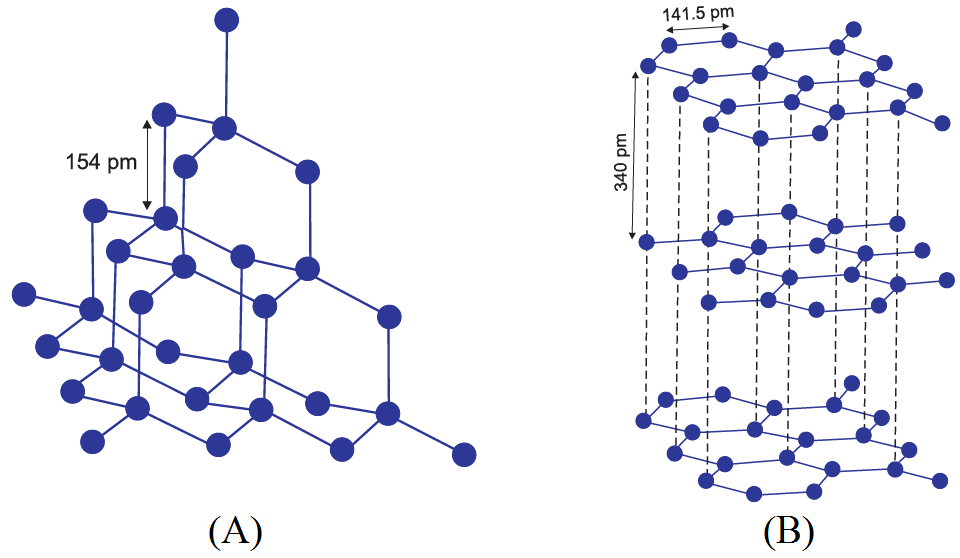
Following are the figures of two different allotropes of carbon. Identify these allotropes from the following options.
- A
$A \rightarrow$ Graphite; $B \rightarrow$ Diamond.
- ✓
$A \rightarrow$ Diamond; $B \rightarrow$ Graphite.
- C
$A \rightarrow$ Graphite; $B \rightarrow$ Fullerene.
- D
$A \rightarrow$ Diamond; $B \rightarrow$ Fullerene.
AnswerCorrect option: B. $A \rightarrow$ Diamond; $B \rightarrow$ Graphite.
View full question & answer→MCQ 1211 Mark
The maxium covalency of aluminium is:
AnswerThe maximum covalency of Aluminium is $6$. Since Aluminium belongs to the $3^{rd}$ period, it possesses a $3d$ subshell as well. As a cation it can use $\ce{sp^3d^2}$ hybrid orbitals for a covalency of $6$.
View full question & answer→MCQ 1221 Mark
Crystalline boron in small amounts may be obtained by :
AnswerCrystalline boron is obtained by reducing volatile boron halides with hydrogen at high temperatures. Ultrapure boron for use in semiconductor industry is produced by the decomposition of diborane at high temperature and then purified with the zone melting process.
View full question & answer→MCQ 1231 Mark
Aluminium oxide is not reduced by chemical reactions since :
- A
Aluminium oxide is reactive.
- B
Reducing agent contaminate
- ✓
Aluminium oxide is highly stable
- D
Process polutes the environment.
AnswerCorrect option: C. Aluminium oxide is highly stable
Aluminium oxide is not reduced by chemical reactions since aluminium oxide is most stable and it does not gain electrons from any reducing agent.
View full question & answer→MCQ 1241 Mark
An element $R$ belongs to $\text{III A}$ group. Which is true with respect to $R$?
- A
It is a gas at room temperature
- B
It has an oxidation state of $+4$
- ✓
It forms an oxide of the type $\mathrm{R}_2 \mathrm{O}_3$
- D
It forms a halide of the type $\mathrm{Rx}_2$
AnswerCorrect option: C. It forms an oxide of the type $\mathrm{R}_2 \mathrm{O}_3$
An $\text{III A}$ group element has valency $3$.
So they form an oxide of type $\mathrm{R}_2 \mathrm{O}_3$.
View full question & answer→MCQ 1251 Mark
The color imparted by $\text{Co(Il)}$ compounds to glass is:
AnswerCobalt primarily used as the metal, in the preparation of magnetic, wear$-$resistant and high$-$strength alloys.
The color imparted by $\text{Co(Il)}$ compounds to glass is deep blue.
View full question & answer→MCQ 1261 Mark
Which of the following is not correct ?
- A
Anhydrous $\mathrm{AlCl}_3$ exists as $\mathrm{Al}_2 \mathrm{Cl}_6$
- B
Anhydrous $\mathrm{AlCl}_3$ sublimes on heating
- C
Anhydrous $\mathrm{AlCl}_3$ fumes in air
- ✓
Anhydrous $\mathrm{AlCl}_3$ is ionic
AnswerCorrect option: D. Anhydrous $\mathrm{AlCl}_3$ is ionic
All statements are correct except that $\mathrm{AlCl}_3$ is covalent in anhydrous form and its aqueous solution is ionic in nature.
View full question & answer→MCQ 1271 Mark
Silicon is the $.........$ abundant element in the earth's crust:
- A
- ✓
$2^{nd}$ most
- C
$3^{rd}$ most
- D
AnswerCorrect option: B. $2^{nd}$ most
Silicon is the second $(27.7\%$ by mass$)$ most abundant element in the earth's crust.
View full question & answer→MCQ 1281 Mark
Which of the element shows $+4$ oxidation state?
AnswerOnly tin is capable of exhibiting stable $+4$ oxidation state while others cannot. $\mathrm{Sn}^{+4}$ state is stable and forms $\mathrm{SnCl}_4$ compound.
View full question & answer→MCQ 1291 Mark
Which of these forms nitride with nitrogen at higher temperature?
AnswerCorrect option: C. Both $A$ and $B$
Aluminium and boron forms nitride with nitrogen at higher temperature due to the high bond energy of nitrogen. In case of aluminium, a thin oxide layer is formed so it also needs high temperature to react with nitrogen to form the nitride.
View full question & answer→MCQ 1301 Mark
An element $'X'$ atomic number $51$ belongs to $.........$
- A
$S-$block
- ✓
$P-$block
- C
$D-$block
- D
$F-$block
AnswerCorrect option: B. $P-$block
View full question & answer→MCQ 1311 Mark
The form of $\mathrm{SiO}_2$ used as piezoelectric material:
AnswerQuartz crystals have piezoelectric properties; they develop an electric potential upon the application of mechanical stress. An early use of this property of quartz crystals was in phonograph pickups. One of the most common piezoelectric uses of quartz today is as a crystal oscillator. The quartz clock is a familiar device using the mineral. The resonant frequency of a quartz crystal oscillator is changed by mechanically loading it, and this principle is used for very accurate measurements of very small mass changes in the quartz crystal microbalance and in thin film monitors.
View full question & answer→MCQ 1321 Mark
Why $\mathrm{Bi}^{3+}$ more stable than $\mathrm{Bi}^{+5}$ ?
- ✓
- B
Due to inert gas electronic configuration
- C
Due to half filled configuration
- D
Due to lanthanide Contraction
Answer$\mathrm{Bi}^{3+}$is more stable than $\ce{Bi^{5+}}$ due to inert pair effect. Ongoing down the group, inert pair effect increases due to more penetration of $s-$ orbital in nucleus due to which element tends to show lower oxidation state more stable than higher oxidation state. Thus, bismuth will show a strong tendency to change into $+3$ state from $+5$ state.
View full question & answer→MCQ 1331 Mark
Which of the following forms vortex ring?
AnswerCorrect option: A. $\mathrm{P}_2 \mathrm{O}_5$
Phosphine forms vortex rings of $\mathrm{P}_2 \mathrm{O}_5$ when it comes in contact of air. These rings are in form of white smoke.
$\therefore$ They are used in making smoke screens in warfare.
View full question & answer→MCQ 1341 Mark
Which is the crystalline form of silica?
AnswerSilica $\ce{(SiO_2)}$ occurs in various crystallographic forms such as quartz, crystobalite and tridymite that are interconvertible at suitable temperatures.
View full question & answer→MCQ 1351 Mark
Aqueous tension is the vapour pressure of water and depends only upon temperature: If the statement is true enter $1$, else enter $0$ :
- ✓
$1$
- B
$0$
- C
Both $A$ and $B$
- D
AnswerAqueous tension is defined as the partial pressure of the water vapour present in the moist gas. Aqueous pressure exerted by a gas at particular temperature and it depends upon temperature.
The pressure exerted by moist gas $=$ pressure exerted by dry gas $+$ pressure of water vapour $($aqueous tension$)$.
View full question & answer→MCQ 1361 Mark
The relationship between first, second and third ionisation enthalpies of each group$-13$ element is:
- A
$\Delta_\text{i}\text{H}_\text{1}>\Delta_\text{i}\text{H}_2>\Delta_\text{i}\text{H}_3$
- ✓
$\Delta_\text{i}\text{H}_\text{1}<\Delta_\text{i}\text{H}_2<\Delta_\text{i}\text{H}_3$
- C
$\Delta_\text{i}\text{H}_1=\Delta_\text{i}\text{H}_2=\Delta_\text{i}\text{H}_3$
- D
$\Delta_\text{i}\text{H}_3<\Delta_\text{i}\text{H}_1<\Delta_\text{i}\text{H}_2$
AnswerCorrect option: B. $\Delta_\text{i}\text{H}_\text{1}<\Delta_\text{i}\text{H}_2<\Delta_\text{i}\text{H}_3$
View full question & answer→MCQ 1371 Mark
$\ce{BF_3}$ easily reacts with Lewis base such as $\ce{NH_3}$ to complete octet around boron. This can be expressed as:
- ✓
$\text{F}_3\text{B}\ +:\text{NH}_{3} \xrightarrow{\ \ \ \ \ }\text{F}_3\text{B}\leftarrow\text{NH}_3$
- B
$\text{F}_3\text{B}+:\text{NH}_3\xrightarrow{\ \ \ \ \ }\text{F} _3\text{B}\rightarrow\text{NH}_3$
- C
$:\text{BF}_3+\text{NH}_3\xrightarrow{\ \ \ \ \ \ \ \ }\text{BF}_3\rightarrow\text{NH}_3$
- D
$:\text{BF}_3+\text{NH}_3\xrightarrow{\ \ \ \ \ \ \ }\text{BF}_3\leftarrow\text{NH}_3$
AnswerCorrect option: A. $\text{F}_3\text{B}\ +:\text{NH}_{3} \xrightarrow{\ \ \ \ \ }\text{F}_3\text{B}\leftarrow\text{NH}_3$
View full question & answer→MCQ 1381 Mark
At standard conditions $.........$ has an allotropic form that is a good electrical conductor:
AnswerCarbon has an allotrope known as Graphite. Graphite is a very good conductor of electricity. It can conduct electricity due to the presence of delocalized free electron.
View full question & answer→MCQ 1391 Mark
Which of the following is used to make transistor and semiconductor devices?
- A
Ultrapure form of germanium.
- B
Ultrapure form of silicon.
- ✓
Both $(a)$ and $(b)$.
- D
Neither $(a)$ nor $(b)$.
AnswerCorrect option: C. Both $(a)$ and $(b)$.
View full question & answer→MCQ 1401 Mark
Halides of $\ce{III A}$ group elements predominantly act as :
AnswerIn a trivalent state, the number of electrons around the central atom in a molecule of the compounds of these elements will be only six. Such electron deficient molecules have a tendency to accept a pair of electrons to achieve octet and thus behave as Lewis acids.
View full question & answer→MCQ 1411 Mark
Pnicogens are the elements of group:
- ✓
$15$
- B
$13$
- C
$\text{VIII}$
- D
AnswerMembers of group $15$ or $VA$ of Periodic Table are called pnicogens. They include $\text{N, P, As, Sb}$ and $\text{Bi}.$
View full question & answer→MCQ 1421 Mark
Boric acid is polymeric due to:
- A
- ✓
The presence of hydrogen bonds.
- C
- D
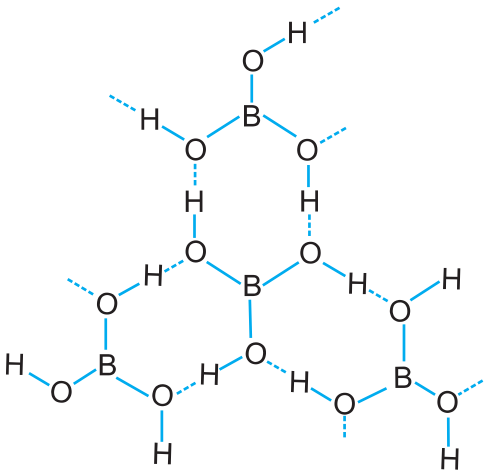
AnswerCorrect option: B. The presence of hydrogen bonds.
Boric acid is polymeric because of the presence of hydrogen bonds. In the given figure, the dotted lines represent hydrogen bonds.
View full question & answer→MCQ 1431 Mark
$\ce{AlH_3}$ is an example for:
- A
- B
- C
- ✓
electron deficient hydride
AnswerCorrect option: D. electron deficient hydride
According to the Bohr's octet rule, each element tends to completely fill its outermost orbit with $8$ electrons in it. Electronic configuration of aluminium is $2, 8, 3$ that means it still needs $5$ more electrons to complete its octet. That's why aluminium is electron deficient.
View full question & answer→MCQ 1441 Mark
Thermodynamically the most stable form of carbon is:
AnswerGraphite is thermodynamically the most stable form of carbon.
View full question & answer→MCQ 1451 Mark
- A
$ \mathrm{CO}_2$
- ✓
$ \mathrm{SiO}_2$
- C
$\mathrm{SO}_2 $
- D
$ \mathrm{NO}_2 $
AnswerCorrect option: B. $ \mathrm{SiO}_2$
Silica is found in many crystalline and amorphous forms.
Quartz is a crystalline form of silica.
View full question & answer→MCQ 1461 Mark
Silicon has a strong tendency to form polymers like silicones. The chain length of silicone polymer can be controlled by adding.
- A
$\mathrm{MeSiCl}_3$.
- B
$\mathrm{Me}_2 \mathrm{SiCl}_2$.
- ✓
$\mathrm{Me}_3 \mathrm{SiCl}$.
- D
$\mathrm{Me}_4 \mathrm{Si}$.
AnswerCorrect option: C. $\mathrm{Me}_3 \mathrm{SiCl}$.
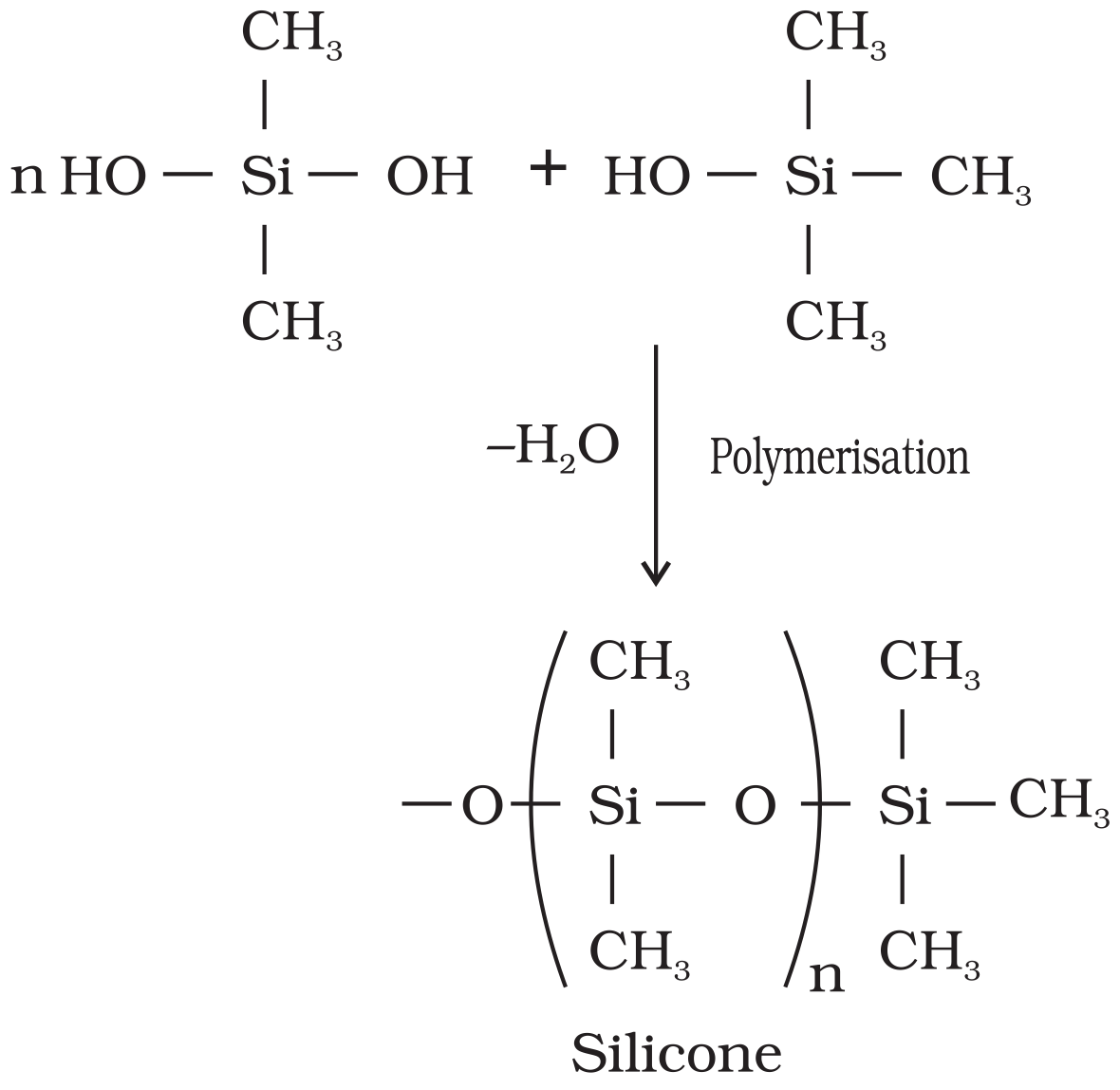
The chain length of the polymer can be controlled by adding $\ce{(CH_3)_3 SiCl}$ which blocks the end as shown below:
View full question & answer→MCQ 1471 Mark
The mixture of $CO$ and $H$, is known as:
- A
- B
- C
- ✓
Both $(b)$ and $(c).$
AnswerCorrect option: D. Both $(b)$ and $(c).$
View full question & answer→MCQ 1481 Mark
The number of possible isomers for disubstituted borazine, $\mathrm{B}_3 \mathrm{N}_3 \mathrm{H}_4 \mathrm{X}_2$ is:
AnswerThe number of possible isomers of distributed borazine is $4$ because of $4$ reactive hydrogen ions.
View full question & answer→MCQ 1491 Mark
Aluminium exist in $+3$ state where as thallium exist in both $+1\ \&+3$ oxidation state. Reason for this is
View full question & answer→MCQ 1501 Mark
Which metal powder suspended in oil is used as a paint for mirrors?
AnswerThe reflective property of aluminium is being used here. Powdered aluminium suspended in oil is used as paint. The low cost and easy availability make it useful in this.
This compound is also known as Diaspore having formula $\mathrm{Al}_2 \mathrm{O}_3 \cdot \mathrm{H}_2 \mathrm{O}$.
View full question & answer→MCQ 1511 Mark
The colour of $\mathrm{Co}\left(\mathrm{BO}_2\right)_2$ is:
AnswerWhen the glassy bead is dipped in $Co$ salt and heated, blue coloured bead is formed.
View full question & answer→MCQ 1521 Mark
Ionisation enthalpy $(\triangle _i \ H_1\ kJ\ mol^{-1})$ for the elements of Group $13$ follows the order.
- A
$\text{B > Al > Ga > In > Tl.}$
- B
$\text{B < Al < Ga < In < Tl.}$
- C
$\text{B < Al > Ga < In > Tl.}$
- ✓
$\text{B > Al < Ga > In < Tl.}$
AnswerCorrect option: D. $\text{B > Al < Ga > In < Tl.}$
On moving down the group from $B$ to $TI$, a regular decreasing trend in the ionisation energy values is not observed.
$\ \ \text{B}\ \ \ \ \ \text{Al}\ \ \ \ \ \text{Ga}\ \ \ \ \ \text{In}\ \ \ \ \ \ \text{Tl}\\801\ \ \ 577\ \ \ 579\ \ \ \ 558\ \ \ \ 589\ \ \ \ \ \text{kJ mol}^{-1}$
In Ga, there are ten d-electrons in the penultimate shell which screen the nuclear charge less effectively and thus, outer electron is held firmly. As a result, the ionisation energy of both $Al$ and $Ga$ is nearly the same. The increase in ionisation energy from In to $Tl$ is due to poor screening effect of $14f$ electrons present in the inner shell.
View full question & answer→MCQ 1531 Mark
The second period elements of $p-$ block starting from boron, are restricted to a maximum covalency of :
- A
Four $($using $1s, 2s $ and two $2p$ orbitals$).$
- B
Six $($using $1s$ and $2s -$ orbitals$)$.
- ✓
Four $ ($using $2s$ and three $2p$ orbitals$).$
- D
Six $($using $1s$ and three $2p$ orbitals$)$.
AnswerCorrect option: C. Four $ ($using $2s$ and three $2p$ orbitals$).$
The second period elements of $p-$ block starting from boron are restricted to a maximum covalency of four $($using one $2s$ and three $2p$ orbitals$).$
View full question & answer→MCQ 1541 Mark
The platinum wire which is used in borax bead test is dipped in:
AnswerThe borax bead test is the most common. A small loop is formed at the end of a platinum wire. The loop is cleaned with concentrated hydrochloric acid and dipped in powdered borax, then heated in the flame of a Bunsen burner until the borax melts, forming a bead.
View full question & answer→MCQ 1551 Mark
The aqueous solution of borax turns red litmus to :
AnswerThis is because of the alkanline nature of the aqueous solution of borax.
View full question & answer→MCQ 1561 Mark
The increasing order of atomic radius:
- A
$\text{Al < Ga < In < TI.}$
- ✓
$\text{Ga < Al < In < TI.}$
- C
$\text{Al < In < Ga < TI.}$
- D
$\text{Al < Ga < TI < In.}$
AnswerCorrect option: B. $\text{Ga < Al < In < TI.}$
$Ga$ is smaller than $'Al\ '$ due to poor shelling effect of $d-$electron effective nuclear charge increases.
View full question & answer→MCQ 1571 Mark
Which of the following is solid at room temperature?
- A
$\text{CO}$
- B
$ \mathrm{CO}_2 $
- ✓
$ \mathrm{SiO}_2 $
- D
$\mathrm{OF}_2 $
AnswerCorrect option: C. $ \mathrm{SiO}_2 $
Silicon dioxide involves covalent $\text{Si−O}$ bonds. It has strong van der waal's forces of interactions and thus exists as solids.
View full question & answer→MCQ 1581 Mark
The property which does not support anomalous behaviour of boron is :
MCQ 1591 Mark
Graphite cleaves easily between the layers. Thus, it is :
- A
- B
- ✓
Both $(a)$ and $(b).$
- D
AnswerCorrect option: C. Both $(a)$ and $(b).$
View full question & answer→MCQ 1601 Mark
The colour of blue glass is due to the presence of oxide of :
AnswerCobalt is a very intense glass colorant and very little is required to show a noticeable amount of colour. Colour of Cobalt glass is blue.
View full question & answer→MCQ 1611 Mark
AnswerBorax : $\mathrm{Na}_2\left[\mathrm{~B}_4 \mathrm{O}_5(\mathrm{OH})_4\right] \cdot 8 \mathrm{H}_2 \mathrm{O}$.
View full question & answer→MCQ 1621 Mark
Group $13$ elements are attacked by non$-$oxidising acids except:
AnswerBoron is not attacked by non-oxidising acids such as $\text{HCl}$ but reacts with oxidising acids such as conc. $\mathrm{HNO}_3$ and conc. $\mathrm{H}_2 \mathrm{SO}_4$ forming boric acid.
Boron, being chemically a non$-$metal, is resistant to attack by non$-$oxidising acids but the other members of the group react with non$-$oxidising acids as typical metals and evolve hydrogen.
View full question & answer→MCQ 1631 Mark
Aluminium is much more reactive than iron because its standard reduction potential is higher than iron. Still, aluminium is less easily corroded than iron because :
AnswerCorrect option: B. It has a higher reducing power and forms a self protective layer of $\ce{Al_2O_3}$.
Aluminium is much more reactive than iron because its standard reduction potential is higher than iron. However, aluminium is still less easily corroded than iron because oxygen forms a protective oxide layer of $\ce{Al_2O_3}$ on its surfac.
View full question & answer→MCQ 1641 Mark
Which of the following strongest lewis acid :
- A
$\mathrm{BCl}_3$
- B
$\mathrm{BF}_3$
- ✓
$\mathrm{BI}_3$
- D
$\mathrm{BBr}_3$
AnswerCorrect option: C. $\mathrm{BI}_3$
$\mathrm{BI}_3$ because backbonding is least effective between $5p-5p$ overlapping.
View full question & answer→