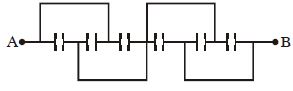
All capacitors used in the diagram are identical and each is of capacitance $C$. Then the effective capacitance between the points $A$ and $B$ is
Medium
Download our app for free and get started
First three capacitors are in parallel and last three are also in parallel. Both the groups are in series.
$\therefore C_{e q}=3 \mathrm{C} / 2=1.5 \mathrm{C}$

Download our appand get started for free
Experience the future of education. Simply download our apps or reach out to us for more information. Let's shape the future of learning together!No signup needed.*
Similar Questions
- 1If the dielectric constant and dielectric strength be denoted by $k$ and $x$ respectively, then a material suitable for use as a dielectric in a capacitor must haveView Solution
- 2A cylindrical capacitor has two co-axial cylinders of length $20 \,cm$ and radii $2 r$ and $r$. Inner cylinder is given a charge $10 \,\mu C$ and outer cylinder a charge of $-10 \,\mu C$. The potential difference between the two cylinders will beView Solution
- 3A spherical charged conductor has surface charge density $\sigma $ . The electric field on its surface is $E$ and electric potential of conductor is $V$ . Now the radius of the sphere is halved keeping the charge to be constant. The new values of electric field and potential would beView Solution
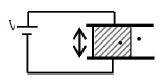
- 4A parallel plate capacitor, partially filled with a dielectric slab of dielectric constant $K$ , is connected with a cell of emf $V\ volt$ , as shown in the figure. Separation between the plates is $D$ . ThenView Solution
- 5If $4 \times {10^{20}}eV$ energy is required to move a charge of $0.25$ coulomb between two points. Then what will be the potential difference between them......$V$View Solution
- 6In a parallel plate capacitor of capacitance $C$, a metal sheet is inserted between the plates, parallel to them. If the thickness of the sheet is half of the separation between the plates. The capacitance will beView Solution
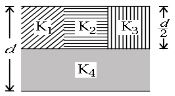
- 7A parallel-plate capacitor of area $A,$ plate separation $d$ and capacitance $C$ is filled with four dielectric materials having dielectric constants $K_1,K_2,K_3$ and $K_4$ as shown in the figure. If a single dielectric material is to be used to have the same capacitance $C$ in this capacitor, then its dielectric constant $K$ is given byView Solution
- 8In one design of capacitor thin sheets ot metal of area $80\ mm \times 80\ mm$ sandwich between them a piece of paper whose thickness is $40\ μm$. The relative permittivity of the paper is $4.0$ and its dielectric strength is $20\ MVm^{-1}$. Calculate the maximum charge that can be put on the capacitorView Solution
[permittivity of free space $ = 9 \times 10^{-12}\ Fm^{-1}$]
- 9View SolutionA parallel plate capacitor is charged and then disconnected from the source of potential difference. If the plates of the condenser are then moved farther apart by the use of insulated handle, which one of the following is true?
- 10The electric potential $V$ at any point $O$ ($x$, $y$, $z$ all in metres) in space is given by $V = 4{x^2}\,volt$. The electric field at the point $(1m,\,0,\,2m)$ in $volt/metre$ isView Solution